



 Chat with AI
Exam 3: Proteins, Carbohydrates, and Lipids

Exam 1: Studying Life246 Questions
Exam 2: Small Molecules and the Chemistry of Life246 Questions
Exam 3: Proteins, Carbohydrates, and Lipids246 Questions
Exam 4: Nucleic Acids and the Origin of Life246 Questions
Exam 5: Cells: the Working Units of Life248 Questions
Exam 6: Cell Membranes246 Questions
Exam 7: Cell Communication and Multicellularity246 Questions
Exam 8: Energy, Enzymes, and Metabolism246 Questions
Exam 9: Pathways That Harvest Chemical Energy246 Questions
Exam 10: Photosynthesis: Energy From Sunlight242 Questions
Exam 11: The Cell Cycle and Cell Division260 Questions
Exam 12: Inheritance, Genes, and Chromosomes250 Questions
Exam 13: Dna and Its Role in Heredity257 Questions
Exam 14: From Dna to Protein: Gene Expression252 Questions
Exam 15: Gene Mutation and Molecular Medicine251 Questions
Exam 16: Regulation of Gene Expression245 Questions
Exam 17: Genomes249 Questions
Exam 18: Recombinant Dna and Biotechnology243 Questions
Exam 20: Mechanisms of Evolution243 Questions
Exam 21: Reconstructing and Using Phylogenies246 Questions
Exam 22: Speciation247 Questions
Exam 23: Evolution of Genes and Genomes252 Questions
Exam 24: The History of Life on Earth246 Questions
Exam 25: Bacteria, Archaea, and Viruses262 Questions
Exam 26: The Origin and Diversification of Eukaryotes252 Questions
Exam 27: Plants Without Seeds: From Water to Land251 Questions
Exam 28: The Evolution of Seed Plants259 Questions
Exam 29: The Evolution and Diversity of Fungi261 Questions
Exam 30: Animal Origins and the Evolution of Body Plans248 Questions
Exam 31: Protostome Animals244 Questions
Exam 32: Deuterostome Animals246 Questions
Exam 33: The Plant Body243 Questions
Exam 34: Transport in Plants248 Questions
Exam 35: Plant Nutrition247 Questions
Exam 36: Regulation of Plant Growth246 Questions
Exam 37: Reproduction in Flowering Plants247 Questions
Exam 38: Plant Responses to Environmental Challenges246 Questions
Exam 39: Physiology, Homeostasis, and Temperature Regulation258 Questions
Exam 40: Animal Hormones249 Questions
Exam 41: Immunology: Animal Defense Systems265 Questions
Exam 42: Animal Reproduction261 Questions
Exam 43: Animal Development261 Questions
Exam 44: Neurons, Glia, and Nervous Systems250 Questions
Exam 45: Sensory Systems249 Questions
Exam 46: The Mammalian Nervous System: Structure and Higher Functions254 Questions
Exam 47: Musculoskeletal Systems259 Questions
Exam 48: Gas Exchange247 Questions
Exam 49: Circulatory Systems252 Questions
Exam 50: Nutrition, Digestion, and Absorption259 Questions
Exam 51: Salt and Water Balance and Nitrogen Excretion251 Questions
Exam 52: Animal Behavior249 Questions
Exam 53: The Physical Environment and Biogeography of Life248 Questions
Exam 54: Populations259 Questions
Exam 55: Species Interactions254 Questions
Exam 56: Communities247 Questions
Exam 57: Ecosystems238 Questions
Exam 58: A Changing Biosphere222 Questions
Select questions type


A research team tracked the carbon atoms in glucose molecules to see where they ended up when the glucose was taken up and metabolized by human cells grown in culture.The team found that 9 percent of the carbon atoms ended up in proteins.This result provides evidence for which biological function of carbohydrates in living organisms?
(Multiple Choice)
4.8/5  (84)
(84) Refer to the figure below showing the three different oligosaccharides present on the surfaces of human red blood cells that determine blood type. 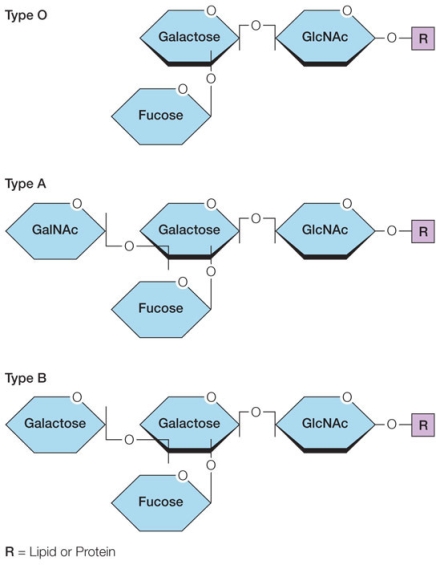 Antibodies are proteins produced in the body in response to foreign substances.Antibodies recognize and bind to these foreign substances to remove them from the body.How would blood cells containing the oligosaccharide type O be received if they were transfused into the body of a patient whose own blood cells contained the oligosaccharide type A? Would the reaction be different if the reverse situation occurred; that is, blood cells containing the oligosaccharide type A transfused into a patient whose blood cells contained oligosaccharide type O? Describe the role of the oligosaccharides in these two situations.
 (Essay)
4.9/5 (86)
(86) Based on its structure, a triglyceride is most closely related to a
(Multiple Choice)
4.8/5 (76)
(76) Sketch and label a triglyceride and a phospholipid.Write a brief comparison of the two structures.
(Essay)
4.8/5 (83)
(83) Unsaturated fatty acids do not pack together because of the _______ in their hydrocarbon chains.
(Multiple Choice)
4.9/5 (98)
(98) Draw a diagram of a phospholipid bilayer, and identify the hydrophobic tails and the hydrophilic heads.Where in the cell can you find such a structure?
(Essay)
4.7/5 (85)
(85) Comparing two fatlike solid substances, you determine that sample A has a higher melting point than sample B.Sample A, therefore,
(Multiple Choice)
5.0/5 (86)
(86) Refer to the figure showing the tertiary structure of a section of a mouse protein, and the table below, showing changes to the stability of the protein for specific single amino acid substitutions. 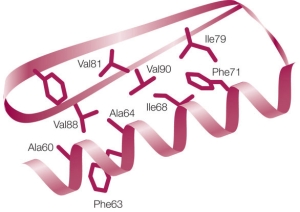
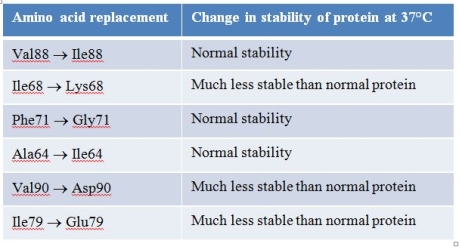 The numbers shown in the left column refer to the amino acid's position in the polypeptide chain.Which conclusion is consistent with these data?
 (Multiple Choice)
4.7/5 (73)
(73) A student claims that all triglycerides have the exact same properties, since they are all composed of the same units: a glycerol molecule and three fatty acids.Which statement provides the best response to this claim?
(Multiple Choice)
4.7/5 (68)
(68) Refer to the figure below. 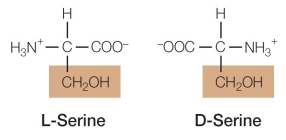 The molecules in the figure are
 (Multiple Choice)
4.8/5 (86)
(86) The monomers that make up polymeric carbohydrates like starch are called
(Multiple Choice)
4.7/5 (75)
(75) Refer to the ribbon model of a section of polypeptide backbone in a protein. 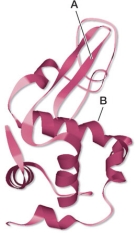 The two examples of secondary structure shown in the figure are a pleated sheet at point A and _______ at point B.
 (Short Answer)
4.8/5 (71)
(71) Lipids are able to perform all of the following functions except
(Multiple Choice)
4.9/5 (73)
(73) The amino acid sequence of a protein isolated from human blood cells is the same as the amino acid sequence of a protein isolated from chimpanzees.Which statement related to this observation is accurate?
(Multiple Choice)
4.7/5 (85)
(85) Suppose you want to construct a protein that is 50 amino acids long.What is the theoretical number of different proteins you could make?
(Multiple Choice)
4.8/5 (79)
(79) Complex carbohydrates are a mainstay of many diets.What are some properties that make them excellent food sources?
(Essay)
4.8/5 (66)
(66) Refer to the figure below. 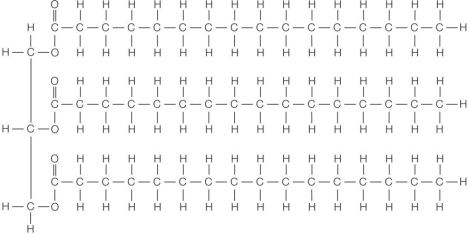 Suppose you had to synthesize a phospholipid using the compound shown above as starting material.What step would you take?
 (Multiple Choice)
4.8/5 (83)
(83) A scientist isolates a previously undiscovered protein from a fruit fly and determines the sequence of amino acids making up the protein.Upon comparing the sequence to a database, he finds another protein isolated from a lizard with the same sequence.The lizard protein is known to be involved in glucose metabolism.The scientist predicts that the fruit fly protein must also be involved in glucose metabolism.How can his prediction be justified?
(Multiple Choice)
4.8/5 (87)
(87) Refer to the table below. 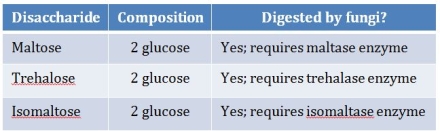 Based on information provided in the table, these disaccharides have different _______.
 (Short Answer)
4.9/5 (81)
(81) 
Filters
- Essay(0)
- Multiple Choice(0)
- Short Answer(0)
- True False(0)
- Matching(0)