



 Chat with AI
Exam 3: Proteins, Carbohydrates, and Lipids

Exam 1: Studying Life246 Questions
Exam 2: Small Molecules and the Chemistry of Life246 Questions
Exam 3: Proteins, Carbohydrates, and Lipids246 Questions
Exam 4: Nucleic Acids and the Origin of Life246 Questions
Exam 5: Cells: the Working Units of Life248 Questions
Exam 6: Cell Membranes246 Questions
Exam 7: Cell Communication and Multicellularity246 Questions
Exam 8: Energy, Enzymes, and Metabolism246 Questions
Exam 9: Pathways That Harvest Chemical Energy246 Questions
Exam 10: Photosynthesis: Energy From Sunlight242 Questions
Exam 11: The Cell Cycle and Cell Division260 Questions
Exam 12: Inheritance, Genes, and Chromosomes250 Questions
Exam 13: Dna and Its Role in Heredity257 Questions
Exam 14: From Dna to Protein: Gene Expression252 Questions
Exam 15: Gene Mutation and Molecular Medicine251 Questions
Exam 16: Regulation of Gene Expression245 Questions
Exam 17: Genomes249 Questions
Exam 18: Recombinant Dna and Biotechnology243 Questions
Exam 20: Mechanisms of Evolution243 Questions
Exam 21: Reconstructing and Using Phylogenies246 Questions
Exam 22: Speciation247 Questions
Exam 23: Evolution of Genes and Genomes252 Questions
Exam 24: The History of Life on Earth246 Questions
Exam 25: Bacteria, Archaea, and Viruses262 Questions
Exam 26: The Origin and Diversification of Eukaryotes252 Questions
Exam 27: Plants Without Seeds: From Water to Land251 Questions
Exam 28: The Evolution of Seed Plants259 Questions
Exam 29: The Evolution and Diversity of Fungi261 Questions
Exam 30: Animal Origins and the Evolution of Body Plans248 Questions
Exam 31: Protostome Animals244 Questions
Exam 32: Deuterostome Animals246 Questions
Exam 33: The Plant Body243 Questions
Exam 34: Transport in Plants248 Questions
Exam 35: Plant Nutrition247 Questions
Exam 36: Regulation of Plant Growth246 Questions
Exam 37: Reproduction in Flowering Plants247 Questions
Exam 38: Plant Responses to Environmental Challenges246 Questions
Exam 39: Physiology, Homeostasis, and Temperature Regulation258 Questions
Exam 40: Animal Hormones249 Questions
Exam 41: Immunology: Animal Defense Systems265 Questions
Exam 42: Animal Reproduction261 Questions
Exam 43: Animal Development261 Questions
Exam 44: Neurons, Glia, and Nervous Systems250 Questions
Exam 45: Sensory Systems249 Questions
Exam 46: The Mammalian Nervous System: Structure and Higher Functions254 Questions
Exam 47: Musculoskeletal Systems259 Questions
Exam 48: Gas Exchange247 Questions
Exam 49: Circulatory Systems252 Questions
Exam 50: Nutrition, Digestion, and Absorption259 Questions
Exam 51: Salt and Water Balance and Nitrogen Excretion251 Questions
Exam 52: Animal Behavior249 Questions
Exam 53: The Physical Environment and Biogeography of Life248 Questions
Exam 54: Populations259 Questions
Exam 55: Species Interactions254 Questions
Exam 56: Communities247 Questions
Exam 57: Ecosystems238 Questions
Exam 58: A Changing Biosphere222 Questions
Select questions type


Refer to the figure below, showing the structure of an amino acid found in living organisms. 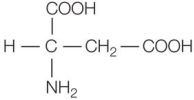 Which figure correctly highlights the portion of this amino acid that differs from other amino acids also found in living organisms?
 (Multiple Choice)
4.7/5  (73)
(73) Which substance is likely to contain the highest percentage of double bonds in the hydrocarbon chains of its triglycerides?
(Multiple Choice)
4.8/5 (71)
(71) Where would the leucine side chain most likely be found in a protein dissolved in water?
(Multiple Choice)
4.9/5 (82)
(82) Leucine and valine have side chains that do not interact with water; therefore, they
(Multiple Choice)
4.8/5 (87)
(87) In a biological membrane, the phospholipids are arranged with the fatty acid chains facing the interior of the membrane.As a result, the interior of the membrane is
(Multiple Choice)
4.9/5 (80)
(80) If all of the cysteine residues of a protein were changed to threonines,
(Multiple Choice)
4.8/5 (83)
(83) Refer to the table below. 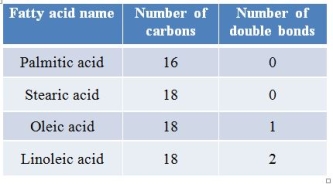 A triglyceride contains glycerol bonded to three stearic acid residues.The molecule that is likely to have a melting point closest to that of this triglyceride is a triglyceride containing
 (Multiple Choice)
4.9/5 (74)
(74) The main function of cellulose, the most abundant organic compound on Earth, is
(Multiple Choice)
4.9/5 (76)
(76) A protein contains two cysteine residues that are widely separated in its amino acid sequence but form a disulfide bridge in its tertiary structure.Which is the most likely outcome if one of these cysteine residues is replaced with an alanine residue?
(Multiple Choice)
4.9/5 (71)
(71) If a hydrophilic amino acid on the surface of an enzyme were changed to a hydrophobic amino acid, which result would be possible?
(Multiple Choice)
4.9/5 (72)
(72) A peptide bond forms between a(n) _______ group on one molecule and a(n) _______ group on the other molecule.
(Multiple Choice)
4.9/5 (88)
(88) Aldehydes and ketones are very similar in that they both contain
(Multiple Choice)
5.0/5 (83)
(83) Which statement provides evidence supporting the claim that glucose has a specific binding interaction with a protein?
(Multiple Choice)
4.8/5 (79)
(79) Which treatment of a mouse protein has the potential to cause either a dramatic change or very little change in its tertiary structure?
(Multiple Choice)
4.9/5 (98)
(98) On the label of a shortening container are the words "hydrogenated vegetable oil." This means that during processing, the number of carbon-carbon double bonds in the oil was decreased and the
(Multiple Choice)
4.9/5 (76)
(76) Refer to the figures numbered 1, 2, 3, and 4 below. 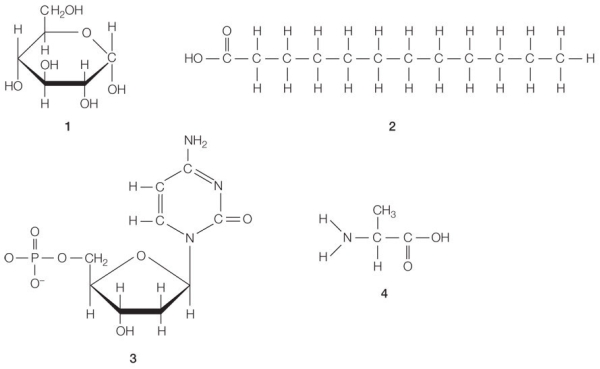 The molecular structures shown represent classes of macromolecules that make up living organisms.A nucleic acid is shown above the number _______.
 (Short Answer)
4.9/5 (82)
(82) Refer to the figure below showing the straight-chain form of glucose. 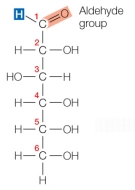 The oxygen bound to carbon _______ becomes one of the members of the ring that forms when this molecule cyclizes.
 (Multiple Choice)
4.9/5 (83)
(83) Two identical samples of a purified protein were subjected to different treatment steps.The biological activity of the protein after each step was measured, as summarized in the table below. 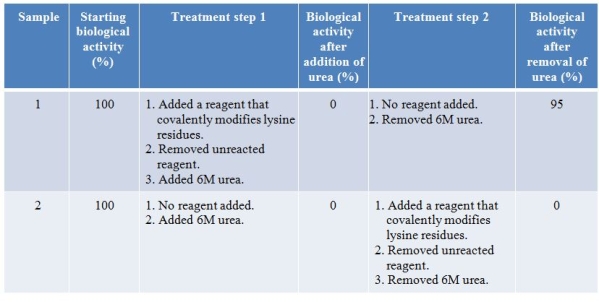 Which statement about structure-function relationships in proteins is consistent with the data?
 (Multiple Choice)
4.8/5 (75)
(75) 
Filters
- Essay(0)
- Multiple Choice(0)
- Short Answer(0)
- True False(0)
- Matching(0)