Multiple Choice
Figure 1 shows a protein enzyme labeled E that catalyzes a chemical reaction involving the substrate molecule labeled C.Figure 2 shows how another molecule, labeled D, binds to a site on the protein that is distinct from the catalytic site. 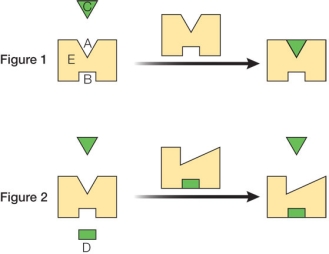 Based on the activities shown, what biological advantage does this protein gain by having the ability to bind molecule D?
A) It gains a new chemical reaction that it can catalyze.
B) It gains the ability to bind a broader range of molecules at its catalytic site.
C) It gains a mechanism for preventing the protein from being degraded.
D) It gains a means for turning the biological activity of the protein on and off.
E) It gains the ability to diffuse through cell membranes.
Correct Answer:

Verified
Correct Answer:
Verified
Q23: Oil and water do not mix easily
Q24: Refer to the figure below. <img src="https://d2lvgg3v3hfg70.cloudfront.net/TB5650/.jpg"
Q25: A macromolecule that is isolated from the
Q26: A structural isomer for the molecule NaOCH<sub>2</sub>CH<sub>3</sub>
Q27: Refer to the figure below. <img src="https://d2lvgg3v3hfg70.cloudfront.net/TB5650/.jpg"
Q29: You are designing an experiment that requires
Q30: Starch and glycogen are similar in that
Q31: Refer to the figure below showing a
Q32: A molecule with the formula C<sub>6</sub>H<sub>12</sub>O<sub>6</sub> can
Q33: An unknown sample known to contain either