



 Chat with AI
Exam 43: Animal Development

Exam 1: Studying Life246 Questions
Exam 2: Small Molecules and the Chemistry of Life246 Questions
Exam 3: Proteins, Carbohydrates, and Lipids246 Questions
Exam 4: Nucleic Acids and the Origin of Life246 Questions
Exam 5: Cells: the Working Units of Life248 Questions
Exam 6: Cell Membranes246 Questions
Exam 7: Cell Communication and Multicellularity246 Questions
Exam 8: Energy, Enzymes, and Metabolism246 Questions
Exam 9: Pathways That Harvest Chemical Energy246 Questions
Exam 10: Photosynthesis: Energy From Sunlight242 Questions
Exam 11: The Cell Cycle and Cell Division260 Questions
Exam 12: Inheritance, Genes, and Chromosomes250 Questions
Exam 13: Dna and Its Role in Heredity257 Questions
Exam 14: From Dna to Protein: Gene Expression252 Questions
Exam 15: Gene Mutation and Molecular Medicine251 Questions
Exam 16: Regulation of Gene Expression245 Questions
Exam 17: Genomes249 Questions
Exam 18: Recombinant Dna and Biotechnology243 Questions
Exam 20: Mechanisms of Evolution243 Questions
Exam 21: Reconstructing and Using Phylogenies246 Questions
Exam 22: Speciation247 Questions
Exam 23: Evolution of Genes and Genomes252 Questions
Exam 24: The History of Life on Earth246 Questions
Exam 25: Bacteria, Archaea, and Viruses262 Questions
Exam 26: The Origin and Diversification of Eukaryotes252 Questions
Exam 27: Plants Without Seeds: From Water to Land251 Questions
Exam 28: The Evolution of Seed Plants259 Questions
Exam 29: The Evolution and Diversity of Fungi261 Questions
Exam 30: Animal Origins and the Evolution of Body Plans248 Questions
Exam 31: Protostome Animals244 Questions
Exam 32: Deuterostome Animals246 Questions
Exam 33: The Plant Body243 Questions
Exam 34: Transport in Plants248 Questions
Exam 35: Plant Nutrition247 Questions
Exam 36: Regulation of Plant Growth246 Questions
Exam 37: Reproduction in Flowering Plants247 Questions
Exam 38: Plant Responses to Environmental Challenges246 Questions
Exam 39: Physiology, Homeostasis, and Temperature Regulation258 Questions
Exam 40: Animal Hormones249 Questions
Exam 41: Immunology: Animal Defense Systems265 Questions
Exam 42: Animal Reproduction261 Questions
Exam 43: Animal Development261 Questions
Exam 44: Neurons, Glia, and Nervous Systems250 Questions
Exam 45: Sensory Systems249 Questions
Exam 46: The Mammalian Nervous System: Structure and Higher Functions254 Questions
Exam 47: Musculoskeletal Systems259 Questions
Exam 48: Gas Exchange247 Questions
Exam 49: Circulatory Systems252 Questions
Exam 50: Nutrition, Digestion, and Absorption259 Questions
Exam 51: Salt and Water Balance and Nitrogen Excretion251 Questions
Exam 52: Animal Behavior249 Questions
Exam 53: The Physical Environment and Biogeography of Life248 Questions
Exam 54: Populations259 Questions
Exam 55: Species Interactions254 Questions
Exam 56: Communities247 Questions
Exam 57: Ecosystems238 Questions
Exam 58: A Changing Biosphere222 Questions
Select questions type


An X ray shows that a patient has a region in her upper spine where several vertebrae are fused on one side, causing curvature of the spine.The doctor tells her that the defect occurred during embryogenesis when
(Multiple Choice)
5.0/5  (81)
(81) The extraembryonic membranes in an amniote allow the embryo to develop within a shell on land.What do these membranes allow the embryo to do that an amphibian embryo is unable to do?
(Multiple Choice)
4.7/5 (88)
(88) Refer to the figure showing some of the manipulations carried out by Spemann on developing amphibians. 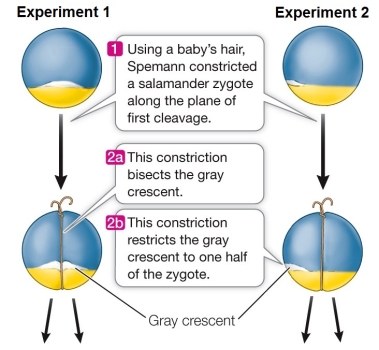 Experiment 2 resulted in
 (Multiple Choice)
4.8/5 (73)
(73) As in chick development, in humans the amnion forms from the
(Multiple Choice)
4.9/5 (76)
(76) A cell is said to be _______ after the point at which its developmental fate will not change, even if the cell's surroundings are altered.
(Short Answer)
4.7/5 (85)
(85) What will happen if a researcher, working with developing amphibians, transplants a piece of ectoderm destined to become the epidermis (outer layer of skin) from one early gastrula to a location destined to be neural tissue in another early gastrula? What will happen if the transplant is made between late gastrulas?
(Essay)
4.7/5 (85)
(85) Following fertilization and two rounds of cell cleavage, each of the four cells of a frog embryo has a centriole that is preparing for the next cleavage.The centriole in each of these cells can trace its origins back to the original centriole provided by the _______ prior to the first cleavage.
(Short Answer)
4.9/5 (93)
(93) A researcher interested in studying development and function of the allantois in a vertebrate wants to select a species with a relatively large allantois.A good recommendation would be to
(Multiple Choice)
4.7/5 (78)
(78) Formation of the endoderm and mesoderm during gastrulation in frogs results from
(Multiple Choice)
4.9/5 (89)
(89) You are examining microscope slides of an early lizard embryo.You see that the neural plate is beginning to fold upward, and lying below it is a rodlike structure that you identify as the _______.
(Short Answer)
4.7/5 (79)
(79) The _______ eventually develop into vertebrae, ribs, trunk muscles, and dermis.
(Short Answer)
4.7/5 (71)
(71) Refer to the figure showing a stage of gastrulation in the frog.  If a piece of ectoderm destined to be epidermis (outer layer of skin) is removed from a gastrula of the stage seen in the figure and put into a location destined to be neural tissue in a similarly aged gastrula, which result is the most likely?
 (Multiple Choice)
4.8/5 (77)
(77) Which result did Hans Spemann get when he bisected a salamander zygote, isolating the gray crescent in one of the two resulting cells?
(Multiple Choice)
4.8/5 (79)
(79) Transformation of the zygote into a mass of cells occurs via
(Multiple Choice)
4.9/5 (81)
(81) The order in which mammalian Hox genes are expressed during development
(Multiple Choice)
4.9/5 (86)
(86) If you were developing an embryology lab and wanted to include animals that display diverse cleavage patterns (complete and incomplete, with different orientations of mitotic spindles), which types of animals might you include? If possible, select animals that are model organisms, and list the cleavage patterns they represent.
(Essay)
4.9/5 (84)
(84) 
Filters
- Essay(0)
- Multiple Choice(0)
- Short Answer(0)
- True False(0)
- Matching(0)