



 Chat with AI
Exam 43: Animal Development

Exam 1: Studying Life246 Questions
Exam 2: Small Molecules and the Chemistry of Life246 Questions
Exam 3: Proteins, Carbohydrates, and Lipids246 Questions
Exam 4: Nucleic Acids and the Origin of Life246 Questions
Exam 5: Cells: the Working Units of Life248 Questions
Exam 6: Cell Membranes246 Questions
Exam 7: Cell Communication and Multicellularity246 Questions
Exam 8: Energy, Enzymes, and Metabolism246 Questions
Exam 9: Pathways That Harvest Chemical Energy246 Questions
Exam 10: Photosynthesis: Energy From Sunlight242 Questions
Exam 11: The Cell Cycle and Cell Division260 Questions
Exam 12: Inheritance, Genes, and Chromosomes250 Questions
Exam 13: Dna and Its Role in Heredity257 Questions
Exam 14: From Dna to Protein: Gene Expression252 Questions
Exam 15: Gene Mutation and Molecular Medicine251 Questions
Exam 16: Regulation of Gene Expression245 Questions
Exam 17: Genomes249 Questions
Exam 18: Recombinant Dna and Biotechnology243 Questions
Exam 20: Mechanisms of Evolution243 Questions
Exam 21: Reconstructing and Using Phylogenies246 Questions
Exam 22: Speciation247 Questions
Exam 23: Evolution of Genes and Genomes252 Questions
Exam 24: The History of Life on Earth246 Questions
Exam 25: Bacteria, Archaea, and Viruses262 Questions
Exam 26: The Origin and Diversification of Eukaryotes252 Questions
Exam 27: Plants Without Seeds: From Water to Land251 Questions
Exam 28: The Evolution of Seed Plants259 Questions
Exam 29: The Evolution and Diversity of Fungi261 Questions
Exam 30: Animal Origins and the Evolution of Body Plans248 Questions
Exam 31: Protostome Animals244 Questions
Exam 32: Deuterostome Animals246 Questions
Exam 33: The Plant Body243 Questions
Exam 34: Transport in Plants248 Questions
Exam 35: Plant Nutrition247 Questions
Exam 36: Regulation of Plant Growth246 Questions
Exam 37: Reproduction in Flowering Plants247 Questions
Exam 38: Plant Responses to Environmental Challenges246 Questions
Exam 39: Physiology, Homeostasis, and Temperature Regulation258 Questions
Exam 40: Animal Hormones249 Questions
Exam 41: Immunology: Animal Defense Systems265 Questions
Exam 42: Animal Reproduction261 Questions
Exam 43: Animal Development261 Questions
Exam 44: Neurons, Glia, and Nervous Systems250 Questions
Exam 45: Sensory Systems249 Questions
Exam 46: The Mammalian Nervous System: Structure and Higher Functions254 Questions
Exam 47: Musculoskeletal Systems259 Questions
Exam 48: Gas Exchange247 Questions
Exam 49: Circulatory Systems252 Questions
Exam 50: Nutrition, Digestion, and Absorption259 Questions
Exam 51: Salt and Water Balance and Nitrogen Excretion251 Questions
Exam 52: Animal Behavior249 Questions
Exam 53: The Physical Environment and Biogeography of Life248 Questions
Exam 54: Populations259 Questions
Exam 55: Species Interactions254 Questions
Exam 56: Communities247 Questions
Exam 57: Ecosystems238 Questions
Exam 58: A Changing Biosphere222 Questions
Select questions type


You find a clay model of an embryo undergoing gastrulation and realize it must represent a reptile or bird and not an amphibian because
(Multiple Choice)
4.8/5  (78)
(78) What two organelles does a sperm contribute at fertilization, and why is each one important?
(Essay)
4.8/5 (83)
(83) A researcher wanted to know if the dermis below the wing epidermis in a chick embryo sent inductive signals to the epidermis that resulted in the epidermis forming wing feathers.The researcher therefore did three experiments with the following results: 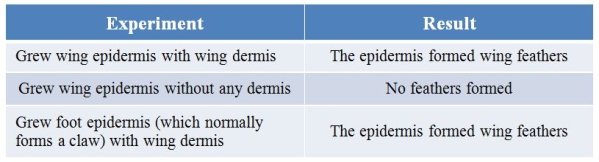 From these results, can we conclude that wing dermis induces epidermis to form wing feathers? Explain your answer.
 (Essay)
4.8/5 (87)
(87) In a placental mammal, destruction of cells within the inner cell mass is most likely to impair which event?
(Multiple Choice)
4.8/5 (78)
(78) In the 1950s, thalidomide was given to pregnant women to ease nausea and insomnia.What happened to some fetuses exposed to this drug?
(Multiple Choice)
4.8/5 (67)
(67) A pregnant woman who is close to her due date has been feeling mild uterine contractions for several hours when suddenly she feels a fluid flowing down her legs.This is an indication that the _______ around the baby has/have ruptured.
(Short Answer)
4.9/5 (78)
(78) A researcher exposes a sea urchin blastula to a protein that inhibits filopodia formation.Which event will most immediately be compromised in the manipulated blastula?
(Multiple Choice)
4.9/5 (76)
(76) Which feature characterizes β-catenin's role in amphibian embryos?
(Multiple Choice)
4.9/5 (69)
(69) The first organizer cells to enter an amphibian embryo move toward the anterior and eventually induce nearby cells to form structures of the _______.
(Short Answer)
4.9/5 (83)
(83) Which statement about cleavage and early development in placental mammals is true?
(Multiple Choice)
4.8/5 (79)
(79) Which embryonic structure contributes directly to the mammalian placenta?
(Multiple Choice)
4.9/5 (73)
(73) Refer to the figure showing a 9-day chick embryo. 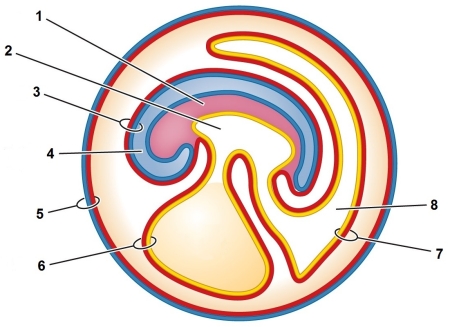 Based on the figure, which statement is true?
 (Multiple Choice)
4.9/5 (86)
(86) The _______ of the blastopore is the primary organizer in amphibian embryos.
(Short Answer)
4.8/5 (81)
(81) The developmental process during which germ layers form and take specific positions relative to one another is called _______.
(Short Answer)
4.9/5 (88)
(88) A researcher working with fruit fly embryos removes the cells containing the pole plasm at the posterior end of an embryo.In a second embryo, the researcher removes several cells just lateral to the ones containing pole plasm.If both embryos develop into larvae, it is most likely that
(Multiple Choice)
4.8/5 (83)
(83) Refer to the figure showing a scanning electron micrograph of a chick embryo. 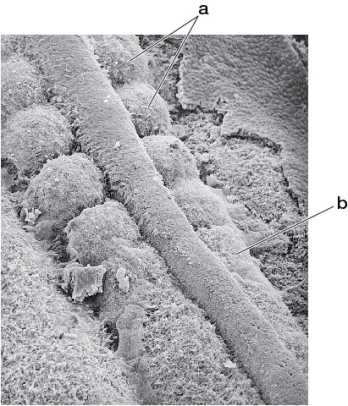 In this image the overlying epidermal ectoderm has been removed, and we are looking down on the embryo from above.The tissue labeled "a" will soon form a(n) _______, which lies posterior to the structures labeled "b."
 (Short Answer)
4.9/5 (88)
(88) _______ is the process by which surface cells roll over the lip of the blastopore and move into the blastocoel during amphibian gastrulation.
(Multiple Choice)
4.7/5 (79)
(79) 
Filters
- Essay(0)
- Multiple Choice(0)
- Short Answer(0)
- True False(0)
- Matching(0)