



 Chat with AI
Exam 43: Animal Development

Exam 1: Studying Life246 Questions
Exam 2: Small Molecules and the Chemistry of Life246 Questions
Exam 3: Proteins, Carbohydrates, and Lipids246 Questions
Exam 4: Nucleic Acids and the Origin of Life246 Questions
Exam 5: Cells: the Working Units of Life248 Questions
Exam 6: Cell Membranes246 Questions
Exam 7: Cell Communication and Multicellularity246 Questions
Exam 8: Energy, Enzymes, and Metabolism246 Questions
Exam 9: Pathways That Harvest Chemical Energy246 Questions
Exam 10: Photosynthesis: Energy From Sunlight242 Questions
Exam 11: The Cell Cycle and Cell Division260 Questions
Exam 12: Inheritance, Genes, and Chromosomes250 Questions
Exam 13: Dna and Its Role in Heredity257 Questions
Exam 14: From Dna to Protein: Gene Expression252 Questions
Exam 15: Gene Mutation and Molecular Medicine251 Questions
Exam 16: Regulation of Gene Expression245 Questions
Exam 17: Genomes249 Questions
Exam 18: Recombinant Dna and Biotechnology243 Questions
Exam 20: Mechanisms of Evolution243 Questions
Exam 21: Reconstructing and Using Phylogenies246 Questions
Exam 22: Speciation247 Questions
Exam 23: Evolution of Genes and Genomes252 Questions
Exam 24: The History of Life on Earth246 Questions
Exam 25: Bacteria, Archaea, and Viruses262 Questions
Exam 26: The Origin and Diversification of Eukaryotes252 Questions
Exam 27: Plants Without Seeds: From Water to Land251 Questions
Exam 28: The Evolution of Seed Plants259 Questions
Exam 29: The Evolution and Diversity of Fungi261 Questions
Exam 30: Animal Origins and the Evolution of Body Plans248 Questions
Exam 31: Protostome Animals244 Questions
Exam 32: Deuterostome Animals246 Questions
Exam 33: The Plant Body243 Questions
Exam 34: Transport in Plants248 Questions
Exam 35: Plant Nutrition247 Questions
Exam 36: Regulation of Plant Growth246 Questions
Exam 37: Reproduction in Flowering Plants247 Questions
Exam 38: Plant Responses to Environmental Challenges246 Questions
Exam 39: Physiology, Homeostasis, and Temperature Regulation258 Questions
Exam 40: Animal Hormones249 Questions
Exam 41: Immunology: Animal Defense Systems265 Questions
Exam 42: Animal Reproduction261 Questions
Exam 43: Animal Development261 Questions
Exam 44: Neurons, Glia, and Nervous Systems250 Questions
Exam 45: Sensory Systems249 Questions
Exam 46: The Mammalian Nervous System: Structure and Higher Functions254 Questions
Exam 47: Musculoskeletal Systems259 Questions
Exam 48: Gas Exchange247 Questions
Exam 49: Circulatory Systems252 Questions
Exam 50: Nutrition, Digestion, and Absorption259 Questions
Exam 51: Salt and Water Balance and Nitrogen Excretion251 Questions
Exam 52: Animal Behavior249 Questions
Exam 53: The Physical Environment and Biogeography of Life248 Questions
Exam 54: Populations259 Questions
Exam 55: Species Interactions254 Questions
Exam 56: Communities247 Questions
Exam 57: Ecosystems238 Questions
Exam 58: A Changing Biosphere222 Questions
Select questions type


Which feature characterizes the yolk sac of developing chicks?
(Multiple Choice)
4.9/5  (72)
(72) Refer to the figure showing a scanning electron micrograph and figure of a chick embryo. 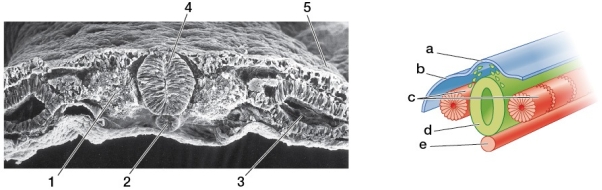 What are the number, letter, and name of the structure immediately ventral to the neural tube? What is one of its functions?
 (Multiple Choice)
4.8/5 (84)
(84) Which gastrulation event in the sea urchin occurs later than the others?
(Multiple Choice)
5.0/5 (90)
(90) Choose the correct pairing of the germ layer and the structure it gives rise to.
(Multiple Choice)
4.8/5 (88)
(88) Which feature is characteristic of cleavage in placental mammals?
(Multiple Choice)
4.8/5 (93)
(93) Which feature characterizes nervous system development in humans?
(Multiple Choice)
4.7/5 (82)
(82) What medical condition can result if a human blastocyst hatches too early from the zona pellucida?
(Short Answer)
4.7/5 (72)
(72) Which of these gastrulation events occurs after the others in sea urchins?
(Multiple Choice)
4.7/5 (83)
(83) A researcher is interested in studying the maternal behavior shown by placental mammals in the hours immediately after giving birth.To ensure timely collection of data, she would like a study species with a short gestation period.Which placental mammal would you recommend?
(Multiple Choice)
4.8/5 (81)
(81) Initiation of nervous system development in amphibians occurs when organizer cells
(Multiple Choice)
4.9/5 (74)
(74) Chorionic villus sampling, one method of prenatal genetic testing, involves taking a small sample of chorionic villi from the placenta.Why would cells from this region of the placenta reveal the genetic makeup of the fetus?
(Essay)
4.8/5 (73)
(73) In developing humans, the first trimester is a time of extreme sensitivity to environmental risks, because
(Multiple Choice)
4.8/5 (84)
(84) If a researcher studying amphibian development blocked the secretion of BMP proteins by mesoderm under the embryo's dorsal surface, the likely result would be that the
(Multiple Choice)
4.8/5 (72)
(72) The gene Hoxb1 is close to the 3ʹ end of a Hox gene complex.Where in a vertebrate embryo might expression of Hoxb1 occur?
(Multiple Choice)
5.0/5 (80)
(80) Working with salamander embryos, Hans Spemann transplanted a piece of a late gastrula that would normally form epidermis of the skin to the region of another late gastrula that would normally form neural tissue.Which result did he get?
(Multiple Choice)
4.9/5 (78)
(78) 
Filters
- Essay(0)
- Multiple Choice(0)
- Short Answer(0)
- True False(0)
- Matching(0)