



 Chat with AI
Exam 43: Animal Development

Exam 1: Studying Life246 Questions
Exam 2: Small Molecules and the Chemistry of Life246 Questions
Exam 3: Proteins, Carbohydrates, and Lipids246 Questions
Exam 4: Nucleic Acids and the Origin of Life246 Questions
Exam 5: Cells: the Working Units of Life248 Questions
Exam 6: Cell Membranes246 Questions
Exam 7: Cell Communication and Multicellularity246 Questions
Exam 8: Energy, Enzymes, and Metabolism246 Questions
Exam 9: Pathways That Harvest Chemical Energy246 Questions
Exam 10: Photosynthesis: Energy From Sunlight242 Questions
Exam 11: The Cell Cycle and Cell Division260 Questions
Exam 12: Inheritance, Genes, and Chromosomes250 Questions
Exam 13: Dna and Its Role in Heredity257 Questions
Exam 14: From Dna to Protein: Gene Expression252 Questions
Exam 15: Gene Mutation and Molecular Medicine251 Questions
Exam 16: Regulation of Gene Expression245 Questions
Exam 17: Genomes249 Questions
Exam 18: Recombinant Dna and Biotechnology243 Questions
Exam 20: Mechanisms of Evolution243 Questions
Exam 21: Reconstructing and Using Phylogenies246 Questions
Exam 22: Speciation247 Questions
Exam 23: Evolution of Genes and Genomes252 Questions
Exam 24: The History of Life on Earth246 Questions
Exam 25: Bacteria, Archaea, and Viruses262 Questions
Exam 26: The Origin and Diversification of Eukaryotes252 Questions
Exam 27: Plants Without Seeds: From Water to Land251 Questions
Exam 28: The Evolution of Seed Plants259 Questions
Exam 29: The Evolution and Diversity of Fungi261 Questions
Exam 30: Animal Origins and the Evolution of Body Plans248 Questions
Exam 31: Protostome Animals244 Questions
Exam 32: Deuterostome Animals246 Questions
Exam 33: The Plant Body243 Questions
Exam 34: Transport in Plants248 Questions
Exam 35: Plant Nutrition247 Questions
Exam 36: Regulation of Plant Growth246 Questions
Exam 37: Reproduction in Flowering Plants247 Questions
Exam 38: Plant Responses to Environmental Challenges246 Questions
Exam 39: Physiology, Homeostasis, and Temperature Regulation258 Questions
Exam 40: Animal Hormones249 Questions
Exam 41: Immunology: Animal Defense Systems265 Questions
Exam 42: Animal Reproduction261 Questions
Exam 43: Animal Development261 Questions
Exam 44: Neurons, Glia, and Nervous Systems250 Questions
Exam 45: Sensory Systems249 Questions
Exam 46: The Mammalian Nervous System: Structure and Higher Functions254 Questions
Exam 47: Musculoskeletal Systems259 Questions
Exam 48: Gas Exchange247 Questions
Exam 49: Circulatory Systems252 Questions
Exam 50: Nutrition, Digestion, and Absorption259 Questions
Exam 51: Salt and Water Balance and Nitrogen Excretion251 Questions
Exam 52: Animal Behavior249 Questions
Exam 53: The Physical Environment and Biogeography of Life248 Questions
Exam 54: Populations259 Questions
Exam 55: Species Interactions254 Questions
Exam 56: Communities247 Questions
Exam 57: Ecosystems238 Questions
Exam 58: A Changing Biosphere222 Questions
Select questions type


The dorsal lip of the blastopore organizes embryo formation in frogs.The equivalent structure in chickens is _______.
(Short Answer)
4.9/5  (68)
(68) Spina bifida is a birth defect in humans in which part of the spinal cord, as well as the adjacent area of the spine, develops abnormally.What process was disturbed during prenatal development in individuals born with spina bifida?
(Short Answer)
4.9/5 (77)
(77) If the dorsal lip of the blastopore is transplanted from one frog gastrula onto a second frog gastrula on the opposite side from the embryo's original blastopore, which result is the most likely?
(Multiple Choice)
4.8/5 (76)
(76) Refer to the figure showing cytoplasmic factors in a fertilized frog egg. 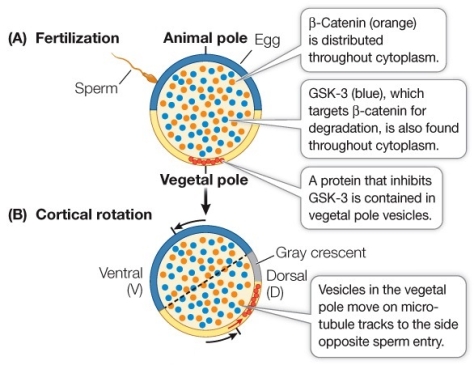 Suppose a researcher experimenting with the frog egg shown in part A removes the vesicles containing the GSK-3 inhibiting protein.What will be the most likely result of this experiment?
 (Multiple Choice)
4.9/5 (69)
(69) Refer to the figure showing manipulations carried out by Spemann on developing amphibians. 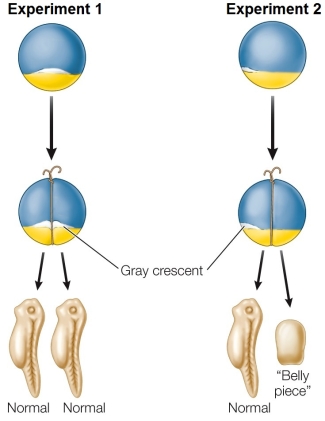 The results of this experiment indicate that the gray crescent is _______ for normal development of the amphibian embryo.
 (Short Answer)
4.8/5 (75)
(75) Experimental destruction of cells of the hypoblast of a developing chick would most immediately impair
(Multiple Choice)
4.9/5 (63)
(63) The mesoderm of the anterior part of a vertebrate embryo is programmed to produce forelegs rather than hind legs by
(Multiple Choice)
4.7/5 (78)
(78) In placental mammals, implantation would fail if cells of the _______ failed to express adhesion molecules.
(Multiple Choice)
4.7/5 (77)
(77) A body plan consisting of repeating segments that are modified during development into structures such as vertebrae, ribs, and muscles depends on the production of cells by
(Multiple Choice)
4.9/5 (80)
(80) A woman ovulates two eggs that are fertilized by different sperm.The embryos implant and develop to full term.The two babies the woman gives birth to are
(Multiple Choice)
4.8/5 (74)
(74) If you experimentally removed the GSK-inhibiting protein from a fertilized amphibian egg, a likely result would be
(Multiple Choice)
4.9/5 (89)
(89) Which are least likely to be cytoplasmic determinants that direct embryonic development in frogs?
(Multiple Choice)
4.7/5 (82)
(82) Experimental overexpression of β-catenin in another region of an amphibian embryo results in
(Multiple Choice)
4.9/5 (81)
(81) The mammalian blastocyst differs from a frog blastula in that the mammalian blastocyst
(Multiple Choice)
4.9/5 (78)
(78) A researcher who wants to block initiation of the cytoplasmic reorganization that is revealed by the appearance of the gray crescent in a developing frog should block the actions of
(Multiple Choice)
4.8/5 (83)
(83) 
Filters
- Essay(0)
- Multiple Choice(0)
- Short Answer(0)
- True False(0)
- Matching(0)