



 Chat with AI
Exam 43: Animal Development

Exam 1: Studying Life246 Questions
Exam 2: Small Molecules and the Chemistry of Life246 Questions
Exam 3: Proteins, Carbohydrates, and Lipids246 Questions
Exam 4: Nucleic Acids and the Origin of Life246 Questions
Exam 5: Cells: the Working Units of Life248 Questions
Exam 6: Cell Membranes246 Questions
Exam 7: Cell Communication and Multicellularity246 Questions
Exam 8: Energy, Enzymes, and Metabolism246 Questions
Exam 9: Pathways That Harvest Chemical Energy246 Questions
Exam 10: Photosynthesis: Energy From Sunlight242 Questions
Exam 11: The Cell Cycle and Cell Division260 Questions
Exam 12: Inheritance, Genes, and Chromosomes250 Questions
Exam 13: Dna and Its Role in Heredity257 Questions
Exam 14: From Dna to Protein: Gene Expression252 Questions
Exam 15: Gene Mutation and Molecular Medicine251 Questions
Exam 16: Regulation of Gene Expression245 Questions
Exam 17: Genomes249 Questions
Exam 18: Recombinant Dna and Biotechnology243 Questions
Exam 20: Mechanisms of Evolution243 Questions
Exam 21: Reconstructing and Using Phylogenies246 Questions
Exam 22: Speciation247 Questions
Exam 23: Evolution of Genes and Genomes252 Questions
Exam 24: The History of Life on Earth246 Questions
Exam 25: Bacteria, Archaea, and Viruses262 Questions
Exam 26: The Origin and Diversification of Eukaryotes252 Questions
Exam 27: Plants Without Seeds: From Water to Land251 Questions
Exam 28: The Evolution of Seed Plants259 Questions
Exam 29: The Evolution and Diversity of Fungi261 Questions
Exam 30: Animal Origins and the Evolution of Body Plans248 Questions
Exam 31: Protostome Animals244 Questions
Exam 32: Deuterostome Animals246 Questions
Exam 33: The Plant Body243 Questions
Exam 34: Transport in Plants248 Questions
Exam 35: Plant Nutrition247 Questions
Exam 36: Regulation of Plant Growth246 Questions
Exam 37: Reproduction in Flowering Plants247 Questions
Exam 38: Plant Responses to Environmental Challenges246 Questions
Exam 39: Physiology, Homeostasis, and Temperature Regulation258 Questions
Exam 40: Animal Hormones249 Questions
Exam 41: Immunology: Animal Defense Systems265 Questions
Exam 42: Animal Reproduction261 Questions
Exam 43: Animal Development261 Questions
Exam 44: Neurons, Glia, and Nervous Systems250 Questions
Exam 45: Sensory Systems249 Questions
Exam 46: The Mammalian Nervous System: Structure and Higher Functions254 Questions
Exam 47: Musculoskeletal Systems259 Questions
Exam 48: Gas Exchange247 Questions
Exam 49: Circulatory Systems252 Questions
Exam 50: Nutrition, Digestion, and Absorption259 Questions
Exam 51: Salt and Water Balance and Nitrogen Excretion251 Questions
Exam 52: Animal Behavior249 Questions
Exam 53: The Physical Environment and Biogeography of Life248 Questions
Exam 54: Populations259 Questions
Exam 55: Species Interactions254 Questions
Exam 56: Communities247 Questions
Exam 57: Ecosystems238 Questions
Exam 58: A Changing Biosphere222 Questions
Select questions type


Refer to the graph.  In the graph, curve _______ best represents the changes in the ratio of nuclear volume to cytoplasmic volume during early cleavage in most animals.At this time, the blastomeres _______ in size.
 (Multiple Choice)
4.8/5  (84)
(84) An obstetrician can listen to the heartbeat of a fetus to determine the health of the heart and whether there is a multiple pregnancy.In which trimester of the pregnancy will the obstetrician first be able to hear the baby's heartbeat? Explain your answer.
(Essay)
4.8/5 (69)
(69) Which statement about developing placental mammals is true?
(Multiple Choice)
4.8/5 (73)
(73) Refer to the figure showing a stage of gastrulation in the frog.  Consider a piece of ectoderm that is destined to be neural tissue in its original location in the gastrula shown in the figure.If it is transplanted into a location destined to be epidermis in a gastrula of similar age, which of the following will result?
 (Multiple Choice)
4.9/5 (85)
(85) Which structure in birds and mammals is the equivalent of the dorsal lip of the amphibian blastopore?
(Multiple Choice)
4.9/5 (79)
(79) A man who suffers from a mitochondrial disease due to a mutation in his mitochondrial DNA is worried he will pass this defect on to his children.A genetic counselor tells the man that there is a negligible probability of his passing this disease on to his offspring, because mitochondria are inherited from the _______.
(Short Answer)
5.0/5 (94)
(94) Which result did Hans Spemann and Hilde Mangold get when they transplanted the dorsal lip of the blastopore of an early amphibian gastrula to the belly region of another early gastrula?
(Multiple Choice)
5.0/5 (74)
(74) In each somite there are several regions of cells that give rise to different structures.Experimental destruction of one somite would impair the development of
(Multiple Choice)
4.9/5 (83)
(83) The region of the frog egg with dark pigmentation, where fertilization can take place, is known as the _______ hemisphere.
(Short Answer)
5.0/5 (99)
(99) Although details of gastrulation differ among sea urchins, frogs, and chickens, there is a common result in all of these animals.What is it?
(Short Answer)
4.8/5 (79)
(79) An embryo exhibits abnormal development in the most posterior part of its body.The responsible Hox gene is located
(Multiple Choice)
4.9/5 (57)
(57) If a researcher inhibited formation of filopodia during sea urchin gastrulation, which of the following would be least likely to form?
(Multiple Choice)
4.7/5 (88)
(88) Which feature is characteristic of development in organisms whose eggs have little to a moderate amount of yolk?
(Multiple Choice)
4.9/5 (71)
(71) A researcher experimentally blocks the protein that inhibits GSK-3 in a frog zygote.Which would be the most immediate effect?
(Multiple Choice)
5.0/5 (76)
(76) The centriole of the sperm becomes the _______ of the zygote.
(Short Answer)
4.9/5 (76)
(76) Refer to the figure showing a 9-day chick embryo. 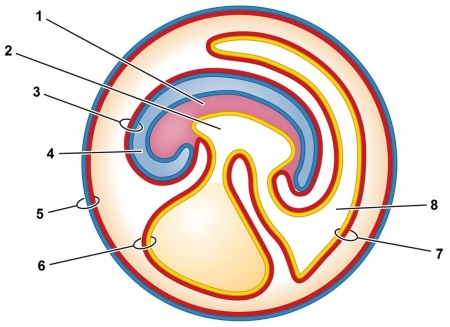 Match the following terms with their label numbers in the figure: allantoic membrane, allantois, amnion, body of embryo, chorion, and yolk sac.
 (Short Answer)
4.8/5 (77)
(77) You are observing a video of development in Xenopus (African clawed frog).Immediately following the segment on gastrulation, the video shows neural crest cells migrating toward their destinations, and you realize that the segment showing _______ is missing.
(Short Answer)
4.7/5 (79)
(79) 
Filters
- Essay(0)
- Multiple Choice(0)
- Short Answer(0)
- True False(0)
- Matching(0)