



 Chat with AI
Exam 43: Animal Development

Exam 1: Studying Life246 Questions
Exam 2: Small Molecules and the Chemistry of Life246 Questions
Exam 3: Proteins, Carbohydrates, and Lipids246 Questions
Exam 4: Nucleic Acids and the Origin of Life246 Questions
Exam 5: Cells: the Working Units of Life248 Questions
Exam 6: Cell Membranes246 Questions
Exam 7: Cell Communication and Multicellularity246 Questions
Exam 8: Energy, Enzymes, and Metabolism246 Questions
Exam 9: Pathways That Harvest Chemical Energy246 Questions
Exam 10: Photosynthesis: Energy From Sunlight242 Questions
Exam 11: The Cell Cycle and Cell Division260 Questions
Exam 12: Inheritance, Genes, and Chromosomes250 Questions
Exam 13: Dna and Its Role in Heredity257 Questions
Exam 14: From Dna to Protein: Gene Expression252 Questions
Exam 15: Gene Mutation and Molecular Medicine251 Questions
Exam 16: Regulation of Gene Expression245 Questions
Exam 17: Genomes249 Questions
Exam 18: Recombinant Dna and Biotechnology243 Questions
Exam 20: Mechanisms of Evolution243 Questions
Exam 21: Reconstructing and Using Phylogenies246 Questions
Exam 22: Speciation247 Questions
Exam 23: Evolution of Genes and Genomes252 Questions
Exam 24: The History of Life on Earth246 Questions
Exam 25: Bacteria, Archaea, and Viruses262 Questions
Exam 26: The Origin and Diversification of Eukaryotes252 Questions
Exam 27: Plants Without Seeds: From Water to Land251 Questions
Exam 28: The Evolution of Seed Plants259 Questions
Exam 29: The Evolution and Diversity of Fungi261 Questions
Exam 30: Animal Origins and the Evolution of Body Plans248 Questions
Exam 31: Protostome Animals244 Questions
Exam 32: Deuterostome Animals246 Questions
Exam 33: The Plant Body243 Questions
Exam 34: Transport in Plants248 Questions
Exam 35: Plant Nutrition247 Questions
Exam 36: Regulation of Plant Growth246 Questions
Exam 37: Reproduction in Flowering Plants247 Questions
Exam 38: Plant Responses to Environmental Challenges246 Questions
Exam 39: Physiology, Homeostasis, and Temperature Regulation258 Questions
Exam 40: Animal Hormones249 Questions
Exam 41: Immunology: Animal Defense Systems265 Questions
Exam 42: Animal Reproduction261 Questions
Exam 43: Animal Development261 Questions
Exam 44: Neurons, Glia, and Nervous Systems250 Questions
Exam 45: Sensory Systems249 Questions
Exam 46: The Mammalian Nervous System: Structure and Higher Functions254 Questions
Exam 47: Musculoskeletal Systems259 Questions
Exam 48: Gas Exchange247 Questions
Exam 49: Circulatory Systems252 Questions
Exam 50: Nutrition, Digestion, and Absorption259 Questions
Exam 51: Salt and Water Balance and Nitrogen Excretion251 Questions
Exam 52: Animal Behavior249 Questions
Exam 53: The Physical Environment and Biogeography of Life248 Questions
Exam 54: Populations259 Questions
Exam 55: Species Interactions254 Questions
Exam 56: Communities247 Questions
Exam 57: Ecosystems238 Questions
Exam 58: A Changing Biosphere222 Questions
Select questions type


Imagine looking at a slide of a cross section of a frog embryo that has just completed neurulation.Which is the sequence of structures you should see, beginning with inside the gut of the embryo and moving outward?
(Multiple Choice)
4.9/5  (80)
(80) Parthenogenesis is the development of unfertilized eggs.Which is the most reasonable assumption about a parthenogenetic species?
(Multiple Choice)
4.7/5 (76)
(76) Neural crest cells will become many different cell types in many different structures, including
(Multiple Choice)
4.9/5 (95)
(95) A researcher working with developing fruit flies wants to produce a fly without gametes.Which element should be targeted for destruction in the early embryo prior to gastrulation in order to achieve this?
(Multiple Choice)
4.8/5 (76)
(76) Which is the typical chronological order in which structures appear during neurulation in the anterior region of an amphibian embryo?
(Multiple Choice)
4.7/5 (82)
(82) The blocklike structures that form alongside the notochord around the time of neurulation are called _______.
(Short Answer)
4.7/5 (77)
(77) Which statement about events during the neurulation stage of development is true?
(Multiple Choice)
4.8/5 (82)
(82) Refer to the figure showing a scanning electron micrograph and figure of a chick embryo. 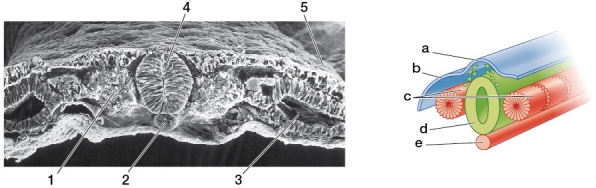 Which labels in the two figures are pointing to the structure that will form vertebrae?
 (Multiple Choice)
4.9/5 (82)
(82) You are conducting an experiment that requires you to start a treatment on amphibian embryos when the nervous system starts developing.At which stage will you start the treatment?
(Multiple Choice)
5.0/5 (70)
(70) A researcher working with frog zygotes experimentally disables the protein that inhibits GSK-3.What will be the immediate result?
(Essay)
4.9/5 (88)
(88) If cells from the presumptive neural ectoderm of a late frog gastrula are transplanted onto the surface of a second late frog gastrula where skin would normally develop, the transplanted cells will still develop into neural tissue.This experiment shows that the transplanted cells are
(Multiple Choice)
4.8/5 (70)
(70) You pull an unlabeled video out of a box labeled "Amphibian and sea urchin gastrulation." While watching the video, you decide it must be a video of a sea urchin embryo and not an amphibian embryo because you see that
(Multiple Choice)
4.8/5 (59)
(59) If you turned a frog egg upside down, you would expect it to reorient relative to gravity because the dense yolk granules are concentrated in the _______ hemisphere of the egg in response to gravity.
(Short Answer)
4.9/5 (76)
(76) Gene duplication during evolution resulted in vertebrates having multiple copies of the _______ gene complex that controls body segmentation.
(Multiple Choice)
4.8/5 (74)
(74) In which way does the notochord differ from the neural tube?
(Multiple Choice)
4.8/5 (83)
(83) Imagine looking at a slide containing a cross section of a frog embryo that has just completed neurulation.If you begin your examination at the dorsal surface of the embryo and moved inward, you will see, in sequence,
(Multiple Choice)
5.0/5 (85)
(85) In frogs, the sperm penetrates the egg in the region of the
(Multiple Choice)
4.8/5 (83)
(83) 
Filters
- Essay(0)
- Multiple Choice(0)
- Short Answer(0)
- True False(0)
- Matching(0)