



 Chat with AI
Exam 43: Animal Development

Exam 1: Studying Life246 Questions
Exam 2: Small Molecules and the Chemistry of Life246 Questions
Exam 3: Proteins, Carbohydrates, and Lipids246 Questions
Exam 4: Nucleic Acids and the Origin of Life246 Questions
Exam 5: Cells: the Working Units of Life248 Questions
Exam 6: Cell Membranes246 Questions
Exam 7: Cell Communication and Multicellularity246 Questions
Exam 8: Energy, Enzymes, and Metabolism246 Questions
Exam 9: Pathways That Harvest Chemical Energy246 Questions
Exam 10: Photosynthesis: Energy From Sunlight242 Questions
Exam 11: The Cell Cycle and Cell Division260 Questions
Exam 12: Inheritance, Genes, and Chromosomes250 Questions
Exam 13: Dna and Its Role in Heredity257 Questions
Exam 14: From Dna to Protein: Gene Expression252 Questions
Exam 15: Gene Mutation and Molecular Medicine251 Questions
Exam 16: Regulation of Gene Expression245 Questions
Exam 17: Genomes249 Questions
Exam 18: Recombinant Dna and Biotechnology243 Questions
Exam 20: Mechanisms of Evolution243 Questions
Exam 21: Reconstructing and Using Phylogenies246 Questions
Exam 22: Speciation247 Questions
Exam 23: Evolution of Genes and Genomes252 Questions
Exam 24: The History of Life on Earth246 Questions
Exam 25: Bacteria, Archaea, and Viruses262 Questions
Exam 26: The Origin and Diversification of Eukaryotes252 Questions
Exam 27: Plants Without Seeds: From Water to Land251 Questions
Exam 28: The Evolution of Seed Plants259 Questions
Exam 29: The Evolution and Diversity of Fungi261 Questions
Exam 30: Animal Origins and the Evolution of Body Plans248 Questions
Exam 31: Protostome Animals244 Questions
Exam 32: Deuterostome Animals246 Questions
Exam 33: The Plant Body243 Questions
Exam 34: Transport in Plants248 Questions
Exam 35: Plant Nutrition247 Questions
Exam 36: Regulation of Plant Growth246 Questions
Exam 37: Reproduction in Flowering Plants247 Questions
Exam 38: Plant Responses to Environmental Challenges246 Questions
Exam 39: Physiology, Homeostasis, and Temperature Regulation258 Questions
Exam 40: Animal Hormones249 Questions
Exam 41: Immunology: Animal Defense Systems265 Questions
Exam 42: Animal Reproduction261 Questions
Exam 43: Animal Development261 Questions
Exam 44: Neurons, Glia, and Nervous Systems250 Questions
Exam 45: Sensory Systems249 Questions
Exam 46: The Mammalian Nervous System: Structure and Higher Functions254 Questions
Exam 47: Musculoskeletal Systems259 Questions
Exam 48: Gas Exchange247 Questions
Exam 49: Circulatory Systems252 Questions
Exam 50: Nutrition, Digestion, and Absorption259 Questions
Exam 51: Salt and Water Balance and Nitrogen Excretion251 Questions
Exam 52: Animal Behavior249 Questions
Exam 53: The Physical Environment and Biogeography of Life248 Questions
Exam 54: Populations259 Questions
Exam 55: Species Interactions254 Questions
Exam 56: Communities247 Questions
Exam 57: Ecosystems238 Questions
Exam 58: A Changing Biosphere222 Questions
Select questions type


Refer to the figure showing a 9-day chick embryo. 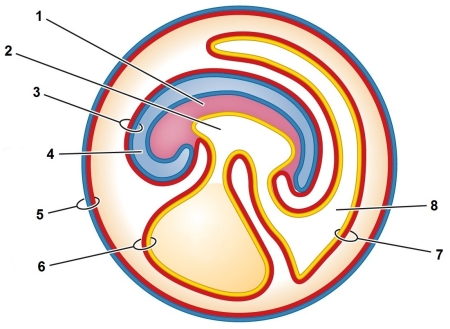 Based on the figure, which statement is true?
 (Multiple Choice)
4.9/5  (82)
(82) The cells from the most lateral portions of the neural plate become migratory cells
(Multiple Choice)
4.9/5 (86)
(86) Evaluate the following statement: The placenta is the organ where fetal and maternal blood supplies mix.
(Essay)
4.8/5 (73)
(73) Which feature would you predict would be found in monotremes (egg-laying mammals)?
(Multiple Choice)
4.9/5 (80)
(80) Which result did Hans Spemann and Hilde Mangold, working with amphibian embryos, obtain?
(Multiple Choice)
4.8/5 (70)
(70) The primitive groove of bird and mammalian embryos and the _______ of amphibian embryos function in similar ways.
(Short Answer)
4.8/5 (78)
(78) Radial, spiral, and rotational cleavage are all forms of _______ cleavage.
(Short Answer)
4.8/5 (87)
(87) _______ genes control differentiation along the anterior‒posterior axis of the developing vertebrate body.
(Short Answer)
5.0/5 (72)
(72) After gastrulation, the ectodermal cells contribute to the developing
(Multiple Choice)
4.9/5 (82)
(82) During development, the _______ is an important structure for waste storage in birds and some mammals, but not in humans.
(Multiple Choice)
4.9/5 (82)
(82) Refer to the figure showing a sea urchin gastrula. 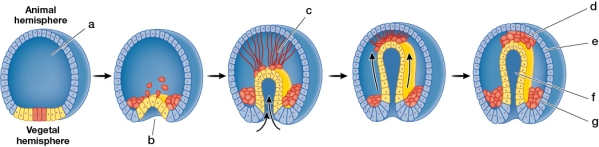 Identify the structures labelled a-g in the figure, using the following terms: archenteron, ectoderm, filopodia, primary mesenchyme, secondary mesenchyme, blastocoel, blastopore.
 (Short Answer)
4.9/5 (73)
(73) The urinary waste of birds is primarily uric acid, which looks like a white paste when released from the bird.When a chick hatches from its shell, you can see this white paste, which had been deposited in the _______, where it was being stored during incubation.
(Short Answer)
4.7/5 (80)
(80) Working with salamander embryos, which result did Hans Spemann get when he transplanted a piece of an early gastrula that would normally form epidermis of skin to the region of another early gastrula that would normally form neural tissue?
(Multiple Choice)
4.8/5 (68)
(68) Place the following events of human early development in the correct order.
(Multiple Choice)
4.9/5 (78)
(78) Choose the correct pairing of human developmental event and trimester.
(Multiple Choice)
5.0/5 (92)
(92) Which feature characterizes cells of the inner cell mass in a mammalian embryo?
(Multiple Choice)
4.9/5 (76)
(76) Blocking the changes in shape and cell adhesion properties that lead to bottle cells would interfere with the
(Multiple Choice)
4.8/5 (68)
(68) 
Filters
- Essay(0)
- Multiple Choice(0)
- Short Answer(0)
- True False(0)
- Matching(0)