



 Chat with AI
Exam 43: Animal Development

Exam 1: Studying Life246 Questions
Exam 2: Small Molecules and the Chemistry of Life246 Questions
Exam 3: Proteins, Carbohydrates, and Lipids246 Questions
Exam 4: Nucleic Acids and the Origin of Life246 Questions
Exam 5: Cells: the Working Units of Life248 Questions
Exam 6: Cell Membranes246 Questions
Exam 7: Cell Communication and Multicellularity246 Questions
Exam 8: Energy, Enzymes, and Metabolism246 Questions
Exam 9: Pathways That Harvest Chemical Energy246 Questions
Exam 10: Photosynthesis: Energy From Sunlight242 Questions
Exam 11: The Cell Cycle and Cell Division260 Questions
Exam 12: Inheritance, Genes, and Chromosomes250 Questions
Exam 13: Dna and Its Role in Heredity257 Questions
Exam 14: From Dna to Protein: Gene Expression252 Questions
Exam 15: Gene Mutation and Molecular Medicine251 Questions
Exam 16: Regulation of Gene Expression245 Questions
Exam 17: Genomes249 Questions
Exam 18: Recombinant Dna and Biotechnology243 Questions
Exam 20: Mechanisms of Evolution243 Questions
Exam 21: Reconstructing and Using Phylogenies246 Questions
Exam 22: Speciation247 Questions
Exam 23: Evolution of Genes and Genomes252 Questions
Exam 24: The History of Life on Earth246 Questions
Exam 25: Bacteria, Archaea, and Viruses262 Questions
Exam 26: The Origin and Diversification of Eukaryotes252 Questions
Exam 27: Plants Without Seeds: From Water to Land251 Questions
Exam 28: The Evolution of Seed Plants259 Questions
Exam 29: The Evolution and Diversity of Fungi261 Questions
Exam 30: Animal Origins and the Evolution of Body Plans248 Questions
Exam 31: Protostome Animals244 Questions
Exam 32: Deuterostome Animals246 Questions
Exam 33: The Plant Body243 Questions
Exam 34: Transport in Plants248 Questions
Exam 35: Plant Nutrition247 Questions
Exam 36: Regulation of Plant Growth246 Questions
Exam 37: Reproduction in Flowering Plants247 Questions
Exam 38: Plant Responses to Environmental Challenges246 Questions
Exam 39: Physiology, Homeostasis, and Temperature Regulation258 Questions
Exam 40: Animal Hormones249 Questions
Exam 41: Immunology: Animal Defense Systems265 Questions
Exam 42: Animal Reproduction261 Questions
Exam 43: Animal Development261 Questions
Exam 44: Neurons, Glia, and Nervous Systems250 Questions
Exam 45: Sensory Systems249 Questions
Exam 46: The Mammalian Nervous System: Structure and Higher Functions254 Questions
Exam 47: Musculoskeletal Systems259 Questions
Exam 48: Gas Exchange247 Questions
Exam 49: Circulatory Systems252 Questions
Exam 50: Nutrition, Digestion, and Absorption259 Questions
Exam 51: Salt and Water Balance and Nitrogen Excretion251 Questions
Exam 52: Animal Behavior249 Questions
Exam 53: The Physical Environment and Biogeography of Life248 Questions
Exam 54: Populations259 Questions
Exam 55: Species Interactions254 Questions
Exam 56: Communities247 Questions
Exam 57: Ecosystems238 Questions
Exam 58: A Changing Biosphere222 Questions
Select questions type


The _______ is the primary embryonic organizer in amphibians.
(Multiple Choice)
4.8/5  (70)
(70) Refer to the figure showing implantation in humans.  Based on the figure, which statement is true?
 (Multiple Choice)
4.8/5 (79)
(79) A _______ is an embryo with a central fluid cavity called a _______.
(Multiple Choice)
4.8/5 (81)
(81) If you were interested in studying spiral cleavage, from which group would you select your study species?
(Multiple Choice)
4.8/5 (78)
(78) If an embryo exhibits abnormal development of peripheral nerves, the source of the problem is most likely damage or impairment of
(Multiple Choice)
4.9/5 (81)
(81) Which statement about cleavage in placental mammals is true?
(Multiple Choice)
4.9/5 (89)
(89) Refer to the figure showing fertilization in an amphibian egg. 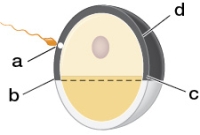 Predict where the gray crescent will form and what region of the embryo this will mark.
 (Multiple Choice)
4.8/5 (83)
(83) At which location in the frog embryo is glycogen synthase kinase-3 (GSK-3) inhibited?
(Multiple Choice)
5.0/5 (83)
(83) Which is the correct matching of term and definition as they relate to gastrulation in frogs?
(Multiple Choice)
4.9/5 (90)
(90) Which statement about frog eggs and early development is true?
(Multiple Choice)
5.0/5 (85)
(85) Which is a shared feature of the embryonic development of chicks and placental mammals?
(Multiple Choice)
4.8/5 (83)
(83) The rod that forms from the chordamesoderm and lends structural support to the developing embryo is called the _______.
(Short Answer)
4.8/5 (88)
(88) Refer to the figure showing an embryo during early cleavage. 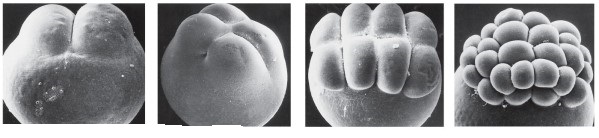 How do you know that this embryo is not that of a frog?
 (Essay)
4.9/5 (85)
(85) You find a microscope slide labeled "Whole mount of early cleavage stage embryo," but the part of the label identifying the organism is missing.Upon observing the embryo under the microscope, you see that the embryo was mounted when it was undergoing its second cleavage and that the two cleavage planes are at a right angle.From this, you are able to conclude that the embryo is from a(n)
(Multiple Choice)
4.8/5 (88)
(88) A researcher studying the development of the eye in Xenopus (the clawed frog) is testing her hypothesis that the optic vesicle induces head ectoderm to form the lens of the eye.When she removes the optic vesicle on one side of the embryo, no lens forms on that side, indicating the optic vesicle is necessary for lens formation.What additional experimental result must she obtain to show that the optic vesicle is also sufficient for inducing lens formation?
(Multiple Choice)
4.7/5 (83)
(83) The "water breaking" often marks the onset of labor in humans.Which extraembryonic membrane(s) rupture(s) at this time?
(Multiple Choice)
4.8/5 (75)
(75) 
Filters
- Essay(0)
- Multiple Choice(0)
- Short Answer(0)
- True False(0)
- Matching(0)