



 Chat with AI
Exam 37: Reproduction in Flowering Plants

Exam 1: Studying Life246 Questions
Exam 2: Small Molecules and the Chemistry of Life246 Questions
Exam 3: Proteins, Carbohydrates, and Lipids246 Questions
Exam 4: Nucleic Acids and the Origin of Life246 Questions
Exam 5: Cells: the Working Units of Life248 Questions
Exam 6: Cell Membranes246 Questions
Exam 7: Cell Communication and Multicellularity246 Questions
Exam 8: Energy, Enzymes, and Metabolism246 Questions
Exam 9: Pathways That Harvest Chemical Energy246 Questions
Exam 10: Photosynthesis: Energy From Sunlight242 Questions
Exam 11: The Cell Cycle and Cell Division260 Questions
Exam 12: Inheritance, Genes, and Chromosomes250 Questions
Exam 13: Dna and Its Role in Heredity257 Questions
Exam 14: From Dna to Protein: Gene Expression252 Questions
Exam 15: Gene Mutation and Molecular Medicine251 Questions
Exam 16: Regulation of Gene Expression245 Questions
Exam 17: Genomes249 Questions
Exam 18: Recombinant Dna and Biotechnology243 Questions
Exam 20: Mechanisms of Evolution243 Questions
Exam 21: Reconstructing and Using Phylogenies246 Questions
Exam 22: Speciation247 Questions
Exam 23: Evolution of Genes and Genomes252 Questions
Exam 24: The History of Life on Earth246 Questions
Exam 25: Bacteria, Archaea, and Viruses262 Questions
Exam 26: The Origin and Diversification of Eukaryotes252 Questions
Exam 27: Plants Without Seeds: From Water to Land251 Questions
Exam 28: The Evolution of Seed Plants259 Questions
Exam 29: The Evolution and Diversity of Fungi261 Questions
Exam 30: Animal Origins and the Evolution of Body Plans248 Questions
Exam 31: Protostome Animals244 Questions
Exam 32: Deuterostome Animals246 Questions
Exam 33: The Plant Body243 Questions
Exam 34: Transport in Plants248 Questions
Exam 35: Plant Nutrition247 Questions
Exam 36: Regulation of Plant Growth246 Questions
Exam 37: Reproduction in Flowering Plants247 Questions
Exam 38: Plant Responses to Environmental Challenges246 Questions
Exam 39: Physiology, Homeostasis, and Temperature Regulation258 Questions
Exam 40: Animal Hormones249 Questions
Exam 41: Immunology: Animal Defense Systems265 Questions
Exam 42: Animal Reproduction261 Questions
Exam 43: Animal Development261 Questions
Exam 44: Neurons, Glia, and Nervous Systems250 Questions
Exam 45: Sensory Systems249 Questions
Exam 46: The Mammalian Nervous System: Structure and Higher Functions254 Questions
Exam 47: Musculoskeletal Systems259 Questions
Exam 48: Gas Exchange247 Questions
Exam 49: Circulatory Systems252 Questions
Exam 50: Nutrition, Digestion, and Absorption259 Questions
Exam 51: Salt and Water Balance and Nitrogen Excretion251 Questions
Exam 52: Animal Behavior249 Questions
Exam 53: The Physical Environment and Biogeography of Life248 Questions
Exam 54: Populations259 Questions
Exam 55: Species Interactions254 Questions
Exam 56: Communities247 Questions
Exam 57: Ecosystems238 Questions
Exam 58: A Changing Biosphere222 Questions
Select questions type


After tilling a garden bed, you notice many more lily plants than you had before.This is because lilies grow from _______.
(Short Answer)
4.8/5  (73)
(73) In flowering plants, pollen is deposited on the surface of the _______, and fertilization occurs within the _______.
(Multiple Choice)
4.9/5 (93)
(93) Refer to the figure. 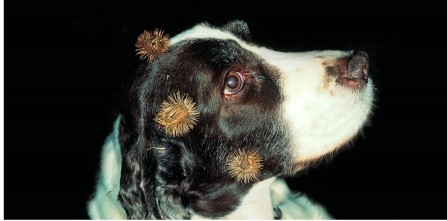 What function is this dog serving for the plant whose fruits are stuck to its head?
 (Multiple Choice)
4.8/5 (78)
(78) Which statement about commercial banana plants grown in tissue culture is false?
(Multiple Choice)
4.8/5 (81)
(81) The phenomenon of hybrid vigor contributes greatly to the financial profits of seed companies, since seeds produced from hybrid varieties have great _______ when planted.
(Short Answer)
4.9/5 (91)
(91) Which structure degenerates under normal circumstances when the first sperm cell enters the embryo sac?
(Multiple Choice)
4.8/5 (74)
(74) Refer to the figure. 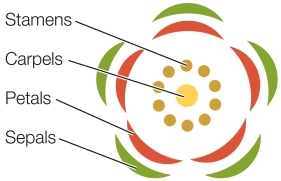 A complete flower has four concentric groups of organs that are modified _______.A perfect flower has both _______ and _______.
 (Multiple Choice)
4.8/5 (78)
(78) What would be expected when a short-day plant, such as commercially grown poinsettia, was checked at night with the overhead lights turned on?
(Multiple Choice)
4.8/5 (73)
(73) The megasporocyte divides _______ to produce four _______ cells.
(Multiple Choice)
5.0/5 (79)
(79) After fertilization of the egg, the integument of the megasporangium develops into the
(Multiple Choice)
4.8/5 (88)
(88) Which of the following is the light receptor responsible for detecting photoperiod?
(Multiple Choice)
4.7/5 (87)
(87) An entire grove of aspens will usually change color simultaneously in the fall because all of the trees have developed from _______ that were produced _______.
(Multiple Choice)
4.9/5 (88)
(88) Define a fruit.Which of the following are fruits: tomato, pear, potato, banana, cucumber, snow pea, peanut, sunflower seed?
(Essay)
4.7/5 (80)
(80) A conifer is found with homologs of the genes that determine the location of floral parts in the flower.These are homologs of _______ genes.
(Multiple Choice)
5.0/5 (82)
(82) Refer to the figure showing two tobacco plants. 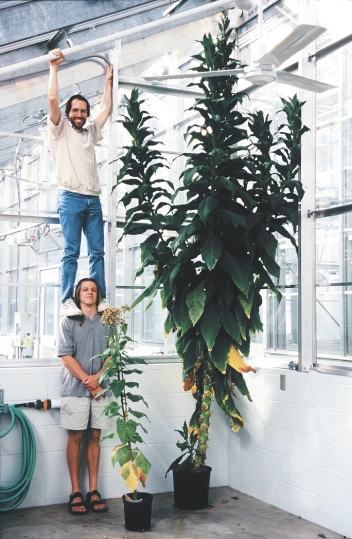 The large plant on the right has failed to flower in summer as normal tobacco plants do.A genetic mutation caused it to become a(n) _______ plant.
 (Multiple Choice)
4.8/5 (86)
(86) Double fertilization in flowering plants results in the production of
(Multiple Choice)
4.9/5 (75)
(75) 
Filters
- Essay(0)
- Multiple Choice(0)
- Short Answer(0)
- True False(0)
- Matching(0)