



 Chat with AI
Exam 37: Reproduction in Flowering Plants

Exam 1: Studying Life246 Questions
Exam 2: Small Molecules and the Chemistry of Life246 Questions
Exam 3: Proteins, Carbohydrates, and Lipids246 Questions
Exam 4: Nucleic Acids and the Origin of Life246 Questions
Exam 5: Cells: the Working Units of Life248 Questions
Exam 6: Cell Membranes246 Questions
Exam 7: Cell Communication and Multicellularity246 Questions
Exam 8: Energy, Enzymes, and Metabolism246 Questions
Exam 9: Pathways That Harvest Chemical Energy246 Questions
Exam 10: Photosynthesis: Energy From Sunlight242 Questions
Exam 11: The Cell Cycle and Cell Division260 Questions
Exam 12: Inheritance, Genes, and Chromosomes250 Questions
Exam 13: Dna and Its Role in Heredity257 Questions
Exam 14: From Dna to Protein: Gene Expression252 Questions
Exam 15: Gene Mutation and Molecular Medicine251 Questions
Exam 16: Regulation of Gene Expression245 Questions
Exam 17: Genomes249 Questions
Exam 18: Recombinant Dna and Biotechnology243 Questions
Exam 20: Mechanisms of Evolution243 Questions
Exam 21: Reconstructing and Using Phylogenies246 Questions
Exam 22: Speciation247 Questions
Exam 23: Evolution of Genes and Genomes252 Questions
Exam 24: The History of Life on Earth246 Questions
Exam 25: Bacteria, Archaea, and Viruses262 Questions
Exam 26: The Origin and Diversification of Eukaryotes252 Questions
Exam 27: Plants Without Seeds: From Water to Land251 Questions
Exam 28: The Evolution of Seed Plants259 Questions
Exam 29: The Evolution and Diversity of Fungi261 Questions
Exam 30: Animal Origins and the Evolution of Body Plans248 Questions
Exam 31: Protostome Animals244 Questions
Exam 32: Deuterostome Animals246 Questions
Exam 33: The Plant Body243 Questions
Exam 34: Transport in Plants248 Questions
Exam 35: Plant Nutrition247 Questions
Exam 36: Regulation of Plant Growth246 Questions
Exam 37: Reproduction in Flowering Plants247 Questions
Exam 38: Plant Responses to Environmental Challenges246 Questions
Exam 39: Physiology, Homeostasis, and Temperature Regulation258 Questions
Exam 40: Animal Hormones249 Questions
Exam 41: Immunology: Animal Defense Systems265 Questions
Exam 42: Animal Reproduction261 Questions
Exam 43: Animal Development261 Questions
Exam 44: Neurons, Glia, and Nervous Systems250 Questions
Exam 45: Sensory Systems249 Questions
Exam 46: The Mammalian Nervous System: Structure and Higher Functions254 Questions
Exam 47: Musculoskeletal Systems259 Questions
Exam 48: Gas Exchange247 Questions
Exam 49: Circulatory Systems252 Questions
Exam 50: Nutrition, Digestion, and Absorption259 Questions
Exam 51: Salt and Water Balance and Nitrogen Excretion251 Questions
Exam 52: Animal Behavior249 Questions
Exam 53: The Physical Environment and Biogeography of Life248 Questions
Exam 54: Populations259 Questions
Exam 55: Species Interactions254 Questions
Exam 56: Communities247 Questions
Exam 57: Ecosystems238 Questions
Exam 58: A Changing Biosphere222 Questions
Select questions type


You have found, among your experimental plant population, a mutant that flowers prematurely.Which modification in the DNA would you expect to find in that plant?
(Multiple Choice)
4.9/5  (95)
(95) You move into a new house.During the first summer you notice that many of the plants in the yard do not bloom.During the second summer the yard is a sea of blooms.In the spring of the third year, there are no plants.Which is the most likely explanation?
(Multiple Choice)
4.9/5 (78)
(78) List the correct order of events in female gametophyte development.
(Multiple Choice)
4.9/5 (100)
(100) Refer to the figure showing the typical life cycle of a plant. 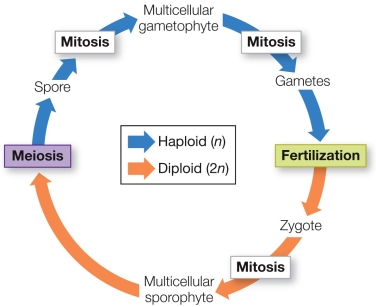 Suppose a botanist is studying a part of a flowering plant represented on the blue part of the figure.What is she studying?
 (Multiple Choice)
4.9/5 (83)
(83) How many sets of flower parts does a single flower have in all dioecious plants?
(Multiple Choice)
4.9/5 (77)
(77) When a vegetative apical meristem ceases production of leaves and axillary buds and instead produces structures such as bracts, it has become a(n)
(Multiple Choice)
4.9/5 (88)
(88) When a vegetative apical meristem becomes an inflorescence meristem,
(Multiple Choice)
4.9/5 (79)
(79) What effect would you expect in a corn plant that lacked abscisic acid?
(Multiple Choice)
4.9/5 (69)
(69) Gemmae, which are produced by some carnivorous plants, form from modified leaves.Each consists of a tiny plantlet and stored nutrients.Production of gemmae is therefore an example of use of vegetative organs for _______ reproduction.
(Short Answer)
4.9/5 (79)
(79) If a farmer is unable to plant fields of winter wheat before winter sets in, which seed treatment will most likely yield a successful crop after spring planting?
(Multiple Choice)
4.9/5 (82)
(82) Phytochrome alternates between two forms, one that absorbs red light and another that absorbs _______ light.
(Short Answer)
4.8/5 (80)
(80) Which of the following are two common ways in which seeds are dispersed?
(Multiple Choice)
4.7/5 (86)
(86) Vegetative plant parts that are modified for asexual reproduction and are short, vertical stems are called _______ and _______.
(Multiple Choice)
4.7/5 (83)
(83) Refer to the figure. 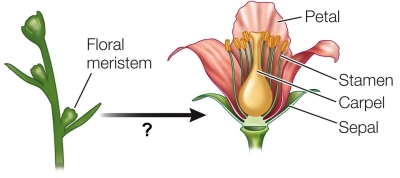 After an apical meristem has been redirected toward developing into a floral meristem, _______ are responsible for further refinement of the floral development pathway.
 (Multiple Choice)
5.0/5 (93)
(93) If standard approaches to induce flowering have failed in an unidentified plant species, which chemical would be the next best option to try?
(Multiple Choice)
4.8/5 (76)
(76) Which characteristic of seed germination is normally a disadvantage to plants but can be used by plants in some habitats to their advantage?
(Multiple Choice)
4.8/5 (90)
(90) The first event that takes place after pollen is released from the anthers is the
(Multiple Choice)
4.8/5 (98)
(98) In apomixis, which of the following occurs in an abnormal way?
(Multiple Choice)
4.8/5 (96)
(96) 
Filters
- Essay(0)
- Multiple Choice(0)
- Short Answer(0)
- True False(0)
- Matching(0)