



 Chat with AI
Exam 37: Reproduction in Flowering Plants

Exam 1: Studying Life246 Questions
Exam 2: Small Molecules and the Chemistry of Life246 Questions
Exam 3: Proteins, Carbohydrates, and Lipids246 Questions
Exam 4: Nucleic Acids and the Origin of Life246 Questions
Exam 5: Cells: the Working Units of Life248 Questions
Exam 6: Cell Membranes246 Questions
Exam 7: Cell Communication and Multicellularity246 Questions
Exam 8: Energy, Enzymes, and Metabolism246 Questions
Exam 9: Pathways That Harvest Chemical Energy246 Questions
Exam 10: Photosynthesis: Energy From Sunlight242 Questions
Exam 11: The Cell Cycle and Cell Division260 Questions
Exam 12: Inheritance, Genes, and Chromosomes250 Questions
Exam 13: Dna and Its Role in Heredity257 Questions
Exam 14: From Dna to Protein: Gene Expression252 Questions
Exam 15: Gene Mutation and Molecular Medicine251 Questions
Exam 16: Regulation of Gene Expression245 Questions
Exam 17: Genomes249 Questions
Exam 18: Recombinant Dna and Biotechnology243 Questions
Exam 20: Mechanisms of Evolution243 Questions
Exam 21: Reconstructing and Using Phylogenies246 Questions
Exam 22: Speciation247 Questions
Exam 23: Evolution of Genes and Genomes252 Questions
Exam 24: The History of Life on Earth246 Questions
Exam 25: Bacteria, Archaea, and Viruses262 Questions
Exam 26: The Origin and Diversification of Eukaryotes252 Questions
Exam 27: Plants Without Seeds: From Water to Land251 Questions
Exam 28: The Evolution of Seed Plants259 Questions
Exam 29: The Evolution and Diversity of Fungi261 Questions
Exam 30: Animal Origins and the Evolution of Body Plans248 Questions
Exam 31: Protostome Animals244 Questions
Exam 32: Deuterostome Animals246 Questions
Exam 33: The Plant Body243 Questions
Exam 34: Transport in Plants248 Questions
Exam 35: Plant Nutrition247 Questions
Exam 36: Regulation of Plant Growth246 Questions
Exam 37: Reproduction in Flowering Plants247 Questions
Exam 38: Plant Responses to Environmental Challenges246 Questions
Exam 39: Physiology, Homeostasis, and Temperature Regulation258 Questions
Exam 40: Animal Hormones249 Questions
Exam 41: Immunology: Animal Defense Systems265 Questions
Exam 42: Animal Reproduction261 Questions
Exam 43: Animal Development261 Questions
Exam 44: Neurons, Glia, and Nervous Systems250 Questions
Exam 45: Sensory Systems249 Questions
Exam 46: The Mammalian Nervous System: Structure and Higher Functions254 Questions
Exam 47: Musculoskeletal Systems259 Questions
Exam 48: Gas Exchange247 Questions
Exam 49: Circulatory Systems252 Questions
Exam 50: Nutrition, Digestion, and Absorption259 Questions
Exam 51: Salt and Water Balance and Nitrogen Excretion251 Questions
Exam 52: Animal Behavior249 Questions
Exam 53: The Physical Environment and Biogeography of Life248 Questions
Exam 54: Populations259 Questions
Exam 55: Species Interactions254 Questions
Exam 56: Communities247 Questions
Exam 57: Ecosystems238 Questions
Exam 58: A Changing Biosphere222 Questions
Select questions type


Due to their more savory flavor, tomatoes are generally thought of as vegetables; the presence of seeds means they are technically considered _______.
(Short Answer)
4.7/5  (82)
(82) Which fact explains how leaves are able to perform their function in relation to flowering?
(Multiple Choice)
4.8/5 (72)
(72) Which processes are required in order for a megasporocyte to produce an egg cell?
(Multiple Choice)
4.9/5 (89)
(89) The transfer of pollen grains to the stigma is called _______.
(Short Answer)
4.7/5 (77)
(77) In the seed, nutrients for the seedling are generally stored as
(Multiple Choice)
4.8/5 (71)
(71) Gene expression of the flowering locus AP1 in apical buds depends on photoperiodic induction of _______ gene expression in leaves.
(Short Answer)
4.8/5 (80)
(80) The fruit generally develops from which part of the flower?
(Multiple Choice)
4.7/5 (99)
(99) Refer to the figure showing a carpel. 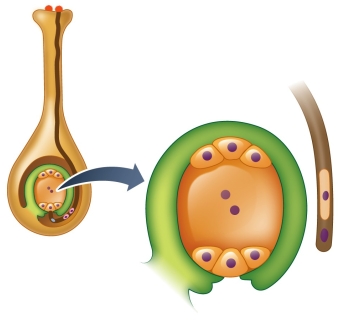 In fertilization, the egg is adjacent to two haploid cells called
 (Multiple Choice)
4.9/5 (68)
(68) Which is a means of asexual reproduction involving nonvegetative parts of a plant?
(Multiple Choice)
4.7/5 (79)
(79) When a leaf on a plant is exposed to a critical day length, _______ is released from the leaf and travels to the bud to initiate flowering.
(Short Answer)
4.8/5 (82)
(82) The Osage orange tree produces a compound fruit that resembles an orange but is very bitter and not particularly edible.The natural range of this tree is a relatively small region in Texas and Oklahoma.What is a likely reason for this narrow ecological range?
(Essay)
4.9/5 (85)
(85) A seed consists of a _______ embryo, a _______ endosperm, and a _______ seed coat.
(Multiple Choice)
4.9/5 (76)
(76) In the mature embryo sac, the cells closest to where the pollen tube enters the ovule (the micropyle) are the
(Multiple Choice)
4.8/5 (68)
(68) Which mechanism helps avoid reproduction resulting from self-pollination?
(Multiple Choice)
4.8/5 (80)
(80) A scientist has perfected a technique for capturing individual cells during the process of reproduction.What will she capture along with one of the synergids just before fertilization?
(Multiple Choice)
4.8/5 (77)
(77) Refer to the figure of tobacco plants. 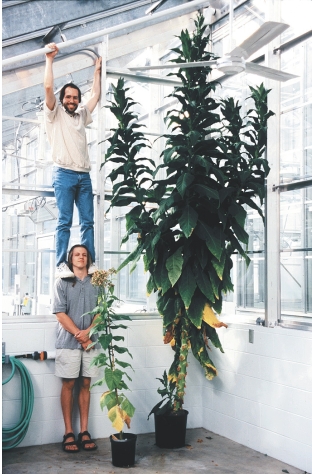 Maryland Mammoth tobacco (the plant on the right) flowers when the day is shorter than a critical maximum.This can be described as a _______ plant.
 (Multiple Choice)
4.9/5 (92)
(92) 
Filters
- Essay(0)
- Multiple Choice(0)
- Short Answer(0)
- True False(0)
- Matching(0)