



 Chat with AI
Exam 37: Reproduction in Flowering Plants

Exam 1: Studying Life246 Questions
Exam 2: Small Molecules and the Chemistry of Life246 Questions
Exam 3: Proteins, Carbohydrates, and Lipids246 Questions
Exam 4: Nucleic Acids and the Origin of Life246 Questions
Exam 5: Cells: the Working Units of Life248 Questions
Exam 6: Cell Membranes246 Questions
Exam 7: Cell Communication and Multicellularity246 Questions
Exam 8: Energy, Enzymes, and Metabolism246 Questions
Exam 9: Pathways That Harvest Chemical Energy246 Questions
Exam 10: Photosynthesis: Energy From Sunlight242 Questions
Exam 11: The Cell Cycle and Cell Division260 Questions
Exam 12: Inheritance, Genes, and Chromosomes250 Questions
Exam 13: Dna and Its Role in Heredity257 Questions
Exam 14: From Dna to Protein: Gene Expression252 Questions
Exam 15: Gene Mutation and Molecular Medicine251 Questions
Exam 16: Regulation of Gene Expression245 Questions
Exam 17: Genomes249 Questions
Exam 18: Recombinant Dna and Biotechnology243 Questions
Exam 20: Mechanisms of Evolution243 Questions
Exam 21: Reconstructing and Using Phylogenies246 Questions
Exam 22: Speciation247 Questions
Exam 23: Evolution of Genes and Genomes252 Questions
Exam 24: The History of Life on Earth246 Questions
Exam 25: Bacteria, Archaea, and Viruses262 Questions
Exam 26: The Origin and Diversification of Eukaryotes252 Questions
Exam 27: Plants Without Seeds: From Water to Land251 Questions
Exam 28: The Evolution of Seed Plants259 Questions
Exam 29: The Evolution and Diversity of Fungi261 Questions
Exam 30: Animal Origins and the Evolution of Body Plans248 Questions
Exam 31: Protostome Animals244 Questions
Exam 32: Deuterostome Animals246 Questions
Exam 33: The Plant Body243 Questions
Exam 34: Transport in Plants248 Questions
Exam 35: Plant Nutrition247 Questions
Exam 36: Regulation of Plant Growth246 Questions
Exam 37: Reproduction in Flowering Plants247 Questions
Exam 38: Plant Responses to Environmental Challenges246 Questions
Exam 39: Physiology, Homeostasis, and Temperature Regulation258 Questions
Exam 40: Animal Hormones249 Questions
Exam 41: Immunology: Animal Defense Systems265 Questions
Exam 42: Animal Reproduction261 Questions
Exam 43: Animal Development261 Questions
Exam 44: Neurons, Glia, and Nervous Systems250 Questions
Exam 45: Sensory Systems249 Questions
Exam 46: The Mammalian Nervous System: Structure and Higher Functions254 Questions
Exam 47: Musculoskeletal Systems259 Questions
Exam 48: Gas Exchange247 Questions
Exam 49: Circulatory Systems252 Questions
Exam 50: Nutrition, Digestion, and Absorption259 Questions
Exam 51: Salt and Water Balance and Nitrogen Excretion251 Questions
Exam 52: Animal Behavior249 Questions
Exam 53: The Physical Environment and Biogeography of Life248 Questions
Exam 54: Populations259 Questions
Exam 55: Species Interactions254 Questions
Exam 56: Communities247 Questions
Exam 57: Ecosystems238 Questions
Exam 58: A Changing Biosphere222 Questions
Select questions type


In photoperiodic responses in plants, the factor to which plants respond is the
(Multiple Choice)
4.8/5  (77)
(77) Which characteristic is representative of some wind-dispersed seeds?
(Multiple Choice)
4.9/5 (92)
(92) A vegetative meristem must _______ in order to begin switching to floral development.
(Multiple Choice)
4.8/5 (87)
(87) Much of the fruit grown in the United States, including wine grapes, is grown on
(Multiple Choice)
4.9/5 (79)
(79) The mature female gametophyte is an embryo sac containing _______ haploid nuclei.
(Short Answer)
4.9/5 (82)
(82) Which statement about the stamen and the carpel or pistil is true?
(Multiple Choice)
4.8/5 (76)
(76) Compare and contrast asexual and sexual reproduction in plants.In which category does self-fertilization belong?
(Essay)
4.9/5 (69)
(69) Instead of germinating immediately after release, many seeds undergo an inactive period of _______.
(Short Answer)
4.8/5 (86)
(86) A new kind of mustard plant is found to flower with any length of day or night as long as it is at least 2 months old.What kind of plant is this?
(Multiple Choice)
4.9/5 (91)
(91) You have discovered that your neighbor's bamboo plants are spreading into your yard.To stop this, what part of the plant must be killed or pruned?
(Multiple Choice)
4.8/5 (69)
(69) You have discovered a mutant plant of a long-day species that does not flower in the appropriate conditions.You find that expression of florigen is low but that the gene for florigen is not mutated.It is likely that the mutation is in the _______ gene.
(Short Answer)
4.7/5 (72)
(72) A newly discovered plant is thought to be wind-pollinated because of its exposure to regular, strong wind in spring and the lack of insect pollinators in its habitat.The presence of which characteristic would confirm this assumption?
(Multiple Choice)
4.8/5 (83)
(83) Refer to the figure showing a Kalanchoe plant. 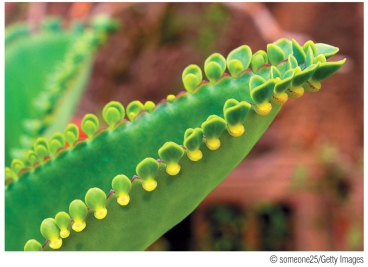 Kalanchoe takes advantage of a relatively uncommon means of vegetative reproduction by using its
 (Multiple Choice)
4.8/5 (67)
(67) The female gametophyte of a flowering plant is called the _______.
(Short Answer)
4.8/5 (72)
(72) Grafting usually involves attaching parts from _______ different plants.
(Multiple Choice)
4.9/5 (79)
(79) The female gametophyte is called the _______, whereas the male gametophyte is called the _______.
(Multiple Choice)
4.8/5 (87)
(87) Because apomixis is the formation of an embryo without fertilization of an egg by a sperm, it is theoretically possible that the genomic makeup of species performing this type of asexual reproduction is _______.
(Short Answer)
4.8/5 (81)
(81) 
Filters
- Essay(0)
- Multiple Choice(0)
- Short Answer(0)
- True False(0)
- Matching(0)