



 Chat with AI
Exam 37: Reproduction in Flowering Plants

Exam 1: Studying Life246 Questions
Exam 2: Small Molecules and the Chemistry of Life246 Questions
Exam 3: Proteins, Carbohydrates, and Lipids246 Questions
Exam 4: Nucleic Acids and the Origin of Life246 Questions
Exam 5: Cells: the Working Units of Life248 Questions
Exam 6: Cell Membranes246 Questions
Exam 7: Cell Communication and Multicellularity246 Questions
Exam 8: Energy, Enzymes, and Metabolism246 Questions
Exam 9: Pathways That Harvest Chemical Energy246 Questions
Exam 10: Photosynthesis: Energy From Sunlight242 Questions
Exam 11: The Cell Cycle and Cell Division260 Questions
Exam 12: Inheritance, Genes, and Chromosomes250 Questions
Exam 13: Dna and Its Role in Heredity257 Questions
Exam 14: From Dna to Protein: Gene Expression252 Questions
Exam 15: Gene Mutation and Molecular Medicine251 Questions
Exam 16: Regulation of Gene Expression245 Questions
Exam 17: Genomes249 Questions
Exam 18: Recombinant Dna and Biotechnology243 Questions
Exam 20: Mechanisms of Evolution243 Questions
Exam 21: Reconstructing and Using Phylogenies246 Questions
Exam 22: Speciation247 Questions
Exam 23: Evolution of Genes and Genomes252 Questions
Exam 24: The History of Life on Earth246 Questions
Exam 25: Bacteria, Archaea, and Viruses262 Questions
Exam 26: The Origin and Diversification of Eukaryotes252 Questions
Exam 27: Plants Without Seeds: From Water to Land251 Questions
Exam 28: The Evolution of Seed Plants259 Questions
Exam 29: The Evolution and Diversity of Fungi261 Questions
Exam 30: Animal Origins and the Evolution of Body Plans248 Questions
Exam 31: Protostome Animals244 Questions
Exam 32: Deuterostome Animals246 Questions
Exam 33: The Plant Body243 Questions
Exam 34: Transport in Plants248 Questions
Exam 35: Plant Nutrition247 Questions
Exam 36: Regulation of Plant Growth246 Questions
Exam 37: Reproduction in Flowering Plants247 Questions
Exam 38: Plant Responses to Environmental Challenges246 Questions
Exam 39: Physiology, Homeostasis, and Temperature Regulation258 Questions
Exam 40: Animal Hormones249 Questions
Exam 41: Immunology: Animal Defense Systems265 Questions
Exam 42: Animal Reproduction261 Questions
Exam 43: Animal Development261 Questions
Exam 44: Neurons, Glia, and Nervous Systems250 Questions
Exam 45: Sensory Systems249 Questions
Exam 46: The Mammalian Nervous System: Structure and Higher Functions254 Questions
Exam 47: Musculoskeletal Systems259 Questions
Exam 48: Gas Exchange247 Questions
Exam 49: Circulatory Systems252 Questions
Exam 50: Nutrition, Digestion, and Absorption259 Questions
Exam 51: Salt and Water Balance and Nitrogen Excretion251 Questions
Exam 52: Animal Behavior249 Questions
Exam 53: The Physical Environment and Biogeography of Life248 Questions
Exam 54: Populations259 Questions
Exam 55: Species Interactions254 Questions
Exam 56: Communities247 Questions
Exam 57: Ecosystems238 Questions
Exam 58: A Changing Biosphere222 Questions
Select questions type


Perfect and imperfect flowers differ from each other in that perfect flowers have all four types of flower parts but imperfect flowers are missing
(Multiple Choice)
4.8/5  (61)
(61) Which structure is not directly involved in asexual reproduction in plants?
(Multiple Choice)
4.8/5 (66)
(66) The major role of the fruit of a flowering plant is to facilitate _______.
(Short Answer)
4.9/5 (78)
(78) You have found two plants that look similar except for their flowers.After bringing samples home for yourself and your friends, you find that neither plant can produce fruit unless both types are in the same garden, and even then only one plant produces fruit.You determine that the plants are actually the same species and must be _______.
(Short Answer)
4.9/5 (76)
(76) Which of the following is a temporal pattern of plant flowering?
(Multiple Choice)
4.8/5 (77)
(77) Which asexual tissue culture technique is used to produce virus-free plants?
(Multiple Choice)
4.8/5 (74)
(74) The pollen grains are the male _______ of the flowering plant.
(Short Answer)
4.8/5 (74)
(74) In terms of their moisture content, fruits can be _______ or dry when they are mature.
(Short Answer)
4.8/5 (87)
(87) The seeds of a new kind of mangrove are not viviparous, which is unusual for that kind of tree.How do these seeds differ from other mangrove seeds?
(Multiple Choice)
4.8/5 (70)
(70) In flowers, the pollen tube grows most of its distance through the _______ to reach the ovary.
(Multiple Choice)
4.8/5 (63)
(63) A unique feature of angiosperm sexual reproduction is the triploid
(Multiple Choice)
4.9/5 (82)
(82) Flowers can occur singly or in an orderly cluster known as a(n)
(Multiple Choice)
4.8/5 (70)
(70) Which list represents the correct order of events (from earliest to latest) in the reproduction of angiosperms?
(Multiple Choice)
4.8/5 (73)
(73) You manage a greenhouse that produces roses for Valentine's Day.Roses normally bloom in June.You need to produce roses that bloom in February.After setting the correct photoperiod in your greenhouse, you still do not have blooming roses.Which condition might have contributed to the problem?
(Multiple Choice)
4.9/5 (98)
(98) You plan to induce the flowering of a crop of long-day plants in the field by using artificial light.Is it necessary to keep the lights on continuously from sundown until the point at which the critical day length is reached? Why or why not?
(Essay)
4.9/5 (88)
(88) Do all flowering plants act as either short- or long-day plants with respect to flowering?
(Multiple Choice)
4.8/5 (67)
(67) Refer to the figure showing the typical life cycle of a plant. 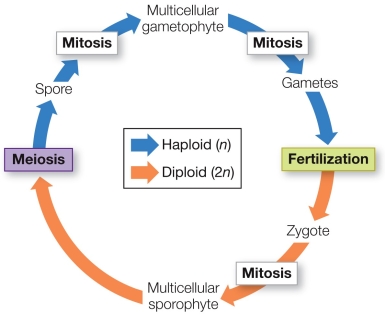 Meiosis occurs early in the period represented by the blue portion of the figure.Could meiosis occur again later in the blue phase? Explain why or why not.
 (Essay)
4.9/5 (92)
(92) 
Filters
- Essay(0)
- Multiple Choice(0)
- Short Answer(0)
- True False(0)
- Matching(0)