



 Chat with AI
Exam 37: Reproduction in Flowering Plants

Exam 1: Studying Life246 Questions
Exam 2: Small Molecules and the Chemistry of Life246 Questions
Exam 3: Proteins, Carbohydrates, and Lipids246 Questions
Exam 4: Nucleic Acids and the Origin of Life246 Questions
Exam 5: Cells: the Working Units of Life248 Questions
Exam 6: Cell Membranes246 Questions
Exam 7: Cell Communication and Multicellularity246 Questions
Exam 8: Energy, Enzymes, and Metabolism246 Questions
Exam 9: Pathways That Harvest Chemical Energy246 Questions
Exam 10: Photosynthesis: Energy From Sunlight242 Questions
Exam 11: The Cell Cycle and Cell Division260 Questions
Exam 12: Inheritance, Genes, and Chromosomes250 Questions
Exam 13: Dna and Its Role in Heredity257 Questions
Exam 14: From Dna to Protein: Gene Expression252 Questions
Exam 15: Gene Mutation and Molecular Medicine251 Questions
Exam 16: Regulation of Gene Expression245 Questions
Exam 17: Genomes249 Questions
Exam 18: Recombinant Dna and Biotechnology243 Questions
Exam 20: Mechanisms of Evolution243 Questions
Exam 21: Reconstructing and Using Phylogenies246 Questions
Exam 22: Speciation247 Questions
Exam 23: Evolution of Genes and Genomes252 Questions
Exam 24: The History of Life on Earth246 Questions
Exam 25: Bacteria, Archaea, and Viruses262 Questions
Exam 26: The Origin and Diversification of Eukaryotes252 Questions
Exam 27: Plants Without Seeds: From Water to Land251 Questions
Exam 28: The Evolution of Seed Plants259 Questions
Exam 29: The Evolution and Diversity of Fungi261 Questions
Exam 30: Animal Origins and the Evolution of Body Plans248 Questions
Exam 31: Protostome Animals244 Questions
Exam 32: Deuterostome Animals246 Questions
Exam 33: The Plant Body243 Questions
Exam 34: Transport in Plants248 Questions
Exam 35: Plant Nutrition247 Questions
Exam 36: Regulation of Plant Growth246 Questions
Exam 37: Reproduction in Flowering Plants247 Questions
Exam 38: Plant Responses to Environmental Challenges246 Questions
Exam 39: Physiology, Homeostasis, and Temperature Regulation258 Questions
Exam 40: Animal Hormones249 Questions
Exam 41: Immunology: Animal Defense Systems265 Questions
Exam 42: Animal Reproduction261 Questions
Exam 43: Animal Development261 Questions
Exam 44: Neurons, Glia, and Nervous Systems250 Questions
Exam 45: Sensory Systems249 Questions
Exam 46: The Mammalian Nervous System: Structure and Higher Functions254 Questions
Exam 47: Musculoskeletal Systems259 Questions
Exam 48: Gas Exchange247 Questions
Exam 49: Circulatory Systems252 Questions
Exam 50: Nutrition, Digestion, and Absorption259 Questions
Exam 51: Salt and Water Balance and Nitrogen Excretion251 Questions
Exam 52: Animal Behavior249 Questions
Exam 53: The Physical Environment and Biogeography of Life248 Questions
Exam 54: Populations259 Questions
Exam 55: Species Interactions254 Questions
Exam 56: Communities247 Questions
Exam 57: Ecosystems238 Questions
Exam 58: A Changing Biosphere222 Questions
Select questions type


Which list represents the correct order of events (from earliest to latest) in the reproduction of angiosperms?
(Multiple Choice)
4.8/5  (74)
(74) The swamp-dwelling mangrove tree typically produces viviparous seeds, which confer what kind of advantage for the offspring?
(Multiple Choice)
4.7/5 (63)
(63) In angiosperms, the megagametophyte is the _______ gametophyte, which is called the _______.
(Multiple Choice)
4.8/5 (79)
(79) The production of _______ is an example of determinate growth.
(Short Answer)
4.9/5 (70)
(70) A newly discovered fruit has a thick, sweet flesh that is relished by bears.This fruit wall is
(Multiple Choice)
4.8/5 (76)
(76) Which cells do not participate in double fertilization in apples?
(Multiple Choice)
4.8/5 (78)
(78) A mutant plant that lacks the receptor for abscisic acid is likely to produce seeds that are _______.
(Short Answer)
5.0/5 (79)
(79) The transition to flowering is most likely to involve production of fewer
(Multiple Choice)
4.9/5 (81)
(81) Which characteristic is most likely to be learned about flowering from experiments using an interruption of night length by a pulse of red light?
(Multiple Choice)
5.0/5 (73)
(73) The integuments of the ovule develop into the _______, and the carpels ultimately become the wall of the _______.
(Multiple Choice)
4.9/5 (65)
(65) A plant's transition to a flowering state is often marked by a(n)
(Multiple Choice)
5.0/5 (79)
(79) Angiosperms show advancement in the functioning of their microgametophytes because _______ is not required for sexual reproduction.
(Multiple Choice)
4.8/5 (100)
(100) Masking experiments demonstrated that _______ measure the photoperiod, and grafting experiments showed that a transmissible factor _______ produced.
(Multiple Choice)
4.9/5 (74)
(74) Refer to the figure. 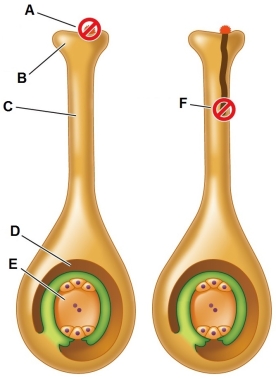 Based on the indicated developmental progress of the pollen grains shown, what can be inferred about this plant's ability to self-pollinate?
 (Short Answer)
4.8/5 (77)
(77) Refer to the figure. 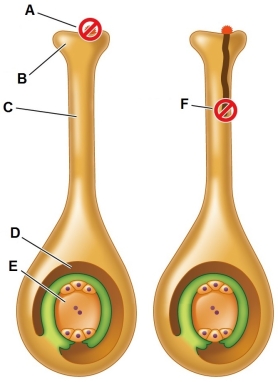 The structure labeled A is a pollen grain.What is another name for a pollen grain?
 (Short Answer)
4.9/5 (75)
(75) Sperm cells in flowering plants are delivered to the egg by a(n)
(Multiple Choice)
4.8/5 (86)
(86) Most peanuts, fruit of a specific species of legume, have _______ embryo sacs, although occasionally some have more or fewer.
(Short Answer)
4.8/5 (88)
(88) 
Filters
- Essay(0)
- Multiple Choice(0)
- Short Answer(0)
- True False(0)
- Matching(0)