



 Chat with AI
Exam 37: Reproduction in Flowering Plants

Exam 1: Studying Life246 Questions
Exam 2: Small Molecules and the Chemistry of Life246 Questions
Exam 3: Proteins, Carbohydrates, and Lipids246 Questions
Exam 4: Nucleic Acids and the Origin of Life246 Questions
Exam 5: Cells: the Working Units of Life248 Questions
Exam 6: Cell Membranes246 Questions
Exam 7: Cell Communication and Multicellularity246 Questions
Exam 8: Energy, Enzymes, and Metabolism246 Questions
Exam 9: Pathways That Harvest Chemical Energy246 Questions
Exam 10: Photosynthesis: Energy From Sunlight242 Questions
Exam 11: The Cell Cycle and Cell Division260 Questions
Exam 12: Inheritance, Genes, and Chromosomes250 Questions
Exam 13: Dna and Its Role in Heredity257 Questions
Exam 14: From Dna to Protein: Gene Expression252 Questions
Exam 15: Gene Mutation and Molecular Medicine251 Questions
Exam 16: Regulation of Gene Expression245 Questions
Exam 17: Genomes249 Questions
Exam 18: Recombinant Dna and Biotechnology243 Questions
Exam 20: Mechanisms of Evolution243 Questions
Exam 21: Reconstructing and Using Phylogenies246 Questions
Exam 22: Speciation247 Questions
Exam 23: Evolution of Genes and Genomes252 Questions
Exam 24: The History of Life on Earth246 Questions
Exam 25: Bacteria, Archaea, and Viruses262 Questions
Exam 26: The Origin and Diversification of Eukaryotes252 Questions
Exam 27: Plants Without Seeds: From Water to Land251 Questions
Exam 28: The Evolution of Seed Plants259 Questions
Exam 29: The Evolution and Diversity of Fungi261 Questions
Exam 30: Animal Origins and the Evolution of Body Plans248 Questions
Exam 31: Protostome Animals244 Questions
Exam 32: Deuterostome Animals246 Questions
Exam 33: The Plant Body243 Questions
Exam 34: Transport in Plants248 Questions
Exam 35: Plant Nutrition247 Questions
Exam 36: Regulation of Plant Growth246 Questions
Exam 37: Reproduction in Flowering Plants247 Questions
Exam 38: Plant Responses to Environmental Challenges246 Questions
Exam 39: Physiology, Homeostasis, and Temperature Regulation258 Questions
Exam 40: Animal Hormones249 Questions
Exam 41: Immunology: Animal Defense Systems265 Questions
Exam 42: Animal Reproduction261 Questions
Exam 43: Animal Development261 Questions
Exam 44: Neurons, Glia, and Nervous Systems250 Questions
Exam 45: Sensory Systems249 Questions
Exam 46: The Mammalian Nervous System: Structure and Higher Functions254 Questions
Exam 47: Musculoskeletal Systems259 Questions
Exam 48: Gas Exchange247 Questions
Exam 49: Circulatory Systems252 Questions
Exam 50: Nutrition, Digestion, and Absorption259 Questions
Exam 51: Salt and Water Balance and Nitrogen Excretion251 Questions
Exam 52: Animal Behavior249 Questions
Exam 53: The Physical Environment and Biogeography of Life248 Questions
Exam 54: Populations259 Questions
Exam 55: Species Interactions254 Questions
Exam 56: Communities247 Questions
Exam 57: Ecosystems238 Questions
Exam 58: A Changing Biosphere222 Questions
Select questions type


Potatoes reproduce asexually using modified stems called _______.
(Short Answer)
4.9/5  (87)
(87) Recall what you have read about the genes involved in flowering in angiosperms: APETALA1 (AP1), CONSTANS (CO), FLOWERING LOCUS D (FD), FLOWERING LOCUS C (FLC), and FLOWERING LOCUS T (FT).Create a genetic pathway for flowering using the genes listed above.(Use "" to indicate the product of a gene that increases the expression of another gene, use "" to indicate the product of a gene that decreases the expression of another gene, and use "+" to indicate the product of a gene that binds to the product of another gene.)
(Essay)
4.8/5 (75)
(75) A plant in which four haploid female nuclei fused with one sperm to produce endosperm would most likely have four
(Multiple Choice)
4.9/5 (80)
(80) You are asked to identify the version of florigen found in carnivorous sundew plants.You decide to start by using biochemical methods to isolate the florigen molecule, which is a(n)
(Multiple Choice)
4.8/5 (76)
(76) Rapid loss of populations due to genetic uniformity has been documented in which species?
(Multiple Choice)
4.8/5 (78)
(78) In biochemically determined self-incompatibility, where does pollen tube growth generally stop?
(Multiple Choice)
5.0/5 (85)
(85) If an insect chews through a flower, from outside to center, in what order will it eat the flower parts?
(Multiple Choice)
4.7/5 (77)
(77) In stable environments, which type of reproduction is most likely to become increasingly common?
(Multiple Choice)
4.7/5 (87)
(87) Refer to the figure showing the initial stage of double fertilization. 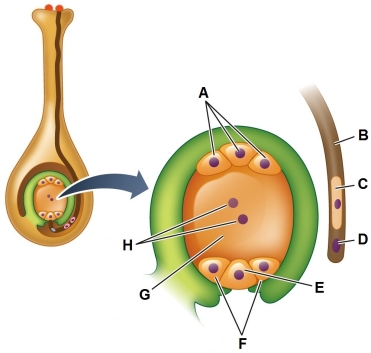 If the pollen grain shown is self pollen, what does the developmental progress of the grain, as indicated in the figure, tell us about this plant's ability to self-pollinate?
 (Short Answer)
4.8/5 (85)
(85) It takes a great deal of effort to detassel corn (remove male flowers).Why can't corn plants simply be sprayed with a meiosis inhibitor to halt pollen production?
(Essay)
4.8/5 (86)
(86) Refer to the figure showing the initial stage of double fertilization. 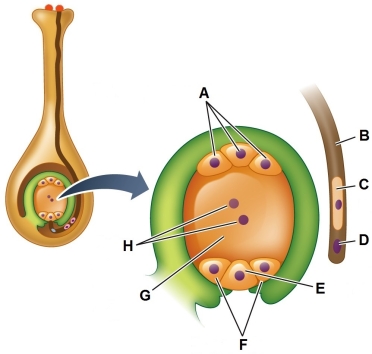 Identify the cell from the microgametophyte that will form the sperm.
 (Multiple Choice)
4.8/5 (82)
(82) After pollination, which of the following events is crucial for fertilization?
(Multiple Choice)
4.8/5 (85)
(85) APETALA1 is a _______ identity gene whose expression causes _______ meristem cells to become reproductive, regardless of environmental cues.
(Multiple Choice)
4.8/5 (77)
(77) A mutant plant with the inability to form pollen tubes has no genetic defects in the pollen grains or cells.Examination of the carpel would show that the megagametophyte is lacking functional _______.
(Short Answer)
4.9/5 (86)
(86) In a short-day plant like cocklebur with a critical day length of 15 hours, flowering can be induced by _______ hours of light alternating with _______.
(Multiple Choice)
4.9/5 (91)
(91) Which statement about vegetative reproduction is most likely to be true?
(Multiple Choice)
4.7/5 (76)
(76) 
Filters
- Essay(0)
- Multiple Choice(0)
- Short Answer(0)
- True False(0)
- Matching(0)