



 Chat with AI
Exam 35: Plant Nutrition

Exam 1: Studying Life246 Questions
Exam 2: Small Molecules and the Chemistry of Life246 Questions
Exam 3: Proteins, Carbohydrates, and Lipids246 Questions
Exam 4: Nucleic Acids and the Origin of Life246 Questions
Exam 5: Cells: the Working Units of Life248 Questions
Exam 6: Cell Membranes246 Questions
Exam 7: Cell Communication and Multicellularity246 Questions
Exam 8: Energy, Enzymes, and Metabolism246 Questions
Exam 9: Pathways That Harvest Chemical Energy246 Questions
Exam 10: Photosynthesis: Energy From Sunlight242 Questions
Exam 11: The Cell Cycle and Cell Division260 Questions
Exam 12: Inheritance, Genes, and Chromosomes250 Questions
Exam 13: Dna and Its Role in Heredity257 Questions
Exam 14: From Dna to Protein: Gene Expression252 Questions
Exam 15: Gene Mutation and Molecular Medicine251 Questions
Exam 16: Regulation of Gene Expression245 Questions
Exam 17: Genomes249 Questions
Exam 18: Recombinant Dna and Biotechnology243 Questions
Exam 20: Mechanisms of Evolution243 Questions
Exam 21: Reconstructing and Using Phylogenies246 Questions
Exam 22: Speciation247 Questions
Exam 23: Evolution of Genes and Genomes252 Questions
Exam 24: The History of Life on Earth246 Questions
Exam 25: Bacteria, Archaea, and Viruses262 Questions
Exam 26: The Origin and Diversification of Eukaryotes252 Questions
Exam 27: Plants Without Seeds: From Water to Land251 Questions
Exam 28: The Evolution of Seed Plants259 Questions
Exam 29: The Evolution and Diversity of Fungi261 Questions
Exam 30: Animal Origins and the Evolution of Body Plans248 Questions
Exam 31: Protostome Animals244 Questions
Exam 32: Deuterostome Animals246 Questions
Exam 33: The Plant Body243 Questions
Exam 34: Transport in Plants248 Questions
Exam 35: Plant Nutrition247 Questions
Exam 36: Regulation of Plant Growth246 Questions
Exam 37: Reproduction in Flowering Plants247 Questions
Exam 38: Plant Responses to Environmental Challenges246 Questions
Exam 39: Physiology, Homeostasis, and Temperature Regulation258 Questions
Exam 40: Animal Hormones249 Questions
Exam 41: Immunology: Animal Defense Systems265 Questions
Exam 42: Animal Reproduction261 Questions
Exam 43: Animal Development261 Questions
Exam 44: Neurons, Glia, and Nervous Systems250 Questions
Exam 45: Sensory Systems249 Questions
Exam 46: The Mammalian Nervous System: Structure and Higher Functions254 Questions
Exam 47: Musculoskeletal Systems259 Questions
Exam 48: Gas Exchange247 Questions
Exam 49: Circulatory Systems252 Questions
Exam 50: Nutrition, Digestion, and Absorption259 Questions
Exam 51: Salt and Water Balance and Nitrogen Excretion251 Questions
Exam 52: Animal Behavior249 Questions
Exam 53: The Physical Environment and Biogeography of Life248 Questions
Exam 54: Populations259 Questions
Exam 55: Species Interactions254 Questions
Exam 56: Communities247 Questions
Exam 57: Ecosystems238 Questions
Exam 58: A Changing Biosphere222 Questions
Select questions type


Corn requires large amounts of nitrogen fertilizer.As energy costs rise, so do the costs of nitrogen fertilizers and of corn.What is the major reason for this?
(Multiple Choice)
4.8/5  (84)
(84) Because the Casparian strip prevents movement of water and ions directly into the xylem, ions must enter the _______ in order to be transported throughout the plant.
(Short Answer)
4.9/5 (64)
(64) A carnivorous plant that produces one of the fastest motions known among plants is the
(Multiple Choice)
4.8/5 (82)
(82) Before the widespread use of fertilizers, agricultural land that had become nutrient depleted was allowed to remain _______ for its nutrient levels to recover.
(Multiple Choice)
4.8/5 (69)
(69) Which is not a reason that plants need sulfur or chlorine?
(Multiple Choice)
4.9/5 (87)
(87) Refer to the table showing the growth of cassava plants on different soil plots.Each experimental group consisted of the same number of plants on the same acreage of each plot. 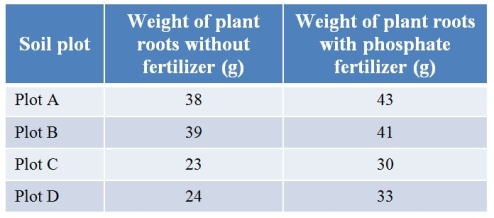 What is one possible explanation for the different growth rates among the different plots?
 (Essay)
5.0/5 (80)
(80) Refer to the figure showing two carnivorous plants. 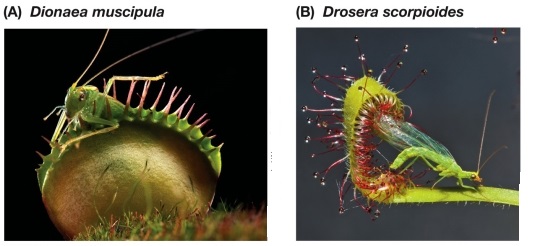 A newly discovered tropical plant has cupped leaves that accumulate water and drowned insects.If the new plant is related to those in the figure, what might it be secreting into the accumulated water?
 (Multiple Choice)
4.8/5 (90)
(90) The artificial process of adding CO2 to soil, which also adds H+, aims to
(Multiple Choice)
4.9/5 (80)
(80) Nitrogen fixation, which is the conversion of atmospheric nitrogen to _______, is catalyzed by a single enzyme called nitrogenase.
(Short Answer)
4.9/5 (93)
(93) _______ are available to the plant in unlimited supply _______.
(Multiple Choice)
4.8/5 (86)
(86) Plants acquire their essential mineral nutrients from water and the _______.
(Short Answer)
4.9/5 (62)
(62) Soils are dynamic systems.What changes might result when land is subjected to heavy irrigation for agriculture after being relatively dry for many years? What changes in the soil might result when a virgin deciduous forest is cut down and replaced by crops that are harvested each year?
(Essay)
4.8/5 (71)
(71) If Mg2+ is in low abundance in a soil where a plant is growing, that plant can increase the absorption of Mg2+ by forming _______ to effectively expand its root system.
(Multiple Choice)
4.9/5 (76)
(76) Some mutant Arabidopsis plants that are very bushy (their shoots are more highly branched than wild-type plants) cannot make strigolactones because of a mutation in a gene necessary for strigolactone biosynthesis.If an investigator applies strigolactones to the plants, they grow normally.What does this experiment suggest about the role of strigolactones in plant growth? How does this add to the story of strigolactones as signals for arbuscules and parasitic plants?
(Essay)
4.9/5 (72)
(72) Refer to the figure showing two different plant symbioses. 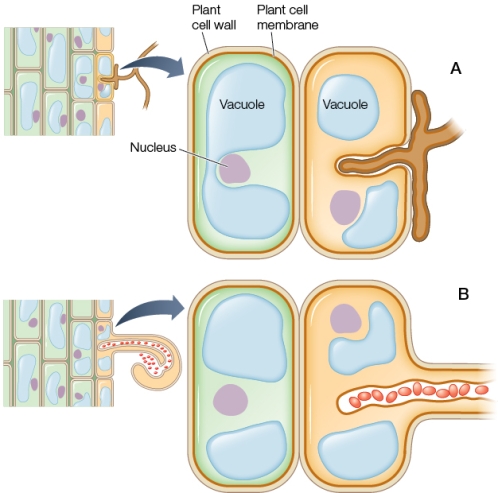 Plant B is most likely experiencing a _______ infection.
 (Short Answer)
4.7/5 (79)
(79) What functions do the negative charges found on humus and mineral particles and protons excreted by plants' roots have in the soil?
(Multiple Choice)
4.8/5 (57)
(57) Plants generally do not thrive in topsoil composed only of clay because such soil tends to
(Multiple Choice)
4.7/5 (70)
(70) 
Filters
- Essay(0)
- Multiple Choice(0)
- Short Answer(0)
- True False(0)
- Matching(0)