



 Chat with AI
Exam 35: Plant Nutrition

Exam 1: Studying Life246 Questions
Exam 2: Small Molecules and the Chemistry of Life246 Questions
Exam 3: Proteins, Carbohydrates, and Lipids246 Questions
Exam 4: Nucleic Acids and the Origin of Life246 Questions
Exam 5: Cells: the Working Units of Life248 Questions
Exam 6: Cell Membranes246 Questions
Exam 7: Cell Communication and Multicellularity246 Questions
Exam 8: Energy, Enzymes, and Metabolism246 Questions
Exam 9: Pathways That Harvest Chemical Energy246 Questions
Exam 10: Photosynthesis: Energy From Sunlight242 Questions
Exam 11: The Cell Cycle and Cell Division260 Questions
Exam 12: Inheritance, Genes, and Chromosomes250 Questions
Exam 13: Dna and Its Role in Heredity257 Questions
Exam 14: From Dna to Protein: Gene Expression252 Questions
Exam 15: Gene Mutation and Molecular Medicine251 Questions
Exam 16: Regulation of Gene Expression245 Questions
Exam 17: Genomes249 Questions
Exam 18: Recombinant Dna and Biotechnology243 Questions
Exam 20: Mechanisms of Evolution243 Questions
Exam 21: Reconstructing and Using Phylogenies246 Questions
Exam 22: Speciation247 Questions
Exam 23: Evolution of Genes and Genomes252 Questions
Exam 24: The History of Life on Earth246 Questions
Exam 25: Bacteria, Archaea, and Viruses262 Questions
Exam 26: The Origin and Diversification of Eukaryotes252 Questions
Exam 27: Plants Without Seeds: From Water to Land251 Questions
Exam 28: The Evolution of Seed Plants259 Questions
Exam 29: The Evolution and Diversity of Fungi261 Questions
Exam 30: Animal Origins and the Evolution of Body Plans248 Questions
Exam 31: Protostome Animals244 Questions
Exam 32: Deuterostome Animals246 Questions
Exam 33: The Plant Body243 Questions
Exam 34: Transport in Plants248 Questions
Exam 35: Plant Nutrition247 Questions
Exam 36: Regulation of Plant Growth246 Questions
Exam 37: Reproduction in Flowering Plants247 Questions
Exam 38: Plant Responses to Environmental Challenges246 Questions
Exam 39: Physiology, Homeostasis, and Temperature Regulation258 Questions
Exam 40: Animal Hormones249 Questions
Exam 41: Immunology: Animal Defense Systems265 Questions
Exam 42: Animal Reproduction261 Questions
Exam 43: Animal Development261 Questions
Exam 44: Neurons, Glia, and Nervous Systems250 Questions
Exam 45: Sensory Systems249 Questions
Exam 46: The Mammalian Nervous System: Structure and Higher Functions254 Questions
Exam 47: Musculoskeletal Systems259 Questions
Exam 48: Gas Exchange247 Questions
Exam 49: Circulatory Systems252 Questions
Exam 50: Nutrition, Digestion, and Absorption259 Questions
Exam 51: Salt and Water Balance and Nitrogen Excretion251 Questions
Exam 52: Animal Behavior249 Questions
Exam 53: The Physical Environment and Biogeography of Life248 Questions
Exam 54: Populations259 Questions
Exam 55: Species Interactions254 Questions
Exam 56: Communities247 Questions
Exam 57: Ecosystems238 Questions
Exam 58: A Changing Biosphere222 Questions
Select questions type


An advantage to using inorganic fertilizers (as opposed to organic fertilizers) is that
(Multiple Choice)
4.8/5  (83)
(83) Plants often use the essential element _______ as a chemical messenger.
(Short Answer)
4.7/5 (85)
(85) Yellowing of the older leaves of a plant is a result of _______ deficiency.
(Multiple Choice)
4.7/5 (71)
(71) Refer to the figure showing root nodule formation. 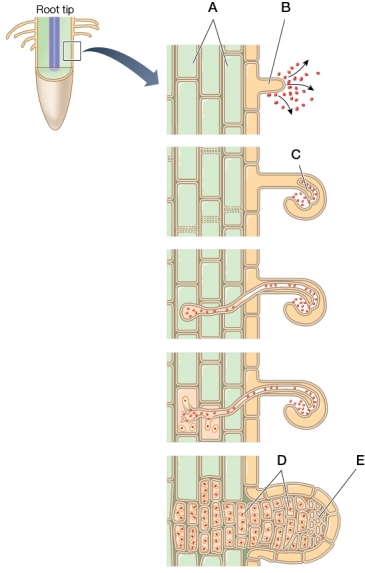 Which letter in the figure indicates an area where root cells release flavonoids?
 (Short Answer)
5.0/5 (69)
(69) Refer to the table.Researchers grew seedlings with phosphate fertilizer, arbuscular mycorrhizae, or both, and then weighed the seedlings after six months. 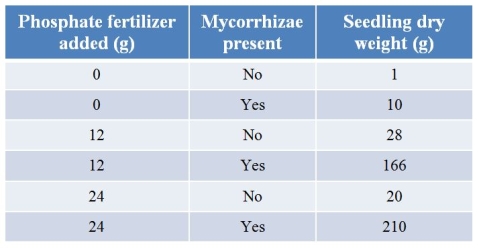 Which conclusion could be drawn from these data?
 (Multiple Choice)
4.8/5 (98)
(98) If you dig through the A and B soil horizons in your garden, you will know that you have reached the C horizon when your shovel is no longer full of
(Multiple Choice)
4.8/5 (76)
(76) In terms of nutrients, macronutrients are _______ abundant than micronutrients in the dry matter of a plant.
(Short Answer)
4.7/5 (81)
(81) To encourage crop growth, farmers often choose to add _______ fertilizers, due to their immediate availability.
(Short Answer)
4.9/5 (78)
(78) A farmer is seen tilling a hard-packed plot of soil.You conclude that the farmer is trying to increase the _______ in the soil.
(Short Answer)
4.9/5 (69)
(69) In the legume-Rhizobium symbiosis, the _______ partner produces leghemoglobin to provide _______ to the _______ partner.
(Multiple Choice)
4.9/5 (92)
(92) Through nodule formation, a legume crop can help subsequent crops in a(n) _______ system by leaving extra nitrogen behind in the soil after it has been harvested.
(Multiple Choice)
4.9/5 (85)
(85) Could a holoparasitic plant species evolve into a hemiparasitic plant species? Why or why not? What about a hemiparasitic plant evolving into a holoparasitic plant?
(Essay)
4.8/5 (98)
(98) Nitrogen-fixing rhizobia can associate with the roots of which common garden plant?
(Multiple Choice)
4.8/5 (80)
(80) Since clay particles are relatively small, what would you expect to be deficient in a soil that is mostly clay?
(Multiple Choice)
4.8/5 (79)
(79) Some parasitic plants are attracted to their hosts by the same chemicals that the host uses to attract
(Multiple Choice)
4.8/5 (78)
(78) What kinds of environmental problems can result from the use of inorganic fertilizers?
(Essay)
4.9/5 (79)
(79) 
Filters
- Essay(0)
- Multiple Choice(0)
- Short Answer(0)
- True False(0)
- Matching(0)