



 Chat with AI
Exam 35: Plant Nutrition

Exam 1: Studying Life246 Questions
Exam 2: Small Molecules and the Chemistry of Life246 Questions
Exam 3: Proteins, Carbohydrates, and Lipids246 Questions
Exam 4: Nucleic Acids and the Origin of Life246 Questions
Exam 5: Cells: the Working Units of Life248 Questions
Exam 6: Cell Membranes246 Questions
Exam 7: Cell Communication and Multicellularity246 Questions
Exam 8: Energy, Enzymes, and Metabolism246 Questions
Exam 9: Pathways That Harvest Chemical Energy246 Questions
Exam 10: Photosynthesis: Energy From Sunlight242 Questions
Exam 11: The Cell Cycle and Cell Division260 Questions
Exam 12: Inheritance, Genes, and Chromosomes250 Questions
Exam 13: Dna and Its Role in Heredity257 Questions
Exam 14: From Dna to Protein: Gene Expression252 Questions
Exam 15: Gene Mutation and Molecular Medicine251 Questions
Exam 16: Regulation of Gene Expression245 Questions
Exam 17: Genomes249 Questions
Exam 18: Recombinant Dna and Biotechnology243 Questions
Exam 20: Mechanisms of Evolution243 Questions
Exam 21: Reconstructing and Using Phylogenies246 Questions
Exam 22: Speciation247 Questions
Exam 23: Evolution of Genes and Genomes252 Questions
Exam 24: The History of Life on Earth246 Questions
Exam 25: Bacteria, Archaea, and Viruses262 Questions
Exam 26: The Origin and Diversification of Eukaryotes252 Questions
Exam 27: Plants Without Seeds: From Water to Land251 Questions
Exam 28: The Evolution of Seed Plants259 Questions
Exam 29: The Evolution and Diversity of Fungi261 Questions
Exam 30: Animal Origins and the Evolution of Body Plans248 Questions
Exam 31: Protostome Animals244 Questions
Exam 32: Deuterostome Animals246 Questions
Exam 33: The Plant Body243 Questions
Exam 34: Transport in Plants248 Questions
Exam 35: Plant Nutrition247 Questions
Exam 36: Regulation of Plant Growth246 Questions
Exam 37: Reproduction in Flowering Plants247 Questions
Exam 38: Plant Responses to Environmental Challenges246 Questions
Exam 39: Physiology, Homeostasis, and Temperature Regulation258 Questions
Exam 40: Animal Hormones249 Questions
Exam 41: Immunology: Animal Defense Systems265 Questions
Exam 42: Animal Reproduction261 Questions
Exam 43: Animal Development261 Questions
Exam 44: Neurons, Glia, and Nervous Systems250 Questions
Exam 45: Sensory Systems249 Questions
Exam 46: The Mammalian Nervous System: Structure and Higher Functions254 Questions
Exam 47: Musculoskeletal Systems259 Questions
Exam 48: Gas Exchange247 Questions
Exam 49: Circulatory Systems252 Questions
Exam 50: Nutrition, Digestion, and Absorption259 Questions
Exam 51: Salt and Water Balance and Nitrogen Excretion251 Questions
Exam 52: Animal Behavior249 Questions
Exam 53: The Physical Environment and Biogeography of Life248 Questions
Exam 54: Populations259 Questions
Exam 55: Species Interactions254 Questions
Exam 56: Communities247 Questions
Exam 57: Ecosystems238 Questions
Exam 58: A Changing Biosphere222 Questions
Select questions type


Photosynthetic plants that steal from other plants are known as _______, while those that cannot carry out photosynthesis are called _______.
(Multiple Choice)
4.8/5  (79)
(79) If an environmental antibiotic temporarily stopped bacterial functioning in the nitrogen cycle, which process(es) could continue?
(Multiple Choice)
5.0/5 (71)
(71) If you wanted to increase the cation-binding capacity of a soil sample as much as possible, you would add
(Multiple Choice)
4.8/5 (83)
(83) Which plant does not have nitrogen-fixing root nodules that contain Rhizobium?
(Multiple Choice)
4.9/5 (80)
(80) Nickel, which _______, was not discovered to be essential for plant growth until 1983.
(Multiple Choice)
4.8/5 (74)
(74) Nutrient deficiency symptoms can be avoided in plants by providing enough
(Multiple Choice)
4.8/5 (77)
(77) Researchers discover that a species of maple tree cannot survive and complete its life cycle without tiny amounts of fluorine.For this tree, fluorine is a(n)
(Multiple Choice)
4.8/5 (90)
(90) Monotropa species (Indian pipe) are holoparasites that strongly resemble fungi when they emerge from the ground.Which feature would distinguish Indian pipe from fungi?
(Multiple Choice)
4.9/5 (76)
(76) Nitrogen fixation is catalyzed by the enzyme _______, which cannot function in the presence of the element oxygen.
(Short Answer)
4.9/5 (83)
(83) Venus flytraps, sundews, and pitcher plants are all examples of
(Multiple Choice)
4.8/5 (84)
(84) Differentiate between hemiparasitic and holoparasitic plants.How would you expect them to differ morphologically?
(Essay)
4.8/5 (70)
(70) To produce a nitrogen fertilizer, the initial step includes energy-intensive processes that convert _______ into _______.
(Multiple Choice)
4.8/5 (70)
(70) Proteins are macromolecules that account for much of a plant's demand for mineral nutrients.Protein molecular structure explains at least some of the need for carbon and which other elements?
(Multiple Choice)
4.8/5 (83)
(83) Refer to the figure showing a soil profile. 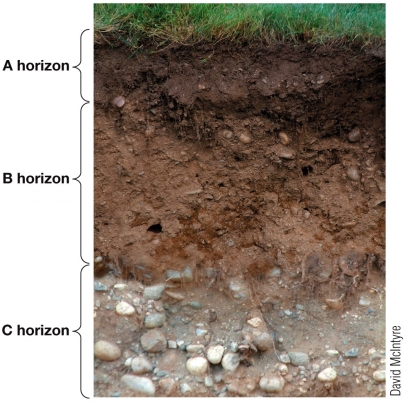 Years of cotton farming in the South have stripped away much of the A horizon of the soils.Subsequent agriculture has
 (Multiple Choice)
4.9/5 (75)
(75) Which four elements are found in highest concentration in plants?
(Multiple Choice)
4.8/5 (87)
(87) Most carnivorous plants are found in boggy, wet, acidic environments.What is the effect of such an environment on nutrient availability?
(Essay)
4.9/5 (91)
(91) 
Filters
- Essay(0)
- Multiple Choice(0)
- Short Answer(0)
- True False(0)
- Matching(0)