



 Chat with AI
Exam 35: Plant Nutrition

Exam 1: Studying Life246 Questions
Exam 2: Small Molecules and the Chemistry of Life246 Questions
Exam 3: Proteins, Carbohydrates, and Lipids246 Questions
Exam 4: Nucleic Acids and the Origin of Life246 Questions
Exam 5: Cells: the Working Units of Life248 Questions
Exam 6: Cell Membranes246 Questions
Exam 7: Cell Communication and Multicellularity246 Questions
Exam 8: Energy, Enzymes, and Metabolism246 Questions
Exam 9: Pathways That Harvest Chemical Energy246 Questions
Exam 10: Photosynthesis: Energy From Sunlight242 Questions
Exam 11: The Cell Cycle and Cell Division260 Questions
Exam 12: Inheritance, Genes, and Chromosomes250 Questions
Exam 13: Dna and Its Role in Heredity257 Questions
Exam 14: From Dna to Protein: Gene Expression252 Questions
Exam 15: Gene Mutation and Molecular Medicine251 Questions
Exam 16: Regulation of Gene Expression245 Questions
Exam 17: Genomes249 Questions
Exam 18: Recombinant Dna and Biotechnology243 Questions
Exam 20: Mechanisms of Evolution243 Questions
Exam 21: Reconstructing and Using Phylogenies246 Questions
Exam 22: Speciation247 Questions
Exam 23: Evolution of Genes and Genomes252 Questions
Exam 24: The History of Life on Earth246 Questions
Exam 25: Bacteria, Archaea, and Viruses262 Questions
Exam 26: The Origin and Diversification of Eukaryotes252 Questions
Exam 27: Plants Without Seeds: From Water to Land251 Questions
Exam 28: The Evolution of Seed Plants259 Questions
Exam 29: The Evolution and Diversity of Fungi261 Questions
Exam 30: Animal Origins and the Evolution of Body Plans248 Questions
Exam 31: Protostome Animals244 Questions
Exam 32: Deuterostome Animals246 Questions
Exam 33: The Plant Body243 Questions
Exam 34: Transport in Plants248 Questions
Exam 35: Plant Nutrition247 Questions
Exam 36: Regulation of Plant Growth246 Questions
Exam 37: Reproduction in Flowering Plants247 Questions
Exam 38: Plant Responses to Environmental Challenges246 Questions
Exam 39: Physiology, Homeostasis, and Temperature Regulation258 Questions
Exam 40: Animal Hormones249 Questions
Exam 41: Immunology: Animal Defense Systems265 Questions
Exam 42: Animal Reproduction261 Questions
Exam 43: Animal Development261 Questions
Exam 44: Neurons, Glia, and Nervous Systems250 Questions
Exam 45: Sensory Systems249 Questions
Exam 46: The Mammalian Nervous System: Structure and Higher Functions254 Questions
Exam 47: Musculoskeletal Systems259 Questions
Exam 48: Gas Exchange247 Questions
Exam 49: Circulatory Systems252 Questions
Exam 50: Nutrition, Digestion, and Absorption259 Questions
Exam 51: Salt and Water Balance and Nitrogen Excretion251 Questions
Exam 52: Animal Behavior249 Questions
Exam 53: The Physical Environment and Biogeography of Life248 Questions
Exam 54: Populations259 Questions
Exam 55: Species Interactions254 Questions
Exam 56: Communities247 Questions
Exam 57: Ecosystems238 Questions
Exam 58: A Changing Biosphere222 Questions
Select questions type


Which sequence represents the correct order of these three mineral particles of the soil, from smallest to largest?
(Multiple Choice)
4.7/5  (73)
(73) If a plant's root produces a nodule meristem, what kind of bacteria must be present in the soil near the plant's roots?
(Multiple Choice)
4.8/5 (80)
(80) Which nutrient would you add to the soil around a plant to help it form abundant membranes and nucleic acids?
(Multiple Choice)
4.8/5 (83)
(83) Mycorrhizae can be found associated with the roots of more than _______ percent of terrestrial plants.
(Multiple Choice)
4.9/5 (84)
(84) Which list represents the correct order of soil horizons that you would encounter if you started digging in your garden?
(Multiple Choice)
4.9/5 (63)
(63) Why do many farmers plant crops such as alfalfa and soybeans without harvesting them?
(Essay)
4.9/5 (80)
(80) Bacteroids must be able to respire to reduce N2 gas.Yet, nitrogenase is inhibited by O2.How is this conflict resolved in a nodule?
(Multiple Choice)
4.7/5 (88)
(88) Plants that photosynthesize and parasitize other plants are called
(Multiple Choice)
4.9/5 (83)
(83) The proteins in the plasma membrane of a plant roots' epidermis that take up nutrients are collectively called
(Multiple Choice)
4.7/5 (83)
(83) The layer of cells that receives nutrients that have been absorbed by the root epidermis or received from symbiotic bacteria is called
(Multiple Choice)
4.8/5 (75)
(75) Refer to the table showing the growth of cassava plants on different soil plots.Each experimental group consisted of the same number of plants on the same acreage in each plot. 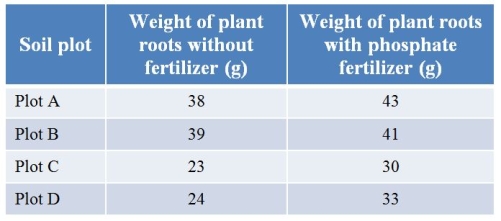 It is likely that some of the plots had higher natural levels of _______.
 (Short Answer)
4.9/5 (71)
(71) Refer to the figure showing a soil profile. 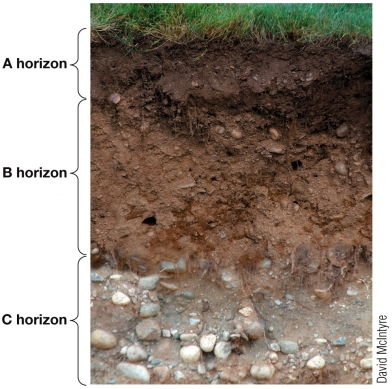 Organic matter for gardeners would come from which horizon(s) shown in the figure?
 (Short Answer)
4.8/5 (83)
(83) The uptake of which chemical element increases most with the addition of mycorrhizae to roots?
(Multiple Choice)
4.9/5 (80)
(80) Which piece of evidence would lead you to believe that symbiotic relationships between plants and soil organisms are based on very ancient processes?
(Multiple Choice)
4.9/5 (73)
(73) Other than rhizobia in root nodules, what kind of bacteria makes symbiotic, nitrogen-fixing associations with land plants?
(Multiple Choice)
4.9/5 (95)
(95) 
Filters
- Essay(0)
- Multiple Choice(0)
- Short Answer(0)
- True False(0)
- Matching(0)