



 Chat with AI
Exam 2: Pediatric

Exam 1: Medicine2 k Questions
Exam 2: Pediatric723 Questions
Exam 3: Psychiatry336 Questions
Exam 4: Surgery563 Questions
Exam 5: Obstetrics & Gynecology469 Questions
Select questions type


A 17-year-old boy is evaluated in the office due to progressive facial puffiness, fatigue, and decreased appetite for the past month. Temperature is 36.7 C (98.1 F), blood pressure is 110/70 mm Hg, pulse is 80/min, and respirations are 18/min. Physical examination shows periorbital and pretibial edema. Serum laboratory results are as follows:  Urinalysis shows 4+ proteinuria, no red blood cells, and no casts. A renal biopsy is performed. Immunofluorescence microscopy shows a diffuse, granular pattern of IgG and C3 along the capillary loops, and electron microscopy shows electron-dense immune deposits along the glomerular basement membrane, findings consistent with membranous nephropathy. Which of the following additional studies should be performed in this patient?
 (Multiple Choice)
4.9/5  (91)
(91) A 3-year-old girl is brought to the office by her mother for evaluation of vulvar pruritus. For the past month, the girl has been scratching her vulvar region through her clothes day and night. There have been no changes in soap or laundry detergent, and the patient does not have pruritus over any other areas. She has been toilet-trained for the past year and has had no accidents, hematuria, or abnormal vaginal discharge. The patient has no chronic medical conditions and has met all developmental milestones. Vital signs are normal. Height and weight are at the 40th percentile for age. On pelvic examination, the vulva is excoriated and there is an adhesive ridge fusing the posterior labia minora in the midline. There is no labial or vulvar atrophy and no plaque formation. The vagina appears pale, and a speculum examination is deferred. Urinalysis is normal. Which of the following is the best next step in management of this patient?
(Multiple Choice)
4.9/5 (77)
(77) A 42-year-old previously healthy woman comes to the office due to worsening double vision and gait unsteadiness. She states she had cramping abdominal pain and diarrhea 2 weeks ago after an outdoor picnic, which spontaneously resolved after 3 days. The double vision began 4 days ago and is persistent and progressive. The patient has also been stumbling while walking due to incoordination. She has had no fever, headache, neck pain, photophobia, or bowel or bladder dysfunction. The patient does not use tobacco, alcohol, or illicit drugs. Vital signs are within normal limits. On physical examination, she is fully alert and oriented with normal memory, speech, and language comprehension. There is mild ptosis of the right eye with weakness of the medial and upward gaze. Left eye movements are normal. Bilateral lower-extremity weakness with loss of deep tendon reflexes is present. There is dysmetria on heel-to-shin testing on both sides. Bilateral upper-extremity muscle strength, reflexes, and coordination are normal. Sensation to touch and pinprick is normal throughout. The remainder of the examination shows no abnormalities. Which of the following is the most likely cause of this patient's current condition?
(Multiple Choice)
4.8/5 (84)
(84) A 13-year-old girl is brought to the clinic by her mother because the girl has been increasingly tired over the last several months. The patient's family is from Greece, and her mother and maternal uncles have chronic anemia. Menarche was 1 year ago. Menses occur regularly each month, lasting 5-6 days with heavy bleeding and passage of clots, requiring her to wake up multiple times each night to change pads. The patient is a vegetarian but occasionally eats eggs. Her family lives in a neighborhood that was built in the 1980s. Vital signs are normal. The patient appears pale. The lungs are clear to auscultation. A soft systolic ejection murmur is heard in the pulmonic area. S1 and S2 are normal, and diastole is quiet. The remainder of the physical examination is normal. Complete blood count shows:  Which of the following is the best next step in evaluation of this patient?
 (Multiple Choice)
4.8/5 (72)
(72) A 2-year-old boy is brought to the office for evaluation of right ear pain. Two days ago, his mother saw him put a small rock in his ear while he was playing outside. She pulled it out and rinsed his ear thoroughly with soapy water in the bath that evening. The patient had no pain that night, but the next morning he woke up crying and pulling on his ear. He has been fussy and has not slept well since then. The patient has had 2 previous episodes of acute otitis media that resolved with antibiotics. Immunizations are up to date. Temperature is 37 C (98.6 F), blood pressure is 90/50 mm Hg, and pulse is 100/min. Examination shows a somewhat anxious child. There is no rhinorrhea. Physical examination of the oropharynx shows normal tonsils with no exudate or erythema. There is no cervical adenopathy. The patient cries during examination of the right ear, which reveals a tender, swollen ear canal. Although only a part of the tympanic membrane is seen, it appears normal. The left ear is normal. Which of the following is the most appropriate treatment for this patient's condition?
(Multiple Choice)
4.9/5 (83)
(83) A term newborn is undergoing routine evaluation in the nursery. The boy was born 12 hours ago via spontaneous vaginal delivery to a 24-year-old woman. His mother had appropriate prenatal care, and her pregnancy was uncomplicated. Delivery was unremarkable, and the patient has had a normal nursery course. He received the hepatitis B vaccine, erythromycin eye ointment, and intramuscular vitamin K after delivery. Family history reveals factor VIII deficiency in the patient's paternal grandfather. Vital signs are normal. Physical examination shows a sleeping newborn with normal tone. A 1/6 systolic murmur is best heard at the left sternal border. Peripheral pulses are strong. Genitourinary examination shows a penis of normal length with no curvature. The urethral meatus extends to the corona on the ventral aspect of the penis, and the foreskin has a dorsal hood appearance. The testes are present bilaterally within the scrotum. The patient urinates through the urethral meatus during examination. The father requests that a circumcision be performed. Which of the following is the best next step in management of this patient?
(Multiple Choice)
4.8/5 (95)
(95) A 10-week-old girl is brought to the emergency department after developing abnormal movements of the arms and legs. This morning, the patient developed a fever and had 3 episodes of emesis. An hour ago, she had sudden rhythmic jerking of the arms and legs, which stopped within 4 minutes. The patient was transported to the emergency department via ambulance and was sleepy during the trip. She has no chronic medical conditions, and vaccinations are up to date. Temperature is 39.3 C (102.7 F), pulse is 160/min, and respirations are 44/min. The patient appears drowsy on examination. The anterior fontanelle is open and full. She has a weak suck and decreased tone. The tympanic membranes and oropharynx are unremarkable. The neck is supple. Cardiac examination reveals tachycardia without murmurs. The lungs are clear bilaterally. The abdomen is soft with normal bowel sounds. Skin examination is normal. Which of the following is the best next step in management of this patient?
(Multiple Choice)
4.8/5 (83)
(83) A 17-year-old boy is brought to the emergency department due to a rash and scrotal swelling. Two days ago, he developed ankle pain, followed by a rash on his legs and the tops of his feet. The lesions are not painful, but they have coalesced and darkened. Today, the patient developed a dull ache in his scrotum. He has had no fever, headache, or diarrhea. The patient has no chronic medical conditions and takes no medications. He is sexually active with 1 partner. Temperature is 36.1 C (97 F), blood pressure is 110/70 mm Hg, and pulse is 94/min. The patient is awake and alert. The neck is supple with no lymphadenopathy. Cardiopulmonary examination is unremarkable. The abdomen is soft with no rebound tenderness or guarding. The extremities have 2+ peripheral pulses. Genitourinary examination shows mild edema in the right testicle with slight tenderness to palpation, and the left testicle is normal. Both ankles are swollen. Skin examination is shown in the exhibit. 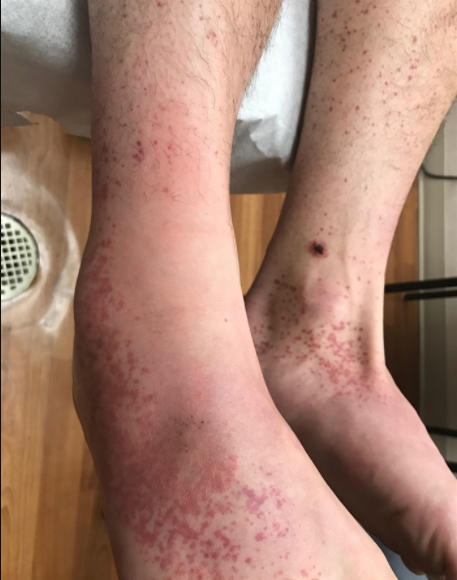 Results from a complete blood count are as follows:
 Which of the following is the most likely diagnosis in this patient?
Results from a complete blood count are as follows: Which of the following is the most likely diagnosis in this patient? (Multiple Choice)
4.8/5 (85)
(85) A 56-year-old woman is evaluated for a monthlong history of intermittent weakness of the right foot and a 3-month history of progressive left arm weakness. The patient has no dysphagia, dysarthria, sensory loss, or bowel or bladder impairment. Other medical conditions include type 2 diabetes mellitus, hypercholesterolemia, and hypertension. She takes metformin, atorvastatin, and lisinopril. Temperature is 36.9 C (98.4 F), blood pressure is 130/78 mm Hg, pulse is 80/min, and respirations are 14/min. Neurologic examination reveals normal speech, language, and mental status. Moderate weakness and atrophy of the distal muscles in the right leg and left arm is noted. Fasciculations are present in the right leg. Deep tendon reflexes are brisk in the upper and lower limbs. Sensory examination shows no abnormalities. Laboratory results are as follows:  Which of the following would be most helpful in treating this patient's current symptoms?
 (Multiple Choice)
4.9/5 (87)
(87) A 7-year-old boy is brought to the office due to "yellow eyes" over the past few months. His parents state that he has been tired, pale, and frequently uninterested in playing. The boy's father has had similar symptoms throughout his life. The patient takes no daily medications. Physical examination shows a tired-appearing boy with pale conjunctivae, scleral icterus, and generalized jaundice. The tip of the spleen is palpable. Laboratory results are as follows: 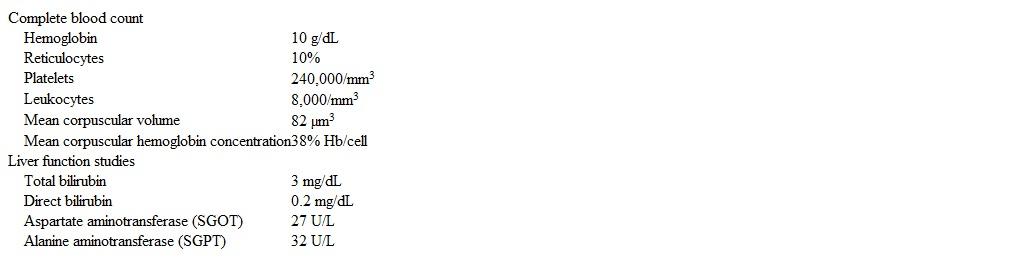 Peripheral smear shows anisocytosis, spherocytes, and polychromatophilia. Direct and indirect antiglobulin (Coombs) tests are negative. Which of the following laboratory tests is the best next step in evaluation of this patient?
 (Multiple Choice)
4.9/5 (93)
(93) A 14-year-old boy is brought to the office due to lower back and buttock pain for 3 months. The pain is diffuse across the lower back and buttocks, worsens with activity, and resolves with rest. It occasionally radiates down the legs. There is no history of trauma. Vital signs are normal. Examination shows a subcutaneous lipoma over the lower back, mild scoliosis, and weak ankle dorsiflexion. Deep tendon reflexes are 1+ in the lower extremities and 2+ in the upper extremities. The lower extremities are thin and weak. What is the most likely diagnosis in this patient?
(Multiple Choice)
4.8/5 (89)
(89) A 17-year-old boy is hospitalized with an acute exacerbation of cystic fibrosis. His respiratory function had remained stable for many years but has begun to deteriorate, with 3 hospital admissions within the past 6 months. The patient's FEV1/FVC ratio has decreased compared with a baseline reading taken 9 months ago and is 30% of predicted value. He is placed on supplemental oxygen, antimicrobial therapy, and inhaled bronchodilators. The hospitalist physician notices that there are no advance directives for this patient's care. Which of the following is the best approach to take?
(Multiple Choice)
4.9/5 (84)
(84) A 16-year-old girl comes to the office due to a skin condition. For the last 3 years, she has had small "pimples" on the posterior surface of her upper arms. The lesions are associated with mild pruritus during the winter months but are otherwise asymptomatic, and the patient is primarily concerned due to their appearance when she wears short-sleeved tops. Medical history is unremarkable, and the patient takes no medications. Examination findings are as shown in the exhibit. 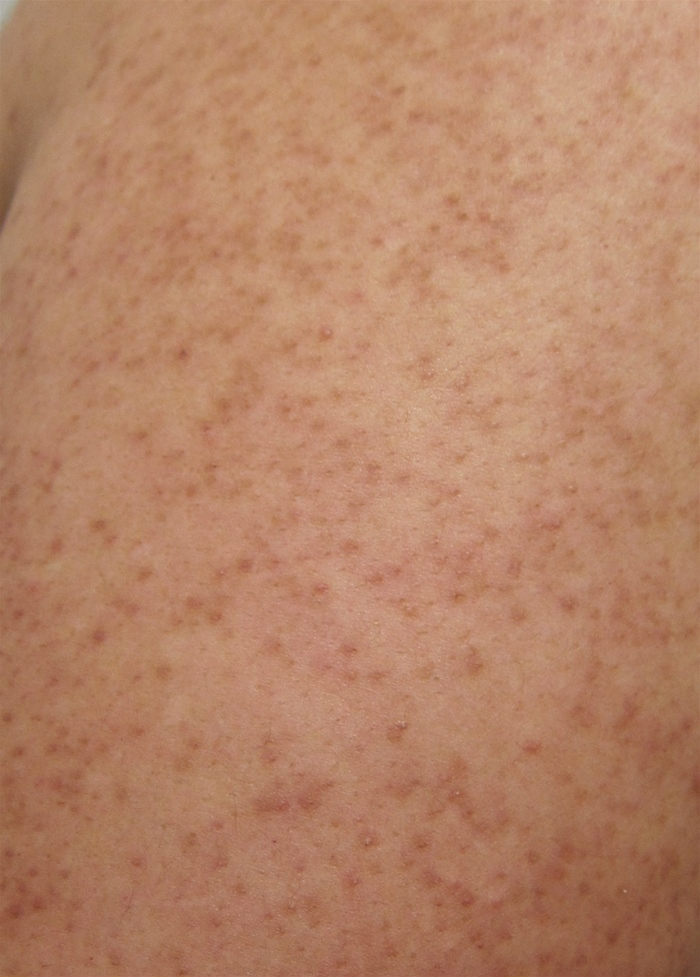 Which of the following is the most likely diagnosis of this patient's skin condition?
 (Multiple Choice)
5.0/5 (83)
(83) A 3-year-old boy is brought to the physician for evaluation of delayed milestones. Over the past year, he has been receiving physical and speech therapies for delays in gross motor skills and speech. He is currently able to walk up and down stairs and run well. He has a vocabulary of approximately 25 words and does not make 2-word sentences. His parents report that he has poor eye contact and does not show interest in engaging with other children. Review of systems is otherwise negative. His vaccinations are up to date. He has an uncle with Down syndrome and a cousin with autism. Head circumference, length, and weight are each at the 5th percentile. Examination of the face shows small palpebral fissures, absent philtrum, and a thin upper lip border. What is the underlying cause of his problems?
(Multiple Choice)
4.8/5 (79)
(79) A 17-year-old boy comes to the office at his father's insistence due to a change in behavior. Ever since his girlfriend ended their relationship last month, the patient has been unable to complete his schoolwork and is uninterested in playing the sports he previously enjoyed. He spends most of his time in his room and refuses to come out for meals. The patient says, "It's too much effort to even get out of bed. I thought everything was going well, and suddenly she just ended it. I don't want to go to school and see her ever again." On further questioning, the patient reports that he has trouble falling asleep and keeps checking his ex-girlfriend's social media posts to see what she is doing in the evenings. He has thought about hanging himself with rope his father keeps in the garage. He has not spoken to anyone else about his suicidal thoughts and does not know if he will act on them. The patient says, "I tried to tell my best friend how I feel, but he just told me to 'get over her.' He doesn't understand and neither will my parents. Please don't tell my parents what I am going through." Which of the following is the most appropriate course of action for this patient?
(Multiple Choice)
4.9/5 (80)
(80) A 4-year-old boy is brought to the office due to unusual behavior and concerns about intellectual development. His parents state that "he doesn't speak a lot and doesn't seem to listen." They describe him as a slow learner who uses only single words and frequently mumbles. The patient is able to recognize a circle and the colors yellow and red, but he struggles to recognize other shapes and colors. He scribbles but does not draw lines. The patient crawled at 7 months and walked by 13 months. When he briefly attended preschool, he refused to speak at all and preferred to play with toy cars by himself. He was asked to leave the school due to daily temper tantrums in which he became hyperactive and banged his head with his hands when the teacher tried to redirect him. The patient was born at term from an uncomplicated pregnancy and delivery, and his physical growth has been normal. Weight and height are at the 50th percentile. During the examination, the patient refuses to speak with the physician and sits in the corner lining up toy cars. When his mother attempts to divert his attention from playing, he has a temper tantrum and begins to hit his head. A brief physical examination is normal. Which of the following is the most likely explanation for this child's behavior?
(Multiple Choice)
4.7/5 (73)
(73) An 11-month-old girl is brought to the emergency department by her stepfather because she is "not acting like herself." For the past 2 days, the girl has had intermittent episodes, lasting 10-15 minutes, during which she cries inconsolably and flexes her hips. Since this morning, the patient has seemed more tired, napping more than usual. Her appetite has been poor; she did not eat breakfast today. The girl was born at term and has no chronic medical conditions. Temperature is 36.7 C (98 F), blood pressure is 100/62 mm Hg, pulse is 160/min, and respirations are 20/min. On examination, the patient is alert but appears tired. Anterior fontanelle is closed. Oral mucous membranes are slightly dry, and the neck is supple. Cardiopulmonary examination is unremarkable. The abdomen is mildly tender but nondistended. There is no rebound tenderness or guarding. Neurologic examination shows equal and reactive pupils, and the face appears symmetric. Strength is 5/5 bilaterally, and reflexes are equal. Which of the following is the best next step in management of this patient?
(Multiple Choice)
4.8/5 (81)
(81) A 5-year-old boy is brought to the office due to a weeklong history of generalized edema and fatigue. Otherwise, he has been well, and his medical history is significant only for obesity. The patient takes a daily multivitamin and no other medications. BMI is at the 98th percentile for age. Blood pressure is 92/55 mm Hg and pulse is 90/min. Periorbital edema and 1+ pretibial edema are found on examination. The scrotum is mildly swollen but nontender. Abdominal examination is unremarkable. Urinalysis results are as follows:  Which of the following is the most likely underlying pathogenesis for this patient's condition?
 (Multiple Choice)
4.8/5 (86)
(86) A 28-year-old woman comes to the emergency department due to left-sided headache and neck pain after a fall while skiing the day prior. She took ibuprofen and rested but the symptoms persisted, and today, she also had transient leg weakness. The patient has no prior medical conditions. She occasionally drinks alcohol but does not use tobacco or illicit drugs. Family history is significant for stroke in her father. Temperature is 37.2 C (99 F), blood pressure is 134/86 mm Hg, and pulse is 90/min. Physical examination shows mild ptosis and miosis of the left eye. There is no excessive lacrimation or rhinorrhea. Funduscopic examination is normal. No carotid bruit is present. Heart and lung sounds are normal. Neurological examination shows normal motor strength, deep tendon reflexes, and sensation in bilateral upper and lower extremities. Which of the following is the most likely cause of this patient's current condition?
(Multiple Choice)
4.7/5 (63)
(63) A 16-month-old girl is brought to the office by her mother due to breathing problems for the past month. The mother says, "She struggles to catch her breath when she gets excited. At other times, she seems to be holding her breath." The mother is also concerned that the patient, who started babbling and saying a few words after turning age 1, has spoken very little for the last few weeks. Medical history is significant for a simple febrile seizure at age 11 months and an upper respiratory tract infection 6 weeks ago. Family history is significant for a learning disorder in her older brother. On physical examination, the patient has a brief period of hyperventilation followed by hypoventilation, which passes within 30 seconds. Vital signs are otherwise normal. The patient makes brief eye contact with the physician but rocks back and forth and says nothing. She repeatedly twists her fingers and has an unsteady gait. This patient would most likely exhibit which of the following features?
(Multiple Choice)
4.7/5 (73)
(73) 
Filters
- Essay(0)
- Multiple Choice(0)
- Short Answer(0)
- True False(0)
- Matching(0)