



 Chat with AI
Exam 2: Pediatric

Exam 1: Medicine2 k Questions
Exam 2: Pediatric723 Questions
Exam 3: Psychiatry336 Questions
Exam 4: Surgery563 Questions
Exam 5: Obstetrics & Gynecology469 Questions
Select questions type


A neonate born 2 hours ago is admitted to the neonatal intensive care unit due to prematurity. He was born at 32 weeks gestation to a 30-year-old primigravida via a precipitous, forceps-assisted delivery due to a nonreassuring fetal heart rate. Rupture of membranes occurred 5 hours before delivery and appeared clear. The mother received betamethasone during labor. In the delivery room, the patient was placed on continuous positive airway pressure due to tachypnea and moderate intercostal and subcostal retractions with low oxygenation saturations. He continued to have desaturations requiring increasing levels of flow. The patient was subsequently intubated, and umbilical lines were placed. Temperature is 36.9 C (98.4 F), pulse is 170/min, and respirations are 40/min. Pulse oximetry is 90% on 40% oxygen. Cardiac examination shows regular rate and rhythm without murmurs. Lung examination shows equal and coarse mechanically ventilated breath sounds bilaterally. The abdomen is protuberant but soft. A chest radiograph is obtained. Which of the following findings is most likely seen on imaging?
(Multiple Choice)
4.8/5  (69)
(69) A 3-year-old boy is brought to the clinic by his parents for fever and rash. Two days ago, the patient developed fever and decreased appetite. Yesterday, a maculopapular rash appeared on his trunk and face and became vesicular. This morning, another small group of vesicles appeared on his arms and legs. The rash is intensely pruritic. The child is playful and has been drinking normally. He is up to date on immunizations and has no medical issues. The patient attends day care. The family travels extensively for the mother's job, and they recently returned from a 2-week trip to South Africa. Temperature is 38.2 C (100.8 F), and pulse is 100/min. Physical examination shows a mild, diffuse maculopapular rash with some scattered vesicular lesions. The mucous membranes are normal. Which of the following is the most likely explanation for this rash?
(Multiple Choice)
4.8/5 (78)
(78) A 2-month-old girl is brought to the clinic for a well-child visit. Her parents are concerned about the back of her head being flat on the right. The infant usually sleeps on her back in a crib but she sometimes naps in a car seat or stroller. She is breastfeeding well and receives vitamin D supplementation. Birth history is significant for a full-term cesarean delivery due to breech presentation. Physical examination shows flattening of the right occiput with anterior displacement of the right ear and forehead. The patient demonstrates a preference to tilt her head to the left while rotating the chin to the right. When the head is turned to the right, there is a firm mass in the inferior portion of the left sternocleidomastoid. The mass does not transilluminate. The hips are stable with no clicks or clunks. Which of the following is the most likely underlying cause of this patient's presentation?
(Multiple Choice)
4.7/5 (92)
(92) An 11-year-old boy is brought to the physician for evaluation of scoliosis. His mother noticed that he always seems to be leaning even when he tries to sit or stand upright. The boy has a history of myopia and upward lens dislocation for which he wears corrective glasses. He otherwise has been healthy and doing well in school. His father had scoliosis and vision problems and died from "heart problems" last year. Physical examination shows a boy with a long face, high arched palate with crowded teeth, and upward dislocation of the lens. He has a tall stature for his age; long arms and legs with minimal subcutaneous fat; long, thin fingers; and a prominent sternum. Joint hypermobility, skin hyperelasticity, and 15 degrees of thoracic scoliosis are seen. A diastolic murmur is heard in the aortic area. Which of the following is the most likely etiology of this patient's condition?
(Multiple Choice)
4.8/5 (81)
(81) A 65-year-old man is brought to the emergency department after being involved in a motor vehicle collision. He lost consciousness briefly on impacting the airbag. Since regaining consciousness, the patient has had numbness, tingling, and marked weakness in both upper extremities but has been able to move his lower extremities normally. Medical history includes osteoarthritis and cervical spondylosis. Blood pressure is 132/74 mm Hg, pulse is 94/min, and respirations are 14/min. Plain x-rays of the cervical spine show no abnormalities except those consistent with mild degenerative arthritis. Which of the following is the most likely diagnosis?
(Multiple Choice)
4.8/5 (79)
(79) A 6-week-old girl is brought to the emergency department due to a rash. Her parents first noticed several red spots on her feet, hands, and buttocks several weeks ago; the spots have now spread to her arms and legs. The patient has been breastfeeding well, with regular stooling and voiding. She has had no fever. The family lives on a rural farm, and the patient was delivered at home at approximately 39 weeks gestation via an uncomplicated, spontaneous vaginal delivery. The mother was evaluated only once during pregnancy, at 10 weeks gestation, and her examination, blood work, and ultrasound were normal. Today, the patient's temperature is 37.3 C (99.1 F). She is not in acute distress. Mucous membranes have no lesions. Heart, lung, and abdominal examinations are unremarkable. Numerous small, nonblanching, erythematous maculopapular spots are distributed over the arms and legs, including the dorsal and ventral surfaces of the hands and feet. Which of the following is the best next step in evaluation of this patient?
(Multiple Choice)
4.9/5 (80)
(80) A 6-year-old boy is brought to the office due to a fever and "lump" on his neck. The patient has had a fever for the past 6 days, and the mother felt the lump when she was bathing him yesterday. This morning, he awoke with a rash on the trunk and redness of the eyes. The patient has had no cough, rhinorrhea, diarrhea, or emesis. He has a history of intermittent asthma and takes albuterol as needed. Vaccinations are up to date. Current temperature is 39.4 C (102.9 F), blood pressure is 90/60 mm Hg, and pulse is 125/min. Physical examination shows an irritable child who is intermittently consoled by his mother. Bilateral conjunctivae are injected. A 2-cm, tender, mobile anterior cervical lymph node is palpated. Heart rate is regular with mild tachycardia and no murmurs, rubs, or gallops. A blanching erythematous rash is present across the trunk. The tongue and lips appear erythematous, and the posterior pharynx has no exudates or tonsillar hypertrophy. Which of the following additional examination findings would be consistent with this patient's presumed diagnosis?
(Multiple Choice)
4.7/5 (73)
(73) A 9-year-old girl is brought to the clinic for evaluation of recurrent vomiting. The patient has no symptoms today but has had nausea, vomiting, and diffuse abdominal pain for several days each month over the last 8 months. When the vomiting occurs, it typically begins early in the morning, recurs 10-15 times a day, and lasts for 2 days. The vomiting is nonbloody and nonbilious. The mother states that the episodes were more frequent around the beginning of the school year and occurred 5 times in a 2-month span. The last 2 times, the mother has taken time off work because the daughter required hospitalization for intravenous hydration. The patient has no fever, headache, or diarrhea during the episodes. Between episodes, she is active and eats well. Height and weight are at the 25th percentile for age, similar to her prior growth curves at her well visit 6 months ago. The patient is in no distress and is well hydrated. Mucous membranes are moist, but the maxillary incisors have erosive dental caries. The abdomen is soft and nontender. Neurologic examination is normal. Which of the following is the most likely cause of this patient's symptoms?
(Multiple Choice)
4.9/5 (77)
(77) A 3-year-old boy is brought to the emergency department due to refusal to walk. The patient's mother first noticed a mild limp 3 days ago after picking him up from day care. The patient tends to climb and jump on furniture, so she initially attributed the limp to rough play. The symptoms worsened today, and the patient now refuses to stand, falling when held up by his mother. He has no chronic medical conditions but has had a runny nose and fever intermittently for 2 months since starting day care. Temperature is 38 C (100.4 F), pulse is 90/min, and respirations are 24/min. Pulse oximetry is 100% on room air. The patient appears comfortable while lying supine on the examination table. He has clear rhinorrhea with several soft and mobile anterior cervical lymph nodes approximately 1 cm in diameter. The abdomen is nontender and the liver edge is palpable. The hips are held flexed bilaterally. During movement of the left hip, the patient wails and resists. Sensation is normal, and reflexes are intact. Babinski sign is negative bilaterally. Laboratory results are as follows:  Which of the following is the best next step in management of this patient?
 (Multiple Choice)
4.9/5 (76)
(76) A 66-year-old woman is brought to the emergency department by her son due to increasing confusion, loss of mobility, and behavioral changes. The patient cries out for no apparent reason and recently exclaimed that "a lion was sleeping in the backyard." She often sees cats in her room when none are present. She has had memory loss and frequently gets lost in her neighborhood. The patient is afebrile; blood pressure is 136/72 mm Hg, pulse is 98/min, and respirations are 16/min. On physical examination, she is alert but disoriented and quite agitated. Physical examination shows increased muscle tone, normal reflexes, and coarse resting tremors in the extremities. Which of the following is most closely associated with this patient's current condition?
(Multiple Choice)
4.7/5 (73)
(73) A 13-year-old boy is brought to the office due to dry cough lasting 2 weeks. The patient has also had low-grade fever, fatigue, and sore throat. Immunizations are up-to-date, and he received his tetanus-diphtheria-acellular pertussis booster 6 months ago. Temperature is 38.1 C (100.6 F), blood pressure is 105/65 mm Hg, pulse is 86/min, and respirations are 18/min. Oxygen saturation is 98% on room air. On examination, the patient appears tired but not ill. The neck is supple and without lymphadenopathy. The oropharynx is erythematous without exudates. Pulmonary auscultation reveals scattered crackles and rhonchi in both lungs. Cardiac and abdominal examination shows no abnormalities. Which of the following is the most likely cause of this patient's symptoms?
(Multiple Choice)
4.8/5 (96)
(96) An 18-year-old girl comes to the office with 3 days of fever, nonproductive cough, dyspnea, and fatigue. The symptoms started after she returned home from a summer school trip to Europe with friends. Her roommate had similar symptoms. The patient has no prior medical issues, and her vaccinations are up to date. She is not sexually active. She does not use tobacco, alcohol, or illicit drugs. Temperature is 38.3 C (101 F), blood pressure is 120/80 mm Hg, pulse is 88/min, and respirations are 16/min. The patient does not appear ill. Faint bilateral crackles are present. Chest x-ray reveals bilateral diffuse infiltrates. Which of the following is the most appropriate next step in management?
(Multiple Choice)
4.9/5 (67)
(67) A 9-year-old boy is brought to the office for evaluation of oral lesions. He had been living in a children's home until he was adopted 3 months ago. He believes the tongue nodules have always been present. They do not hurt or itch. He has no taste disturbance and eats a variety of solids and liquids. He is not bothered by drinking hot or cold liquids. Vital signs are stable. He is tall for his age with long arms and fingers. Tongue examination is shown below. On palpation, the tongue nodules feel discrete, firm, and rubbery. They are not tender. This patient is at greatest risk from which of the following conditions? 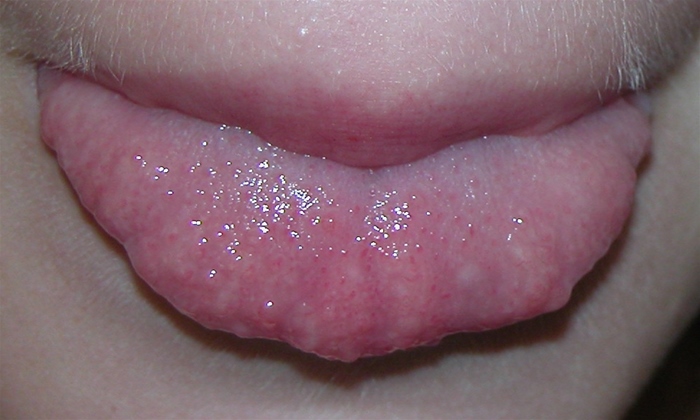
(Multiple Choice)
4.8/5 (79)
(79) A 10-month-old girl is brought to the emergency department for evaluation of bright red stools. About an hour ago, the girl's mother found bright red-tinged formed stools mixed with mucus in the patient's diaper. The patient has had intermittent abdominal pain since yesterday. These episodes resolve after 10-15 minutes but have been occurring more frequently since this morning. The patient goes to day care, and several other children have had runny nose, vomiting, and diarrhea over the past week. She takes no medications, and her immunizations are up to date. Temperature is 37.3 C (99.1 F), blood pressure is 100/60 mm Hg, and pulse is 150/min. Examination reveals diffuse abdominal tenderness; the infant also appears tired. Fecal testing is positive for blood and negative for leukocytes. Which of the following is the most likely diagnosis in this patient?
(Multiple Choice)
4.8/5 (71)
(71) A 29-year-old man comes to the emergency department due to lower extremity weakness. The patient has not been feeling well over the past several days and has had worsening back pain. When he woke up this morning, he noticed weakness in both legs and had to have a friend help him walk to the car. The patient has a history of HIV, which was acquired via shared needles, but does not take antiretroviral therapy consistently. The patient still uses injection drugs occasionally but no longer shares needles. Temperature is 38 C (100.4 F), blood pressure is 116/68 mm Hg, and pulse is 98/min. The lungs are clear on auscultation, and heart sounds are normal with no murmurs. Abdominal examination shows a distended bladder. The back is tender to palpation over the lower thoracic region. Neurological examination reveals 3/5 bilateral lower extremity muscle strength with upgoing bilateral plantar reflexes. Skin examination shows scattered folliculitis and no lower extremity edema. Which of the following is the most likely cause of this patient's weakness?
(Multiple Choice)
4.8/5 (72)
(72) A 1-week-old neonate is brought to the office due to a rash on his back and bilateral groin areas. The patient's mother first noticed it this morning as she was changing him; he seems to be doing well otherwise. He is breastfed every 2 hours and produces 8 wet diapers and 6 stools a day. There has been no fever. The patient sleeps most of the day and night in his crib, swaddled in a fleece blanket. Since birth, he has been using the same shampoo and bath soap and has been wearing the same brand of onesies underneath his pajamas. Other than vitamin D drops, the patient takes no medications. Temperature is 36.9 C (98.4 F), pulse is 115/min, and respirations are 45/min. On examination, he is awake, alert, and in no distress. Skin examination of the back is shown in the exhibit. 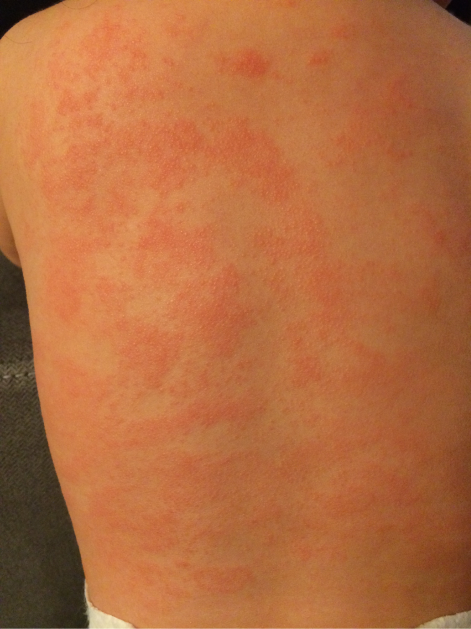 The bilateral groin areas reveal similar lesions. The remainder of the examination is unremarkable. Which of the following is the most appropriate next step in management of this patient's rash?
 (Multiple Choice)
4.8/5 (84)
(84) A 55-year-old man comes to the office because of numerous falls for the past few weeks. Yesterday, he felt so dizzy that he fell on the ground and hurt his knees. He has also noticed dry mouth, dry skin, and erectile dysfunction over this period. His medical history is significant for the recent onset of resting tremors. He was diagnosed with diabetes 6 months ago, which is controlled with diet. Blood pressure is 121/84 mm Hg supine, and 92/61 mm Hg standing. Physical examination reveals rigidity and bradykinesia. What is the most likely diagnosis of this patient?
(Multiple Choice)
4.9/5 (69)
(69) A 55-year-old truck driver comes to the office due to impaired vision over the past 6 months. He has had increasing difficulty when looking sideways and now has to completely turn his neck to look to the side. He also has intermittent headaches that worsen in the morning. The patient recently developed a decreased libido, which he attributes to his long work hours and night shifts. He has no fever, weakness or numbness, or bladder/bowel problems. His BMI is 32 kg/m2. Examination shows decreased vision in the temporal fields on both sides. Neurological examination shows 5/5 muscle strength, normal sensation, normal gait and coordination, and 2+ deep tendon reflexes. Which of the following is the most likely diagnosis?
(Multiple Choice)
5.0/5 (100)
(100) A 12-month-old girl is brought to the office due to diarrhea. Two weeks ago, the girl had fever, vomiting, and diarrhea with poor oral intake that lasted for 3 days, after which the fever and vomiting resolved and the diarrhea improved. The girl then resumed her regular diet, including whole milk with varied meals. She subsequently developed worsening diarrhea with no fever or vomiting. The stools occur about 3 times only during the day and are bulky and malodorous but without blood or mucus. The girl does not take any medications. Vital signs are normal. On examination, she is alert and well hydrated. Her abdomen is distended and hypertympanic. There is mild diffuse tenderness to palpation, but no rebound, guarding, or masses. Stool for occult blood is negative. Which of the following is the most likely cause of her current symptoms?
(Multiple Choice)
5.0/5 (67)
(67) A 2-year-old boy with sickle cell anemia is brought to the emergency department by his parents due to pallor and decreased responsiveness. Yesterday, the patient had abdominal pain and less energy than usual. This morning, he looked pale and the parents had difficulty awakening him. The patient has had no fever, vomiting, diarrhea, or rashes. He takes daily folic acid and prophylactic penicillin against pneumococcal infection. Temperature is 36.7 C (98.1 F), blood pressure is 70/30 mm Hg, pulse is 158/min, and respirations are 44/min. On physical examination, the patient appears pale and is asleep but is briefly arousable to painful stimuli. Examination reveals a 3/6 systolic ejection murmur throughout the precordium and clear breath sounds. Abdominal examination demonstrates marked splenomegaly, and the patient grimaces with palpation of the left upper quadrant. Capillary refill is >3 seconds, and the extremities are cyanotic and cool to the touch. Which of the following laboratory profiles would most likely be seen in this patient?
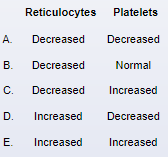
(Multiple Choice)
4.8/5 (90)
(90) 
Filters
- Essay(0)
- Multiple Choice(0)
- Short Answer(0)
- True False(0)
- Matching(0)