



 Chat with AI
Exam 2: Pediatric

Exam 1: Medicine2 k Questions
Exam 2: Pediatric723 Questions
Exam 3: Psychiatry336 Questions
Exam 4: Surgery563 Questions
Exam 5: Obstetrics & Gynecology469 Questions
Select questions type


A 5-year-old boy is brought to the clinic due to persistent ear drainage. The patient first developed drainage from his right ear 6 months ago. When the drainage did not improve with antibiotics, he was diagnosed with a cholesteatoma, which was removed. After surgery, the patient's symptoms improved but recurred following an episode of acute otitis media. Over the past 2 months, he has been treated with several oral antibiotics with only transient improvement. Examination shows copious, foul-smelling, purulent drainage from the right ear canal. The ear is suctioned, revealing a normal-appearing external canal. The tympanic membrane is heavily scarred with a large perforation and no cholesteatoma. Which of the following organisms is the most likely cause of this patient's infection?
(Multiple Choice)
4.8/5  (76)
(76) A 3-year-old boy is brought to the emergency department due to fever and respiratory distress. Medical history includes recurrent otitis media and a hospitalization for pneumonia. Immunizations are up to date. Height and weight are at the 40th percentile for age. Temperature is 39.5 C (103.1 F), blood pressure is 90/60 mmHg, pulse is 140/min, and respirations are 38/min. He is drooling and has marked stridor. Emergency intubation is performed, and an inflamed epiglottis is noted. Antibiotics are administered; blood culture grows Haemophilus influenzae type b. Laboratory results show deficient serum-specific antibody titers to tetanus, diphtheria, H influenzae type b, and pneumococcus. What additional testing is indicated in this patient?
(Multiple Choice)
4.9/5 (71)
(71) A 17-year-old girl is brought to the office by her mother, who says that the patient has become increasingly irritable and difficult to get along with since the academic year began 7 months ago. The mother says, "She reacts negatively whenever I try to reassure her that everything is okay. Just last week, she got upset when I complimented her outfit." The mother observes that her daughter always seems on edge and sleeps poorly. The patient says she lies awake at night reviewing conversations she had with peers at school and ruminating about whether she said the right thing. She also worries about maintaining her grades and getting into college and has concerns about her appearance and clothes. She recently met a boy she likes but is afraid of being rejected by him due to her acne. The patient wishes she could change but says, "I can't help it; I am always thinking too much." During the day, she feels tired and has difficulty concentrating. Which of the following is the most likely diagnosis?
(Multiple Choice)
4.9/5 (88)
(88) A 7-week-old boy is brought to clinic by his mother due to trouble stooling. The patient passed meconium in the first 24 hours of life and stooled easily for the first 2 weeks. To pass a stool now, he has to strain for approximately 10 minutes, during which he often cries, his body gets stiff, and his face turns bright red. This behavior is even more pronounced in the early morning, when the patient appears to be asleep but is found to be grunting and straining to pass stool. He stools 2 or 3 times daily, and the stools are soft, yellow, and seedy. The patient is exclusively breastfed without issues. Temperature is 36.8 C (98.2 F) and pulse is 135/min. Physical examination reveals a soft, nontender abdomen with mild distension and no palpable masses. Rectal tone is normal, and there is no anal fissure. Which of the following is the best next step in management of this patient?
(Multiple Choice)
4.7/5 (72)
(72) A 3-year-old girl is brought to the emergency department for sudden onset of weakness. She was well until this morning, when she woke up and was unable to climb out of bed. Her mother lifted her up, but the child was unable to bear weight on her right leg. She could not grasp her mother's hand to stand up. The patient has had no recent fevers or upper respiratory symptoms. She was adopted from Nigeria 6 months ago, and family history is unknown. The child has had no hospitalizations or illnesses since her adoption. Her developmental milestones have been appropriate for age. Temperature is 37.2 C (99 F), pulse is 140/min, and respirations are 18/min. The patient is awake and alert but has difficulty articulating. Her head is normocephalic and atraumatic. Pupils are 2 mm and react to light and accommodation. Tympanic membranes and pharynx are clear. Cardiovascular examination demonstrates tachycardia but normal S1 and S2 without murmurs. Lungs are clear on auscultation. There is significant weakness, hypotonia, and hyperreflexia of the right arm and leg. Neuroimaging studies are pending. Which of the following additional tests is most likely to reveal an underlying abnormality in this patient?
(Multiple Choice)
4.9/5 (75)
(75) A 16-year-old boy with Crohn disease is brought to the office due to diarrhea and rash. For the last 3 months, the patient has had watery, nonbloody diarrhea 3 or 4 times daily as well as a rash on his distal arms and legs that sometimes becomes intensely pruritic. He has also had a difficult time concentrating in school and has been less interested in his usual activities, such as skateboarding and rollerblading. Vital signs are normal. Physical examination reveals a smooth, red tongue. The abdomen is soft, is nontender, and has no hepatosplenomegaly. A dry, erythematous, and hyperpigmented rash is located on the distal arms and legs. The affected area has thickened skin and sharp lines of demarcation. Neurologic examination is normal. This patient's symptoms are most likely due to a deficiency of which of the following vitamins?
(Multiple Choice)
4.9/5 (72)
(72) A 4-year-old girl is brought to the emergency department due to blisters on her left hand. Two days ago, the patient developed small, fluid-filled lesions, which have since increased in size and are now mildly tender and itchy. She has a history of eczema and takes no medications. Temperature is 38.1 C (100.6 F). Vital signs are otherwise normal. Examination findings of the hand are shown in the image below. Which of the following is the most likely pathogen of this patient's condition? 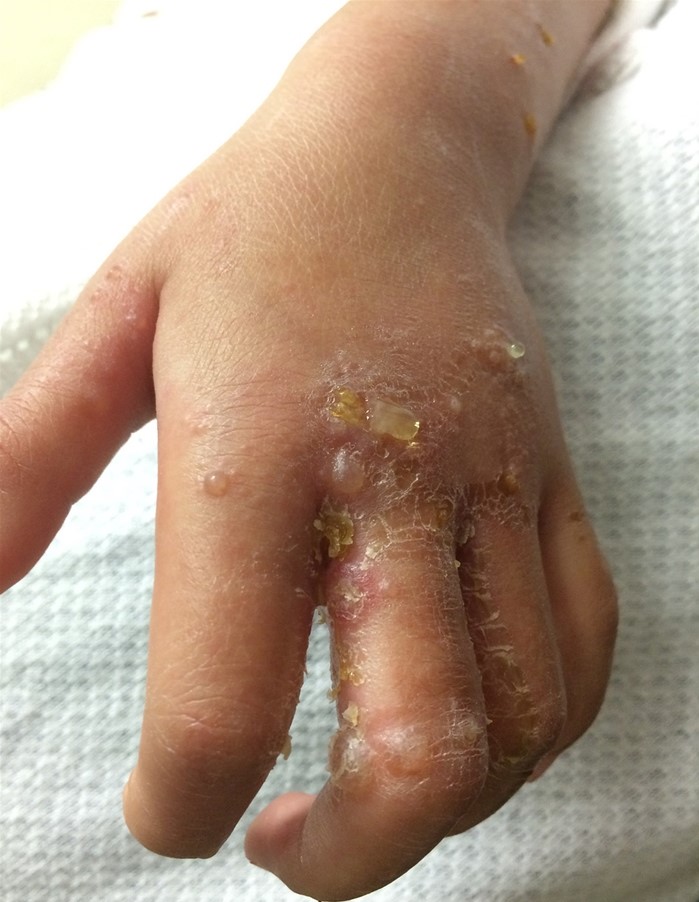
(Multiple Choice)
4.8/5 (83)
(83) A 10-month-old girl is brought to the office due to a rash. The patient has had a low-grade fever for the past 3 days that has been controlled with acetaminophen. A rash developed on her face 2 days ago and has since spread to her chest, abdomen, and extremities. The patient has had no cough, rhinorrhea, nasal congestion, vomiting, or diarrhea. She has otherwise been healthy. The patient has received all routine, age-appropriate vaccinations and takes no medications. Temperature is 38 C (100.4 F), blood pressure is 100/50 mm Hg, pulse is 88/min, and respirations are 18/min. Physical examination shows a playful infant with small, tender lymph nodes in the suboccipital, posterior auricular, and posterior cervical areas. There is patchy erythema on the soft palate. The rash is shown in the image below. A similar-appearing rash is present on the face. 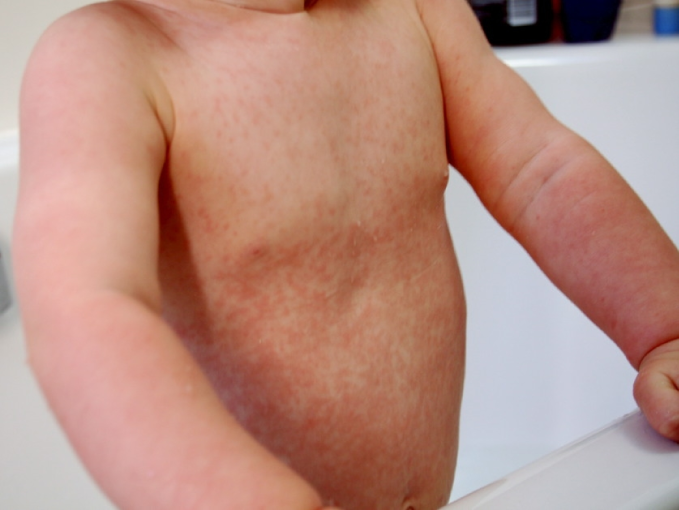
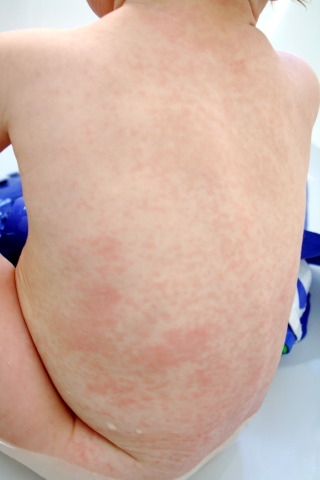 The remainder of the examination is normal. Which of the following diagnoses is most consistent with this patient's presentation?
 (Multiple Choice)
4.7/5 (73)
(73) A 13-year-old girl is brought to the clinic by her mother due to difficulty walking. The patient noticed a mild ache in both hips 2 months ago that occurred most days after walking home from school. The aches usually resolved after rest but this week, the aches have worsened to the point where she has difficulty walking, and ibuprofen only minimally relieves the symptoms. Her mother attributed the symptoms to muscle soreness related to deconditioning because the patient gained noticeable weight over the past year. The patient has no chronic medical conditions and takes no other medications. Height is at the 75th percentile, and weight is at the 97th percentile. Temperature is 37.4 C (99.3 F). The patient has a waddling gait with both feet turned laterally. Bilateral knees have full range of motion. Both hips externally rotate during hip flexion, and there are no palpable clicks when the hips are brought back to extension. There is limited internal rotation bilaterally. There is mild tenderness to palpation at the bilateral anterior groin. Which of the following is the most likely diagnosis in this patient?
(Multiple Choice)
4.8/5 (73)
(73) A 4-year-old boy is brought to the clinic due to fever for the past 5 days. He has also had a cough productive of yellow-green mucus. The patient had pneumonia a year ago that required hospitalization for hypoxia. Currently, he takes no daily medications other than acetaminophen as needed for fever. The patient has received all of his vaccinations except for an annual influenza vaccine. His family is originally from Peru, but he was born in the United States and has not traveled outside of the country. Temperature is 38.9 C (102 F), blood pressure is 90/60 mm Hg, pulse is 112/min, and respirations are 20/min. Pulse oximetry is 99% on room air. His weight is at the 75th percentile, and review of his medical records reveals that he is growing well. Physical examination reveals a young child with moist mucous membranes, rales and decreased breath sounds over the left lower lung, and comfortable work of breathing. Chest x-ray demonstrates an opacity over the lower left lung with minimal layering of fluid on lateral decubitus film. Which of the following is the most appropriate next step in management of this patient?
(Multiple Choice)
4.8/5 (75)
(75) A 4-year-old boy is brought to the emergency department for evaluation of persistent fevers. About 6 weeks ago, the patient developed rhinorrhea, cough, and body aches after returning from a family trip to Costa Rica. Although the other symptoms resolved, he still has intermittent fevers and aches. The fevers tend to spike in the evenings and are accompanied by a pink, nonpruritic rash. Both features completely resolve by morning. The patient has continued to attend preschool because he feels well during the day. However, he has had a fever and rash every evening for the last 5 days. The patient takes no medications. Temperature is 39.1 C (102.4 F). He appears tired. The oropharynx and bilateral tympanic membranes are normal. Cardiac examination shows tachycardia without murmurs. There are several pink macules at the waist and bilateral axillae. The spleen is palpable 3 cm below the costal margin. There is swelling of both knees and tenderness with deep palpation. Laboratory results are as follows:  Which of the following is the most likely diagnosis in this patient?
 (Multiple Choice)
4.9/5 (86)
(86) An 8-year-old girl is brought to the office due to a breast mass. The mother first noticed the mass when she was helping the patient try on a swimsuit last week. The mass is tender and located on the right side. The patient has no chronic medical conditions. Weight and height are at the 60th and 70th percentile, respectively. Examination shows a tender, firm, 2-cm mass posterior to the right nipple. There is no overlying erythema or axillary lymphadenopathy. Pubic hair development is Tanner stage 1. Which of the following is the most likely diagnosis?
(Multiple Choice)
4.8/5 (86)
(86) A 17-year-old boy is brought to the emergency department due to facial swelling. This morning, he developed mild swelling of the lips, which then progressed to severe diffuse facial swelling by the afternoon. The patient has had no fever, recent infections, abdominal pain, vomiting, or other swelling. He is a junior in high school and has been very stressed this week due to midterm examinations. His mother says that he had a similar episode when he had a tooth extracted a year ago. The patient has no chronic medical conditions and takes no medications. His father and paternal grandmother both have hypertension. Temperature is 36.9 C (98.4 F), blood pressure is 120/80 mm Hg, pulse is 82/min, and respirations are 18/min. Examination shows severe edema of the entire face; the patient is unable to open his eyes. The lungs are clear to auscultation, and neither stridor nor muffled voice is present. No rashes are detected. Mild edema of the hands is also seen. Which of the following best explains the pathophysiology of this patient's condition?
(Multiple Choice)
4.9/5 (75)
(75) A 5-hour-old girl is evaluated in the newborn nursery due to "crying a lot." She was born at 40 weeks gestation by vacuum-assisted vaginal delivery to a mother with gestational diabetes mellitus. The delivery was complicated by a prolonged second stage of labor due to difficulty in delivering the shoulders. Estimated fetal weight on prenatal ultrasound was 4 kg (8.8 lb). The patient's birth weight was 4.6 kg (10 lb). Physical examination shows a small area of scalp edema that does not cross suture lines. Palpation of the left clavicular bone reveals crepitus. Passive movement of the left upper extremity elicits crying. Moro reflex is decreased on the left. Bilateral extremities are neurovascularly intact. Which of the following is the best next step in management of this patient?
(Multiple Choice)
4.9/5 (87)
(87) A 6-year-old boy is brought to the clinic by his mother due to behavioral concerns. Several months ago, the parents divorced. Over the past month, the mother has noticed that the patient has become increasingly inattentive, which has affected his school and home life. At school, his first-grade teacher has noticed that he often stares into space, blinking for several seconds. Some students in his class have teased him because of this behavior. On several occasions at home, while helping to set the dinner table or while cleaning his room, he would pause. When questioned by his mother, the patient would ignore her, blankly staring before resuming the task. During physical examination, he is pleasant, talkative, and interactive. Neurologic examination shows intact cranial nerves. The patient has normal strength, sensations, and reflexes bilaterally. Gait is normal and Romberg test is negative. This patient would most likely benefit from which of the following?
(Multiple Choice)
4.9/5 (65)
(65) A 3-year-old boy is brought to the office due to a weeklong history of edema that is gradually worsening. The patient has not been ill recently, and his medical history is unremarkable. He takes no daily medications, and vaccinations are up to date. Temperature is 36.7 C (98.1 F), blood pressure is 104/76 mm Hg, pulse is 85/min, and respirations are 18/min. On examination, there is periorbital edema and 1+ pretibial pitting edema. The remainder of the physical examination is normal. Laboratory results are as follows:  Urinalysis shows 4+ proteinuria and no red blood cells. Which of the following is the best next step in management of this patient?
 (Multiple Choice)
4.7/5 (87)
(87) A 9-month-old girl is brought to the clinic for a well-child visit. She was born precipitously at 35 weeks gestation due to preterm labor to a 22-year-old primigravida who did not receive prenatal care. The patient's neonatal course was notable for a 1-week hospital stay due to difficulty feeding. She was hospitalized for bronchiolitis at age 3 months for 4 days. The patient can crawl but has not begun cruising. She has been babbling and repeating "mama." Height, weight, and head circumference track along the 25th percentile. She is alert and smiling at the examiner and her mother. Ophthalmoscopic examination reveals a white reflex in the left eye and a red reflex in the right. Extraocular movements are intact, and the pupils are equal and reactive to light. The corneal light reflex is symmetric. The remainder of the examination is normal. Which of the following is the most likely cause of this patient's physical examination findings?
(Multiple Choice)
4.8/5 (69)
(69) A 2-month-old girl is brought to the office by her parents for an initial visit. The family recently moved to the area, and the patient has not been seen by a health care provider since hospital discharge. She was born via scheduled cesarean delivery at 39 weeks gestation. Routine prenatal serology was normal. The patient developed jaundice at age 2 days with total bilirubin of 11.2 mg/dL. Her 2-year-old sister also has a history of neonatal jaundice, which required phototherapy. The family has a dog and a cat, both of whom live inside. Weight, length, and head circumference are in the 5th percentile. There is mild hepatosplenomegaly and jaundice, and cardiac auscultation shows a soft I/VI systolic ejection murmur. Ultrasound of the head reveals punctate calcifications around the ventricular margin. For which of the following complications is this patient at greatest risk?
(Multiple Choice)
4.9/5 (75)
(75) A 6-year-old boy is brought to the clinic by his parents due to 3 weeks of itchy, red eyes. The patient has had intermittent, mild, clear eye drainage and rubs his eyes frequently. These symptoms have worsened so that he now has difficulty paying attention at school. His parents have noticed some light crusting of both eyes when he wakes up in the morning. The patient has a history of mild, intermittent asthma for which he uses an albuterol inhaler. He lives with his parents, little sister, 2 cats, and a hamster. His sister has had rhinorrhea, cough, pharyngitis, and fever for 2 days. Vital signs are normal. Examination shows bilateral, diffuse conjunctival injection and mild eyelid edema. The child has no photophobia. Visual acuity is 20/20 in both eyes. Which of the following is the most likely etiology of this patient's condition?
(Multiple Choice)
4.9/5 (84)
(84) A 14-year-old girl is brought to the office due to a rash. Five days ago, the patient became ill with fever, sore throat, and malaise. Ibuprofen helped the fever. However, the sore throat persisted; so her father gave her amoxicillin, which was unused after a previous throat infection. The patient took the first dose of amoxicillin 3 days ago. Today, she noticed a rash over her entire body. She has no cough, abdominal pain, nausea, or vomiting. She has no other medical conditions and has taken amoxicillin previously without reaction. Temperature is 38.3 C (100.9 F), blood pressure is 110/70 mm Hg, pulse is 84/min, and respirations are 12/min. Examination shows enlarged, erythematous tonsils bilaterally with white exudates and diffuse bilateral cervical lymphadenopathy. Auscultation reveals a 1/6 systolic murmur along the left sternal border. The lungs are clear bilaterally. The abdomen is soft and nontender with mild hepatosplenomegaly. An erythematous, polymorphous, maculopapular rash is present over the entire body. Which of the following is the most likely diagnosis in this patient?
(Multiple Choice)
4.8/5 (78)
(78) 
Filters
- Essay(0)
- Multiple Choice(0)
- Short Answer(0)
- True False(0)
- Matching(0)