



 Chat with AI
Exam 2: Pediatric

Exam 1: Medicine2 k Questions
Exam 2: Pediatric723 Questions
Exam 3: Psychiatry336 Questions
Exam 4: Surgery563 Questions
Exam 5: Obstetrics & Gynecology469 Questions
Select questions type


An 11-year-old girl is brought to the clinic due to blurry vision. The symptoms began 2 weeks ago at school, when a teacher noticed that the child often moved closer to the front of the classroom to see the board. At home, the patient takes frequent breaks when playing video games because of nausea and headaches. She has type 1 diabetes mellitus, which was diagnosed 2 years ago after she was hospitalized for diabetic ketoacidosis. Since then, the diabetes has been well controlled with insulin. The patient's vision examination 6 months ago was normal. Visual acuity today shows 20/40 bilaterally with no changes after refraction. The pupils are equal and reactive to light, and extraocular movements are intact. Visual fields are full, with enlarged blind spots bilaterally. Dilated retinal examination is shown in the image below: 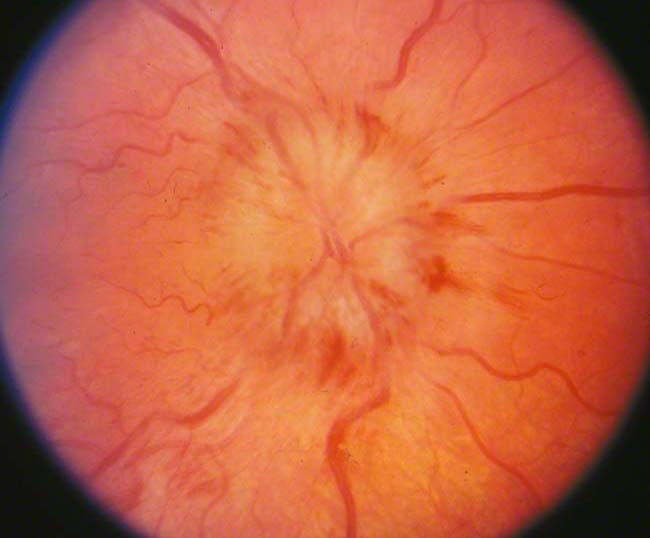 The remainder of the neurologic examination is normal. Which of the following is the most likely cause of this patient's symptoms?
 (Multiple Choice)
4.9/5  (92)
(92) A 7-year-old girl is brought to the emergency department by her father due to right hip pain. The patient first developed the pain yesterday after playing in the backyard. Her father placed ice on her hip, which initially helped, but after waking this morning, she refused to walk and now has pain in the left hip and left lower abdomen. The patient has no chronic medical conditions and takes no medications. Immunizations are up to date, and weight is at the 60th percentile. Temperature is 37.3 C (99.1 F), blood pressure is 94/66 mm Hg, pulse is 90/min, and respirations are 20/min. The patient is awake and alert. The oropharynx is clear. Cardiopulmonary examination is unremarkable. There is pain during passive range of motion of the right and left hips but no focal tenderness to palpation. Mild abdominal tenderness is present at the left lower quadrant. Several palpable petechiae are noted over the lower extremities. Complete blood count, coagulation studies, erythrocyte sedimentation rate, and urinalysis are normal. Which of the following is the best next diagnostic step in management of this patient?
(Multiple Choice)
4.9/5 (74)
(74) A 16-year-old boy comes to the emergency department due to sore throat and fever. He started having a mild sore throat after returning from summer camp about a week ago, and it has worsened in the last 2 days. The patient also has right neck pain and earache but no cough or shortness of breath. He does not use tobacco or illicit drugs and is not sexually active. Temperature is 38.8 C (102 F), blood pressure is 118/74 mm Hg, and pulse is 104/min. Enlarged and tender cervical lymph nodes are present. The patient is not able to fully open his mouth, but examination of the oral cavity shows pooling of saliva, a large right tonsil with swelling of the right soft palate, and deviation of the uvula to the left. Ear examination shows normal tympanic membranes. A rapid test for Streptococcus pyogenes is negative. Which of the following is the most likely diagnosis?
(Multiple Choice)
4.8/5 (75)
(75) A 1-day-old boy is evaluated in the nursery for minimal right-hand movement. He was born at 39 weeks gestation by forceps-assisted, vaginal delivery to a mother with insulin-controlled gestational diabetes mellitus and obesity. The delivery was complicated by shoulder dystocia. Birth weight was 4.4 kg (9.7 lb). Examination of the right upper extremity shows extension of the wrist, hyperextension of the metacarpophalangeal joints, and flexion of the interphalangeal joints. Grasp reflex is absent. Moro and biceps reflexes are intact. There is no crepitus. The left arm is normal. There is slight ptosis of the right eyelid, and the right pupil is 2.5 mm smaller than the left. The remainder of the examination is unremarkable. Which of the following is the most likely cause of this patient's presentation?
(Multiple Choice)
4.8/5 (72)
(72) A 40-year-old man comes to the office due to coughing while drinking. Over the past 2 months, the patient has been coughing when he drinks water because it "goes down the wrong pipe." On occasion, water will come out of his nose when drinking. Also, his speech sounds slurred and nasal. The patient has no medical conditions and takes no medications. On examination, there are no mucosal lesions in the oral cavity or oropharynx. Palate elevation is sluggish on the right side. The tongue appears thin and there are fasciculations. When the physician taps on the chin while the mouth is slightly open, the jaw jerks forward briskly. Which of the following is the most appropriate next step to establish a diagnosis in this patient?
(Multiple Choice)
4.9/5 (87)
(87) A 4-month-old girl is brought to the emergency department via ambulance after a seizure at home. The patient was born at 35 weeks gestation via spontaneous vaginal delivery to a gravida 3 para 3 woman. The pregnancy was complicated by limited prenatal care and polysubstance use disorder. The patient is currently cared for by a foster family. The foster mother says that she was bottle feeding when the patient's extremities suddenly started shaking. She was unresponsive for 1-2 minutes. On examination, the patient is sleeping but arouses with examination. Height and weight are at the 25th percentile, and head circumference is at the 97th percentile for age. Retinal examination reveals evidence of acute and chronic retinal inflammation and is shown in the image below: 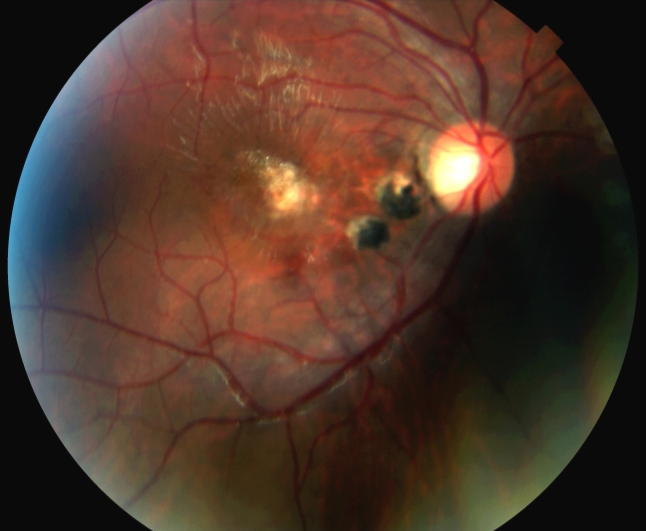 Heart and lung sounds are normal. The abdomen is soft with moderate hepatosplenomegaly. Which of the following is the most likely cause of this patient's presentation?
 (Multiple Choice)
4.8/5 (73)
(73) A 6-day-old boy is brought to the office for a routine visit after birth. The patient is exclusively breastfed with adequate voiding and stooling. Prenatal and birth histories are unremarkable. He was born full term via spontaneous vaginal delivery. Temperature is 37.2 C (99 F), blood pressure is 82/52 mm Hg, pulse is 144/min, and respirations are 42/min. Oxygen saturation is 98% on room air. The patient is comfortable and in no distress. Lungs are clear to auscultation. A soft, 2/6 holosystolic murmur is heard at the left lower sternal border. Apical cardiac impulse is normal. Brachial and femoral pulses are 2+ and equal. The skin is pink and well perfused. Which of the following is the most appropriate next step in management of this patient?
(Multiple Choice)
4.9/5 (82)
(82) A 2-year-old boy is brought to the office by his parents for a well-child check. This is the child's first appointment since the family purchased a new house, and the parents want guidance on how to best child-proof the home. They moved into a single-story house built in 1985 in a quiet neighborhood. Outside, there is an in-ground pool in the backyard and a private well used for drinking water. The father is a police officer and keeps his handgun unloaded and inside a safe in the home office. There is an electric water heater, central air conditioning, and grounded electrical outlets throughout the home. Which of the following is the best recommendation to provide safety for their child?
(Multiple Choice)
4.9/5 (68)
(68) A 7-year-old boy is brought to the office due to hair loss. For the last few weeks, he has had worsening hair loss in patches on the scalp. There is no associated pain or itching. Medical history is unremarkable, and the patient's height and weight have consistently tracked at around the 30th percentile for age. He has achieved developmental milestones within the normal range and has had no significant academic issues at school. Skin examination findings are as shown in the exhibit. 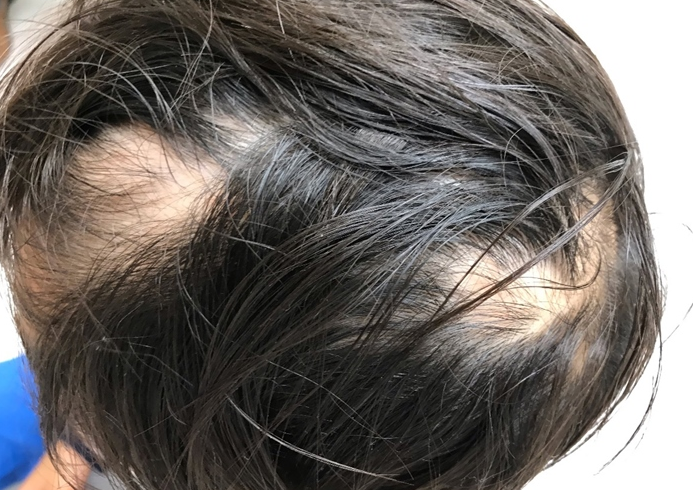 Which of the following is the most likely cause of this patient's hair loss?
 (Multiple Choice)
4.9/5 (79)
(79) A 9-year-old African-American boy is brought to emergency department due to high fever, poor appetite, and irritability. Blood pressure is 80/60 mm Hg and pulse is 140/min. He has been hospitalized several times before for poorly localized abdominal pain. He also has a history of hematuria. The boy has not received several routine vaccinations because his mother is afraid that they will cause autism. His hematocrit is 22% and the reticulocyte count is 12%. The patient dies several hours after the admission. This patient's death may have been prevented by which of the following?
(Multiple Choice)
4.8/5 (85)
(85) A previously healthy 9-year-old boy is evaluated for a deep puncture wound to the foot. He was walking barefoot on the beach when he stepped on a rusty nail. His parents cleaned the wound with soap and water and applied pressure to it. The boy takes no medications. He has not received any vaccinations due to parental preference. The boy's parents are divorced and have joint custody of him. The indications, benefits, and risks of tetanus vaccination are discussed with both parents. The mother consents to the proposed tetanus vaccination and requests that it be administered immediately. However, his father refuses to agree to the vaccination as he prefers to explore herbal remedies. Which of the following is the most appropriate next step in management of this patient?
(Multiple Choice)
4.9/5 (83)
(83) A 9-year-old boy is brought to the office by his parents for a well-child visit. The father is a certified personal trainer and has created a detailed strength training plan for the child; however, the mother is concerned about safety due to the child's age. The plan includes direct supervision of the child during warm-up as well as individualized exercises with light, free weights and weight machines using low resistance every other day. The child is eager to begin strength training. He is performing well in 5th grade and participates in soccer and lacrosse. The child has no chronic medical conditions and takes no medication. Vital signs are normal. BMI is above the 85th percentile for age. Sexual maturity rating (Tanner stage) is 1. Examination is otherwise unremarkable. Which of the following is recommended regarding exercise in this patient?
(Multiple Choice)
4.9/5 (82)
(82) A 3-hour-old boy is being evaluated in the newborn nursery. The patient was born via spontaneous vaginal delivery to a 25-year-old woman, gravida 2 para 2. The mother had no prenatal care and takes no medications. Head circumference is at the 90th percentile. Weight is at the 25th percentile. Temperature is 37.3 C (99.1 F), pulse is 140/min, and respirations are 32/min. Per the Ballard Score, the patient is at 38 weeks gestation. Head examination shows a full fontanelle. The ears are in the normal position. The oropharynx is clear. Cardiopulmonary examination is unremarkable. The abdomen is soft with no organomegaly. Examination of the back shows a large myelomeningocele. Bilateral lower extremities are flaccid. Head imaging is most likely to reveal which of the following?
(Multiple Choice)
4.7/5 (72)
(72) A 6-day-old boy is brought to the office for a routine visit after discharge from the hospital. He is exclusively breastfed and is gaining weight appropriately. He was born at 40 weeks gestation to a primigravida who had an uncomplicated vaginal delivery. Physical examination at rest shows bilateral medial deviation of the forefoot. Ankle movements appear normal, and passive and active movement of the foot results in lateral deviation of the forefoot. The remainder of the physical examination is normal. Which of the following is the best next step in management of this patient?
(Multiple Choice)
4.9/5 (98)
(98) A 3-year-old girl is brought to the emergency department due to a first-time seizure. The patient was watching television 30 minutes ago when her left arm began to twitch, which progressed to twitching in all 4 extremities and loss of consciousness for 1 minute. Medical history is notable for receptive and expressive language delays. Vital signs are normal. Examination shows a sleepy but arousable toddler lying on the bed. An erythematous patch is present on the right forehead and upper eyelid, which her parents say has been present since birth. There is a light brown macule with an irregular border measuring 0.5 cm on the abdomen. Skin examination is otherwise normal. Visual field examination reveals a left homonymous hemianopia. Neurologic examination is otherwise unremarkable. Which of the following is the most likely diagnosis in this patient?
(Multiple Choice)
4.9/5 (93)
(93) A 3-year-old boy is brought to the emergency department for evaluation of a rash. The rash started on his face yesterday and has since spread to his chest, back, and arms. He has also had a runny nose, dry cough, and fever for the past week. The patient is irritable and uninterested in playing. He has not received vaccinations since age 6 months and takes no medications. A few weeks ago, he went on a camping trip in North Carolina but has not traveled outside the country. Temperature is 40.6 C (105 F), pulse is 130/min, and respirations are 24/min. Examination shows a tired-appearing boy with watery and injected bilateral conjunctivae. Tiny white round lesions are present on the buccal mucosa next to the first and second upper molars. The oropharynx and tonsils are erythematous. Small, soft, mobile lymph nodes are palpated along the anterior and posterior cervical chains. The nontender, blanching rash is shown below. 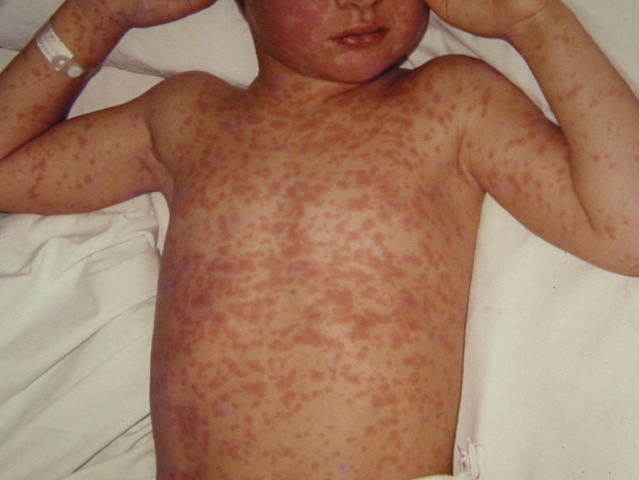 Which of the following is the most likely diagnosis in this patient?
 (Multiple Choice)
5.0/5 (85)
(85) A 1-month-old boy is brought to the emergency department due to poor feeding. Over the past 2 weeks, the patient has been breathing harder and faster during feeds with associated diaphoresis and pallor. He has not had fever and has never turned blue, stopped breathing, or lost consciousness. The patient has no sick contacts. Medical history is unremarkable, and he takes no daily medications. Temperature is 36.7 C (98 F), blood pressure is 90/46 mm Hg, pulse is 124/min, and respirations are 62/min. Oxygen saturation is 95% on room air. There is no stridor. Mild retractions are present. Physical examination reveals a 4/6 holosystolic murmur at the left lower sternal border associated with a palpable thrill. The lungs have rales at both bases. The liver is palpable 3 cm below the right costal margin. Which of the following is the most likely cause of this patient's clinical presentation?
(Multiple Choice)
4.8/5 (76)
(76) A 4-day-old, full-term boy is brought to the office for his first visit after an uncomplicated vaginal delivery and unremarkable newborn nursery course. The patient's mother, gravida 1 para 1, has blood type A positive, and prenatal laboratory results and ultrasound were normal. Birth weight was 3.4 kg (7 lb 8 oz) and length was 48.5 cm (18 in). He has been exclusively breastfed since birth and nurses for 10 minutes on each breast every 4 hours. The mother's milk began to come in this morning. The infant passed several dark brown, sticky, meconium stools during the first 2 days of life, but his last stool was yesterday and dark green. He has 2 wet diapers each day but has not voided today. The neonate's current weight is 3 kg (6 lb 10 oz). He has scleral icterus and jaundice of the face, chest, and abdomen. The rest of his physical examination is normal. Laboratory results are as follows:
 Which of the following is the most likely cause of this infant's hyperbilirubinemia?
 (Multiple Choice)
4.9/5 (75)
(75) A 6-hour-old boy is being evaluated in the nursery. He was born at 39 weeks gestation via spontaneous vaginal delivery to a 33-year-old primigravida. The pregnancy was complicated by intravenous drug use, and the mother was incarcerated for 2 months during the second trimester. First trimester serologies, including RPR, HIV antibodies, and hepatitis B surface antigen (HBsAg), were negative. Due to the mother's risk profile, follow-up testing was obtained during the third trimester and revealed the following:  Liver function testing was normal. Hepatitis C and repeat HIV testing were negative. The remainder of the pregnancy was uncomplicated. The infant weighs 3.7 kg (8 lb 3 oz). Physical examination of the infant is normal. There is no jaundice or hepatomegaly. Which of the following is the most appropriate next step in management of this infant?
 (Multiple Choice)
4.8/5 (86)
(86) A 36-year-old previously healthy man comes to the office due to neck pain. Two days ago, the patient was lifting weights when he suddenly experienced neck and upper back pain. He has had constant dull pain and intermittent sharp pain with neck movements that radiates to his left hand. He also reports a tingling sensation in the left hand but has had no weakness or bladder or bowel dysfunction. Vital signs are within normal limits. Physical examination shows cervical paraspinal muscle spasm. There is mildly decreased sensation to pinprick in the left fourth and fifth digits. There are no other sensory deficits and no upper or lower extremity muscle weakness is present. Deep tendon reflexes are normal throughout. Which of the following is the most appropriate next step in management of this patient?
(Multiple Choice)
4.9/5 (82)
(82) 
Filters
- Essay(0)
- Multiple Choice(0)
- Short Answer(0)
- True False(0)
- Matching(0)