



 Chat with AI
Exam 2: Pediatric

Exam 1: Medicine2 k Questions
Exam 2: Pediatric723 Questions
Exam 3: Psychiatry336 Questions
Exam 4: Surgery563 Questions
Exam 5: Obstetrics & Gynecology469 Questions
Select questions type


A 54-year-old man comes to the office due to recurrent falls. During ambulation, the patient prominently flexes his right hip and knee and the right foot slaps to the floor with each step. Romberg sign is absent. Which of the following is the most likely cause of this gait abnormality?
(Multiple Choice)
4.9/5  (86)
(86) A 16-year-old boy is brought to the clinic for evaluation of headaches. For the last month, he has had daily, throbbing pain in the frontal region that is worse in the morning and occasionally associated with nausea and vomiting. Acetaminophen provides some relief. The patient also had several brief episodes of blurriness in his left eye during football practice last week. In addition to acetaminophen, he takes oral isotretinoin for severe acne. Temperature is 36.7 C (98.1 F), blood pressure is 130/80 mm Hg, pulse is 70/min, and respirations are 15/min. The patient is sitting up and cooperative with the examination. The pupils are equal and reactive to light. Eye examination shows bilateral optic disc edema and decreased visual acuity. The visual fields are full. There is no neck stiffness. Motor examination reveals 5/5 strength, 2+ deep tendon reflexes, and a normal plantar response. Sensory examination is unremarkable. Which of the following is the most likely cause of this patient's symptoms?
(Multiple Choice)
4.9/5 (84)
(84) A 22-year-old woman comes to the office due to recurrent syncopal episodes. The first episode occurred about a year ago when her roommate died by suicide. Since then, she has had several similar episodes provoked by strong emotion. The episodes are preceded by lightheadedness, weakness, and blurred vision; last about 3 minutes; and end with rapid recovery of consciousness. The patient has had no significant injuries related to syncope except once when she had superficial bruises. Medical history is insignificant. She takes no medications and does not use alcohol or illicit drugs. Blood pressure is 110/70 mm Hg while supine and 108/70 mm Hg while standing. Physical examination findings are within normal limits. A recent ECG was normal. Which of the following is the best next step in management of this patient?
(Multiple Choice)
4.8/5 (88)
(88) A 4-month-old boy is brought to clinic by his mother for routine follow-up. He was last seen at his 2-month checkup. The mother reports that the patient continues to feed well but has noticed that his head is larger than other infants'. He can roll from front to back, sit straight when propped, and hold his head steady without support. The patient can bring objects to his mouth and make babbling sounds. The patient was born at 37 weeks gestation and adopted at birth. Temperature is 37.2 C (99 F), pulse is 130/min, and respirations are 30/min. Examination shows a symmetrical head with an open and soft fontanelle. Pupils are equal and reactive, and extraocular movements are intact. Eyes and ears are in the normal positions. The neck is supple. Abdominal and skin examination is unremarkable. Extremities appear normal. Growth charts are shown in the exhibit.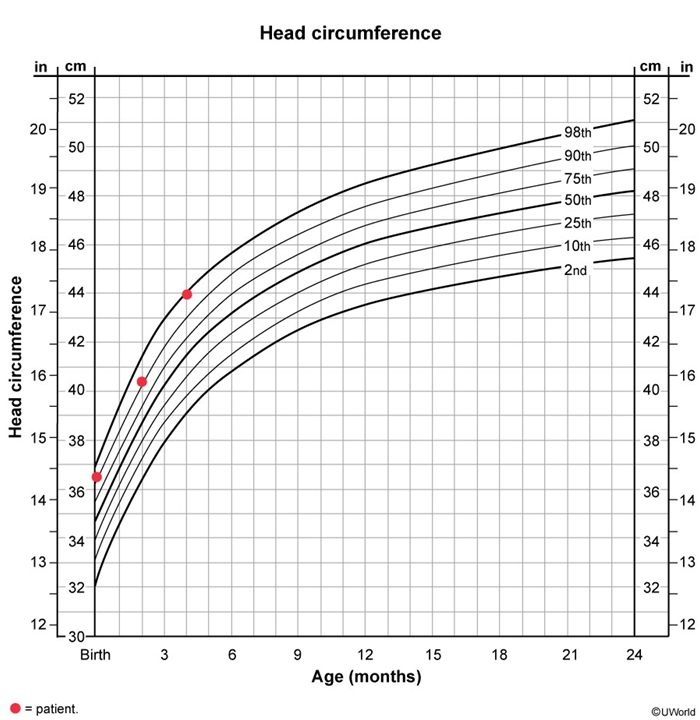
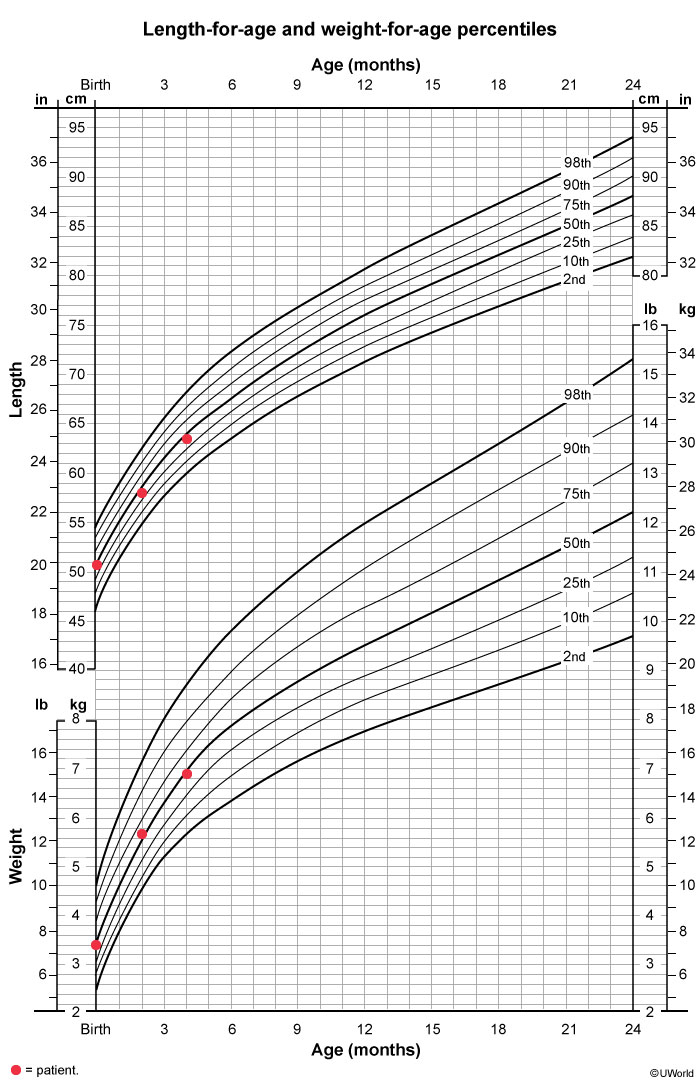 Head ultrasound shows normal ventricles and brain parenchyma. Which of the following is the best next step in management of this patient?
 (Multiple Choice)
4.7/5 (63)
(63) A term newborn is evaluated in the nursery 1 hour after a spontaneous vaginal delivery to a 28-year-old primigravida whose pregnancy was uneventful. The patient's Apgar scores were 9 and 9 at 1 and 5 minutes, respectively. Vital signs are normal. Physical examination shows a newborn sleeping comfortably with overlapping coronal sutures. There is a I/VI systolic murmur at the left upper sternal border that radiates to the axilla. The lungs are clear bilaterally. The abdomen is soft, and the liver is palpable 2 cm below the costal margin. Genitourinary examination shows curvature of an underdeveloped penis. The urethral meatus is at the ventral surface of the base and flanked by the surrounding scrotal sac. Gonads are not palpable. Examination of the back shows a sacral dimple with intact skin. The patient has normal fingers and toes. There is cyanosis in the digits. There is symmetric movement of all 4 extremities, and Moro and suck reflexes are normal. Which of the following is the best next step in evaluation of this patient?
(Multiple Choice)
4.7/5 (76)
(76) A 3-month-old boy is brought to the emergency department due to fever and respiratory distress. The patient's parents report that he has had a cough and labored breathing over the past 2 weeks. He was born at term and lives at home in North Carolina with his parents, 2 older siblings, and grandmother. The family has 2 dogs and a cat. The grandmother has a chronic cough, but there are no other sick contacts or recent travel. Temperature is 39.1 C (102.4 F). The patient is pale and lethargic. The liver and spleen are palpable 4 cm below the costal margin. CT scan reveals diffuse micronodular lesions in the lungs, liver, and spleen. The boy is intubated and admitted to the intensive care unit. Which of the following is the most likely cause of this patient's findings?
(Multiple Choice)
4.8/5 (84)
(84) A 2-day-old boy is evaluated in the newborn nursery. The patient was born at an estimated 40 weeks gestation to a 26-year-old primigravida who received no prenatal care. He has been taking 30 mL (1 oz) of a cow's milk-based formula every 3 hours since birth. The mother says the boy seems uncomfortable. She is worried about dehydration because he has been spitting up formula after his last few feeds and has only had one damp diaper and a single stool since birth. Birth weight was 3,200 g (7 lb 1 oz), and weight today is 3,260 g (7 lb 3 oz). Temperature is 36.7 C (98.1 F), pulse is 150/min, and respirations are 66/min. Pulse oximetry is 88%on room air. Lung examination shows diminished breath sounds bilaterally. Cardiac examination is normal. The abdomen is distended. The urethral meatus appears intact. A small sacral dimple with intact skin overlies the coccyx. His skin is warm and pink. Chest radiograph reveals diminished lung volumes bilaterally with a normal heart size. The patient is placed on supplemental oxygen. Which of the following is the best next step in the evaluation of this patient's condition?
(Multiple Choice)
4.8/5 (82)
(82) An 8-year-old girl is brought to the office due to involuntary movements of the hands and body for a week. The movements get worse when the patient feels anxious, and she cannot suppress them. She has also had an urge for frequent hand cleaning. Vital signs are normal. On examination, the patient has inappropriate laughing and frequent throat clearing. The tonsils are enlarged and hyperemic. Neurologic examination shows generalized, involuntary movements of the body. Grip strength is strong; however, the patient cannot maintain it because of irregular hand and arm movements. Cranial nerve, sensation, and mental status examinations show no abnormalities. Complete blood count, serum chemistries, and liver function studies are normal. What is the most likely cause of this patient's symptoms?
(Multiple Choice)
4.8/5 (72)
(72) A 62-year-old man with hypertension and stage 3 chronic kidney disease comes to the office due to poor sleep. The patient describes a crawling sensation in his legs about 15-20 minutes after getting into bed at night. Walking and pacing or wiggling his legs alleviates the symptoms, but they return when he gets back in bed. Physical examination shows no lower extremity sensory or motor abnormalities. The first-line pharmacotherapy for this patient's condition targets a receptor for which of the following substances?
(Multiple Choice)
5.0/5 (74)
(74) A 3-year-old boy is brought to the emergency department by his stepfather due to right knee swelling. The knee swelled immediately after the patient fell while playing outside. He is generally healthy and very active. His stepfather reports that last week while climbing on the living room couch, he fell onto the floor and developed a large bruise to his left hip. Temperature is 36.7 C (98.1 F). Examination shows an uncomfortable-appearing boy with significant swelling of the right knee. The patient has pain with knee movement and limited range of motion. An area of ecchymosis is seen on the left hip. There are also scattered ecchymoses to the anterior shins. The remainder of the physical examination is normal. Laboratory results are as follows:  Radiograph of the right knee shows a large effusion but no fracture. Which of the following is the best next step in management of this patient?
 (Multiple Choice)
4.7/5 (85)
(85) A 69-year-old man comes to the office due to progressive bilateral loss of vision over the past several months. He only has problems with his central vision. His peripheral field and navigational vision are not affected. He does not use tobacco or alcohol. The patient does not have a history of diabetes or hypertension. Two years ago, he had cataracts removed from both eyes. What is the most likely diagnosis?
(Multiple Choice)
4.9/5 (73)
(73) A 9-year-old boy is brought to the office by his father for evaluation of chest and abdominal discomfort. For the past several months, the patient has felt a "burning" sensation in his chest after eating. He was evaluated 6 weeks ago and had a normal examination and was prescribed a proton-pump inhibitor, which he has been taking daily. The patient says the medication doesn't seem to help, and now he has stomach aches after eating. His typical diet consists of soft foods, such as yogurt and mashed potatoes, and he tries to avoid solid foods due to stomach pain. He has also vomited a few times after eating, but his father is not sure if that was due to a specific food. The patient drinks water and no juice or soda. Temperature is 37 C (98.6 F). Physical examination shows eczematous patches on bilateral antecubital fossae and behind both knees. Endoscopy shows circular rings and thickened, linear furrowing of the esophagus. Histology results are pending. Which of the following is the most likely diagnosis?
(Multiple Choice)
4.8/5 (73)
(73) A 1-day-old girl is in the newborn nursery undergoing routine evaluation. She was born at term to a 24-year-old woman by uncomplicated vaginal delivery. The Apgar scores were 7 at 1 minute and 8 at 5 minutes. The prenatal course was complicated with asymptomatic bacteriuria that was treated with an antibiotic. The mother took multivitamins daily throughout the pregnancy. Physical examination of the infant shows bilaterally enlarged mammary glands. The labia are slightly swollen and blood-tinged vaginal discharge is seen. What is the best next step in the management of this patient?
(Multiple Choice)
5.0/5 (69)
(69) A 3-hour-old girl is being evaluated in the newborn nursery for excessive coughing. The patient was being bottle-fed by her mother and within a few minutes began coughing forcefully. The mother allowed the infant to rest, but she continued to cough. The patient was born via spontaneous vaginal delivery to a 30-year-old primigravida who had no prenatal care. Ballard score estimates the infant to be around 38 weeks gestation. Vital signs are normal. The patient is awake, and the coughing has subsided. The oropharynx is clear with an intact palate. Lung examination reveals coarse breath sounds, particularly on the right side. Abdominal examination shows no organomegaly. When a nasogastric tube is inserted, it encounters resistance at 10 cm. Chest radiograph shows that the end of the tube is at the upper esophagus. Which of the following additional evaluations is currently indicated in this patient?
(Multiple Choice)
4.9/5 (81)
(81) A 4-month-old boy is brought to the office due to occasional episodes of vomiting and irritability over several weeks. The vomitus occasionally resembles formula but is often green. The patient is irritable both before and after vomiting, typically refuses to feed, and often cannot be consoled. His mother has tried various formulas, without success, to improve the symptoms. The patient was born at 39 weeks gestation via cesarean delivery. An omphalocele diagnosed during the prenatal period was surgically repaired at birth without complications. Vital signs are normal. The neck is supple, and the anterior fontanelle is flat. The abdomen is soft, nontender, and nondistended. Bowel sounds are normal. Rectal examination shows normal, brown stool that is negative for fecal occult blood. Which of the following is the most likely cause of this patient's current symptoms?
(Multiple Choice)
4.8/5 (73)
(73) A 2-year-old boy is brought to the emergency department after swallowing magnets 45 minutes ago. The patient was playing with his older brother's toys when he ingested a few high-power, rare-earth magnets. He has no chest or abdominal pain, nausea, or difficulty breathing. When the patient drank water, he had no pain with swallowing. He has no medical conditions and has had no surgeries. Temperature is 36.9 C (98.4 F), pulse is 88/min, and respirations are 25/min. On examination, the patient is playful and not in distress. Cardiopulmonary examination is normal. The abdomen is soft and nontender. The remainder of the physical examination is unremarkable. Chest x-ray reveals 2 small, radiopaque objects in the distal esophagus; there is no mediastinal widening or subdiaphragmatic air. Which of the following is the best next step in management of this patient?
(Multiple Choice)
4.7/5 (74)
(74) A 9-year-old girl is brought to the clinic for evaluation of persistent nasal congestion. Her symptoms began 2 weeks ago with fever, rhinorrhea, and congestion. Over the last week, the patient has developed a dry cough that is worse at night, and she has had to miss her daily swim practice. Her mother had been treating the symptoms with acetaminophen and an over-the-counter cough and cold medication. The fever has resolved, but nasal symptoms have not improved. The patient has no chronic medical conditions and takes no daily medications. Her father smokes cigarettes outside the house. Temperature is 37.2 C (99 F). Examination shows erythema and swelling of the nasal turbinates with purulent nasal drainage bilaterally. Mucopurulent discharge is present in the posterior pharynx. Bilateral tympanic membranes are clear and mobile. The lungs are clear to auscultation. Which of the following is the most common risk factor for development of this patient's current condition?
(Multiple Choice)
4.8/5 (95)
(95) A newborn boy is undergoing evaluation immediately after birth in the delivery room. He was born to a primigravida mother at 38 weeks gestation. The prenatal course was otherwise uncomplicated, with negative routine infectious serologies and normal anatomic ultrasound. The amniotic fluid was clear. The infant cries immediately and is actively moving all 4 extremities. He is taken to a warmer and dried with blankets. A minute after delivery, heart rate is 120/min. He grimaces and cries vigorously during brief manipulation and examination by the provider. His body is pink but extremities are cyanotic. Which of the following is the most appropriate next step in the management of this patient?
(Multiple Choice)
4.9/5 (84)
(84) A 12-week-old female infant is brought to the office by her mother due to a three-week history of weakness, poor appetite, and choking spells during feeding. Other accompanying symptoms include excessive sleeping, constipation and apathy. Her prenatal history is unremarkable. She was delivered vaginally at 38 weeks of gestation. She was born outside the United States. Her weight and length at birth were within normal range. She is exclusively breastfed. Her mother's family history is unremarkable. The identity and family history of her father are unknown. The pertinent physical findings include apathy, weakness, hypotonia, large tongue, sluggish movement, abdominal bloating, and an umbilical hernia. Based on the given information, what is the most likely diagnosis?
(Multiple Choice)
4.7/5 (80)
(80) An 11-year-old girl is brought to the emergency department due to right shoulder pain. The patient first noticed the pain 4 days ago after softball practice. She has been placing cold compresses over the shoulder and taking acetaminophen with initial improvement, but the pain has awakened her from sleep the last 2 nights. Today she is unable to lift her right arm to brush her teeth. Four months ago, the patient was diagnosed with polyarticular juvenile idiopathic arthritis involving the wrists, knees, and ankles. She is taking methotrexate, and her symptoms had been gradually improving after dose adjustments. Temperature is 38.5 C (101.3 F). The patient holds her right arm at her side, and she resists attempts to move the shoulder due to pain. The overlying skin is warm. Bilateral wrists, knees, and ankles are mildly edematous. The shoulder joint is aspirated, and synovial fluid analysis reveals leukocyte count of 55,000 cells/mm3, with 80% polymorphonuclear cells and 20% lymphocytes. Which of the following is the best next step in management of this patient?
(Multiple Choice)
4.8/5 (87)
(87) 
Filters
- Essay(0)
- Multiple Choice(0)
- Short Answer(0)
- True False(0)
- Matching(0)