



 Chat with AI
Exam 2: Pediatric

Exam 1: Medicine2 k Questions
Exam 2: Pediatric723 Questions
Exam 3: Psychiatry336 Questions
Exam 4: Surgery563 Questions
Exam 5: Obstetrics & Gynecology469 Questions
Select questions type


A 6-week-old boy is brought to the physician with persistent, worsening vomiting over the past 2 weeks. The emesis occurs with every feed, is nonbilious, and is projectile in nature. The emesis has persisted even though his mother has tried small, frequent feeds and holding the infant upright after feeds. On physical examination, peristaltic waves are seen over the upper abdomen, and an olive-shaped mass is palpated in the right upper quadrant. Laboratory results are as follows: 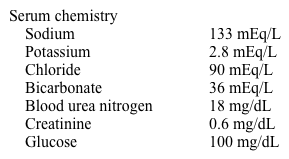 Which of the following is the most appropriate next step in management of this patient?
 (Multiple Choice)
5.0/5  (80)
(80) A 5-year-old girl is brought to the office for evaluation of "itchy private parts" for the past week. Her mother has noticed the scratching at bedtime but not during the day. Due to the itching, the patient has difficulty falling asleep. Her mother has been applying a topical emollient with only minimal symptom relief. The patient has no urinary symptoms and has soft bowel movements once every other day. She attends daycare during the week and lives with her mother, stepfather, and 13-year-old stepbrother, none of whom have similar symptoms. Physical examination shows an erythematous vulva and no vaginal discharge. The perianal area is excoriated and diffusely erythematous. No other lesions are noted. Which of the following is the most likely diagnosis in this patient?
(Multiple Choice)
4.8/5 (70)
(70) A 45-year-old white male presents with a 4-month history of headaches. The headache is generalized, dull, constant, and worsened by bending, coughing and sneezing. It is unresponsive to simple analgesics, and associated with nausea and vomiting. His wife says he has been acting strangely for the last few months, and she has noted a personality change. The neurological examination is non-focal. Fundoscopy reveals papilledema. His CT scan is shown below. 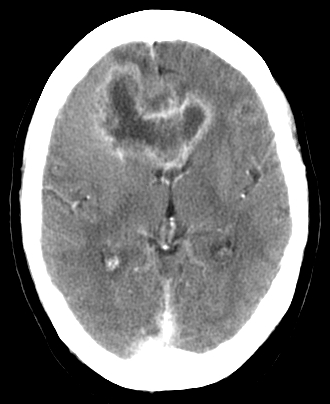 Which of the following is the most likely diagnosis?
 (Multiple Choice)
4.9/5 (69)
(69) A previously healthy 15-month-old girl is brought to the emergency department by her parents due to an episode of unresponsiveness. The patient was playing with her toys and, as the father removed them to prepare for bedtime, she began crying incessantly. There was a long pause in crying, during which the patient made no noise and stopped breathing until she turned blue, became limp, and was unresponsive for a few seconds. After this episode, she was alert and acted like her usual self. The patient takes no medications, and her vaccinations are up to date. Family history is unremarkable. She is at the 40th percentile for weight, height, and head circumference. Vital signs and physical examination are unremarkable. This patient's most likely diagnosis is associated with which of the following?
(Multiple Choice)
5.0/5 (89)
(89) A 12-year-old boy is brought to the office due to a left neck mass. One month ago, he had a fever and upper respiratory tract infection symptoms. A week later, he noticed a painful lump in the left side of his neck. He also has leakage of fluid from a hole below the mass. On examination, there is a cystic left neck mass and a small pit anterior to the sternocleidomastoid muscle that is leaking mucopurulent fluid. Which of the following is the most likely diagnosis of this lesion?
(Multiple Choice)
4.9/5 (72)
(72) A 16-year-old boy is brought to the clinic for evaluation of intermittent fevers. He first noticed symptoms after returning from a rabbit hunting trip in Pennsylvania a month ago. Initially, the fevers occurred every few days; however, for the past 2 weeks, he has had daily temperature spikes ?38.1 C (100.6 F). The patient has been taking acetaminophen daily, which reduces the fevers only temporarily. Since the trip, he has also noticed a swelling above his right collarbone that has enlarged to the size of a quarter. He has no dyspnea, night sweats, or weight loss. The patient has no chronic medical conditions, and immunizations are up to date. He has 3 pet cats at home. He is sexually active and has had 3 lifetime partners. Temperature is 38.3 C (100.9 F). Multiple small right anterior cervical lymph nodes are palpable. The right supraclavicular fossa has a solitary, firm, 2.5-cm (1-in) palpable lymph node. Cardiopulmonary examination is normal. The abdomen is soft with no palpable masses. Biopsy of the lymph node is shown in the exhibit. 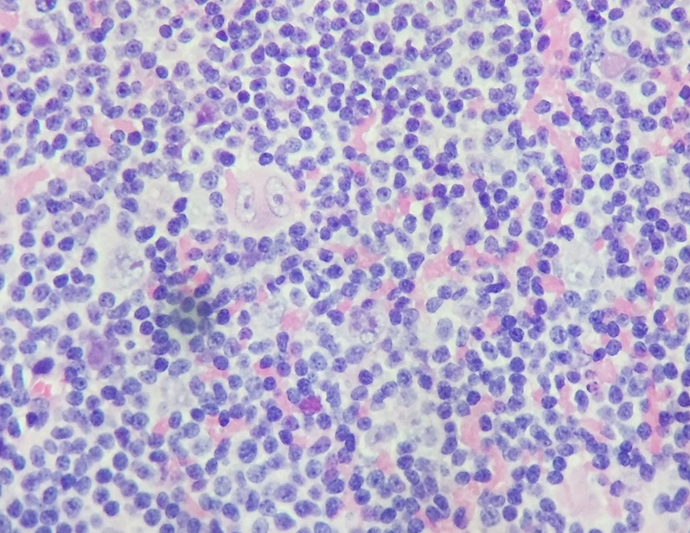 Which of the following is the most likely diagnosis for this patient?
 (Multiple Choice)
5.0/5 (93)
(93) A 5-year-old boy is brought to the clinic by his parents due to hearing loss. Over the past year, the patient has had increased difficulty hearing normal conversations. He was born at 36 weeks gestation and was small for gestational age but otherwise has had no medical problems. He is at the 50th-75th percentile for height, weight, and head circumference. A tuning fork held over the middle of the forehead sounds louder in the left ear. Tuning fork sounds are better heard with air conduction bilaterally. Which of the following is the most likely etiology of this patient's hearing loss?
(Multiple Choice)
4.8/5 (75)
(75) A 5-year-old boy is brought to the emergency department with eye pain. This morning, the boy began to have right eye pain that did not improve with ibuprofen and warm compresses. Over the last few hours, he has had blurred vision. The patient has a history of frequent otitis media, multiple dental caries, recurrent sinusitis, and atopic dermatitis. He is allergic to mosquito bites, which result in urticaria. Temperature is 39.4 C (102.9 F), blood pressure is 100/70 mm Hg, pulse is 120/min, and respirations are 20/min. The patient is cooperative but appears tired and uncomfortable. Visual acuity is 20/70 in the right eye and 20/10 in the left. Examination shows conjunctival injection, proptosis, and periorbital edema and erythema on the right. Neurologic examination reveals limited adduction of the right eye and pain with extraocular movements. Funduscopic examination is normal. The left eye is normal. There is moderate tenderness to palpation over the right cheek. Examination of the oral cavity shows a large, malodorous dental caries in the left lower second molar. The remainder of the examination is unremarkable. Which of the following predisposing factors is most likely responsible for this patient's condition?
(Multiple Choice)
4.8/5 (67)
(67) A 7-year-old boy comes to the office with his father due to nighttime bed wetting. The patient was daytime toilet trained by age 2 but has continued to wet his bed about 3 nights a week, leading to several canceled camping trips. The patient urinates 5 or 6 times during the day and has no urgency or dribbling. He has a soft bowel movement every day. His father achieved nighttime dryness at age 9. Medical history includes attention deficit hyperactivity disorder that is treated with lisdexamfetamine. The patient is seeing a speech therapist for stuttering and has struggled with low self-esteem. He was born at 34 weeks due to non-reassuring fetal heart tones. Growth and development have been on track. Vital signs, examination, urinalysis, and urine culture are normal. Which of the following is the greatest risk factor for this patient's nighttime bed wetting?
(Multiple Choice)
4.9/5 (83)
(83) A 6-month-old boy is brought to the clinic for routine care. He cannot sit with support, and his mother is concerned that his head is large for his age. For the last week, the patient has napped more frequently and vomited at the end of sleep. Height and weight are at the 25th percentile. Head circumference is at the 95th percentile (increased from the 50th percentile at birth and the 75th percentile at age 4 months). The anterior fontanelle is bulging. MRI of the head is shown in the image below: 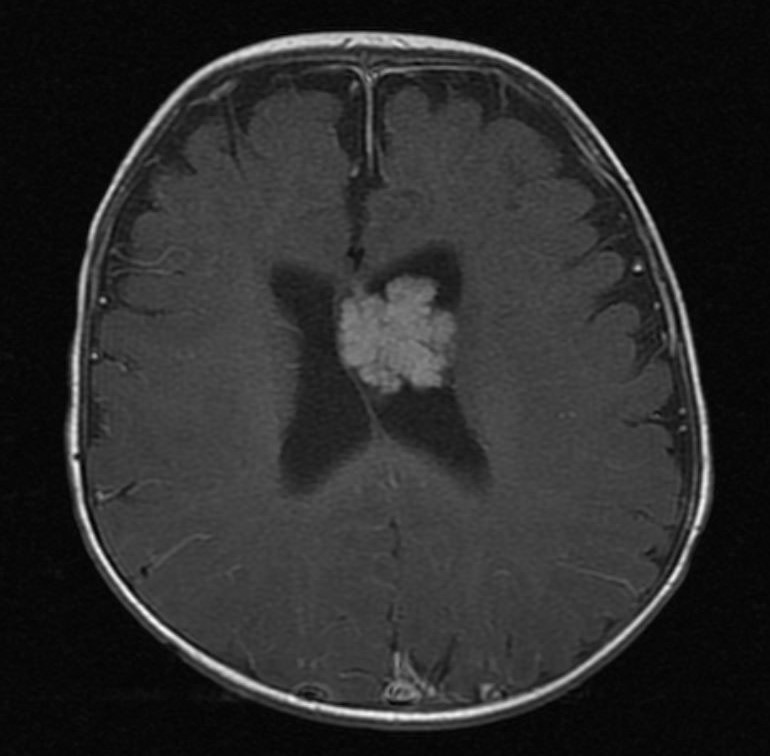 Which of the following is the most likely cause of this patient's condition?
 (Multiple Choice)
4.8/5 (73)
(73) A 3-year-old boy is brought to the office by his parents for the evaluation of dry eyes and photophobia. He has some difficulty in adapting to darkness. He is a very poor eater, and his diet consists mainly of canned foods, and very rarely, fresh vegetables or milk. Examination reveals dry, scaly skin, follicular hyperkeratosis in the extensor surfaces of the extremities, and dry, silver-gray plaques on the bulbar conjunctiva. What is the most likely diagnosis of this patient?
(Multiple Choice)
4.8/5 (86)
(86) An 8-year-old boy is brought to the emergency department due to a staring episode this evening. While eating dinner, the parents first noticed the patient's head tilt to the right, followed by right arm twitching. The patient then began chewing his lips and picking at his shirt while staring straight ahead. He did not respond to his name or to touch. The episode lasted for 2-3 minutes, and the patient seemed confused and tired afterward. He had no incontinence during the event but was unable to move his right arm for 5-10 minutes afterward. The patient has no other medical conditions or allergies. He was previously doing well in school, but his grades have declined over the past few months, and his teacher has noted that he seems intermittently distracted. Vital signs are normal. Physical examination shows an awake and alert child. Cranial nerves are intact, and reflexes are 2+. Romberg test is negative. An interictal electroencephalogram is normal and does not change with hyperventilation. Which of the following is the most likely diagnosis in this patient?
(Multiple Choice)
4.8/5 (65)
(65) A 40-year-old woman comes to the office due to worsening gait disturbances over the past several months. The patient has had difficulty taking steps, as if her feet were stuck to the floor, and she feels unsteady while walking. She has had no falls, headache, vertigo, vision loss, or focal weakness or numbness. Three years ago, the patient had subarachnoid hemorrhage (SAH) from ruptured posterior communicating artery aneurysm, which was treated with endovascular coiling; she has had no recurrent bleeding. She has no other medical conditions and takes no medications. Vital signs are within normal limits. Physical examination shows flat affect and psychomotor retardation. The pupils are equal and reactive to light. The cranial nerves and funduscopic examination are unremarkable. Muscle strength, deep tendon reflexes, and sensation are normal throughout. The gait is slow and wide-based with small steps. MRI of the head is shown in the exhibit. 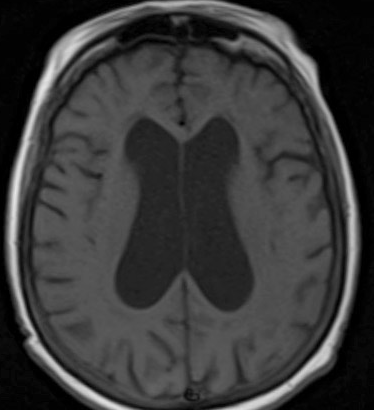 Lumbar puncture reveals normal opening pressure, and the cerebrospinal fluid cell counts and laboratory studies are within normal limits. Which of the following is the most likely cause of this patient's gait disturbance?
 (Multiple Choice)
4.8/5 (71)
(71) A 13-year-old girl comes to the office for a routine well-child visit. She reports skin lesions on her trunk that are not painful or pruritic but have increased in size and number over the past few years. She has no chronic medical problems and takes no medications. Vital signs are within normal limits. Physical examination reveals several large, uniformly pigmented, macular skin lesions. Her eye examination is shown below. 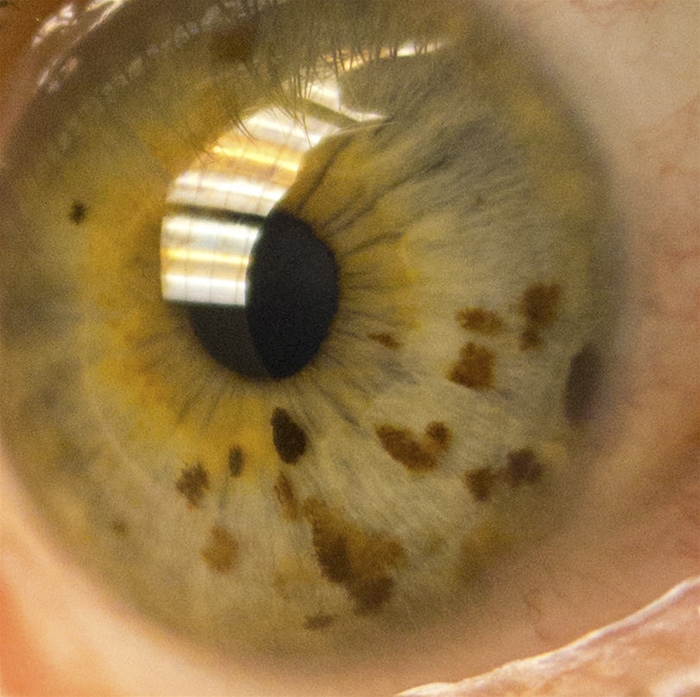 This patient is at greatest risk of developing which of the following?
 (Multiple Choice)
4.8/5 (74)
(74) A 30-month-old is brought to the office by his parents for a well-child visit. The parents are divorced and share custody. They disagree about car safety and ask for advice about his car seat. He currently sits in a rear-facing car seat. His mother says that the car seat manual states that the boy's height and weight are acceptable to remain in this position. His father says that the boy's legs are bent against the back seat while he is rear-facing and that other children in the preschool face forward in their car seats. The parents also have a 10-year-old daughter who was a similar size and had transitioned out of rear-facing by this age. The boy is 95th percentile for height and weight. Which of the following is the most appropriate advice for this patient?
(Multiple Choice)
4.9/5 (85)
(85) A 21-year-old man comes to the emergency department due to unsteady gait and difficulty urinating for a day. Over the past 4 days, the patient has noticed numbness beginning in both feet and gradually progressing to the thighs, buttocks, and abdomen. He has no pain. Temperature is 37 C (98.6 F), blood pressure is 120/70 mm Hg, pulse is 88/min, and respirations are 18/min. On examination, sensation to light touch, temperature, and pinprick is reduced below the midthoracic region. Vibration and joint position sensation are absent in both feet. Muscle bulk and tone are normal, but strength in both lower extremities is 4/5. Deep tendon reflexes in the lower extremities are brisk with bilateral upgoing plantar reflexes. Upper extremity examination is normal. Which of the following is the most likely diagnosis?
(Multiple Choice)
4.9/5 (81)
(81) A 12-year-old boy is brought to the office by his parents due to progressive back pain. The pain began several months ago in the central low back during sports practice. Over the last month, the pain has persisted after other activities and occasionally radiates to the patient's buttocks and legs. Neither acetaminophen nor ibuprofen has significantly improved the pain. The patient has had no fever, rash, or other joint pain. He participates in golf and competitive diving. Medical history is unremarkable. His mother and maternal aunt have rheumatoid arthritis. Temperature is 36.7 C (98 F), blood pressure is 110/65 mm Hg, pulse is 80/min, and respirations are 16/min. Physical examination reveals a palpable step-off in the lumbosacral area. The pain is reproducible with lumbar extension; lumbar flexion is painless. Straight-leg raising test is normal bilaterally. Gait is normal. Which of the following is the most likely diagnosis?
(Multiple Choice)
4.8/5 (73)
(73) A 4-week-old girl is brought to the office after her parents noticed bright red blood in the stool this morning. The stool was looser than normal and had streaks of blood in it. The patient also has been fussier than usual with feeds over the past day. There have been no changes in her intake, which consists of a standard cow's milk-based formula taken every 3 hours. The patient was born at full term following an uncomplicated delivery. Her weight is tracking along the 50th percentile. Vital signs are normal. She is alert and well appearing. The remainder of the examination is normal. Which of the following is the most likely cause of this patient's gastrointestinal symptoms?
(Multiple Choice)
4.9/5 (95)
(95) A 16-year-old boy is brought to the office by his parents for evaluation of depression. For the past 2 weeks, the patient has cried daily since his girlfriend ended their relationship. After school, he has gone directly to his bedroom and has avoided his parents. The patient quit his high school baseball team last week and now only plays violent video games. He sleeps the majority of the day and states that he has no energy and that his appetite has decreased substantially. The patient also falls asleep in class, when he's not skipping school, and his grades have dropped. Last week, he got into a fight with a classmate. The patient's father is an avid hunter and keeps multiple firearms in the basement of their home. Examination shows a cooperative boy with a flat affect. He says that he has no suicidal or homicidal ideation but has multiple superficial lacerations on the wrists and forearms. Which of the following would be the most effective recommendation for decreasing this patient's immediate suicide risk?
(Multiple Choice)
4.7/5 (78)
(78) A 4-year-old boy is brought to clinic for evaluation of crossed eyes. The mother noticed that the patient's left eye has been very slightly deviated toward the nose over the last few months. The patient has no chronic medical conditions and takes no medications. Vaccinations are up to date. Visual acuity screen reveals 20/20 and 20/50 in the right and left eyes, respectively. Corneal light reflex is central in the right eye and temporal in the left eye. When the right eye is covered, the left eye shifts fixation from a nasal to temporal direction. When the left eye is covered, the right eye remains in midline position. Red reflex is more intense in the left eye. Dilated funduscopic examination is normal bilaterally. In addition to corrective lenses, which of the following is the best next step in management of this patient?
(Multiple Choice)
5.0/5 (83)
(83) 
Filters
- Essay(0)
- Multiple Choice(0)
- Short Answer(0)
- True False(0)
- Matching(0)