



 Chat with AI
Exam 2: Pediatric

Exam 1: Medicine2 k Questions
Exam 2: Pediatric723 Questions
Exam 3: Psychiatry336 Questions
Exam 4: Surgery563 Questions
Exam 5: Obstetrics & Gynecology469 Questions
Select questions type


A 12-month-old boy is brought to the office by his parents for a routine well-child visit. He was born at 39 weeks gestation. Birth weight was 3.4 kg (7 lb 8 oz) and length was 50.8 cm (20 in). He was primarily breastfed until last week, when he was transitioned to cow's milk. The patient can feed himself small pieces of table food with his thumb and first finger and drinks from a sippy cup. His only words are "mama," "dada," and "doggy." His parents are concerned about his growth because some children at his day care center seem taller. The patient weighs 12 kg (26.5 lb) and is 76.2 cm (30 in) tall. On examination, he can pull himself up to stand and stand unassisted but requires holding onto objects for support while walking. He comes to his parents when called by name but does not speak during the examination. Which of the following is the most appropriate assessment of this patient's development?
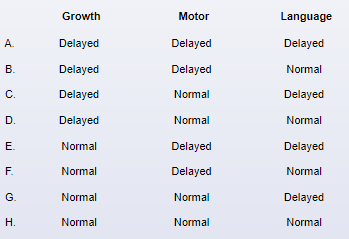
(Multiple Choice)
4.8/5  (82)
(82) A 65-year-old man comes to the office due to unsteady gait and frequent falls over the past 2 months. His left side feels "weak," which makes it difficult to maintain balance when walking or standing. He has also had headaches and nausea, which are worse in the mornings before he has had coffee. The patient has a history of hypertension and type 2 diabetes mellitus, and he had a myocardial infarction 5 years ago. He takes insulin for diabetes mellitus but does not routinely monitor his blood glucose. The patient is a former smoker and does not use alcohol or illicit drugs. Blood pressure is 130/80 mm Hg and pulse is 76/min. Ambulation results in the patient swaying to the left and using the wall to brace himself. There is increased resistance to passive flexion of the left upper and lower extremity. Which of the following is the most likely cause of his current condition?
(Multiple Choice)
4.9/5 (79)
(79) A 13-year-old girl is brought to the office by her mother for a preparticipation sports physical. She is planning to play lacrosse, which she had played the previous school year. The coach notified the mother that the girl's posture seemed abnormal. The patient has no chronic medical conditions and takes no daily medications. She has not undergone menarche. BMI is at the 50th percentile. Physical examination shows a right-sided lumbar prominence during forward bend test, and there is no tenderness of the spine. The remainder of the examination reveals no abnormalities with normal neurologic function. Which of the following is the best next step in the management of this patient?
(Multiple Choice)
4.8/5 (85)
(85) A 58-year-old man comes to the office accompanied by his wife, who is concerned about his abnormal behavior during sleep. Several years ago she first noticed that he would occasionally shout and jerk his arms and legs while remaining asleep. Over the past year, these episodes have become more frequent, occurring 3-4 nights a week, and his movements have become more violent. The episodes typically occur at least 2 hours after he has fallen asleep. Sometimes he kicks and punches his wife as if he were defending himself from attack. The patient has fallen out of bed on occasion and once knocked over the nightstand. His wife is afraid that he will inadvertently injure himself or her. The patient has no history of irritable, aggressive, or violent behavior during the day or any history of sleep difficulties; however, his dreams have become more intense and he has frequent nightmares of being attacked. He has a history of hypertension that is well controlled. Physical examination is unremarkable. This patient is at greatest risk of developing which of the following disorders?
(Multiple Choice)
4.8/5 (78)
(78) A 3-year-old girl is brought to the emergency department by her babysitter for evaluation of burns. The babysitter states that she was bathing the child when the child turned on the hot water. The child began crying and was quickly removed from the water. The patient lives with her biological parents, who are at work, and has been cared for by this babysitter for the last 6 months. Examination reveals an alert child who is crying inconsolably and in severe pain. The back, buttocks, and legs have patches of blistered, waxy, red skin. If found in this patient, which of the following burn characteristics would be most concerning for child abuse?
(Multiple Choice)
4.9/5 (93)
(93) A 5-year-old boy is brought to the clinic for a routine examination. The patient is doing well at his preschool and is making friends. His parents report that he has been sleeping longer than usual, often into the afternoon on weekends. They think it is because he is staying up late watching television, and they note he is moving closer to the screen because he cannot see the images clearly. Now, when he wakes up in the morning, the patient has a headache throughout his head that does not resolve with over-the-counter acetaminophen. The patient's father has obstructive sleep apnea and wears a continuous positive airway pressure mask at night. Height is at the 5th percentile and weight is at the 25th percentile. Temperature is 36.7 C (98 F). Visual acuity is decreased bilaterally. The cranial nerves are intact. Cardiopulmonary examination is normal. Skin reveals numerous freckles in the axillae and 8 flat, small, uniformly hyperpigmented macules on the trunk. Which of the following is the best next step in management of this patient?
(Multiple Choice)
4.9/5 (82)
(82) A 16-year-old boy is brought to the emergency department due to an eye injury. About an hour ago, he was playing paintball and was shot in the face by an opponent. The patient was not wearing eye protection. He felt immediate pain and had difficulty seeing. He has no chronic medical conditions. Temperature is 37.5 C (99.5 F). Examination shows periorbital edema and ecchymosis with proptosis of the left eye. Palpation over the left eyelid reveals rock-hard induration. Visual acuity is 20/100 in the left eye and 20/20 in the right. There is a relative afferent pupillary defect in the left eye. Which of the following is the best next step in management of this patient?
(Multiple Choice)
4.8/5 (89)
(89) A 3-year-old boy with sickle cell anemia is brought to the emergency department due to fever. He has chills but no bone pain, cough, or difficulty breathing. The patient's medical history includes hospitalization as an infant for dactylitis and again last summer for splenic sequestration crisis. Other than ibuprofen and acetaminophen for fever and pain, he takes no medications regularly and his vaccinations are current. Temperature is 39.5 C (103.2 F), blood pressure is 78/40 mm Hg, pulse is 140/min, and respiratory rate is 22/min. Physical examination shows a lethargic boy with mild pallor. Laboratory results are as follows: 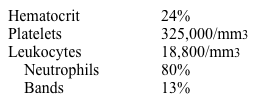 Blood culture is pending. Which of the following organisms is the most likely cause of this patient's condition?
 (Multiple Choice)
4.9/5 (76)
(76) A 5-year-old girl is brought to the emergency department due to 3 days of fever and cough. Physical examination shows increased respiratory effort and right-sided crackles. Neutrophilic leukocytosis and a right lower lobe consolidation are present. The patient is admitted to the hospital, and intravenous ceftriaxone and azithromycin are started. An hour later, the patient reports upper abdominal discomfort, and the urine is noted to be dark colored. On repeat examination, the patient appears listless and has tachycardia, tachypnea, and mild upper abdominal tenderness. Repeat laboratory results are as follows:  Which of the following is most likely to reveal the cause of this patient's deterioration after hospitalization?
 (Multiple Choice)
4.9/5 (73)
(73) A 5-year-old boy is brought to the emergency department by his parents due to difficulty walking. The patient first developed pain in the legs this morning and has not wanted to walk today. He played 2 soccer games yesterday with no pain or trauma. A week ago, the patient had a low-grade fever and cough that have since resolved. He has had no nausea, emesis, diarrhea, weight loss, or night sweats. The patient has no significant medical history and takes no daily medications. Temperature is 36.7 C (98.1 F), blood pressure is 90/40 mm Hg, pulse is 138/min, and respirations are 20/min. Examination shows an uncomfortable-appearing boy lying in bed; the patient cries with any attempt to move his legs. A purplish, nonblanching rash is noted over the buttocks and posterior thighs. The abdomen is soft with active bowel sounds. There is mild, diffuse tenderness to palpation with no rebound or guarding. Lower extremity joints demonstrate no deformity, erythema, swelling, or warmth. The patient refuses to walk due to pain in his legs. Laboratory results from urinalysis are as follows:  This patient is at greatest risk for developing which of the following complications?
 (Multiple Choice)
4.9/5 (75)
(75) An 18-month-old boy is brought to the emergency department due to blood in his stool, which the parents noticed when changing his diaper. The infant has had no previous bleeding and has been eating and drinking normally. He has a history of recurrent otitis media, frequent herpes labialis, and 2 episodes of pneumonia. Vital signs are normal. On examination, the patient is well developed, well nourished, and has a fair complexion. He has eczema on his cheeks, trunk, and extremities. Scattered petechiae are also visible on his lower extremities. The remainder of the physical examination is unremarkable. Laboratory studies show a platelet count of 24,000/mm3 and a leukocyte count of 9,000/mm3. Peripheral smear confirms the low platelet count and that the platelets are small. Genetic testing confirms the diagnosis. Which of the following processes is most likely affected by this patient's gene mutation?
(Multiple Choice)
5.0/5 (99)
(99) You are called to the nursery to evaluate a newborn infant. The mother is a 24-year-old primigravida. Her pregnancy was complicated by preeclampsia. The infant was delivered at 39-weeks gestation via emergent cesarean section due to maternal hypertension and non-reassuring fetal heart tones. On examination, the infant's weight is 2.6 kg (5 lb 11 oz) placing him in the 5th percentile, height is 18 inches (46 cm) placing him in the 5th percentile, and head circumference is 13 inches (33 cm) placing him in the 10th percentile. The infant's head seems large for his body. There is a paucity of subcutaneous fat. The remainder of the physical examination is unremarkable. This infant is at risk for having (or developing) which of the following?
(Multiple Choice)
5.0/5 (81)
(81) A 5-year-old girl is brought to the clinic due to abdominal cramping and diarrhea. The diarrhea started 3 days ago and was initially watery but now contains visible mucus. The patient attends a small day care where several other children have recently developed similar diarrhea. Temperature is 38.3 C (101 F), blood pressure is 100/62 mm Hg, and pulse is 98/min. On examination, she appears uncomfortable but is appropriately answering questions and is interactive. The mouth is slightly dry. Heart and lung examinations are normal. The abdomen is diffusely tender to palpation without hepatosplenomegaly. A stool sample is positive for occult blood, and a stool culture is also obtained. The patient tolerates fluids she receives in the office. In addition to encouraging increased fluid intake, which of the following is the most appropriate management of this patient?
(Multiple Choice)
4.8/5 (83)
(83) A 15-year-old girl comes to the office due to yellow vaginal discharge for the past 2 days. The patient has also had bleeding between menstrual periods for the past 2 months. She has no fevers, chills, or pelvic pain. She is sexually active. The patient's parents are at work and she comes to the appointment alone. She does not have any medical conditions, takes no medications, and has no allergies. Temperature is 36.7 C (98 F), blood pressure is 110/70 mm Hg, and pulse is 78/min. Physical examination shows a nontender abdomen. Pelvic examination reveals mucopurulent discharge at the cervical os; there is no cervical motion or adnexal tenderness. Urine pregnancy test is negative. The patient is prescribed the appropriate treatment and leaves the office. Several hours later, the patient's mother comes to the office asking for an explanation for the visit and for the antibiotic prescription. Which of the following is the most appropriate response?
(Multiple Choice)
4.7/5 (67)
(67) A 1-hour-old boy is evaluated for respiratory distress. The patient was born at 39 weeks gestation via cesarean delivery. The mother's pregnancy was complicated by gestational diabetes, and she was nonadherent with treatment. Birth weight was at the 95th percentile. Apgar scores were 5 and 7 at 1 and 5 minutes, respectively. Temperature is 36.6 C (97.9 F), pulse is 160/min, and respirations are 70/min. Oxygen saturation is 94% on room air. The patient is in mild respiratory distress with a plethoric appearance. Cardiac examination reveals a 3/6 systolic ejection murmur. Physical examination is otherwise unremarkable. Bedside echocardiography shows increased thickness of the interventricular septal wall. Which of the following is the best initial therapy for this patient?
(Multiple Choice)
4.8/5 (86)
(86) A 4-week-old boy is being evaluated in the neonatal intensive care unit. The patient was born at 31 weeks gestation to a 26-year-old primigravida via spontaneous vaginal delivery. The mother had an uneventful pregnancy prior to the onset of labor. At delivery, the patient had breathing difficulty and required mechanical ventilation until age 4 days, when he was weaned to nasal cannula. He also received intravenous antibiotics until cultures were sterile at 36 hours. In addition, the patient has been receiving total parenteral nutrition exclusively since birth. Enteral feeds were introduced today, and weight has been stable at the 75th percentile for gestational age. Temperature is 37.4 C (99.3 F), pulse is 130/min, and respirations are 38/min. Pulse oximetry is 90% on 3 L/min of oxygen through a nasal cannula at 40% fraction of inspired oxygen. Examination reveals mild subcostal retractions and bilateral faint crackles. Cardiac examination is unremarkable. The abdomen is mildly protuberant but soft. Bowel sounds are present. This patient is at highest risk for developing which of the following complications?
(Multiple Choice)
4.8/5 (79)
(79) An 8-month-old girl is brought to the clinic by her mother for posthospitalization follow-up. She was admitted and discharged last week due to fatigue and anemia requiring transfusion of packed red blood cells. Since going home, the patient has had no issues. On examination, she is alert and interactive. Cardiopulmonary examination is unremarkable. The spleen is palpated 2 cm below the costal margin. Hemoglobin electrophoresis performed prior to her initial transfusion shows 5% hemoglobin A2 and 95% hemoglobin F. Her mother asks about the long-term outcome. It is discussed that the patient will need chronic red blood cell transfusions to maintain her hemoglobin at an appropriate level, but individuals are now able to survive into the fifth and sixth decades of life with supportive management. In addition to chronic transfusions, the patient will require which of the following supportive medications to improve long-term survival?
(Multiple Choice)
4.8/5 (81)
(81) A 16-year-old girl is brought to the office due to dark brown urine and fatigue for a week. Temperature is 37.2 C (99 F), blood pressure is 140/94 mm Hg, pulse is 80/min, and respirations are 16/min. Physical examination shows no abnormalities. Laboratory results are as follows: 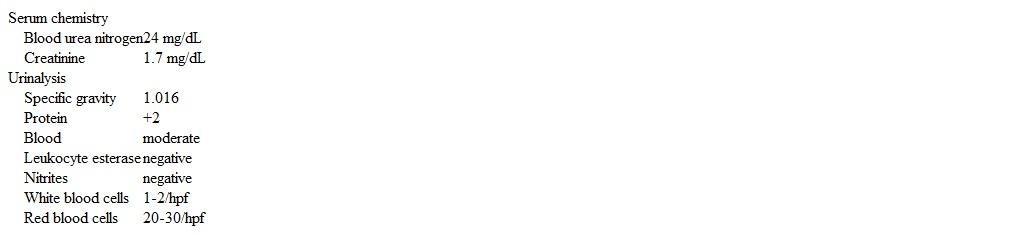 Which of the following is the most appropriate next step in management?
 (Multiple Choice)
4.9/5 (83)
(83) A 3-hour-old newborn is being evaluated in the nursery. The patient was born at 37 weeks gestation via spontaneous vaginal delivery to a 32-year-old woman. The mother had regular prenatal care and no complications during the pregnancy or delivery. Family history is unremarkable. The patient measures at the 50th percentile for weight and head circumference. Length is at the 75th percentile. Examination shows a vigorously crying newborn who soothes easily. The anterior fontanelle is open, soft, and flat. The patient has a strong suck reflex, and the neck appears normal. The eyes appear normally spaced. Chest examination is normal with equal breath sounds bilaterally. The abdomen is soft and has no organomegaly. Urogenital examination shows curvature of an underdeveloped phallus with the urethral meatus at the base. Labioscrotal folds are fused, and the gonads are not palpable. The 17-hydroxyprogesterone level is elevated. Which of the following is the most likely karyotype in this patient?
(Multiple Choice)
4.9/5 (71)
(71) A 9-year-old girl is brought to the clinic due to acute vision changes. Two hours ago, the symptoms began at school after the patient bumped into another student while walking to her gifted and talented class. After sitting, she noticed difficulty seeing out of the right eye. The patient has high myopia and recently received new glasses and an updated prescription. Vital signs are normal. Visual acuity with her glasses on shows 20/50 in the right eye and 20/20 in the left. The pupils are equal and reactive bilaterally. Extraocular muscles are intact, but there is vibration of the iris during left and right movement, a finding consistent with lens dislocation. In addition to ophthalmologic management, which of the following is indicated in this patient?
(Multiple Choice)
4.8/5 (80)
(80) 
Filters
- Essay(0)
- Multiple Choice(0)
- Short Answer(0)
- True False(0)
- Matching(0)