



 Chat with AI
Exam 2: Pediatric

Exam 1: Medicine2 k Questions
Exam 2: Pediatric723 Questions
Exam 3: Psychiatry336 Questions
Exam 4: Surgery563 Questions
Exam 5: Obstetrics & Gynecology469 Questions
Select questions type


A 17-year-old boy is brought to the clinic due to fever and facial pain. Two days ago, fever, myalgias, and fatigue began. This morning, pain and fullness developed in the right cheek. The patient has no chronic medical conditions and takes no daily medications. Immunizations are not up to date, but the family cannot remember which ones were missed. The patient is in high school and is on the school track team. He has a girlfriend but is not sexually active. He does not drink, smoke, or use illicit drugs. Temperature is 38.3 C (100.9 F). Examination reveals an alert, uncomfortable-appearing adolescent. Tenderness and fullness are present in the right cheek, which obscures the angle of the mandible. Bilateral tympanic membranes are clear. The oropharynx has no erythema, exudate, or tonsillar enlargement. No cervical lymph nodes are palpable. This patient is at greatest risk for developing which of the following complications?
(Multiple Choice)
4.8/5  (79)
(79) A 14-year-old girl is brought to the office for a routine physical examination. The patient is starting high school and is going to be on the school's cross-country team. She has no concerns today. She is healthy and takes no daily medications. Family history is significant for hypertension in her mother. The patient has not undergone menarche and is not sexually active. Height and weight are at the 25th percentile for age. Physical examination shows sexual maturity rating (Tanner) stage 1 breast development. The abdomen is soft, nontender, and nondistended. A small, nonreducible mass is palpated in the left inguinal area. On pelvic examination, the external genitalia appear normal, and there is no pubic hair. The vagina ends in a blind pouch. Sonogram confirms the absence of a uterus, cervix, and ovaries. Karyotype is 46,XY. Which of the following is the best next step in management of this patient?
(Multiple Choice)
4.9/5 (73)
(73) A 1-day-old boy is undergoing routine evaluation in the nursery. He was born via vaginal delivery to a primigravida at 38 weeks gestation. The mother took a daily prenatal vitamin and had routine prenatal care. Pregnancy was complicated by gestational diabetes, which was controlled by diet. Labor and delivery were unremarkable. Birth weight was 3.7 kg (8 lb 2 oz). The boy is awake and alert with normal tone and a strong sucking reflex. The lungs are clear to auscultation, and the heart has a normal rate and rhythm without murmurs. The abdomen is soft, nontender, and nondistended. The penis is uncircumcised, and the urethral meatus is visualized at the tip of the glans. The scrotum is significantly swollen with no discoloration. Both testicles are palpated within the scrotal sac. A light shone behind the scrotum transilluminates the swelling. Which of the following is the most appropriate next step in management of this patient?
(Multiple Choice)
4.8/5 (72)
(72) A 2-year-old boy is brought to the office by his parents for evaluation after he lost consciousness earlier today. The patient was running around at a playground when he tripped and fell, landing on his outstretched hands. He did not hit his head on the ground. The patient gasped and, instead of crying, suddenly became pale, limp, and diaphoretic and then lost consciousness. There were no clonic movements. He regained consciousness after several seconds and returned to normal activity within 2-3 minutes. The patient has otherwise been healthy, but his mother says that he had a similar episode a month ago. Temperature is 36.7 C (98.1 F), blood pressure is 90/50 mm Hg, pulse is 100/min, and respirations are 20/min. Pulse oximetry is 100% on room air. On examination, the patient is alert and playful. Heart sounds are normal with no murmurs. Neurologic examination shows no focal deficits. The skin has a normal color. The patient has 2+ peripheral pulses. Which of the following testing is required to establish this patient's most likely diagnosis?
(Multiple Choice)
4.8/5 (71)
(71) A 6-month-old girl is brought to the emergency department due to cough, congestion, and increased work of breathing over the past 2 days. The patient has been very fussy and has a decreased appetite. For the last week, her parents and 5-year-old brother have had congestion and rhinorrhea without high fevers or myalgias. Her brother's school has reported many sick children over the past winter. Temperature is 37.6 C (99.7 F) and respirations are 65/min. On examination, the patient is fussy and tachypneic with nasal flaring and subcostal retractions. Lung examination reveals a prolonged expiratory phase with diffuse crackles and end-expiratory wheezing. Which of the following is the best next step in management of this patient's condition?
(Multiple Choice)
4.8/5 (77)
(77) A 4-week-old girl is brought to the office due to yellowing of the skin. The parents first noticed the symptoms a week ago and the patient's skin has become progressively more yellow. She was born at term to a primigravida mother via spontaneous vaginal delivery. The pregnancy and delivery were unremarkable, and the patient was discharged at 48 hours of life. She is exclusively breastfed and is gaining weight appropriately. Bowel movements occur once or twice daily, but the stool has become increasingly light in color and is now pale gray. Examination reveals scleral icterus and jaundice to the umbilicus. The liver is palpable 4 cm below the costal margin and the spleen tip is palpable. Laboratory results are as follows: Which of the following is the most likely primary mechanism for this patient's hyperbilirubinemia?
(Multiple Choice)
4.9/5 (90)
(90) A 25-hour-old boy is evaluated in the nursery due to vomiting. The patient was born at 36 weeks gestation via spontaneous vaginal delivery to a 24-year-old primigravida. His mother was attempting to breastfeed when he developed "bright green" vomiting. She tried to feed again, but the vomiting recurred. The patient has not yet had a bowel movement. Temperature is 36.7 C (98.1 F) and pulse is 170/min. Examination shows a crying infant with a distended abdomen. Rectal examination shows normal tone and caliber with no stool in the rectal vault. Radiographs of the abdomen reveal markedly dilated loops of small bowel with no rectal air and no free air. Which of the following is the most likely cause of this patient's symptoms?
(Multiple Choice)
4.9/5 (62)
(62) A 3-day-old boy is evaluated in the neonatal intensive care unit for intermittent episodes of bradycardia and desaturation for the past 12 hours. He was born at 29 weeks gestation and had a birth weight of 1,050 g (2 lb 5 oz). The patient had respiratory distress syndrome initially, for which he was intubated and given endotracheal surfactant therapy. He was then extubated to continuous positive airway pressure on day of life 1 and has been stable since. Antibiotics were discontinued at age 36 hours when cultures remained sterile. During examination, the patient has cessation of respiratory effort that lasts about 25 seconds. The heart rate decreases to 85/min, and the oxygen saturation decreases to 72%. The patient recovers spontaneously, and the vital signs normalize. Physical examination after the episode is normal. Chest x-ray reveals resolving granular opacities bilaterally. Which of the following is the best next step in management of this patient?
(Multiple Choice)
4.9/5 (84)
(84) A 3-month-old girl undergoes flexible fiberoptic laryngoscopy for evaluation of noisy breathing. Two weeks ago, the patient began making squeaky noises when lying on her back, which have been getting progressively louder and more persistent. Her mother has been putting her to sleep on the stomach, which quiets the breathing. The patient is adequately gaining weight, is breastfeeding well, and does not appear to have labored breathing or cyanosis. Flexible fiberoptic laryngoscopy shows that both nasal cavities are patent to the nasopharynx. The adenoids are small and nonobstructive, and the palate functions well with symmetric elevation. The tonsils and base of tongue are small and not obstructive. There is intermittent collapse of the arytenoid cartilages into the airway, which worsens during crying. The vocal cords are mobile. This patient is most likely making which of the following abnormal sounds?
(Multiple Choice)
4.9/5 (84)
(84) A newborn girl is evaluated in the delivery room 30 minutes after delivery. The infant was born at 41 weeks gestation to a 23-year-old woman, gravida 2 para 1, via uncomplicated vaginal delivery. The mother was previously healthy and had routine prenatal care. Serology was normal. The pregnancy was complicated by polyhydramnios and gestational diabetes necessitating insulin. The infant's vital signs are normal and birth weight is 4.2 kg (9 lb 4 oz). Apgar scores were 7 and 9 at 1 and 5 minutes, respectively. Physical examination shows an active, crying infant lying under the radiant warmer. Cardiac auscultation reveals a soft, 1/6 systolic murmur. The infant's hands and feet are cyanotic; the mucosal membranes are pink. Moro reflex is normal. The remainder of the examination is normal. Which of the following tests is most likely to be abnormal?
(Multiple Choice)
4.9/5 (71)
(71) A 27-year-old woman comes to the office due to a headache for the last 2 weeks. She describes the headache as "a dull ache" and characterizes it as intermittent, 5/10 in severity, and associated with nausea and vomiting. She is afebrile and never had such a headache before. She has no visual complaints. She is a nonsmoker and drinks alcohol only on weekends. Her only drugs are oral contraceptive pills. Her menses are regular, and she has never conceived. She has no family history of similar problems. Temperature is 37.1 C (98.8 F), blood pressure is 120/75 mm Hg, pulse is 80/min, and respirations are 15/min. She is 178 cm (5 feet 10 inches) tall, and her weight is 98 kg (216 lbs). Neurological examination is nonfocal, and there are no signs of meningeal irritation. Funduscopy reveals papilledema. MRI of the brain is normal. Which of the following complications is likely to develop if this patient is left untreated?
(Multiple Choice)
4.7/5 (86)
(86) An 18-year-old woman comes to the emergency department due to 3 days of worsening fever, headache, and neck pain. She lives in Boston, Massachusetts. She is employed as a barista and is sexually active with one partner. Temperature is 39.1 C (102.4 F). The patient is alert and conversational but appears uncomfortable. Photophobia and mild nuchal rigidity are present. There is generalized adenopathy in the cervical, axillary, and inguinal areas. A diffuse maculopapular rash is seen over the chest, abdomen, and proximal extremities. Genital examination is normal. Cerebrospinal fluid results are as follows:  PCR testing of the cerebrospinal fluid for enterovirus and herpes simplex virus is negative. Which of the following organisms is the most likely cause of this patient's symptoms?
 (Multiple Choice)
4.9/5 (70)
(70) An 11-year-old girl is brought to the emergency department for visual disturbances. Two hours ago, the patient saw flashing lights followed by spots of vision loss. These symptoms fully resolved within 30 minutes. Since then, a bifrontal, throbbing headache and nausea have developed. The patient has had no fever, eye pain, or head trauma. She has had two similar headaches in the last 6 months. Temperature is 37.2 C (99 F), blood pressure is 102/68 mm Hg, and pulse is 88/min. On examination, the patient is alert and appears in moderate discomfort with her eyes closed. Extraocular movements are intact. Funduscopic examination is normal, and pupils are equal and reactive to light, but the patient is uncomfortable during assessment due to the light. Cardiovascular, respiratory, abdominal, and neurologic examinations are normal. Which of the following is the best next step in management of this patient?
(Multiple Choice)
4.8/5 (72)
(72) A 3-year-old, previously healthy girl is brought to the emergency department due to difficulty swallowing. The patient has had fever, chills, malaise, myalgias, and sore throat for a week. Today, she is refusing to drink fluids and spits out any liquids given to her. The patient has a history of small puncture wounds on her left forearm that the family noticed 2 months prior. It is unclear how the wounds occurred, but the site was cleaned and dressed and has since healed completely. Temperature is 40 C (104 F), blood pressure is 90/60 mm Hg, pulse is 144/min, and respirations are 34/min. Examination shows an agitated, disoriented girl with copious drool and facial grimacing who frequently spits saliva. There is numbness surrounding a small, healed scar on the left forearm. The neck is supple with full range of motion. Which of the following is the most likely diagnosis?
(Multiple Choice)
4.7/5 (80)
(80) A 6-year-old boy is brought to the office by his mother due to bed-wetting. The patient has stayed dry during the daytime since age 3 but has continued to wet his bed at night. At the last visit 2 months ago, the mother noted that he was wetting the bed once or twice a week. Behavioral modifications were recommended at that time, with improvement in frequency of symptoms. However, since kindergarten started a month ago, frequent nighttime bed-wetting has recurred. In the last week, the mother has also noticed that liquid stool has frequently leaked onto the underwear. The patient's height and weight track along the 50th percentile. Vital signs are normal. On physical examination, the left side of the abdomen is firmer compared to the right. Rectal sphincter tone is normal. Genitalia are normal. Gait is normal. Which of the following is the best next step in management of this patient?
(Multiple Choice)
4.8/5 (86)
(86) A 12-year-old African American boy is brought to the emergency department with back pain, abdominal pain, and dark urine that began earlier this morning. The patient has never had symptoms like these before. Two days ago, he developed fever, runny nose, and cough, for which he took ibuprofen. Temperature is 37 C (98.6 F), blood pressure is 110/60 mm Hg, and pulse is 100/min. The patient appears tired and has scleral icterus. There is clear rhinorrhea. Lung examination is unremarkable. Heart sounds are normal. Abdominal examination reveals mild, diffuse tenderness with palpation, but no rebound tenderness or rigidity. There is no rash. Hemoglobin is 8.2 g/dL. Peripheral blood smear reveals bite cells and red blood cell inclusions on crystal violet staining. Which of the following is the most likely cause of this patient's condition?
(Multiple Choice)
4.7/5 (66)
(66) A 2-day-old infant is evaluated in the newborn nursery. The patient was born at term via spontaneous vaginal delivery to a 30-year-old woman. The pregnancy and delivery were uncomplicated. The mother had regular prenatal care, and her only medication was a daily prenatal vitamin. Family history is unremarkable. The patient's length at birth was at the 10th percentile. Weight and head circumference were at the 25th percentile. On initial examination after delivery, the patient was found to have ambiguous genitalia. The infant has been breastfeeding and has had appropriate urine and stool output. Examination shows an alert newborn with normal tone. The abdomen is soft with no palpable masses. Genitourinary examination reveals severe curvature of an underdeveloped phallus. The urethral meatus is at the base of the structure, flanked by labioscrotal folds; the gonads are not palpable. Examination of the mother shows no acne or hirsutism. Laboratory results are as follows: 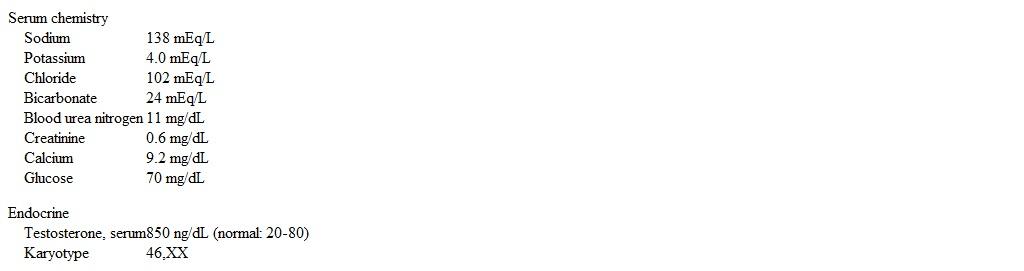 Which of the following is the most likely diagnosis in this patient?
 (Multiple Choice)
4.7/5 (71)
(71) A 1-hour-old boy is brought to the nursery for evaluation. The mother arrived at the hospital in labor; she received no prenatal care but says that the pregnancy was uncomplicated. As a result of a category III fetal heart rate tracing, the patient was born via cesarean delivery and had a strong cry and good muscle tone immediately after delivery. Apgar scores were 8 and 9 at 1 and 5 minutes, respectively. On examination, he is at the 5th percentile for weight, 3rd percentile for length, and 8th percentile for head circumference. Auscultation of the heart and lungs is unremarkable. Hepatosplenomegaly is present. Over the next several days, the patient develops jaundice, clear rhinorrhea, and a maculopapular rash on the feet and buttocks that later desquamates. This patient most likely has which of the following congenital infections?
(Multiple Choice)
4.8/5 (75)
(75) A 5-year-old girl is brought to the emergency department due to decreased energy and alertness. The patient has sickle cell disease and has been fatigued since yesterday. She has no fever or cough. She takes penicillin and folic acid. Temperature is 37.1 C (98.8 F), blood pressure is 80/40 mm Hg, pulse is 190/min, and respirations are 30/min. Pulse oximetry is 97% on room air. The patient is lethargic but can follow simple commands. There is faint scleral icterus, and mucous membranes are dry. Cardiac examination shows tachycardia with a 2/6 systolic murmur at the left sternal border. The lungs are clear to auscultation. Abdominal examination shows tenderness, and the spleen is palpated 6 cm below the costal margin. Strength is 4/5 in all extremities, and sensations are intact. Reflexes are equal bilaterally, and cerebellar examination is unremarkable. The results of a complete blood count are as follows:  In addition to intravenous fluids, which of the following is the best next step in management of this patient's condition?
 (Multiple Choice)
4.9/5 (78)
(78) A 10-week-old boy is brought to the clinic for a follow-up visit. He was evaluated in the emergency department 2 weeks ago due to fever. He was well appearing. Laboratory testing revealed leukopenia and anemia. He received empiric antibiotics and was discharged with outpatient follow-up. Bacterial cultures were negative, and his fever resolved. The mother says the patient has been doing well and has continued to normally take soy-based formula feeds. He was born at term, has no other medical conditions, and takes no medications. Temperature is 37 C (98.6 F), blood pressure is 96/62 mm Hg, pulse is 120/min, and respirations are 30/min. Pulse oximetry is 99% on room air. The patient is awake. Physical examination shows no abnormalities. Laboratory results are as follows:  Which of the following is the most likely cause of this patient's anemia?
 (Multiple Choice)
4.7/5 (82)
(82) 
Filters
- Essay(0)
- Multiple Choice(0)
- Short Answer(0)
- True False(0)
- Matching(0)