



 Chat with AI
Exam 2: Pediatric

Exam 1: Medicine2 k Questions
Exam 2: Pediatric723 Questions
Exam 3: Psychiatry336 Questions
Exam 4: Surgery563 Questions
Exam 5: Obstetrics & Gynecology469 Questions
Select questions type


A 6-year-old boy is brought to the office due to pallor and decreased energy. For the past 2 days, the patient has been less active, uninterested in playing, and sleeping throughout the day. On review of systems, the parents note that he developed a fever, emesis, and diarrhea 10 days ago, but his symptoms resolved without intervention after a few days. His older sister had a sore throat a few days ago, but no other family members have been ill. The patient has no chronic medical conditions. Temperature is 37.1 C (98.8 F), blood pressure is 120/70 mm Hg, and pulse is 145/min. Physical examination shows a tired-appearing boy with pale lips. A grade 2/6 systolic murmur is present. The lungs are clear to auscultation. The abdomen is soft, nontender, and nondistended. Laboratory results are as follows:  Which of the following is the most likely cause of kidney injury in this patient?
 (Multiple Choice)
4.8/5  (82)
(82) A 71-year-old man is brought to the office by his daughter due to a change in behavior over the past year. He began having memory problems several years ago and frequently forgot his grandchildren's names. Also, the patient often had difficulty finding words. Several times recently, he was found roaming his apartment building because he was lost. The patient insists that there is nothing wrong with him and jokingly makes excuses for the symptoms his daughter is reporting. He has never used alcohol or illicit drugs. Blood pressure is 155/85 mm Hg, pulse is 90/min, and respirations are 15/min. Plantar reflexes are downgoing bilaterally. The remainder of the neurologic examination is within normal limits. Montreal Cognitive Assessment score is 15 on a scale of 30 (normal: ≥26). Laboratory results are as follows: 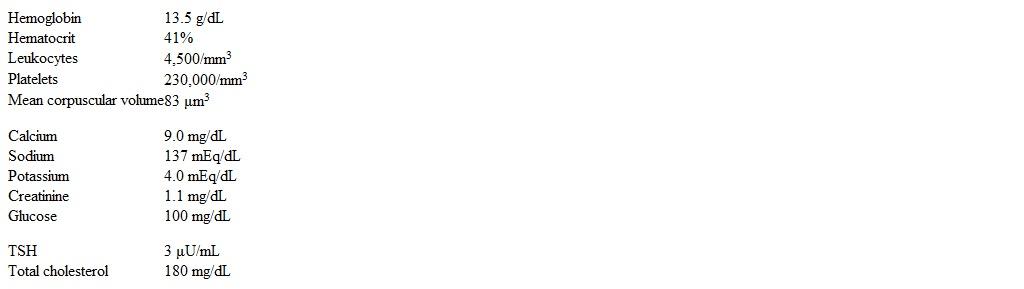 Which of the following abnormalities is most likely to be seen on this patient's MRI?
 (Multiple Choice)
4.9/5 (88)
(88) A 17-year-old girl is brought to the office by her mother for a routine well-child visit. They have no concerns. The patient is in the tenth grade, and her grades are Bs and Cs. She participates in year-round soccer and has a well-varied diet. Menarche was at age 12, and menses are regular. The patient has been sexually active with 1 partner for the past 2 years, and she uses condoms consistently. She does not use alcohol, tobacco, or illicit drugs. Previous laboratory testing includes negative HIV, gonorrhea, and chlamydia results 6 months ago. Last year, due to reported fatigue, she had a complete blood count performed with normal results. This patient should be screened for which of the following conditions at this visit?
(Multiple Choice)
4.8/5 (80)
(80) A 2-year-old boy is brought to the emergency department following a 2-minute, generalized tonic-clonic seizure at home, which resolved spontaneously. The patient was behaving normally until last night, when he appeared to have abdominal pain and felt "warm to the touch." He has had no emesis but has been having frequent watery, loose stools over the past day that now contain blood and mucus. Temperature is 39.7 C (103.5 F), blood pressure is 100/62 mm Hg, pulse is 140/min, and respirations are 26/min. The patient is awake, active, and responsive. The pupils are equal and reactive, and the fundi appear normal. The oral mucosa is dry. The abdomen is soft with hyperactive bowel sounds and left lower quadrant tenderness to palpation. There is no hepatosplenomegaly or abdominal masses. Cranial nerve examination and deep tendon reflexes are normal. Which of the following is the most likely cause of this patient's symptoms?
(Multiple Choice)
4.8/5 (82)
(82) A 6-year-old boy is brought to the pediatrician with leg pain. Over the last few months, he has had pain in both legs that occurs only at night. The pain is worst in his thighs although he occasionally has pain in his calves as well. The episodes last a few hours each and improve with massage and over-the-counter medications. The pain has remained unchanged over the past few months. When he has the pain, the patient does not feel an urge to move the legs. He has no leg pain during the day. He is able to walk, run, and play at school without any complaints, and his mother has noticed no change in his activity level. He has no fever, chills, or weight loss and there is no history of recent trauma. On examination, the boy has full range of motion of the hips and knees bilaterally. No swelling or tenderness to palpation is noted and he has a normal gait. His mother is very worried because his 9-year-old cousin died of leukemia 6 months earlier. Which of the following is the most appropriate next step in management of this patient?
(Multiple Choice)
4.8/5 (83)
(83) A 23-year-old man is found unconscious at the scene of a motor vehicle collision with an obvious left leg deformity and a large laceration of the left temporal scalp. As the patient is being rolled onto a backboard, he regains consciousness. He recalls no details of the collision but reports severe left leg pain, headache, and some shortness of breath. Blood pressure is 94/60 mm Hg, pulse is 120/min, and respirations are 18/min. Peripheral intravenous access is obtained, and 1 L of intravenous fluids is administered. On the way to the hospital, the patient develops progressive weakness on the right side and becomes obtunded. On arrival, blood pressure is 160/90 mm Hg, pulse is 50/min, and respirations are 10/min. Which of the following nerves is most likely to be compromised in this patient?
(Multiple Choice)
4.9/5 (72)
(72) A 57-year-old man comes to the office due to several months of progressive difficulty walking. Lately, weakness and stiffness in both legs has made it difficult to ambulate without support. The patient also has numbness and tingling in his arms and legs. His medical history includes hypertension and hyperlipidemia. The patient has smoked a pack of cigarettes daily for 30 years and has used injection drugs in the past. He has had several sexual partners. Temperature is 36.6 C (97.9 F), blood pressure is 140/90 mm Hg, and pulse is 78/min. Physical examination shows normal mental status and cranial nerves. There is mild weakness and atrophy of the upper arm muscles with decreased triceps reflex. Bilateral lower extremity strength is 4/5. Vibratory and pain sensation is decreased in both the hands and legs. Babinski sign is upgoing bilaterally. Further evaluation of this patient is most likely to reveal which of the following?
(Multiple Choice)
4.9/5 (87)
(87) While making rounds in the newborn nursery, a physician is asked to examine a 2-day-old infant who is not feeding well. A nurse reports that the infant is irritable, is not sleeping well, and has had several episodes of vomiting and loose stools that day. A review of the maternal history reveals that the mother had poor prenatal care and the pregnancy was complicated by intrauterine growth restriction. On examination, the infant is diaphoretic and has a high-pitched cry. The infant is also noted to have occasional sneezing and is mildly tachypneic. No dysmorphic features are noted and the remainder of the examination is unremarkable. This infant's symptoms are most likely caused by prenatal exposure to which of the following?
(Multiple Choice)
4.8/5 (69)
(69) A newborn boy is evaluated for respiratory distress shortly after delivery. He was born at an estimated 37 weeks gestation via spontaneous vaginal delivery to a 20-year-old primigravid mother who had no prenatal care. The mother has no chronic medical conditions and does not use tobacco, alcohol, or illicit drugs. The boy's temperature is 36.7 C (98 F), pulse is 144/min, and respirations are 70/min. Pulse oximetry is 84% on room air. Physical examination shows flattened facies. There are intercostal retractions, and bilateral lungs have decreased aeration. The abdomen is distended, and there is a palpable, soft, suprapubic midline mass. The external male genitalia appear normal. The extremities are cyanotic, and bilateral clubfeet are present. Which of the following is the most likely underlying cause of this patient's clinical condition?
(Multiple Choice)
4.8/5 (75)
(75) A 12-year-old boy is brought to the office by his mother for follow-up of behavioral problems. The patient has had poor attention, difficulty listening, and hyperactivity since kindergarten. Despite ongoing behavioral therapy, he continues to have problems at school and at home. He is easily distracted in the classroom and has difficulty sitting still and following instructions. His schoolwork is disorganized and sloppy and his grades are below his academic potential. At home, he annoys family members with his intrusive behavior, forgets his chores, and becomes moody and irritable when reprimanded. Pharmacological treatment options are discussed. The mother is opposed to stimulant medication and would like to consider alternatives. Which of the following is the most appropriate medication to recommend at this time?
(Multiple Choice)
4.8/5 (91)
(91) A 3-year-old boy is brought to the office by his mother for follow-up after an emergency department visit for a lower extremity fracture. One week ago, the patient fell while running on the stairs and was found to have a closed tibial fracture. He was placed in a cast and has been doing well since. His history is also notable for a femur fracture shortly after learning to walk at age 13 months. The patient has speech delay and mild hearing loss. His mother has had multiple fractures since childhood and has hearing loss as well. Vital signs are normal. Height and weight are at the 5th and 20th percentiles, respectively. Examination shows a young boy with no dysmorphic features. Bilateral upper and proximal lower extremities have 5/5 strength. Hypermobility of the joints in the hands is noted. The right leg is casted from below the knee to the foot, and capillary refill of the toes is <2 seconds. Based on this clinical presentation, this patient most likely has a defect in which of the following genes?
(Multiple Choice)
4.7/5 (74)
(74) A 2-year-old boy is brought to the clinic due to a "painful swelling" on his right arm. Medical history includes 2 previous skin infections. The patient had a perianal abscess incised and drained at age 2 months after no improvement following a course of oral antibiotics; cultures grew Staphylococcus aureus. At age 7 months, he had an episode of left inguinal lymphadenitis. Temperature is 37.3 C (99.1 F). Physical examination shows an indurated, fluctuant mass on the lateral aspect of the patient's right arm. The remainder of the physical examination is unremarkable. The mass is drained, and the cultures grow Serratia marcescens; the patient is appropriately treated. Additional laboratory studies show normal leukocyte, platelet, and B- and T-cell concentrations. Dihydrorhodamine flow cytometry is abnormal. In addition to trimethoprim-sulfamethoxazole, which of the following additional prophylactic therapies is recommended in this patient?
(Multiple Choice)
4.8/5 (77)
(77) A 17-year-old girl is brought to the clinic due to vision changes. Over the past 2 months, the patient has had difficulty seeing at night while driving. Last week, she was almost involved in a motor vehicle collision because she did not see a car approaching at an intersection. The patient is a strict vegan and eats a variety of plant products. She takes no daily medications. Temperature is 37.1 C (98.8 F). Visual acuity is 20/20 bilaterally. Bilateral lashes, conjunctivae, and cornea appear unremarkable. Pupils are equal and reactive, and extraocular muscles are intact. The patient has a visual field defect in the midperiphery in both eyes. Red reflex is equal bilaterally. Funduscopic examination reveals optic disc pallor and attenuation of retinal vessels with focal areas of discoloration bilaterally. Which of the following is the most likely cause for this patient's presentation?
(Multiple Choice)
4.9/5 (95)
(95) A 16-year-old boy is brought to the office by his mother due to behavioral concerns. The patient has been coming home after curfew most nights and arguing with his parents more than usual. The mother notes that he has been spending most of his time at home alone in his room with the door closed and seems less interested in attending family get-togethers. The mother also shares that she found a marijuana joint under the patient's bed last week; when asked about the joint, he stated it belongs to a friend and he does not use drugs. The patient maintains a B average in school and plays in the high school band. When interviewed alone, the patient states he has tried marijuana a few times and lied to his mother because he was afraid that she would tell his father. The patient says he would rather avoid talking to his father for as long as possible and shares that his father refers to him as a disappointment. He has no chronic medical conditions and takes no medications. Vital signs are normal; growth curves are tracking consistently. Physical examination shows no abnormalities. Which of the following is the most appropriate next step in management of this patient?
(Multiple Choice)
4.9/5 (70)
(70) A 9-year-old girl is evaluated because of a rash. Multiple light patches appeared on the patient's face, chest, back, and arms a week after she began attending a swim camp and became more pronounced over the past month. The spots are mildly itchy but not painful. No dietary changes or use of new soaps has occurred. The patient applies a new suntan lotion 5 days a week while swimming in the camp's chlorinated pool; however, the spots do not tan even though the surrounding skin does. She has a history of allergic rhinitis and takes oral antihistamines. She has no history of major illness or hospitalization. Vital signs are normal. On examination, the patient is awake, alert, and comfortable. There is mild nasal congestion with enlarged turbinates and clear postnasal drip but no pharyngeal erythema. Lung sounds are clear. No heart murmurs are present. Multiple pale macules appear on the face, trunk, back, and upper arms, as shown in the image below. 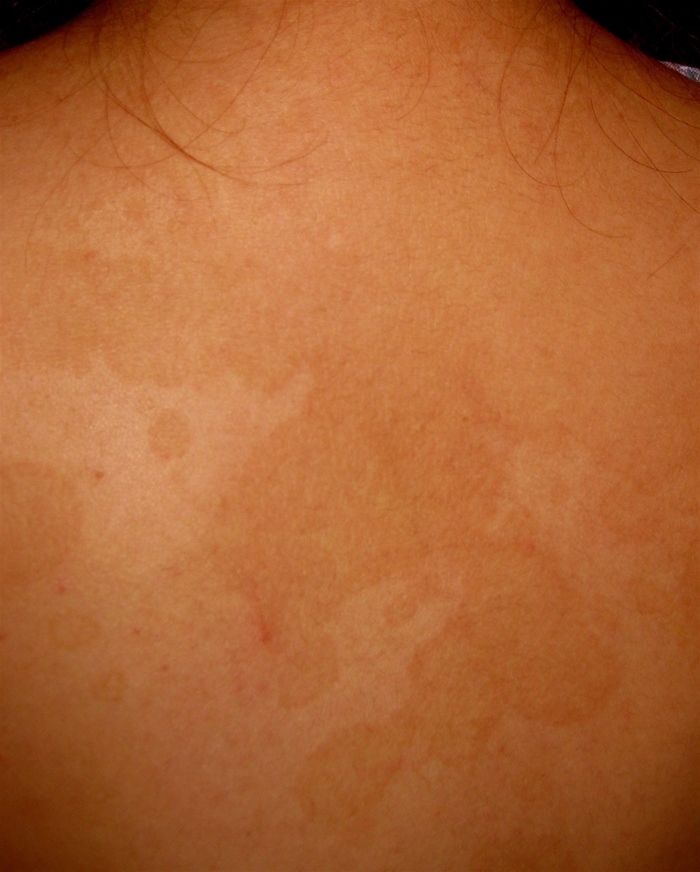 Some of the spots have slight scaling, and they are not tender to palpation. Which of the following is the most likely diagnosis in this patient?
 (Multiple Choice)
4.7/5 (84)
(84) A 15-year-old boy is admitted to the hospital for management of right elbow pain and swelling. The symptoms began 5 days ago while he was watching television at home. The patient has factor VIII deficiency and has been receiving prophylactic recombinant factor VIII infusions through a subcutaneous port 3 times weekly since he was 11 months old. When this episode began, the frequency of his infusions was increased to daily, but the swelling and pain remain. Temperature is 37.6 C (99.7 F). The right elbow has edema, is tender to palpation, and has limited range of motion relative to the left elbow. Laboratory results are as follows:  Which of the following is the most likely cause of this patient's symptoms?
 (Multiple Choice)
5.0/5 (88)
(88) An 8-year-old previously healthy girl is brought to the office by her mother due to hair loss on the scalp. Several weeks ago, the mother noticed the patch of hair loss, which has progressively enlarged. The mother also says that the girl frequently scratches at the area. The child recently changed to a different school and has been anxious about new teachers and friends. Skin examination findings are shown in the image below. 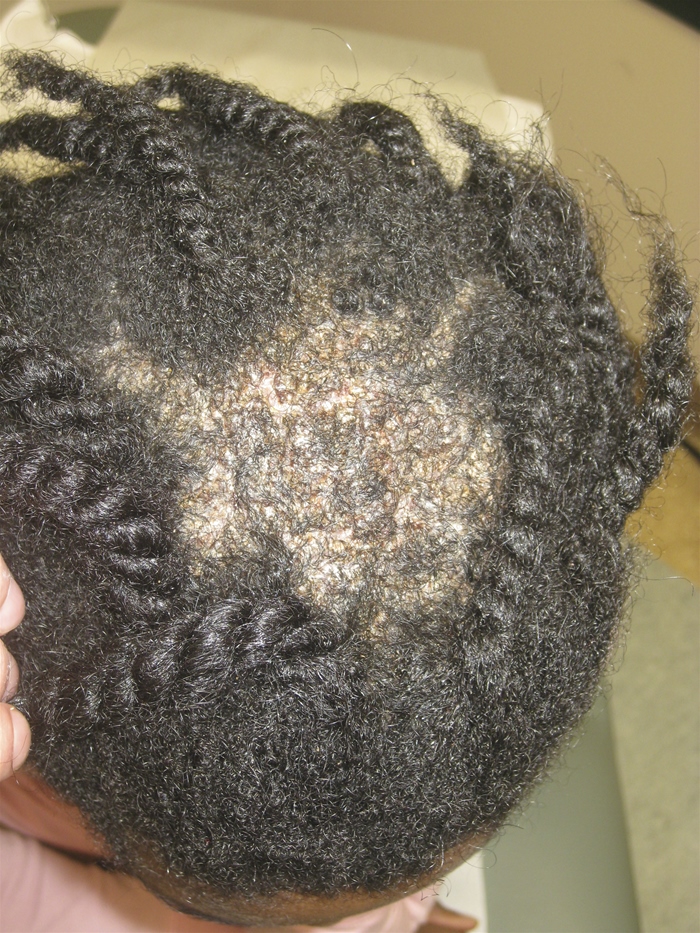 There are several enlarged, tender, occipital and posterior auricular lymph nodes. Which of the following is the most likely cause of this patient's condition?
 (Multiple Choice)
4.8/5 (73)
(73) An 8-year-old boy is brought to the emergency department due to neck swelling and fever. He first developed left-sided neck swelling 2 days ago. Over the last 24 hours, the area has become significantly larger, and the patient cries if the area is touched. He developed fever this morning but has otherwise been well. Temperature is 38.9 C (102 F). Physical examination shows a red, tender, and fluctuant anterior cervical mass approximately 4 cm in diameter in the left anterior lymph node chain. Incision and drainage are performed, and the patient is admitted to the hospital for intravenous antibiotic therapy. Anaerobic bacteria are cultured from the aspirated purulent fluid. Which of the following risk factors most likely contributed to this patient's condition?
(Multiple Choice)
4.7/5 (70)
(70) A 16-year-old previously healthy boy is brought to the emergency department 30 minutes after a head injury. He was playing football when he had a helmet-to-helmet impact with another player. The patient was dazed and disoriented for several minutes after the incident but did not lose consciousness. He stumbled and fell after getting up. The patient is now awake and alert and reports mild headache but no nausea, vision changes, or other subjective neurologic deficits. Vital signs are within normal limits. On physical examination, he appears tired. There is no obvious head deformity. The pupils are equal and reactive, and there is no facial droop. Bilateral upper and lower extremity muscle strength, deep tendon reflexes, and sensation are normal. Which of the following is the most likely cause of this patient's symptoms?
(Multiple Choice)
5.0/5 (78)
(78) A 16-year-old boy is brought to the emergency department due to high fever and sore throat. He also has severe, diffuse leg pain. The symptoms started abruptly 8 hours ago, and the patient says that he has "never felt as terrible" as in the last few hours. Due to his rapid progression of illness, his parents felt an evaluation could not wait for a scheduled outpatient appointment later today. Temperature is 39.1 C (102.4 F). On examination, the patient appears pale. There is diffuse erythema of the posterior pharynx without exudate. The tonsils are 2+ bilaterally. The neck is supple without significant adenopathy. Heart and lung examinations are normal. There is no hepatosplenomegaly. The bilateral lower extremities are diffusely tender to palpation with mottling of the skin. Rapid streptococcal and influenza testing are negative. A complete blood count and blood culture are obtained. Which of the following additional tests is the best next step in evaluation of this patient?
(Multiple Choice)
4.7/5 (76)
(76) 
Filters
- Essay(0)
- Multiple Choice(0)
- Short Answer(0)
- True False(0)
- Matching(0)