



 Chat with AI
Exam 2: Pediatric

Exam 1: Medicine2 k Questions
Exam 2: Pediatric723 Questions
Exam 3: Psychiatry336 Questions
Exam 4: Surgery563 Questions
Exam 5: Obstetrics & Gynecology469 Questions
Select questions type


A 36-year-old woman comes to the emergency department due to severe headache and vision disturbance. The symptoms began abruptly an hour ago, and since then she has also felt weak, dizzy, and nauseated. The patient has had no similar symptoms in the past. Medical history is significant for a prolactinoma diagnosed a month ago, which is being treated with cabergoline. She does not use tobacco, alcohol, or illicit drugs. Temperature is 37.6 C (99.7 F), supine blood pressure is 80/50 mm Hg with a decrease to 60/40 mm Hg on standing, and pulse is 110/min. On physical examination, the patient appears anxious and in moderate distress. There is mild ptosis and impaired adduction on the right. Bitemporal hemianopsia is present. Bilateral upper and lower extremity muscle strength and sensation are normal. The neck veins are flat, heart and lung sounds are normal, and there is no abdominal tenderness or extremity edema. Which of the following is the most likely underlying cause of this patient's hemodynamic changes?
(Multiple Choice)
4.9/5  (82)
(82) A 56-year-old man is brought to the emergency department due to severe dizziness and difficulty walking since this morning. He also reports a sharp, stabbing pain on the left side of his face. The patient has had no tinnitus or hearing loss, and medical history includes type 2 diabetes mellitus and hypertension. Blood pressure is 144/90 mm Hg and pulse is 92/min. On physical examination, there is mild left-sided ptosis, and the left pupil is smaller than the right, but both pupils react briskly to light. Horizontal and rotational nystagmus is present. Sensation to pain and temperature is decreased on the left side of the face and the right trunk and limbs. On standing, the patient has a wide base and falls to the right if unsupported. He is unable to walk without assistance. Which of the following is the most likely location of this patient's brain lesion?
(Multiple Choice)
5.0/5 (81)
(81) A 1-day-old girl is in the neonatal intensive care unit due to low birth weight. She was born at 36 weeks gestation to a 25-year-old woman via a precipitous spontaneous vaginal delivery. The patient required minimal manual stimulation after delivery and had a subsequent strong cry. Apgar scores were 5 and 8 at 1 and 5 minutes, respectively. Weight, length, and head circumference are <3rd percentile. The red reflex is absent bilaterally, and both pupils appear cloudy. A continuous, harsh murmur is best heard over the left upper sternal border. The abdomen is nondistended and nontender. The liver and spleen are enlarged. Tone is normal, and Moro reflex and palmar grasp reflex are intact. Which of the following maternal factors is most commonly associated with this patient's presentation?
(Multiple Choice)
4.7/5 (88)
(88) A 7-month-old boy is brought to the office due to streaks of blood in his stools. The infant was exclusively breastfed until a month ago, when rice cereal and cow's milk-based formula were introduced into his diet. Previously, stools were soft and yellow and occurred at least once a day. For the past 3 weeks, however, stools have become hard and pellet-like, occurring every 2-3 days. In the past week, the patient's mother noticed thin streaks of bright red blood on the outside of the stools. The patient has had no change in appetite, vomiting, or fever. Height and weight have been tracking along the 25th percentile since birth. Vital signs are normal. On examination, the patient is in no distress. The abdomen is mildly distended, and there is no pain on palpation. There is firmness on palpation in the left lower quadrant and a small anal fissure at the 6 o'clock position. The remainder of the examination is unremarkable. Which of the following is the most appropriate management of this patient?
(Multiple Choice)
4.7/5 (76)
(76) A 17-year-old, previously healthy boy is brought to the emergency department due to a 3-day history of abdominal pain and diarrhea. The patient initially developed watery, loose stools with periumbilical pain that has since moved to the right lower quadrant. Over the past 24 hours, he has had 12 mucus-containing, loose bowel movements as well as nausea and fever. His younger brother has also had diarrhea, which has contained some streaks of blood, for the past few days but is now improving. Temperature is 38.8 C (101.8 F), blood pressure is 110/70 mm Hg, and pulse is 110/min. Examination shows mild diaphoresis. Right lower quadrant tenderness is present; there is no rebound or rigidity. Laboratory analysis shows a white blood cell count of 13,700/mm3 with 80% neutrophils. What is the most likely diagnosis?
(Multiple Choice)
4.9/5 (83)
(83) A 10-month-old boy is brought to the emergency department due to respiratory distress. He developed a fever yesterday, and his breathing has become increasingly labored. The boy was recently admitted due to streptococcal pneumonia 2 months ago, which required chest tube placement and a weeklong hospital stay. Medical history is also notable for recurrent ear infections starting at age 5 months, at which time his weight dropped from the 40th to the 20th percentile. Temperature is 39.2 C (102.6 F), blood pressure is 100/68 mm Hg, pulse is 138/min, and respirations are 40/min. Heart sounds are normal. Lung examination reveals diffuse scattered crackles. Several collections of small, red, dilated blood vessels are visible on the bilateral sclera. There are no palpable lymph nodes. A tracheal aspirate is positive for Pneumocystis jirovecii. Which of the following laboratory results is most consistent with this patient's likely underlying diagnosis?
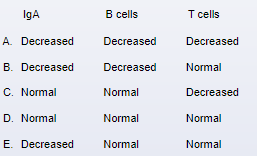
(Multiple Choice)
4.9/5 (89)
(89) An 8-year-old boy is brought to the office due to intermittent headaches for the past 6 months. The headaches occur once or twice a month and can last 2-10 hours. The patient describes them as "pounding like loud music" located over the entire frontal area. The headaches are often associated with nausea and either nasal congestion or rhinorrhea. The pain does not wake him from sleep. Each episode, the patient's mother gives him ibuprofen, which improves the pain. He sometimes worries about developing an episode while in school. He has missed 2 days of school due to headache and has spent this time with his mother, refusing to watch television or play video games due to the brightness of the screen. Vital signs are normal, and neurologic examination, including funduscopy, is unremarkable. Which of the following is the most likely cause of this patient's clinical presentation?
(Multiple Choice)
5.0/5 (83)
(83) A 2-day-old Asian girl is evaluated in the newborn nursery due to jaundice. She was born at 40 weeks gestation to a 30-year-old mother via uncomplicated vaginal delivery. Membranes ruptured spontaneously an hour prior to delivery. Prenatal laboratory testing was normal. Group B streptococcus screen was negative. Maternal blood group is AB, Rh D-positive. The patient has been exclusively breastfeeding with good latch, voiding appropriately, and passing meconium. She has 2 healthy older siblings, both of whom required phototherapy in the first few days of life. Weight and length are at the 50th percentile. Vital signs are normal. On examination, jaundice of the face and neck is present. The remainder of the examination is unremarkable. Laboratory results at 34 hours of life are as follows:  Which of the following mechanisms is contributing to this newborn's condition?
 (Multiple Choice)
4.7/5 (71)
(71) A 21-day-old girl is brought to the emergency department due to difficulty feeding. The neonate was born at term following an uncomplicated pregnancy and had been feeding well with a standard, cow's milk-based formula until 2 days ago. Since then, she has been sleepier, with a weak suck and fewer wet diapers. Today, she is increasingly fussy and is refusing to feed. Temperature is 35.1 C (95.2 F), blood pressure is 78/52 mm Hg, pulse is 150/min, and respirations are 62/min. The neonate is irritable and difficult to console. She has a full fontanelle and dry mucous membranes. Scleral icterus and jaundice of the face and chest is present. The lungs are clear, and no murmur is present. Abdominal examination is normal. Neurologic examination shows equal movement of all 4 extremities with mildly decreased muscle tone. Which of the following is the best next step in management of this neonate?
(Multiple Choice)
4.9/5 (75)
(75) A 17-year-old girl is brought to the office due to bright red blood in the urine for 2 days. She has also had dysuria but no trauma, fever, or flank pain. The patient has no history of serious illness and takes no medications. She has regular menstrual periods, and her last period was 2 weeks ago. Temperature is 37.2 C (99 F). Examination shows no abnormalities. Laboratory results are as follows:  Which of the following is the best next step in management of this patient?
 (Multiple Choice)
5.0/5 (78)
(78) A 14-year-old girl is brought to the office for a well-child examination. The patient's mother states that she is doing well in school and plays on the volleyball team. The patient sleeps 9 hours every night and often until noon on weekends. She drinks 2 glasses of 2% milk daily and her screen time is limited to 2 hours a day. She has no chronic medical conditions and takes no medications. At age 12, she received her first dose of human papillomavirus (HPV) vaccination, with another dose administered 6 months later. The patient underwent menarche at age 13, and her last menstrual period was 2 weeks ago. She has never been sexually active. The patient's mother has hypothyroidism, and her maternal grandmother recently died from complications of type 2 diabetes mellitus. Height and weight are at the 60th percentile. Blood pressure is 104/68 mm Hg and pulse is 60/min. Physical examination reveals an alert and engaged adolescent. Sexual maturity rating (Tanner) stage is 4. Cardiopulmonary examination is unremarkable. The abdomen is soft and nontender. The remainder of the examination is normal. Which of the following is the best next step in management of this patient?
(Multiple Choice)
4.9/5 (76)
(76) An 18-month-old girl is brought to the emergency department due to fever and abdominal pain. Yesterday she began to cry while urinating. Today her parents saw a small amount of blood in the urine, and the urine was malodorous. The patient was born at term and has no chronic medical conditions. Temperature is 38.9 C (102 F), blood pressure is 96/62 mm Hg, pulse is 130/min, and respirations are 20/min. Physical examination shows suprapubic tenderness and left costovertebral angle tenderness. Complete blood count reveals leukocytosis. Serum creatinine and electrolytes are normal. Catheterized urinalysis results are as follows:  A urine culture grows 100,000 colony-forming units/mL of Escherichia coli. Antibiotics are administered, and her fever and pain resolve on the second day of hospitalization. In addition to completing the current course of antibiotics, which of the following is the best next step in management of this patient?
 (Multiple Choice)
4.9/5 (83)
(83) A 3-year-old otherwise healthy boy is brought to the office due to difficulty with bowel movements. Two months ago, the patient began toilet training. Although he has been able to urinate in the toilet, he has struggled with bowel movements. Prior to toilet training, the patient had a soft bowel movement every day. In the past 6 weeks, he has had hard stools every 3 or 4 days. He often cries while having a bowel movement and screams "ouch!" The patient drinks 24 oz of milk and 8 oz of water per day and eats vegetables, meats, and grains. He refuses to eat fruits. Height and weight have been tracking along the 75th percentiles. Examination shows a cooperative, well-nourished boy. The abdomen is firm, mildly distended, and nontender. An anal fissure is present. The remainder of the examination is unremarkable. Which of the following is the best next step in management of this patient?
(Multiple Choice)
4.8/5 (73)
(73) A 3-year-old boy is brought to the office due to neck swelling. Yesterday, his parents first noticed a small lump on the right side of his neck. Today, the area is red, painful to touch, and larger. The patient had a cough, runny nose, and low-grade fever a week ago, and those symptoms have resolved. When the symptoms appeared, the family had just returned from a family reunion in eastern Arkansas, where several cousins also had a runny nose and fever. The patient has no chronic medical conditions and takes no medications. Immunizations are up to date. Temperature is 38.6 C (101.5 F), blood pressure is 104/74 mm Hg, pulse is 98/min, and respirations are 25/min. On examination, a 5-cm, tender, warm, and poorly mobile anterior cervical lymph node is palpated on the right side. The overlying area is erythematous. Cardiopulmonary examination is normal. The abdomen is soft with no hepatosplenomegaly. The remainder of the examination is normal. Which of the following is the most appropriate treatment for this patient?
(Multiple Choice)
4.8/5 (79)
(79) A 4-month-old boy is brought to the office due to abnormal twisting movements of the limbs and torso. The patient also is not able to push up on his arms when prone. He was born at full term to a 30-year-old woman by forceps-assisted vaginal delivery. The delivery was complicated by cephalohematoma. The patient has not been evaluated since discharge at age 2 days. Vital signs are normal. Weight and length are at the 50th percentile for age. His eyes are crossed, and he does not react to sound. Dystonic extremities are noted on examination. Which of the following is the most likely explanation for this patient's current condition?
(Multiple Choice)
4.7/5 (87)
(87) A 52-year-old right-handed woman comes to the emergency department due to speech arrest and right arm weakness. The symptoms began suddenly at breakfast but resolved after about 30 minutes. The patient has a history of relapsing-remitting multiple sclerosis. Three months ago, she was hospitalized due to blurry vision in the left eye, which was treated with corticosteroids and improved after several weeks. The patient's other medical issues include hypertension and hyperlipidemia. She is currently not taking any disease-modifying therapy for her multiple sclerosis. She has a 40-pack-year history of tobacco use. Blood pressure is 170/96 mm Hg, and pulse is 92/min. BMI is 35 kg/m2. There is a mild afferent pupillary defect in the left eye with diminished visual acuity. Noncontrast CT scan of the head is unremarkable. Which of the following is the best next step in treatment of this patient?
(Multiple Choice)
4.8/5 (71)
(71) A 74-year-old man is brought to the office by his wife due to a change in behavior. Over the last year, the patient has had difficulty recognizing his grandchildren and has gotten lost in his local grocery store more than once. He enjoys playing Sudoku in the Sunday newspaper but has had increasing difficulty completing the puzzles. He has also been increasingly distractible during conversation and says that he sometimes sees animals in the house despite the couple not owning any. The patient has not seen a doctor in >20 years and takes no medications. His wife says that he started "slowing down" and talking about stiffness and a tremor approximately 4 years ago, which was before he experienced any behavioral symptoms; they never sought medical care because they assumed it was "just part of getting older." Examination shows intact cranial nerves as well as pinprick and light touch sensations. There is rigidity in the bilateral upper and lower extremities that is worse on the left. Tremor is present in both hands at rest and is worse in the left hand. Movement and speech are slowed. Gait is unsteady and marked by a shortened stride. Which of the following is the most likely diagnosis?
(Multiple Choice)
4.9/5 (80)
(80) A 74-year-old man comes to the emergency department due to 2 weeks of progressive leg weakness and difficulty standing and walking. He has also had increasing urinary hesitancy and dribbling of urine. The patient has had low back pain for several months, but the pain has recently worsened and begun radiating to his legs. He was diagnosed with metastatic squamous cell lung cancer a year ago and received chemotherapy initially, but the patient stopped treatment due to side effects. He also has a history of hypertension and chronic obstructive pulmonary disease. Lower extremity examination shows normal bulk and tone but decreased strength of major muscle groups bilaterally. Knee reflexes are decreased on both sides. There are patchy areas of sensory loss in the bilateral lower extremities. Digital rectal examination shows loss of sensation in the perianal skin, decreased anal sphincter tone, and mildly enlarged prostate. A lesion at which of the following sites is most likely responsible for this patient's symptoms?
(Multiple Choice)
4.9/5 (70)
(70) A 5-year-old girl is brought to the emergency department with sudden-onset weakness on her left side and slurred speech. She was sitting on the floor at home playing with her toys when she lost her balance and toppled over. Her father caught her and she did not hit her head. The patient has a history of developmental delay and "eye problems," for which she has been seen by an ophthalmologist. She has no other chronic medical conditions. She takes no medications and has no known allergies. Vital signs are normal. Weight is at the 5th percentile and height is at the 90th percentile. Examination shows an alert, fair-skinned, blue-eyed girl. She has long, thin arms and legs and a decreased upper-to-lower segment ratio. Left upper and lower deep-tendon reflexes are brisk; Babinski sign is upgoing on the left side. Joint hyperlaxity and skin hyperelasticity are also seen. Which of the following is the most likely diagnosis in this patient?
(Multiple Choice)
4.7/5 (74)
(74) A 26-year-old woman comes to the office due to eye problems. One week ago while driving, her eyes closed spontaneously after she looked at the headlights of an oncoming car. She briefly could not open her eyes and had to stop driving until the symptoms gradually improved over several minutes. Since then, she has had 3 similar episodes brought on by bright light exposure. The patient has had no fever, eye pain or discharge, blurry or double vision, headaches, or extremity weakness or numbness. She has a history of asymptomatic sarcoidosis and takes no medications. Vital signs are within normal limits. On physical examination, there is no facial asymmetry. Frequent blinking of the eyes is noted, and shining light in the eyes to assess pupillary response causes involuntary tonic closure of the eyelids bilaterally. The remainder of the examination is normal. Which of the following is the most likely diagnosis?
(Multiple Choice)
4.8/5 (86)
(86) 
Filters
- Essay(0)
- Multiple Choice(0)
- Short Answer(0)
- True False(0)
- Matching(0)