



 Chat with AI
Exam 2: Pediatric

Exam 1: Medicine2 k Questions
Exam 2: Pediatric723 Questions
Exam 3: Psychiatry336 Questions
Exam 4: Surgery563 Questions
Exam 5: Obstetrics & Gynecology469 Questions
Select questions type


A 16-year-old boy is brought to the office for pain and limited motion of the right knee. The patient has had previous episodes of sudden swelling in his right knee and does not recall them being associated with injury. This current episode of knee pain began 6 months ago. Initially the pain was controlled with heating pads and acetaminophen, but it has gradually worsened over the last 2-3 months. The patient now has difficulty walking. He is worried that he will be unable to go on his annual camping trip with his family. The patient had an episode of prolonged bleeding after a tooth extraction several years ago. He is sexually active, has 2 lifetime partners, and uses condoms intermittently. Temperature is 36.7 C (98 F). On examination, the patient is alert and in no distress. The right knee is swollen and boggy with a small effusion present. The knee is not fully extendable with either active or passive motion. Which of the following is the most likely cause of this patient's knee joint findings?
(Multiple Choice)
4.9/5  (83)
(83) A 2-month-old boy is brought to the emergency department by ambulance after a seizure. His mother says that he rolled off the bed last night while his older sister was changing his clothes and that he cried for a few minutes but fed well last night. Today, the patient had a tonic-clonic seizure that lasted 4 minutes after his morning feeding. He has been otherwise healthy. The patient was born at 31 weeks gestation, and his postnatal course was complicated by respiratory distress and hypoxia requiring intubation for several days. Height and weight are at the 50th percentile; head circumference is at the 98th percentile. Temperature is 36.7 C (98 F), blood pressure is 90/50 mm Hg, and pulse is 144/min. Physical examination shows a limp infant who withdraws from painful stimuli. The anterior fontanelle is full and tense. Funduscopy reveals bilateral papilledema and retinal hemorrhages. The abdomen is soft with no hepatosplenomegaly. Which of the following is the most likely etiology of this patient's seizure?
(Multiple Choice)
4.7/5 (76)
(76) A 2-hour-old boy is evaluated in the delivery room for minimal right arm movement. He was born at 37 weeks gestation by vacuum-assisted, vaginal delivery to a 39-year-old woman who had excessive weight gain during pregnancy. The delivery was complicated by a 3-minute shoulder dystocia. Birth weight was 4.6 kg (10.1 lb). Examination shows a small area of edema in the scalp that does not cross suture lines. The right upper extremity is held in adduction and internal rotation with the elbow extended, forearm pronated, and wrist and fingers flexed. Moro and biceps reflexes are absent in the right arm. The remainder of the examination is normal. Which of the following is the most appropriate next step in management of this patient's condition?
(Multiple Choice)
4.9/5 (80)
(80) A 20-month-old girl is brought to the office due to fever and fussiness for the past 5 days. She has been less playful than usual and is not eating well today. The patient has had several episodes of acute otitis media in the last year, all of which resolved with oral antibiotics. Temperature is 38.6 C (101.5 F), blood pressure is 100/60 mm Hg, and pulse is 120/min. Examination of the right ear reveals a protruded auricle with tenderness and swelling behind the ear. Otoscopy reveals narrowing of the external ear canal; the tympanic membrane cannot be seen. Left ear examination is normal. Which of the following is the most likely diagnosis?
(Multiple Choice)
4.9/5 (65)
(65) A 2-year-old girl is brought to the clinic due to vomiting. Vomiting has occurred every morning for the past week but has increased in frequency and now occurs intermittently throughout the day. Today, the patient has vomited 8 times and become irritable and lethargic but has had no hematemesis, diarrhea, or sick contacts. She was born at 29 weeks gestation and has a ventriculoperitoneal shunt that was placed after birth due to intraventricular hemorrhage. Temperature is 36.7 C (98.1 F), blood pressure is 90/50 mm Hg, pulse is 104/min, and respirations are 24/min. Physical examination reveals a sleepy, irritable child. The anterior fontanelle is enlarged and tense. Pupils are equal and reactive, and funduscopic examination is limited by lack of patient cooperation. The abdomen is soft and mildly tender to palpation. There is no rebound, guarding, or palpable mass. Skin turgor is decreased, and capillary refill is 2 seconds. Which of the following is the best next step in management of this patient?
(Multiple Choice)
4.8/5 (87)
(87) A 7-week-old boy is brought to the office for routine follow-up after being discharged from the neonatal intensive care unit (NICU). He was born at 32 weeks gestation, and the pregnancy was complicated only by preterm labor. After delivery, the patient received a short course of prophylactic antibiotics while awaiting blood culture results, which were negative for bacterial growth. Other than difficulty feeding, he had no other issues in the NICU. By age 6 weeks, the patient was taking a normal volume of fortified preterm formula and gaining weight appropriately. He was discharged from the hospital last week and has continued taking formula and ferrous sulfate. Temperature is 37.5 (99.5 F), pulse is 150/min, and respirations are 30/min. Pulse oximetry is 98% on room air. The patient is awake and alert. Cardiac auscultation reveals a 2/6 systolic flow murmur with no gallop. The abdomen is soft with no organomegaly. Laboratory results are as follows:  The peripheral smear shows normocytic, normochromic red blood cells. Which of the following is the most likely underlying cause of this patient's laboratory findings?
 (Multiple Choice)
4.8/5 (74)
(74) A 14-year-old girl is brought to the office by her mother for evaluation of lack of menstruation. The patient has no headaches, nipple discharge, or abdominal or pelvic pain. She takes a topical retinoid and an oral antibiotic for acne and was recently prescribed glasses for myopia. Her last office visit was 3 months ago for evaluation of gastroenteritis. Vaccinations are up to date, including human papillomavirus. Her mother has hypothyroidism; family history is otherwise unremarkable. The patient has 2 older sisters, both of whom underwent menarche at age 13. The patient is not sexually active and does not use tobacco, alcohol, or illicit drugs. Since her last appointment, height has increased from 152 cm (5 ft) to 155 cm (5 ft 1 in, 10th percentile) and weight is unchanged at 45.4 kg (100 lb, 15th percentile). Blood pressure is 118/72 mm Hg and pulse is 68/min. Physical examination shows nodulocystic acne on the face; the skin on the chest and back is clear. The thyroid is soft with no palpable nodules. Breast development is Tanner stage 4 and pubic hair is Tanner stage 3. Which of the following is the best next step in management of this patient?
(Multiple Choice)
4.9/5 (80)
(80) A 6-year-old boy is brought to the emergency department due to difficulty moving his right arm and leg. The patient was playing alone in his room when his mother heard him fall and then found him unresponsive on the floor. He regained consciousness after 3 minutes, but he was confused and unable to move his right arm and leg. The patient has no known medical conditions and takes no medications. He has had normal development. The patient's mother has a history of migraines, and his maternal uncle died last year from a hemorrhagic stroke. On physical examination, he is alert with normal speech and behavior and no complaints of pain. Heart sounds are normal. CN II-XII are intact. The right upper and lower extremities are flaccid, and right-sided strength is 0/5. Left-sided strength is 5/5 in the upper and lower extremities. Sensation to light touch is intact in all the extremities. CT scan of the head and MRI of the brain are normal. Over the next 4 hours, the patient gradually regains complete motor function in his right arm and leg. Which of the following is the most likely cause of this patient's hemiplegia?
(Multiple Choice)
4.8/5 (70)
(70) A 52-year-old man comes to the office due to upper extremity weakness and pain in his shoulders and upper back since shoveling snow 3 weeks ago. His left arm also has started to feel heavy, and he has difficulty dressing and undressing because he lacks the strength to pull clothes over his head. The patient has not had similar symptoms before and recalls no other trauma to the area. He has a history of hypertension and hypothyroidism. Vital signs are within normal limits. Physical examination of the shoulder joints shows no deformity, and passive range of motion is full with no pain. There is moderate weakness of left shoulder abduction, but strength in the other muscle groups is normal. Decreased sensation to light touch and pinprick is present on the left lateral forearm. The remainder of the examination shows no abnormalities. Which of the following is the most appropriate next step in evaluation of this patient's symptoms?
(Multiple Choice)
4.9/5 (73)
(73) A 4-year-old boy is brought to the clinic by his mother due to concerns about his vision. While wearing a pirate costume at home last week, the patient refused to use the eye patch, stating that he could not see. This occurred only when the patch was placed over the right eye. The patient was born at 34 weeks gestation and takes no daily medications. Vital signs are normal. Eye examination shows symmetric corneal reflexes. The red reflex is equal bilaterally. Cover test shows no eye deviation, and extraocular movements are intact. Visual acuity is 20/30 in the right eye. In the left eye, the patient is unable to see the visual acuity chart and is able to count fingers only at a close distance. Funduscopic examination shows sharp disc margins with normal vessel caliber and course. Which of the following is the most likely cause of this patient's clinical findings?
(Multiple Choice)
4.9/5 (79)
(79) A 3-year-old boy is brought to the emergency department due to a sore throat. The boy woke up with the sore throat this morning and has refused to eat. His mother gave him acetaminophen, but it did not relieve his pain. Temperature is 38.7 C (101.7 F) and respirations are 28/min. The patient is sitting still on his mother's lap and appears scared. He has a hoarse voice, rhinorrhea, and mild stridor. Tympanic membranes are clear bilaterally. Examination of the posterior pharynx shows no erythema or tonsillar exudate. The anterior neck is tender to palpation. Lung examination reveals transmitted upper airway sounds that are equal bilaterally without crackles or wheezes. Lateral neck x-ray is shown below: 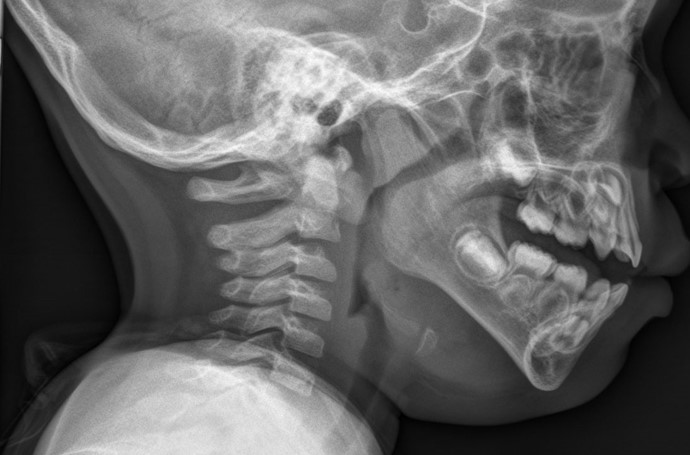 Which of the following is the most likely diagnosis in this patient?
 (Multiple Choice)
4.8/5 (82)
(82) A 2-day-old boy in the newborn nursery did not pass his hearing screening bilaterally. He was born at 37 weeks gestation by cesarean delivery due to labor complicated by minimal fetal heart rate variability and recurrent late decelerations. The mother had an ultrasound at 8 weeks gestation in the emergency department but did not have routine prenatal care. She had a brief febrile illness during her first trimester of pregnancy, followed by 5-7 days of joint pain that resolved without intervention. The infant's weight, length, and head circumference are <5th percentile. Vital signs are normal. The red reflex is absent bilaterally. Cardiac examination reveals a loud, harsh murmur heard throughout systole and diastole over the left second intercostal space. The liver and spleen are palpable on abdominal examination. Which of the following is the most likely etiology of this infant's clinical presentation?
(Multiple Choice)
4.9/5 (75)
(75) A 17-year-old girl is admitted to the hospital due to lower extremity weakness. Onset of tingling in the patient's feet began 5 days ago; she then developed weakness 3 days ago, which has been worsening, and now she cannot stand or walk. She had an upper respiratory infection 2 weeks ago; otherwise, medical history is unremarkable. Temperature is 36.7 C (98 F), blood pressure is 110/70 mm Hg, pulse is 85/min, and respirations are 18/min. Pulse oximetry is 99% on room air. Physical examination shows an adolescent girl in no acute distress and clear lungs on auscultation. Bilateral ankle and knee flexion/extension strength is 1/5, and hip flexors are 2/5. Reflexes are absent in the lower extremities. The upper extremities have 3/5 strength and 1+ reflexes. The patient can keep her head erect and swallow saliva. Gag reflex is intact. Cerebrospinal fluid results are as follows:  Which of the following is the most appropriate next step in management of this patient?
 (Multiple Choice)
4.8/5 (81)
(81) A 38-year-old woman with multiple sclerosis comes to the office due to insomnia for the past several weeks. The patient also reports episodes of an uncomfortable "tingly" sensation in her legs associated with an urge to stretch her legs or move around. The symptoms are worse when she is lying in bed at night or when watching television or working at her computer. The patient began taking over-the-counter antihistamines to help her sleep but states she wakes up a few hours later with worsening symptoms. She feels exhausted and foggy-headed during the day. The patient is taking a stable-dose disease-modifying treatment for multiple sclerosis, and her most recent exacerbation was 2 years ago. She has no other medical conditions. Physical examination shows mildly increased lower extremity reflexes but normal muscle strength and sensations. Which of the following is the most appropriate pharmacotherapy for this patient's current symptoms?
(Multiple Choice)
4.7/5 (75)
(75) A 15-year-old girl is brought to the office for evaluation of primary amenorrhea. The patient's mother and older sisters underwent menarche around age 13. The patient has had no changes in weight or nipple discharge but has difficulty identifying various odors. She has no known medical conditions and has had no surgery. The patient takes no daily medications and does not use tobacco, alcohol, or illicit drugs. She is not sexually active. Height is at the 3rd percentile for age, with 4.8 cm (1.9 in) of growth noted in the last year. Visual fields are intact. No breast tissue is present, and there is no axillary or pubic hair. Ultrasound confirms the presence of a uterus and 2 normal-appearing ovaries. Serum FSH level is 2 mU/mL (normal: 4-30 mU/mL) and LH is 3 mU/mL (normal: 5-25 mU/mL). Karyotype analysis of this patient is most likely to show which of the following?
(Multiple Choice)
4.9/5 (80)
(80) A 2-year-old girl is brought to the office due to drainage from the left ear. The patient has been irritable over the past few days, and this morning, her mother noticed foul-smelling drainage on her pillow. Three weeks ago, the patient was treated with amoxicillin for an episode of acute otitis media. Temperature is 37.9 C (100.2 F); all other vital signs are normal. On examination, the left external ear is unremarkable except for some dried, crusted drainage at the entrance of the external canal. Otoscopic examination reveals a perforated, erythematous left tympanic membrane with a small amount of purulent drainage. Which of the following is the most appropriate pharmacotherapy for this patient?
(Multiple Choice)
4.8/5 (87)
(87) An 86-year-old woman is brought to the emergency department due to progressive confusion and lethargy for the past several hours. The patient has a history of Alzheimer dementia, and her family reports that she has been gradually declining in mental and physical capacity for the last 6 months. She also has had several falls and requires assistance with daily activities. Other medical conditions include hypertension and osteoarthritis. Temperature is 38 C (100.4 F), blood pressure is 170/100 mm Hg, and pulse is 70/min. On physical examination, the patient is somnolent but arousable. She withdraws from painful stimuli applied to her right side but not to her left. Noncontrast CT scan of the head is shown in the image below: 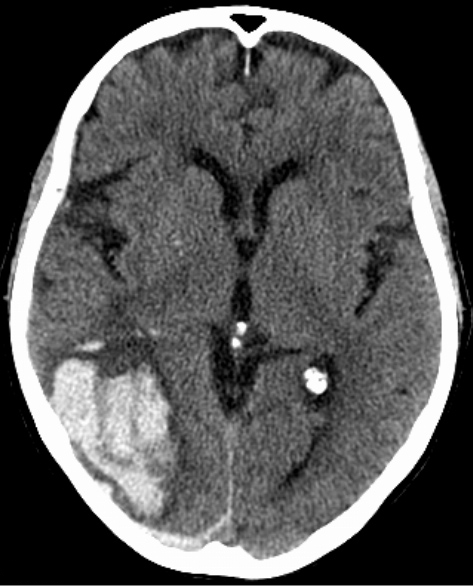 Which of the following is the most likely underlying cause of this patient's current condition?
 (Multiple Choice)
4.8/5 (87)
(87) A 13-year-old girl is brought to the office due to lower abdominal pain for the past 4 days. The patient has rectal pain with bowel movements, but no melena or frank blood. She has had this pain several times over the past year, but it usually resolves after 2 or 3 days. She has no fever, chills, nausea, vomiting, loss of appetite, dysuria, hematuria, or abnormal vaginal discharge. The patient has no chronic medical conditions or previous surgeries. She has not reached menarche and has never been sexually active. Temperature is 36.7 C (98 F) and blood pressure is 110/70 mm Hg. BMI is 24 kg/m2. Physical examination shows a nondistended abdomen without rebound or guarding. There is lower abdominal tenderness to deep palpation in the midline. The external genitalia are Tanner stage 3. On pelvic examination, a smooth, firm mass is protruding between the labia majora. Which of the following is the most likely diagnosis?
(Multiple Choice)
4.8/5 (90)
(90) A 56-year-old right-handed man comes to the physician with right-sided weakness and speech difficulty. He speaks in short sentences with considerable effort. He fully follows written and verbal commands but has difficulty writing and repeating. Which of the following lesion locations is most likely responsible for the observed findings?
(Multiple Choice)
4.7/5 (81)
(81) A 17-year-old girl comes to the emergency department due to a nosebleed that began an hour ago after she was hit in the face by a basketball. She pinched the nostrils for about 20 minutes in an attempt to stop the bleeding, but the hemorrhage continued after pressure was removed. The patient has a history of heavy, painful menses and takes scheduled ibuprofen for the first few days of her period. Her last period was a week ago. Temperature is 37.2 C (99 F). Examination shows clear lung fields with normal S1 and S2. The liver span measures 8 cm along the midclavicular line, and the spleen is not palpable. Scattered ecchymoses are present on both legs and arms. Laboratory results are as follows:  Which of the following is the most likely cause of this patient's condition?
 (Multiple Choice)
4.9/5 (75)
(75) 
Filters
- Essay(0)
- Multiple Choice(0)
- Short Answer(0)
- True False(0)
- Matching(0)