



 Chat with AI
Exam 2: Pediatric

Exam 1: Medicine2 k Questions
Exam 2: Pediatric723 Questions
Exam 3: Psychiatry336 Questions
Exam 4: Surgery563 Questions
Exam 5: Obstetrics & Gynecology469 Questions
Select questions type


A 65-year-old woman comes to the office due to deteriorating memory. She used to pride herself on her sharp memory and is very concerned about its loss, saying, "Over the last 6 months I have been forgetting the most trivial things." The patient has had to delegate tasks such as household chores and cooking to her husband because of her poor memory and "cloudy thinking." "I have been feeling useless and worthless since retiring last year. Now I just watch TV all day and barely have enough energy to eat. I haven't felt like gardening in over a year-I used to love it!" Both the patient's mother and father died of complications of Alzheimer disease. She's lost 5 kg (11 lb) over the last 2 months but her physical examination is within normal limits. On testing with the Montreal Cognitive Assessment, she scores 24/30 (normal ≥26) with deficits in delayed recall and attention. Laboratory results, including thyroid function, are unremarkable. MRI of the head is normal. Which of the following is the best next step in management of this patient?
(Multiple Choice)
5.0/5  (82)
(82) A 2-day-old boy is evaluated in the newborn nursery for jaundice. He was born to a 24-year-old primigravid woman who is in good health. The mother consumed a well-balanced diet and took prenatal vitamins throughout the pregnancy. The infant is breastfeeding poorly, with a weak latch and suck. On examination, the patient has jaundice, scleral icterus, a large tongue, and a hoarse cry. His tone is normal but his activity is decreased. Laboratory results are as follows: 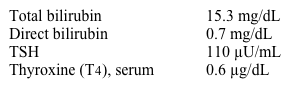 Which of the following is the most likely cause of this infant's condition?
 (Multiple Choice)
4.9/5 (66)
(66) A 6-month-old girl is brought to the office for a routine well-child visit. The patient has been breastfeeding well and has recently started eating pureed solid foods. She babbles but does not say "mama" or "dada." Her 2-year-old brother has a speech delay requiring therapy twice a week. The patient is at the 40th percentile for length, 50th percentile for weight, and 60th percentile for head circumference. She cries when the physician picks her up but is easily consoled by her mother. The patient transfers a toy from her left hand to her right and sits unsupported, but she falls forward after a few seconds. When her father calls her name, she turns to him and smiles. She is unable to pull to a stand and does not crawl. Moro and grasp reflexes are absent. Firm stroking of the soles of her feet causes the big toes to turn up. Which of the following is the most appropriate assessment of this child's development?
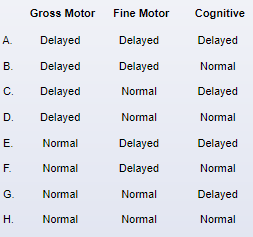
(Multiple Choice)
4.8/5 (71)
(71) A 1-week-old girl is evaluated in the neonatal intensive care unit. She was born at 29 weeks gestation via spontaneous vaginal delivery due to preterm labor. Her mother had routine prenatal care. Rupture of membranes with clear amniotic fluid occurred 2 hours prior to delivery. Apgar scores were 8 and 8 at 1 and 5 minutes, respectively. Birth weight was 1.51 kg (3 lb 5.3 oz). The patient has been tolerating enteral feeds via an orogastric tube, and her weight remains appropriate. Vital signs are normal. Examination shows a sleeping, nondysmorphic infant. A nasal continuous positive airway pressure mask is in place. The anterior fontanelle is open and soft. The oropharynx is clear, and the neck is supple. The lungs are clear to auscultation, and cardiac examination is unremarkable. The abdomen is soft without organomegaly. The external genitalia appear normal, and the skin is intact. The newborn moves all 4 extremities. Which of the following screening tests is indicated in this patient?
(Multiple Choice)
4.8/5 (80)
(80) An 18-month-old girl is brought to the office by her parents due to a rash and blisters that started this morning. Yesterday, the child was very fussy, particularly when her parents picked her up. The patient also had a fever that responded well to ibuprofen. This morning, the parents noted erythema and peeling skin around her mouth, axillae, and inguinal areas. Medical history is significant for otitis media 6 months ago. Vaccinations are up to date, and the patient takes no daily medications. Temperature is 39 C (102.2 F), blood pressure is 89/52 mm Hg, pulse is 145/min, and respirations are 28/min. Examination reveals an irritable child who cries with any attempt to move her. Superficial flaccid bullae and an erythematous rash are diffusely distributed over the body. Slight focal pressure to the back results in sloughing of the top layer of skin with underlying erythema. The face appears edematous, with perioral crusting. A single pustule is noted under the left naris, but no mucosal lesions are seen. Which of the following is the most likely diagnosis in this patient?
(Multiple Choice)
4.9/5 (94)
(94) A 6-year-old boy is brought to the office for an annual wellness check. He has no symptoms. Medical and family history are unremarkable. Vital signs are within normal limits. The patient's height and weight are both appropriate for age. On examination, an abdominal mass is palpated in the right upper quadrant. Laboratory evaluation, including bilirubin, alkaline phosphatase, alanine aminotransferase, and aspartate aminotransferase, is unremarkable. A common bile duct cyst is identified by abdominal ultrasound and is confirmed by MR cholangiopancreatography. Which of the following is the best next step in management?
(Multiple Choice)
4.8/5 (90)
(90) An 18-month-old girl is brought to the office for a well-child visit. The girl speaks 15 words, can run, and follows simple commands. The parents place her in a rear-facing car seat in the back seat and brush her teeth with fluoride-based toothpaste twice a day. She enjoys fruits and vegetables, including whole grapes, strawberries, bananas, and raw carrots. The patient's diet also includes meats, grains, and dairy. The family has gates at the top and bottom of staircases and keeps household cleaners under the sink in a locked cabinet. They have a small backyard and are interested in ideas for summer water activities. The patient takes no medications, and vaccinations are up to date. Routine anticipatory guidance for toddlers is discussed. Which of the following is the most appropriate advice for this family?
(Multiple Choice)
4.9/5 (86)
(86) A newborn boy is undergoing examination in the delivery room immediately following birth. He was born via spontaneous vaginal delivery at 39 weeks gestation to a primigravid 15-year-old adolescent. Delivery was complicated by meconium-stained amniotic fluid. The mother received prenatal care and had an uncomplicated pregnancy. At 5 minutes of life, the patient's heart rate is 120/min and respiratory rate is 50/min. He is flexing his extremities, and he moves and cries vigorously in response to stimulation. The patient has cyanosis of the hands, feet, and circumoral area; the remainder of his skin is pink. Which of the following interventions is indicated during this patient's hospital stay?
(Multiple Choice)
4.8/5 (80)
(80) A 2-year-old boy is brought to the emergency department after his parents found a dark red, formed stool in his diaper. He has been eating and drinking well but seems more tired than usual. The family lives on a ranch raising cattle and goats. Temperature is 37 C (98.6 F). Examination shows a pale, cooperative boy. The abdomen is soft, nondistended, nontender, and without masses. There are no anal fissures or hemorrhoids. A fecal occult blood test is positive. Laboratory results are as follows:  Which of the following is most likely to confirm the diagnosis for this patient?
 (Multiple Choice)
4.7/5 (75)
(75) A 48-year-old man comes to the emergency department due to a week of progressive blurred vision and floaters in the right eye. He has not had ocular pain, fever, or headache. The patient has a history of AIDS and has been noncompliant with therapy. He was recently hospitalized for Pneumocystis pneumonia. Temperature is 37.2 C (99 F), blood pressure is 120/70 mm Hg, and pulse is 78/min. BMI is 17 kg/m2. Vision is decreased in the right eye, and funduscopic examination shows several yellow-white exudates immediately adjacent to the fovea and retinal vessels. Several white patches are present on the oropharyngeal mucosa. Neurologic examination shows no focal weakness or sensory loss. Which of the following is the most likely diagnosis?
(Multiple Choice)
4.8/5 (65)
(65) A 67-year-old woman comes to the office for follow-up. Four weeks ago, she experienced sudden-onset right side numbness, and evaluation revealed an ischemic stroke. The patient feels like some of her sensation is returning but experiences transient burning pain in the right upper and lower limbs that can be induced even by a light touch. Her medical history is significant for hypertension and type 2 diabetes mellitus. She smoked a half-pack of cigarettes daily for 30 years but stopped after her stroke. Blood pressure is 125/70 mm Hg, and pulse is 74/min and regular. Neurologic examination shows right side hemianesthesia and mild athetosis of the right hand. There is hyperesthesia on the right side of the body demonstrated by exaggerated pain on light touch. Motor strength is normal in all 4 extremities. Which of the following is the most probable location of the stroke experienced 4 weeks ago by this patient?
(Multiple Choice)
4.8/5 (68)
(68) A 26-year-old woman comes to the office due to blurry vision in her left eye. She first noticed a "smudge" in the center of her left vision 2 days ago. The patient had been using the computer more than normal to study for an examination and thought that this might be the cause. She ceased using the computer, but the smudge gradually enlarged to involve almost the entire left visual field. She also reports that colors appear "washed out." The patient has mild left ocular discomfort with eye movement. She has no chronic medical problems. Temperature is 36.7 C (98 F), blood pressure is 124/82 mm Hg, and pulse is 78/min. Visual acuity is 20/200 in the left eye and 20/20 in the right. When light is moved from the right eye to the left, the left pupil dilates. Muscle strength, deep tendon reflexes, and sensation are normal. Funduscopic examination is unremarkable. Which of the following is the most likely diagnosis?
(Multiple Choice)
5.0/5 (95)
(95) An 18-month-old boy is brought to the emergency department by his parents due to worsening cough and fever. The patient developed the cough 6 days ago; it increased in frequency over the past day and caused him to wake frequently overnight. He has had fever to 38.3 C (100.9 F) for 3 days. The child takes no medications and has no significant medical history. Temperature is 38.8 C (101.8 F), and respirations are 45/min. Oxygen saturation is 96%. Physical examination shows an active, alert, and playful toddler with mild tachypnea and intermittent suprasternal retractions. Auscultation reveals scattered wheezing and crackles over bilateral lung fields. The remainder of the physical examination is unremarkable. Chest x-ray is shown in the exhibit. 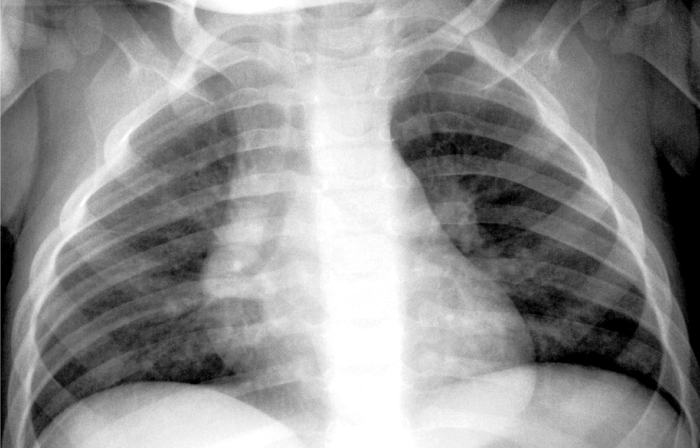 Which of the following is the best next step in the care of this patient?
 (Multiple Choice)
4.9/5 (77)
(77) A 3-day-old boy is being evaluated in the newborn nursery. The patient was born at 35 weeks gestation due to preterm prelabor rupture of membranes. The pregnancy and delivery were otherwise unremarkable. The workup for infection is negative. The patient is breastfeeding every 1-3 hours with adequate elimination. His parents have begun to give him a supplemental multivitamin. Length and weight are in the 25th percentile, adjusted for gestational age. Physical examination shows a sleeping newborn. The anterior fontanel is open, soft, and flat. Red reflexes are present bilaterally. The palate is intact. Cardiopulmonary examination is normal. The abdomen is soft with no organomegaly. Genitourinary examination shows an uncircumcised penis of normal length. The left testis is located within the inguinal canal, and the right testis is palpable in the scrotum. Which of the following is the best next step in management of this patient?
(Multiple Choice)
4.9/5 (78)
(78) An 18-hour-old boy is evaluated in the emergency department for low muscle tone since birth. He was delivered at home to a 19-year-old woman at approximately 40 weeks gestation who received no prenatal care. Since birth, the infant has breastfed 4 times, has a weak suck each time, and falls asleep a few minutes after he begins nursing. Weight is 2.3 kg (5.1 lb). The eyes have upslanting palpebral fissures, and the mouth is open with a protruding tongue. The palate is narrow but intact. Cardiopulmonary examination is normal. The abdomen is soft with no hepatosplenomegaly. When the infant is held under the arms, his legs are extended and he almost slips through the examiner's hands. Which of the following is the most likely underlying diagnosis for this patient?
(Multiple Choice)
4.9/5 (65)
(65) A 2-day-old girl in the newborn nursery is being evaluated for abdominal distension. The patient was born at 39 weeks gestation to a 38-year-old woman by spontaneous vaginal delivery. The mother received epidural analgesia with fentanyl for labor contractions, and the delivery was uncomplicated. Since birth, the girl has shown little interest in breast or bottle feeding. She spit up the last feed but has not vomited. The patient has not yet passed meconium. On physical examination, the anterior fontanelle is open and flat. The palate is intact, and the neck is supple. Cardiopulmonary examination is unremarkable. The abdomen is firm and distended. Examination of the back shows a shallow, 2-mm diameter sacral dimple, and the overlying skin is intact without rashes or hair. Digital rectal examination reveals increased tone followed by release of stool. Extremities appear normal with equal strength and reflexes bilaterally. Abdominal x-ray is shown in the image below: 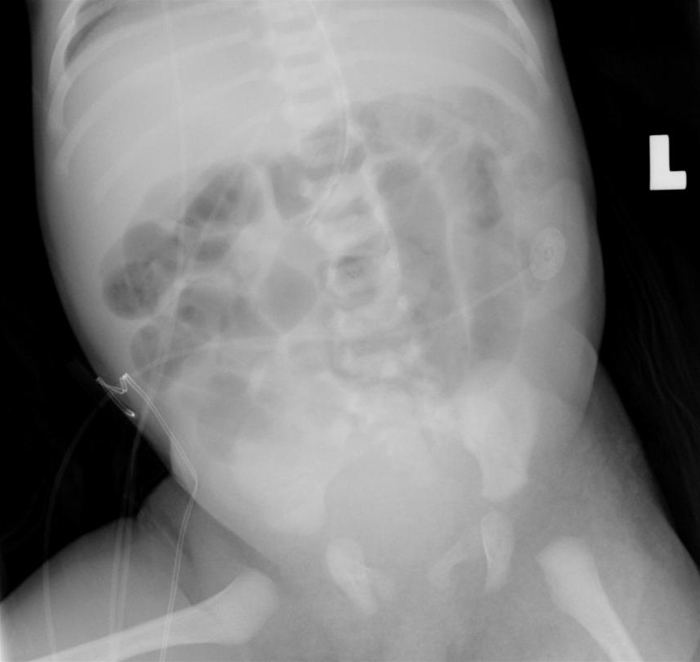 Which of the following is the most likely mechanism for this patient's findings?
 (Multiple Choice)
4.8/5 (84)
(84) A 6-month-old boy is brought to the clinic for a routine well-child check. The patient was exclusively breastfed for the first 4 months of life. Over the past 2 months, his family has gradually introduced complementary foods, including cereals and several infant fruit and vegetable products, into his diet. The family is concerned about introducing highly allergenic foods such as peanuts, shellfish, and eggs because the patient's cousin was hospitalized after developing a severe allergic reaction to eggs. The patient is developing normally and growing at the 50th percentile for weight. His medications include a vitamin D supplement and petroleum jelly for dry skin. Heart, lung, and abdominal examinations are normal. There are small, dry, scaly patches of skin over the extensor surfaces of the extremities. Which of the following is the best approach to the introduction of highly allergenic foods in this patient?
(Multiple Choice)
4.8/5 (81)
(81) A 7-year-old girl comes to the office with her mother due to "wetting her bed" for the past week. The patient has been dry at night for the past year but has woken up about once a night for the past week because she urinated in the bed. She has no fever, dysuria, hematuria, or changes in bowel movements. There have been no changes in the patient's diet or fluid intake; the family eats dinner at 6:00 PM, with which she has her last glass of milk or juice for the day. The patient goes to bed at 8:30 PM. The patient has no medical conditions and takes no daily medications. Her parents divorced six months ago, and she lives with her mother and older sister. Temperature is 36.7 C (98.1 F), blood pressure is 96/57 mm Hg, and pulse is 70/min. Height and weight are at the 40th percentile. Cardiopulmonary examination is unremarkable. The abdomen is soft and nontender. The external genitalia appear normal with no rashes or excoriations. Which of the following is the best next step in management of this patient?
(Multiple Choice)
4.8/5 (82)
(82) A 4-year-old girl is brought to the office by her father due to a day of dysuria and lower abdominal pain. The girl has been toilet-trained for a year but had an episode of urinary incontinence last night. The patient was hospitalized at age 2 for fatigue secondary to hemolytic anemia. Workup ultimately revealed a low glucose-6-phosphate dehydrogenase level at baseline. She has had no hematologic complications since then. Physical examination shows mild suprapubic tenderness but no costovertebral angle tenderness. The remainder of the physical examination is unremarkable. Laboratory results are as follows:  Which of the following antibiotics should be avoided in this patient?
 (Multiple Choice)
4.9/5 (79)
(79) A 36-year-old woman comes to the office after a month of almost daily, bandlike headaches, dizziness, and fatigue. She has experienced irritability, inability to concentrate, and poor sleep of the same duration. Prior to the onset, she had an accident at work; a box fell on her head, and she lost consciousness briefly. The patient was taken to an emergency department and all tests were normal, so she was discharged. She has had no nightmares or flashbacks of the event. She has no known medical problems. She drinks 1-2 glasses of wine every evening but does not use tobacco or illicit drugs. The patient is afebrile. Blood pressure is 125/85 mm Hg and pulse is 76/min. Cardiopulmonary and abdominal examinations are unremarkable. She appears anxious but her neurologic evaluation including attention and memory is normal. Which of the following is the most likely diagnosis?
(Multiple Choice)
4.9/5 (86)
(86) 
Filters
- Essay(0)
- Multiple Choice(0)
- Short Answer(0)
- True False(0)
- Matching(0)