



 Chat with AI
Exam 2: Pediatric

Exam 1: Medicine2 k Questions
Exam 2: Pediatric723 Questions
Exam 3: Psychiatry336 Questions
Exam 4: Surgery563 Questions
Exam 5: Obstetrics & Gynecology469 Questions
Select questions type


A 4-year-old boy is brought to the emergency department by his father for increasing fatigue. Three weeks ago, the patient developed a fever and congestion. The upper respiratory symptoms resolved, but the fever has persisted and he has also developed poor appetite and some weight loss. The patient has been less active and is refusing to walk. He has no chronic medical conditions. The patient's family emigrated from Kenya 2 years ago. Temperature is 39.4 C (102.9 F), blood pressure is 100/70 mm Hg, and pulse is 140/min. Height and weight are at the 80th percentile. The oropharynx is clear, and the conjunctivae are pale. Enlarged, nontender lymph nodes are palpable in the cervical, axillary, and inguinal regions. Lungs are clear to auscultation, but the spleen is enlarged. Deep palpation along the middle of the bilateral thighs elicits tenderness. Multiple petechiae are seen. Laboratory results are as follows:  Chest x-ray is normal. Which of the following would most likely confirm the diagnosis?
 (Multiple Choice)
4.9/5  (80)
(80) A 1-month-old girl is brought to the office for a routine newborn examination. She was born at 39 weeks gestation to a 26-year-old primigravida by cesarean section for breech presentation. The pregnancy and delivery were otherwise uncomplicated, and prenatal ultrasound revealed normal fetal anatomy. The infant is formula fed every 3-4 hours and sleeps 5-6 hours overnight. The patient lives at home with her parents and grandparents. She received the hepatitis B vaccine at age 5 days. Physical examination shows an alert infant who is moving all extremities equally. There are 4 skin creases along the patient's inner left thigh and 1 on the right thigh. When supine with the knees flexed, the left knee appears to be inferior to the right knee. Skin examination shows a nonblanching, blue-grey macule with indefinite borders over the sacrum. The rest of the examination is normal. Which of the following is the most appropriate next step in management of this patient?
(Multiple Choice)
4.9/5 (77)
(77) A 35-year-old man comes to the office due to episodes of grunting, blinking, and squinting that last for a few moments at a time. His new girlfriend has noticed occasional episodes of these behaviors, especially when they argue. The patient had similar episodes during middle school, often associated with feeling stressed or anxious. Although he does not have distress regarding the movements, he agreed to be evaluated at his girlfriend's suggestion. The patient has no significant medical history. Family history is notable for obsessive-compulsive disorder in his father. Vital signs are normal and physical examination is unremarkable. Which of the following is the best next step in management?
(Multiple Choice)
4.8/5 (71)
(71) An 8-year-old boy is brought to the office due to a 2-month history of excessive urination. The parents report that the boy is sometimes irritable and restless and has been drinking excessive amounts of water. He has had normal growth with achievement of all expected milestones and takes no medications. The patient's maternal grandfather tends to drink excess amounts of water. Vital signs reveal tachycardia. On physical examination, mucous membranes are dry. Neurologic examination shows no focal deficits. Laboratory results on a random blood sample are as follows: 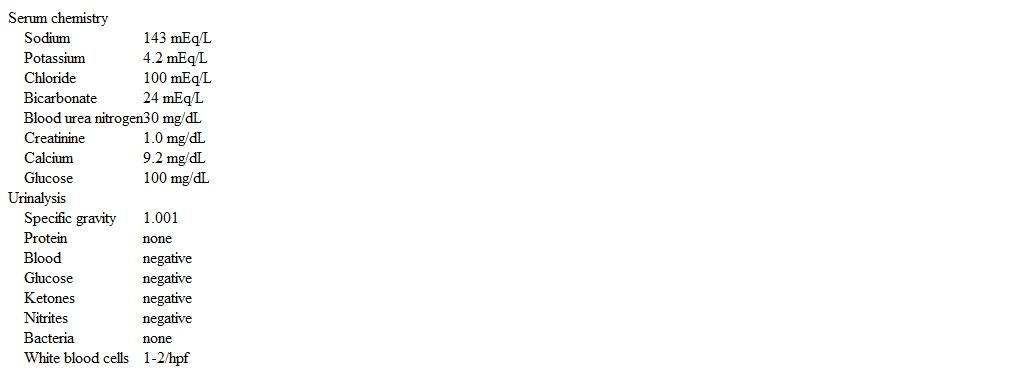 Urine osmolality is 120 mOsm/kg H2O. Which of the following is the most appropriate next step in management?
 (Multiple Choice)
4.8/5 (80)
(80) A 63-year-old woman is brought to the office due to a change in behavior over the past year. The patient was a highly successful CEO of a large company but had to step down 3 months ago due to poor performance. She once excelled in organization and strategic planning, but 9 months ago, she began to have significant difficulty planning important meetings. Now the patient is unable to shop and cook for herself. She has had recent bouts of sadness and urinary frequency. Medical history is significant for hypertension and type 2 diabetes mellitus. Temperature is 37.1 C (98.8 F), blood pressure is 132/79 mm Hg, pulse is 76/min, and respirations are 14/min. The patient scores 23/30 (normal: ≥26) on the Montreal Cognitive Assessment. Gait is slow and unsteady. Extraocular movements are intact. Reflexes are 3+ in the left upper extremity and 2+ on the right. Which of the following is the most likely diagnosis in this patient?
(Multiple Choice)
5.0/5 (81)
(81) A 6-month-old boy is brought to the emergency department for fussiness. Last night, the patient became irritable and developed nonbloody, nonbilious vomiting after breastfeeding. His mother gave him acetaminophen, which improved his fussiness. Overnight, he woke up crying and is now inconsolable. The patient was born at term and has a history of constipation, for which he takes prune juice. He has had daily soft bowel movements for the last 2 weeks. Temperature is 37.1 C (98.8 F), pulse is 150/min, and respirations are 48/min. The patient appears irritable and is difficult to console. The anterior fontanel is soft. Bilateral tympanic membranes and oropharynx are clear. The neck is supple. Bowel sounds are present. The patient writhes and is inconsolable on deep palpation of the lower abdomen. No organomegaly or abdominal mass is palpated. Genitourinary examination shows an uncircumcised penis. No testis is palpable in the right scrotum. The left testis is normal. There is no mass in the inguinal canal. Which of the following is the most likely diagnosis?
(Multiple Choice)
4.8/5 (75)
(75) A 2-year-old boy is brought to the emergency department by ambulance due to convulsions. This morning, the patient was sitting on the sofa at home when he suddenly developed rhythmic movements of both arms and legs that lasted about 3 minutes. He was not responsive during the event. Emergency personnel report that the child was sleepy and seemed confused when they arrived. The patient has had rhinorrhea for the past 2 days and fever since this morning. He has had no cough, vomiting, or diarrhea. The patient has no chronic medical conditions, and immunizations are current. His uncle has epilepsy. Temperature is 39.2 C (102.6 F). Physical examination shows an alert and playful toddler. Bilateral conjunctivae are clear, and clear rhinorrhea is present. The neck is supple with full range of motion. Mucous membranes are moist, and capillary refill is <2 seconds. The remainder of the examination is normal. After treating the fever with acetaminophen, which of the following is the best next step in management of this patient?
(Multiple Choice)
4.9/5 (72)
(72) A 2-month-old boy is brought to the emergency department for evaluation of cyanosis. He became fussy and sweaty while taking his bottle, and his lips "turned blue" for several minutes during the feeding. The infant has had similar episodes during feeding and crying, but these resolved quickly. The patient was born at 39 weeks gestation, and his birth weight was average for gestational age. His weight gain has been slow, currently at the 5th percentile. He is fed pumped breast milk fortified with powdered formula to augment caloric intake. Temperature is 37 C (98.6 F), blood pressure is 80/50 mm Hg, pulse is 150/min, and respirations are 55/min. On examination, the infant is ill-appearing, agitated, cyanotic, and tachypneic. Cardiac auscultation reveals a grade 2/6 crescendo-decrescendo systolic ejection murmur at the left upper sternal border and a single second heart sound. The patient is placed in a knee-chest position immediately. This maneuver improves the patient's condition predominantly by which of the following mechanisms?
(Multiple Choice)
4.8/5 (76)
(76) A 14-year-old girl is brought to the office for evaluation of hand tremors. A week ago, the patient began experiencing a fluttering sensation, followed by involuntary shaking of her right hand. The shaking resolved spontaneously after an hour but has recurred several times since and also involved the left hand. The tremor occurs at rest or during activities and can be interrupted only by either grasping an object or clenching the hand. Vital signs are within normal limits. On physical examination, the patient has a flat affect. At rest, low-frequency tremors of both hands are present. Cranial nerve examination, motor strength, and deep tendon reflexes are normal. The tremors cease during the examination, but at the end, a bilateral coarse tremor can be observed. Which of the following is the most likely diagnosis?
(Multiple Choice)
4.8/5 (77)
(77) A 5-hour-old boy is evaluated in the nursery for minimal right arm movement. He was born at 39 weeks gestation to a 37-year-old multigravida via vaginal delivery complicated by difficulty extracting the shoulders. Review of medical records reveals a maternal history of hypertension and recreational marijuana use. The mother missed most of her prenatal appointments. The patient's birth weight is 4.5 kg (9 lb 14 oz). Vital signs are normal. Examination shows a plethoric infant with crepitus and irregularity over the right clavicle. Moro reflex is absent on the right extremity. Bilateral biceps and grasp reflexes are intact and symmetric. Which of the following risk factors predisposed the infant to this complication?
(Multiple Choice)
4.8/5 (73)
(73) A 14-year-old boy is brought to the office for evaluation after his father experienced sudden cardiac arrest during a hiking trip. The boy has no symptoms or known chronic medical conditions. Blood pressure is 110/60 mm Hg and pulse is 75/min. Physical examination shows a supple neck with no jugular venous distension. The carotid pulse has a dual upstroke. There is strong apical impulse, and a faint midsystolic murmur is best heard at the cardiac apex and along the left sternal border. The lungs are clear to auscultation. Which of the following maneuvers is most likely to increase the murmur intensity in this patient?
(Multiple Choice)
4.8/5 (83)
(83) A 10-year-old girl comes to the office for a routine follow-up visit. The girl has a history of sickle cell disease and had frequent admissions for pain crises in early childhood. Two years ago, she was started on hydroxyurea, which eliminated the pain crises. She has had no recent illnesses, emergency department visits, or hospitalizations. Vital signs are normal, and examination is unremarkable. Laboratory results are as follows: 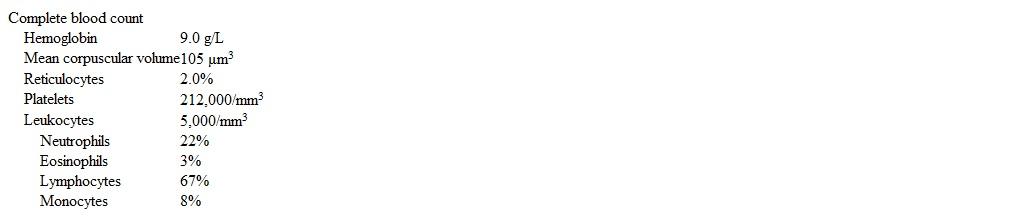 Which of the following hemoglobin patterns would most likely be seen on electrophoresis in this patient?
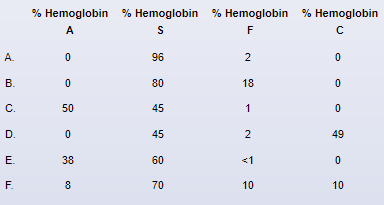
Which of the following hemoglobin patterns would most likely be seen on electrophoresis in this patient?
(Multiple Choice)
4.9/5 (82)
(82) An 11-year-old boy is brought to the emergency department by his mother due to a week of fever, malaise, productive cough, and worsening dyspnea. The patient has cystic fibrosis that was diagnosed at birth and has since had recurrent episodes of sinusitis and lung infections. He has no other chronic medical conditions and is up to date on all recommended vaccinations. Temperature is 38.5 C (101.3 F), pulse is 110/min, and respirations are 30/min. Oxygen saturation is 92% on room air. Auscultation of the lungs reveals bilateral fine crackles and rhonchi. The patient is admitted to the hospital, and broad-spectrum antibiotics are started. A week later, there is no improvement in symptoms. Laboratory studies reveal peripheral blood eosinophilia and an IgE level of 3,225 IU/mL. Which of the following is the most likely cause of this patient's current condition?
(Multiple Choice)
5.0/5 (89)
(89) A 34-year-old man comes to the emergency department due to progressive leg weakness for the past several days. He also reports a tingling sensation in the toes and mild low back pain. Three weeks ago, the patient was evaluated for flulike illness, oral ulcer, and lymphadenopathy and was diagnosed with HIV infection. He has not started antiretroviral therapy yet while waiting for drug resistance testing results. Temperature is 37 C (98.6 F), blood pressure is 120/70 mm Hg, and pulse is 72/min. Lower extremity examination shows marked muscle weakness and loss of deep tendon reflexes bilaterally. Touch, pain, and vibration sensations are intact. Upper extremity examination shows no abnormality. There is no focal back tenderness and no signs of meningeal irritation are present. Which of the following would be most helpful in revealing the cause of this patient's weakness?
(Multiple Choice)
4.9/5 (77)
(77) A 50-year-old woman is brought to the emergency department after suddenly experiencing right upper and lower extremity weakness while jogging on a treadmill. Her weakness gradually worsened over the next hour, and she had severe headache, nausea, and vomiting. The patient has a history of chronic hypertension but stopped taking antihypertensives several months ago. She does not use tobacco but drinks 1 or 2 glasses of wine on weekends. Blood pressure is 230/112 mm Hg and pulse is 76/min and regular. On physical examination, the patient is stuporous and responds to painful stimuli only. There is right hemiplegia, right hemisensory loss, and leftward deviation of the eyes. Which of the following is the most likely diagnosis?
(Multiple Choice)
5.0/5 (71)
(71) A 4-year-old girl is brought to the clinic by her parents due to painful swelling in her groin, which began 2 weeks ago and has gradually become red and tender. Cool compresses and over-the-counter analgesics have not improved her symptoms. The patient attends preschool 3 times a week and returned from a family trip to China 2 months ago. The family has 2 dogs, a cat, and a turtle. Temperature is 37.4 C (99.3 F); other vital signs are normal. Examination shows a small, nontender papule on the anterior left thigh. There is a 4-cm, tender, soft, and freely mobile left inguinal lymph node with overlying erythema. Which of the following is the most likely causative organism of this patient's condition?
(Multiple Choice)
4.9/5 (82)
(82) A 6-month-old boy is brought to the office for a well-child visit. The patient sits with support, mouths toys, and responds to his name. He has not yet started babbling or using a pincer grasp. The patient drinks 24-28 oz daily of donated, pasteurized breast milk obtained through a local milk bank. He was adopted from Uganda at age 2 months. The only available birth history is that the patient was born full-term and that labor and delivery were uncomplicated. Family history is unknown. Immunizations are up to date. He has no chronic medical conditions and takes no medications. Height and weight are at the 20th and 40th percentiles, respectively. Head circumference is at the 30th percentile. The patient has no dysmorphic facial features. The anterior fontanel is open and flat, and the skull bones are soft and flexible to pressure. Bilateral swelling of the wrist is present. There is no bowing of the lower extremities. Cardiopulmonary and abdominal examinations are normal. An x-ray of the wrist is performed. Which of the following is the most likely cause of this patient's x-ray abnormality?
(Multiple Choice)
4.8/5 (74)
(74) A 13-month-old boy is brought to the emergency department by his aunt due to leg pain. He was dropped off at her house this morning by the mother and since then has cried whenever his left leg is touched, refuses to stand up, and has been irritable. Treatment with acetaminophen has not provided any relief. According to the aunt, the patient was born at home, and his mother received no prenatal care during her pregnancy. He was breastfed exclusively until age 6 months. The patient has had no routine health care and takes no daily medications or supplements. The toddler's father is unknown; his mother had a forearm and wrist fracture as a child. Weight is at the 5th percentile and height is at the 50th percentile. On physical examination, the left distal thigh has mild swelling and point tenderness. The skin has no bruising, but beefy erythematous plaques with satellite papules are present in the diaper area. X-ray of the left thigh reveals a medial metaphyseal corner fracture of the distal femur. Which of the following is the most likely cause of this patient's x-ray findings?
(Multiple Choice)
4.7/5 (80)
(80) A 3-year-old boy is brought to the office by his parents due to leg pain. Over the past 3 months, he has had progressive, bilateral lower leg pain that is worse with activity. The patient began walking at age 19 months and has always walked on his toes. He has had no fever, joint swelling, or rash. The patient takes no medications, and his immunizations are up to date. He was adopted as an infant, and his biological family history is unknown. Examination shows bilateral calf enlargement and thin, atrophied thighs. There is no focal tenderness with palpation. The patient has a waddling gait. His creatine kinase level is markedly elevated. Muscle biopsy shows replacement of muscle by fat and connective tissue. Which of the following additional tests should be performed at this time?
(Multiple Choice)
4.8/5 (62)
(62) A 17-year-old boy with chronic immune thrombocytopenia (ITP) comes to the clinic for follow-up. The patient was initially diagnosed with ITP over a year ago when he developed prolonged epistaxis after colliding with another player during a soccer game. This past school year the patient has been unable to participate in sports due to frequent episodes of mucosal bleeding after mild trauma warranting pharmacologic intervention. He has received treatment with multiple medications, including intravenous immunoglobulin and prednisone. His response to treatment has been transient, with platelet counts that have decreased rapidly to the 10,000/mm3 range at follow-up visits. Physical examination shows diffuse petechiae and a few areas of ecchymosis along the thighs but is otherwise normal. Laboratory results are as follows: 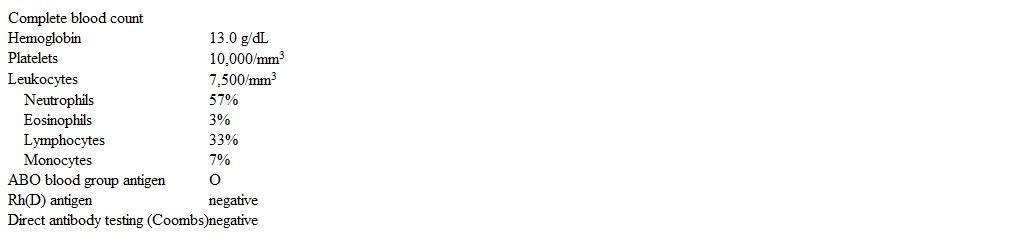 Workup for autoimmune disorders and chronic viral infections is negative. Bone marrow evaluation reveals a normocellular marrow with slightly increased megakaryocytes. Which of the following is the best next step in management of this patient?
 (Multiple Choice)
4.8/5 (80)
(80) 
Filters
- Essay(0)
- Multiple Choice(0)
- Short Answer(0)
- True False(0)
- Matching(0)