



 Chat with AI
Exam 2: Pediatric

Exam 1: Medicine2 k Questions
Exam 2: Pediatric723 Questions
Exam 3: Psychiatry336 Questions
Exam 4: Surgery563 Questions
Exam 5: Obstetrics & Gynecology469 Questions
Select questions type


A 67-year-old retired college professor comes to the office for evaluation of memory loss. The patient has had intermittent episodes of misplacing objects and forgetting appointments. He also reports difficulty concentrating. The patient performs most activities of daily living independently. He has a history of well-controlled hypertension. Family history is significant for dementia in his mother. Vital signs are within normal limits. Mini-Mental State Examination is administered to screen for cognitive impairment. Which of the following factors may limit validity of the screening tool in this patient?
(Multiple Choice)
4.7/5  (72)
(72) A 2-year-old boy is brought to the emergency department due to fever and respiratory distress. A week ago the patient had rhinorrhea and nasal congestion that spontaneously resolved. For the past 3 days he has had persistent fever and has become increasingly tired. Today his breathing is labored. The patient has no chronic medical conditions and is up to date with recommended vaccinations. Temperature is 38.2 C (100.7 F). Scattered, mobile, subcentimeter lymph nodes are palpable in the anterior cervical chain bilaterally. Cardiac examination shows tachycardia, an S3 gallop, and a grade 3/6 holosystolic murmur loudest at the cardiac apex. Brachial and femoral pulses are 1+. Pulmonary examination reveals tachypnea, nasal flaring, and subcostal retractions. Scattered wheezes are present at the lung bases and persist despite bronchodilator treatment. The liver is palpated 4 cm (1.6 in) below the costal margin. Which of the following is the most likely diagnosis in this patient?
(Multiple Choice)
4.9/5 (67)
(67) A 5-month-old girl is brought to the office by her parents for evaluation of a skin lesion on her buttock. Her parents initially noticed a small, red macule several weeks after her birth and thought it was an insect bite. They have been applying over-the-counter hydrocortisone cream but the lesion has progressively enlarged, especially over the last 2 months. The skin lesion is shown in the image below. 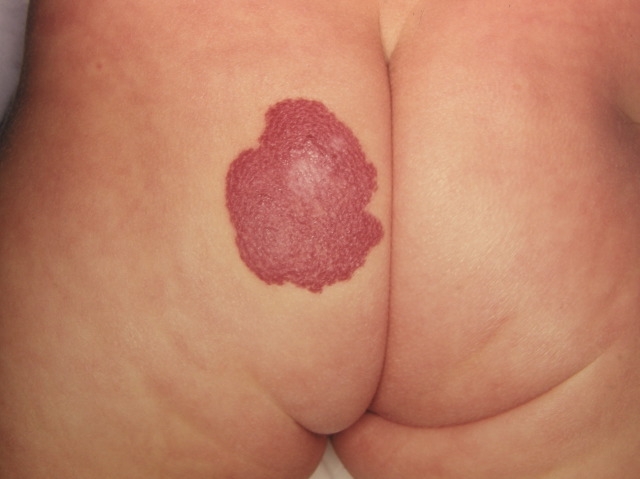 Which of the following is the most likely diagnosis in this patient?
 (Multiple Choice)
4.8/5 (64)
(64) A 17-year-old girl is brought to the office due to a worsening rash on her left upper arm. The rash was the size of a dime when the patient initially noticed it 3 weeks ago, but it has since grown in size, developed a raised edge, and become increasingly itchy. She has applied moisturizing creams without improvement. The patient takes no medications and has no allergies. The rash is shown in the image below: 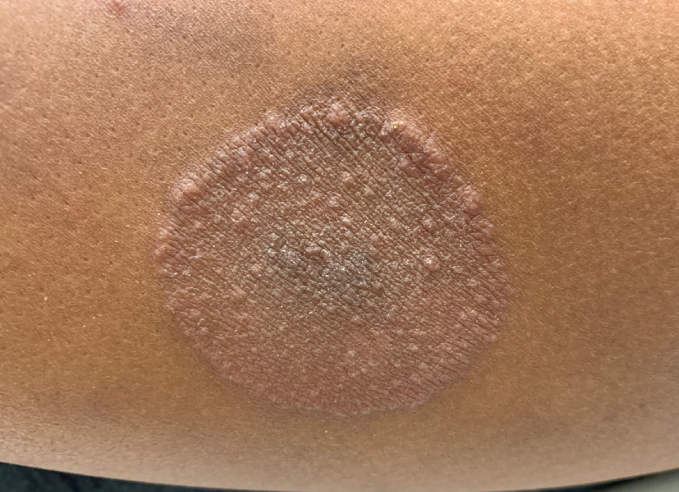 What is the most likely diagnosis for this patient?
 (Multiple Choice)
4.8/5 (76)
(76) A 6-month-old girl is brought to the physician for evaluation of irritability and listlessness. Her parents are concerned that the child cannot sit or roll even though she was able to do so several weeks before. The child was previously healthy except for 2 prior respiratory infections. On examination, the patient is hypotonic with hepatosplenomegaly and a protuberant abdomen. She has a bright red macula on ophthalmologic examination along with cervical lymphadenopathy. All deep-tendon reflexes are diminished. Which of the following is the most likely cause of this child's developmental regression?
(Multiple Choice)
4.9/5 (80)
(80) A 52-year-old man with a history of schizoaffective disorder is admitted to the hospital for treatment of a lower extremity cellulitis. The patient does not appear to have any other acute medical illness. He is continued on his home medications-lithium, risperidone, and sertraline-and cephalosporin therapy is initiated to treat his infection. During the hospital stay, the patient also receives ibuprofen and acetaminophen for pain and lorazepam as needed for anxiety and insomnia. His infection improves over the next 10-14 days, but prior to discharge, he develops repeated episodes of vomiting and diarrhea. At the same time, the patient becomes tremulous and uncoordinated, which makes it difficult for him to walk without falling. In addition, he seems confused. Vital signs are normal. Physical examination shows fasciculations and bilateral tremor. Which of the following medications is most likely to have caused this patient's new symptoms?
(Multiple Choice)
4.8/5 (76)
(76) A 21-month-old girl is brought to the emergency department due to difficulty swallowing. She first became ill 3 days ago with runny nose, cough, and low-grade fever. Over the last 4 hours, she became extremely fussy at home and refused to eat or drink. The patient previously has been well and has received all her immunizations. Temperature is 38.3 C (101 F), pulse is 180/min, and respirations are 40/min. The patient is agitated, drooling, and has suprasternal and intercostal retractions. She has audible stridor. Lung examination reveals diminished breath sounds. Due to impending respiratory failure, the patient undergoes endotracheal intubation. During intubation, the epiglottis is noted to be erythematous and edematous. Which of the following is the best empiric antibiotic therapy for this patient?
(Multiple Choice)
4.9/5 (81)
(81) A 5-day-old girl is brought to the office by her parents after nursery discharge. She was born at 37 weeks gestation via cesarean delivery due to a nonreassuring fetal status secondary to fetal growth restriction. The patient was discharged from the hospital on day of life 4. She is exclusively breastfed, and the mother says the patient often spits up breast milk, sometimes while asleep. She occasionally rests on the mother's chest in the prone position while both are awake. The patient uses a pacifier for sleep. The parents are concerned about her varied breathing pattern because she often takes rapid, shallow breaths followed by 5-10 second pauses. The patient lives at home with her mother and father, who occasionally smoke cigarettes. Vital signs and physical examination are appropriate for age. The mother says that a neighbor's 2-month-old infant recently passed away in her sleep and is wondering if there is anything she should do differently. Which of the following interventions has the greatest impact on this patient's safety?
(Multiple Choice)
4.9/5 (70)
(70) A 12-day-old boy is brought to the emergency department by his parents due to poor feeding. The patient is exclusively breastfed but has been less interested in feeding since last night. He was born via scheduled repeat cesarean delivery. Maternal group B streptococcal screening was positive, but intrapartum antibiotic prophylaxis was deferred due to the planned cesarean delivery. The pregnancy was otherwise unremarkable, and the infant had an uncomplicated nursery stay. The patient's 3-year-old brother attends day care and has had rhinorrhea and cough this week. Temperature is 35.1 C (95.2 F). Physical examination shows a hypotonic, lethargic infant with a full anterior fontanelle. Initial laboratory studies reveal a leukocyte count of 2,000/mm3 with 20% bands. During the evaluation, he becomes apneic and requires intubation. Which of the following is the most likely cause of this patient's condition?
(Multiple Choice)
4.9/5 (71)
(71) A 3-month-old full-term boy is brought to the emergency department for refusal to feed. The infant has been exclusively breastfed since birth but has not been latching onto the nipple. He has been urinating normally and usually stools 3 or 4 times a day, but his last bowel movement was several days ago. He was previously able to hold his head up on his own but his head now seems floppy. The patient's family recently moved to California and has been enjoying stroller walks in their newly built neighborhood. Other than daily vitamin D supplementation, the infant has never ingested food, even honey. Vital signs are normal. Examination shows bilateral ptosis, sluggish pupillary reaction to light, copious drool, weak suck and gag reflexes, and head lag. The extremities are flaccid and in extension. What is the most likely mechanism of this patient's illness?
(Multiple Choice)
4.9/5 (84)
(84) A 20-year-old woman comes to the office due to hearing loss. The patient is a student and has difficulty hearing her professors, even when sitting in the front row. She also has trouble with balancing poses during yoga. The patient has no medical conditions and takes only oral contraceptives. She drinks alcohol on weekends and does not smoke. Her mother also developed hearing loss in her 20s. Ear examination is normal. Gait is normal, but standing on 1 foot is difficult, especially with closed eyes. Audiogram shows bilateral sensorineural hearing loss. Which of the following is the most likely cause of this patient's symptoms?
(Multiple Choice)
4.9/5 (93)
(93) A 63-year-old man is brought to the office by his daughter due to recurrent falls. According to his daughter, the patient has lost his balance and fallen several times over the past 6 months. He has not sustained serious injuries. She has also noticed some "shaking" of his right hand that is most apparent at rest. The patient has lived alone since his wife died 5 years ago and still shops, cooks, and cleans independently. Blood pressure is 141/68 mm Hg and pulse is 72/min. Neurologic examination shows mild rigidity of the limb muscles that is most prominent on the right side with a slow, shuffling gait. The patient is prescribed medication for his symptoms but returns to the office 4 weeks later reporting "disturbing visions of strangers creeping around corners of his apartment." On examination, he is alert and scores 27/30 on the Montreal Cognitive Assessment (normal: ≥26). Which of the following is the most likely explanation for this patient's new symptoms?
(Multiple Choice)
4.9/5 (93)
(93) A 1-year-old boy is brought to the clinic to establish care after his family's recent move to the area. The patient was born at full term and has been growing and developing normally. Each day, he eats meat and pasta and drinks 300 mL (10 oz) of whole milk; however, he does not eat fruit and vegetables. The patient takes no daily medications or vitamins. Weight and height are at the 50th percentile. Conjunctivae and mucous membranes are pale. Cardiac examination reveals no murmurs. Pulmonary examination is normal. The abdomen is soft, and no hepatosplenomegaly is noted. Complete blood count results are as follows:  Which of the following is the most likely cause of this patient's anemia?
 (Multiple Choice)
4.7/5 (75)
(75) A 10-minute-old neonate is evaluated in the delivery room for low oxygen saturation and difficulty breathing. The patient was born at 36 weeks gestation to a 37-year-old mother whose pregnancy was complicated by poorly controlled type 2 diabetes mellitus. Membranes were ruptured 3 hours prior to delivery, and the fluid was clear. Apgar scores were 5 and 7 at 1 and 5 minutes, respectively. Temperature is 36.9 C (98.4 F), pulse is 166/min, and respirations are 70/min. Examination shows cyanosis of the lips and mucous membranes. The patient is grunting and has intercostal and subcostal retractions. Cardiac examination shows a 1/6 systolic ejection murmur at the left upper sternal border. Breath sounds are decreased bilaterally. The abdomen is soft with no organomegaly. Pulses are 2+ in all extremities. Pulse oximetry on room air is 64% in the right hand and foot. An orogastric tube is placed, and the patient is started on continuous positive airway pressure with supplemental oxygen. Pulse oximetry improves to 82%. Chest radiograph is shown in the image below: 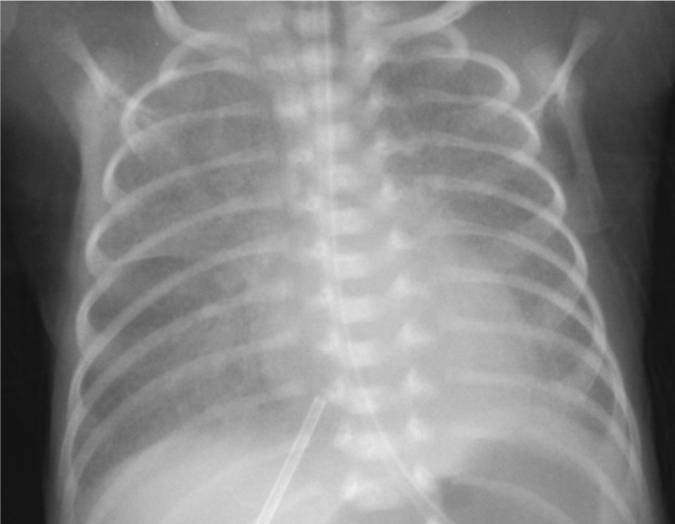 Blood cultures are obtained, and intravenous antibiotics are started. Which of the following is the most appropriate pharmacotherapy for this patient?
 (Multiple Choice)
4.9/5 (79)
(79) A 12-year-old boy is brought to the emergency department due to worsening facial swelling. Thirty minutes ago, the patient began experiencing a burning sensation and swelling of the eyes. He also has had a scratchy sensation and tightness in the throat as well as crampy abdominal pain. The patient was seen at an urgent care clinic earlier today due to persistent sore throat for the past several days. He was diagnosed with acute pharyngitis and prescribed amoxicillin. The patient has no other medical conditions and no known drug allergies. Temperature is 37.2 C (99 F), blood pressure is 116/68 mm Hg, and pulse is 92/min. Physical examination shows bilateral periorbital swelling and mild conjunctival erythema. There are scattered, raised wheals on his trunk. Which of the following is most likely involved in the pathogenesis of this patient's current condition?
(Multiple Choice)
4.9/5 (71)
(71) A 14-year-old boy is brought to the clinic due to severe left ear pain. Medical history includes several episodes of acute otitis media as a toddler; each infection resolved promptly with antibiotics. Over the past 3 years, the patient has developed recurrent acute otitis media, often complicated by sinusitis. Last year, he missed 2 weeks of school due to an episode of pneumonia. Vital signs are unremarkable. Examination shows an erythematous and bulging left tympanic membrane. Immunoglobulin testing reveals:  Vaccinations are up to date, but vaccine titers for tetanus, diphtheria, and pneumococcus are low. Which of the following defects is most likely present in this patient?
 (Multiple Choice)
4.8/5 (76)
(76) A boy is brought to the nursery shortly after birth. The patient was born at term to a 36-year-old primigravid mother via spontaneous vaginal delivery following a pregnancy complicated by chronic hypertension. Her only prenatal care was at 10 weeks gestation in the emergency department and was due to vaginal discharge and spotting. Ultrasound confirmed a 10-week intrauterine gestation. The mother was diagnosed with Chlamydia trachomatis and treated with azithromycin. The infant was born vigorous with Apgar scores of 7 and 9 at 1 and 5 minutes, respectively. The patient's measurements are charted below, and the examination is otherwise unremarkable. 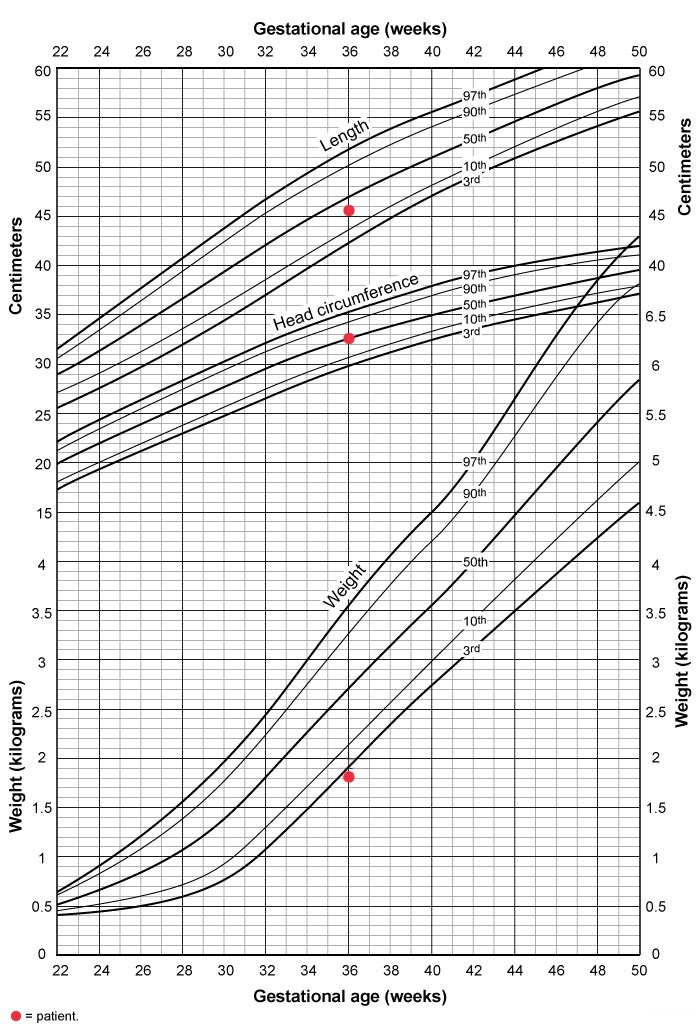 Which of the following is the most likely cause of this patient's findings?
 (Multiple Choice)
4.9/5 (69)
(69) A 13-year-old girl with cystic fibrosis is evaluated in the emergency department after developing lightheadedness and nausea during an outdoor soccer game. The patient bumped heads with another player 10 minutes into the game but did not lose consciousness and continued playing. Near the end of the second half, she developed profound generalized weakness, felt she was going to pass out, and had to be carried off the field. Her parents say that she has been well except for runny nose and congestion the past 4 days. Temperature is 39 C (102 F), pulse is 136/min, and respirations are 26/min. The patient is alert and oriented but is sweating profusely. While being assessed, she develops abdominal cramps and nausea and then vomits. Which of the following is the most likely diagnosis in this patient?
(Multiple Choice)
4.7/5 (77)
(77) A newborn boy is being evaluated in the nursery for respiratory distress. He was born an hour ago at 37 weeks gestation via spontaneous vaginal delivery to a primigravid mother who had scant prenatal care. Delivery was uneventful. During skin-to-skin contact, the mother noticed his face turn blue. The patient was stimulated and began crying, which improved his color. Weight, length, and head circumference are in the 25th-50th percentile. Temperature is 36.8 C (98.2 F), pulse is 150/min, and respirations are 48/min. Pulse oximetry is 97% on room air. As the crying stops, pulse oximetry decreases to 80% on room air. A 5-French catheter is unable to be passed through either naris. The ears are short and wide with no earlobes. The right eye is as shown below: 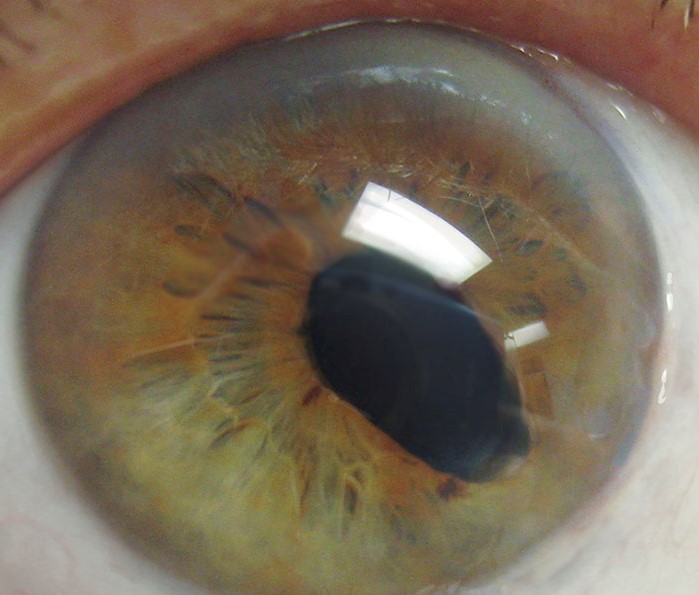 Oropharyngeal examination reveals a cleft palate. The patient has a loud, harsh, holosystolic murmur best heard at the lower left sternal border. The testes are not palpable. The skin and extremities appear normal. Which of the following is the most likely diagnosis in this patient?
 (Multiple Choice)
4.9/5 (76)
(76) A 9-year-old boy is brought to the office by his parents for evaluation of behavior problems. His mother says that he never listens, gets distracted easily, and is hyperactive all the time. He is unable to sit still at the dinner table, constantly interrupts her when she is speaking on the phone, and makes excuses for forgetting his homework and chores. The father says his wife is overreacting as the boy has always been very active. He adds, "I was the same way as a kid; I am sure he'll grow out of it." There have been no changes in the patient's appetite or sleep. He has friends at school and likes to play sports and video games. Physical examination is remarkable for a scar on his right leg and multiple scabs on his right knee, which he reports are due to falling off his bike and skateboard. The remainder of the physical examination is normal. The child's mother asks if there is any medication that can help him "calm down." Which of the following is the most appropriate next step in management of this patient?
(Multiple Choice)
4.8/5 (65)
(65) 
Filters
- Essay(0)
- Multiple Choice(0)
- Short Answer(0)
- True False(0)
- Matching(0)