



 Chat with AI
Exam 2: Pediatric

Exam 1: Medicine2 k Questions
Exam 2: Pediatric723 Questions
Exam 3: Psychiatry336 Questions
Exam 4: Surgery563 Questions
Exam 5: Obstetrics & Gynecology469 Questions
Select questions type


A 2-day-old boy is evaluated in the newborn nursery due to a diffuse rash that developed this morning on his torso and extremities. The patient has been breastfeeding every 2-3 hours and voiding frequently. He was born via vaginal delivery at 40 weeks gestation to a 30-year-old woman. Maternal history is notable for the occasional development of cold sores during stressful events, most recently a year ago. Temperature is 36.7 C (98.1 F), pulse is 132/min, and respirations are 42/min. Physical examination shows pustules overlying erythematous skin on the extremities; the palms and soles are spared. There are scattered erythematous papules, as shown in the exhibit. 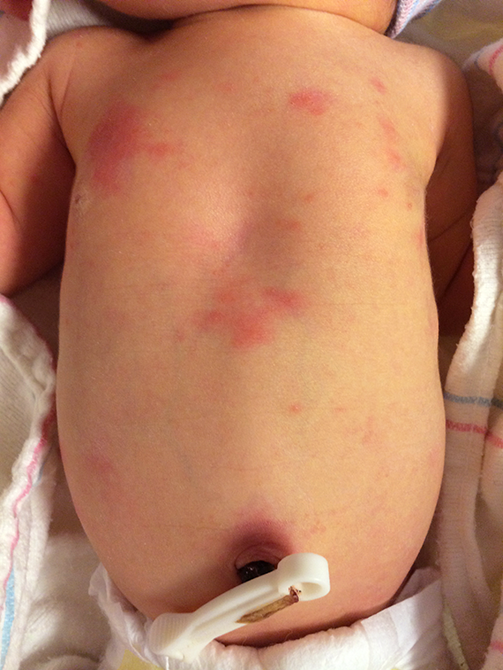
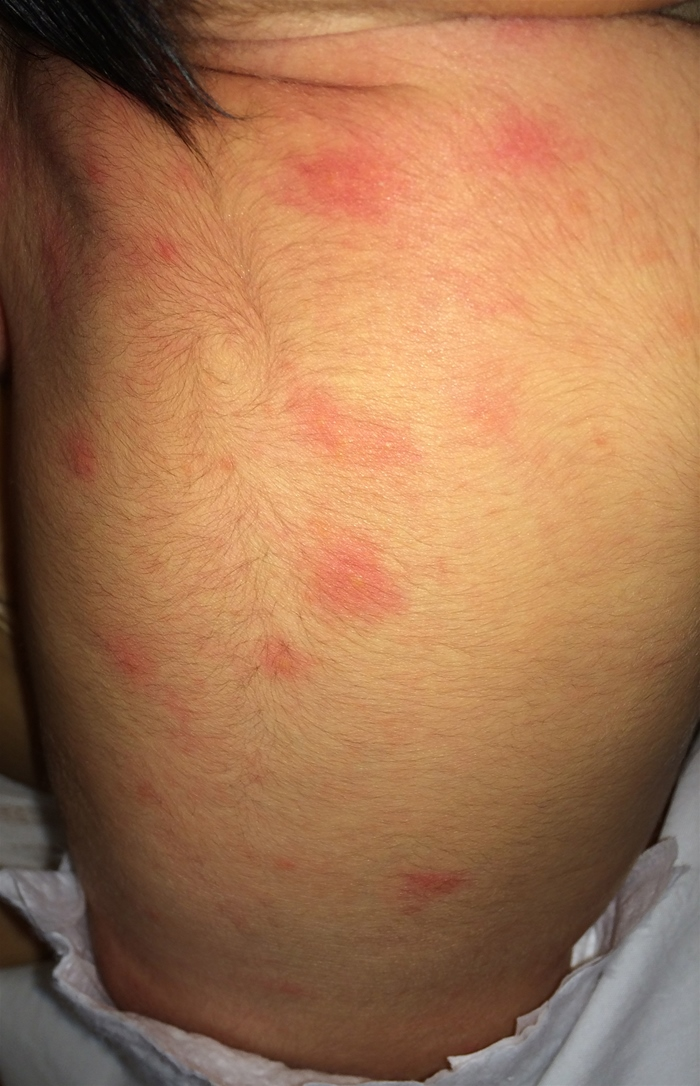 Examination is otherwise unremarkable. Which of the following is the most appropriate next step in management of this patient?
 (Multiple Choice)
4.8/5  (85)
(85) A previously healthy 2-year-old girl is brought to the hospital due to lethargy and confusion for 1 day. Four days ago, the patient developed fever and nasal discharge. These symptoms resolved in 2 days, but she has been progressively tired and disoriented for the past day. The patient's older sister had a cold sore on her lip 2 weeks ago. Temperature is 37.1 C (98.8 F). On examination, she is minimally responsive. The pupils are equal and have a sluggish reaction to light. The sclerae are nonicteric, and the neck is supple. Mild hepatomegaly is present. Laboratory results are as follows:  CT scan of the head reveals diffuse cerebral edema. Which of the following is most helpful to establish a diagnosis in this patient?
 (Multiple Choice)
4.9/5 (85)
(85) A 5-year-old boy is brought to the emergency department due to an episode of bright-red urine an hour ago. The boy has no chronic medical conditions, but he had nasal congestion, sore throat, and vomiting last week. Temperature is 37.1 C (98.8 F), blood pressure is 108/66 mm Hg, pulse is 110/min, and respirations are 20/min. The patient is awake and alert. The oropharynx is unremarkable, and the neck is supple with no lymphadenopathy. Cardiopulmonary examination is normal, and the abdomen is soft and nontender. There is no hepatosplenomegaly. Skin examination shows diffuse flat, red pinpoint macules and raised ecchymoses along the lower extremities and trunk. Laboratory results are as follows: 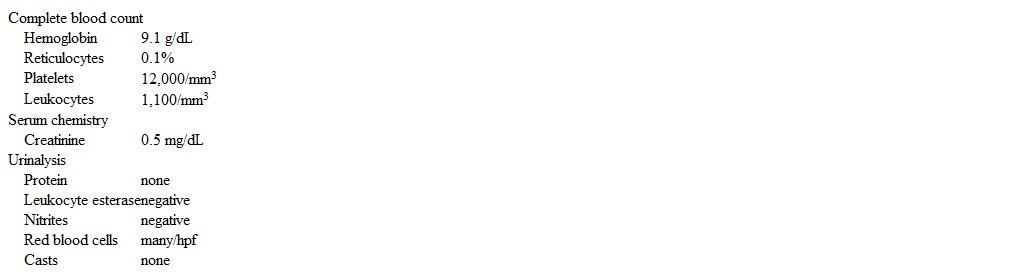 Which of the following is most appropriate in management of this patient?
 (Multiple Choice)
4.9/5 (90)
(90) A 3-day-old boy is brought to the emergency department for evaluation of vomiting and abnormal movements. The patient's arms and legs began rhythmically jerking about 20 minutes ago. The movements were symmetric and lasted for a minute. He has also had persistent vomiting today, especially after feeding, and had an episode of loose, nonbloody stool. The patient was born at term after an uncomplicated pregnancy and is exclusively breastfed. Temperature is 37.1 C (98.8 F). Examination shows a lethargic newborn with diffuse hypotonia as well as jaundice. The liver edge is palpable. Laboratory results are as follows:  Which of the following is the most likely diagnosis in this patient?
 (Multiple Choice)
4.8/5 (79)
(79) A 5-year-old girl is brought to the clinic due to a rash. The patient developed multiple pruritic lesions over her neck and left arm 2 weeks ago. Similar lesions have also developed on the patient's cousin who recently spent the night, and the family is concerned about some form of infestation. The family searched their home including furniture and found numerous webs. Vital signs are normal. On examination, the patient is scratching her neck and left arm where multiple 3- to 5-mm erythematous papules are arranged in a linear pattern. Several of the papules have a central hemorrhagic punctum. Which of the following is the most likely diagnosis in this patient?
(Multiple Choice)
4.7/5 (96)
(96) A 16-year-old girl is brought to the clinic due to vomiting and abdominal pain. Since this morning, the patient has had multiple episodes of nonbilious, nonbloody emesis as well as intermittent nausea and abdominal pain. She has also had 3 episodes of watery diarrhea. The patient attended a school cookout approximately 36 hours prior to her first bout of emesis, and several of her friends who also attended have similar symptoms. Temperature is 37.4 C (99.1 F), blood pressure is 115/75 mm Hg, and pulse is 95/min. She appears uncomfortable but is alert and interactive. Mucous membranes are slightly dry. There is diffuse tenderness to deep palpation on abdominal examination but no masses or hepatosplenomegaly. The skin is well perfused, and no rashes are evident. Which of the following is the most likely etiology of this patient's illness?
(Multiple Choice)
4.9/5 (83)
(83) A 5-year-old girl is brought to the office for evaluation of pubic hair. Her mother first noticed dark hair in the genital area while helping her daughter bathe several weeks ago. The patient has also developed axillary hair and adult-type body odor over the last 2 weeks. She has no known medical conditions and takes no daily medications. She started kindergarten 3 months ago. The girl's mother underwent menarche at age 12. Weight is at the 75th percentile, height is at the 90th percentile, and BMI is at the 25th percentile. Fundoscopic examination and pupillary reaction are normal bilaterally. Cardiopulmonary examination is normal. The abdomen is soft and nontender; no masses are palpable. Breasts are prepubertal. Sparse, dark, coarse hair is noted in both axillae and over the mons pubis and labia majora. There is no clitoromegaly. Mild comedonal acne is present on the forehead, nose, and chin. Which of the following is the best next step in evaluation of this patient?
(Multiple Choice)
4.9/5 (81)
(81) A 52-year-old woman comes to the office due to intermittent pain on the right side of the face for 3 weeks. The intense, sharp pain on the right cheek and lips lasts several seconds and recurs several times a day. The patient is afraid to brush her teeth or drink cold water because both trigger the pain. She is pain free between episodes. She has a history of hypertension, type 2 diabetes mellitus, and seasonal allergies. The patient does not use tobacco, alcohol, or illicit drugs. Temperature is 36.9 C (98.4 F), blood pressure is 136/84 mm Hg, and pulse is 80/min. No rash or facial asymmetry is noted. The remainder of the neurologic examination shows no abnormalities. Which of the following is the most likely cause of this patient's current condition?
(Multiple Choice)
4.8/5 (68)
(68) A 2-year-old boy is brought to the emergency department by his babysitter due to noisy breathing. The patient has had rhinorrhea, congestion, and a cough for 2 days. The cough worsened last night when he developed a high-pitched noise during inspiration that worsens when he cries. Earlier today, the patient was playing in the same room as his 6-year-old brother, who also has cold symptoms. He has no chronic medical conditions. The babysitter is unsure of the patient's immunization status. Temperature is 38 C (100.4 F), pulse is 140/min, and respirations are 44/min. Pulse oximetry is 96% on room air. On examination, the patient is alert with mild suprasternal retractions and a harsh, dry cough. The pharynx is mildly erythematous without tonsillar enlargement or asymmetry. The lungs are clear on auscultation. Which of the following is the most likely diagnosis?
(Multiple Choice)
4.9/5 (86)
(86) A 79-year-old woman is brought to the office due to recurrent falls. Over the past year, the patient has become increasingly unsteady while walking and has had several falls. The patient has had no headaches, vision changes, nausea, or vomiting. Medical history is significant for hypertension, for which she takes losartan. Vital signs are within normal limits. Cardiopulmonary and abdominal examinations are unremarkable. Neurological examination shows normal cranial nerves and fundoscopy. There is increased tone and hyperreflexia of the lower extremities. Sensation to light touch and vibration is intact. When instructed to walk, the patient moves slowly with small steps and a wide base; she takes several steps to turn around. CT scan of the brain is shown below. 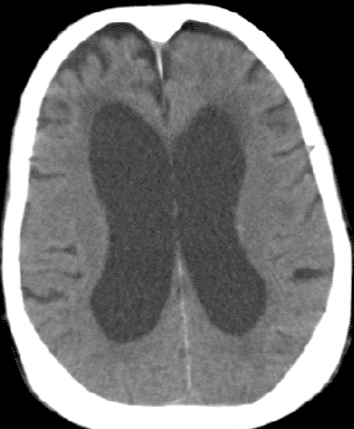 This patient's symptoms would most likely improve with which of the following?
 (Multiple Choice)
4.8/5 (67)
(67) A 10-year-old boy is brought to the emergency department due to 2 days of rhinorrhea, congestion, cough, and wheezing that worsened over the 6 hours prior to arrival. Chest x-ray reveals hyperinflation and bronchial wall thickening. He receives nebulized albuterol and ipratropium, intravenous corticosteroids, and intravenous magnesium sulfate. Due to lack of significant improvement in symptoms, the patient is admitted to the intensive care unit and given continuous nebulized albuterol, intravenous terbutaline, and bilevel noninvasive positive airway pressure ventilation. After 2 hours, pulse oximetry shows 89% on 0.6 FiO2, and the patient becomes agitated. Breath sounds are diminished but equal bilaterally, and no wheezing or stridor is heard. The patient's trachea is midline. Laboratory results are as follows:  Which is the best next step in management of this patient?
 (Multiple Choice)
4.9/5 (87)
(87) A 65-year-old woman comes to the office for evaluation of progressively worsening memory. The patient lives alone and considers herself "very independent"; however, she has recently forgotten to pay her bills on several occasions and also lost her way while driving in a previously familiar neighborhood 2 weeks ago. Review of systems reveals no other symptoms except for mild urinary urgency. The patient has a history of hypertension and hyperlipidemia. She does not use tobacco, alcohol, or illicit drugs. Temperature is 36.7 C (98 F), blood pressure is 130/90 mm Hg, pulse is 72/min, and respirations are 14/min. The lungs are clear to auscultation, and a grade 2/6 systolic ejection murmur is present. Abdominal examination shows no tenderness or masses. The cranial nerves are intact, funduscopy is normal, and there is no tremor. The patient immediately recalls all 3 of 3 items read to her, but 5 minutes later she can remember none of them. Her gait is broad-based and shuffling. Blood cell count and serum chemistry studies are within normal limits. Which of the following is the most likely underlying cause of this patient's symptoms?
(Multiple Choice)
4.8/5 (84)
(84) A 3-year-old boy is brought to the clinic due to 3 days of fever and painful swelling in his right groin. His medical history includes 4 episodes of cutaneous abscesses and a lung abscess due to Staphylococcus aureus, all of which required drainage and prolonged antimicrobial therapy. The patient's maternal uncle died in childhood from recurrent infections. Temperature is 38.5 C (101.3 F). Physical examination shows an enlarged, tender, and fluctuant lymph node in the right inguinal area. There are several areas of scarring over previous drainage sites. The remainder of the physical examination is normal. Laboratory results are as follows:  Gram stain of fluid aspirated from the affected lymph node reveals numerous organism-filled, segmented neutrophils. Cultures grow Aspergillus niger. Which of the following tests would most likely confirm this patient's diagnosis?
 (Multiple Choice)
4.9/5 (100)
(100) An 18-month-old boy is brought to the emergency department due to fever and facial rash for 2 days. The patient has a history of atopic dermatitis for which his parents occasionally apply over-the-counter steroid cream. He had a flare-up of dry, thickened, itchy skin on his cheeks 4 days ago. Two days ago, the patient developed many overlying, painful bumps that have since increased in number. Vaccinations are up to date. Temperature is 38.5 C (101.3 F). Physical examination shows an uncomfortable-appearing child with numerous painful, clear vesicles over erythematous skin on both cheeks, as well as a few scattered lesions with overlying, dark red crusting. Submandibular lymphadenopathy is present. The rest of the skin appears dry. Which of the following is the most likely etiology of this patient's rash?
(Multiple Choice)
4.8/5 (70)
(70) A 3-week-old boy in the neonatal intensive care unit has several episodes of vomiting. The vomiting developed 6 hours ago and is bilious but nonbloody. The patient was born at 28 weeks gestation by vaginal delivery due to cervical insufficiency. Birth weight was 900 g (2 lb). The patient initially required mechanical ventilation but was extubated to oxygen via nasal cannula last week. He has advanced on continuous nasogastric formula feeds and has gained appropriate weight daily. The infant has had small, yellow, seedy stools but no bowel movement for the past 24 hours. Temperature is 35.6 C (96 F), blood pressure is 75/45 mm Hg, pulse is 165/min, and respirations are 70/min. Pulse oximetry is 97% on 2 L oxygen. Examination shows a lethargic neonate. The abdomen is tense and distended with hypoactive bowel sounds. Laboratory results indicate leukocytosis and metabolic acidosis. Which of the following imaging findings would most likely be seen in this patient?
(Multiple Choice)
4.9/5 (80)
(80) A 70-year-old man comes to the office 4 weeks after experiencing an ischemic stroke. Medical history is significant for long standing hypertension and type 2 diabetes mellitus. Vital signs are unremarkable. BMI is 24 kg/m2. The patient is right-handed. Only the right side of his face is shaved. When asked to raise his left arm, the patient raises his right. When asked to fill in the numbers of a clock, he puts numbers only on the right side. Which of the following areas is most likely affected by the stroke in this patient?
(Multiple Choice)
4.9/5 (85)
(85) A 15-year-old, previously healthy boy is brought to the office due to progressive muscle weakness. Over the past 2 months, the patient has had increasing difficulty making facial expressions, including smiling and frowning. He has also had difficulty swallowing but has no pain. The patient takes no medications, and vaccinations are up to date. He was adopted as an infant, and his biological family history is unknown. Physical examination shows ptosis, temporal wasting, thin cheeks, and emaciated extremities. Delayed relaxation is noted on contraction of the thenar and hypothenar muscles, which also appear atrophied. Deep tendon reflexes are normal and Babinski sign is absent. Testicular volume is small for age. What is the most likely mode of genetic transmission of this patient's condition?
(Multiple Choice)
4.8/5 (99)
(99) A 21-year-old man with a prior history of seizures is brought to the emergency department by ambulance during a tonic-clonic seizure. His mother, who accompanied him, found him on the floor seizing. She says that he has not been compliant with his medications. The patient received intravenous lorazepam, thiamine, and glucose en route but continued seizing. In the emergency department, he is unresponsive and cyanotic. His blood pressure is 96/54 mm Hg and his pulse is 152/min and regular. His pupils are mid-size and reactive to light. Clonic jerks of all extremities are observed. The patient is at highest risk for which of the following?
(Multiple Choice)
4.9/5 (89)
(89) A 6-year-old girl is brought to the office for evaluation of breast and pubic hair development. Her parents noticed that she started developing breasts several months ago, and she recently started growing coarse axillary and pubic hair. The patient has had no changes in her behavior or school performance. She has no headaches, visual changes, vomiting, or vaginal bleeding. The patient has no chronic medical conditions and no previous surgery. She takes no daily medications and has no known allergies. BMI is at the 50th percentile for age. Physical examination reveals axillary hair; pubic hair is Tanner stage 3, and breasts are Tanner stage 3. The remainder of the examination is unremarkable. Bone age is consistent with age 8. Basal LH level is high. Which of the following is the best next step in evaluation of this patient?
(Multiple Choice)
4.7/5 (65)
(65) A 3-year-old boy is brought to the emergency department due to a 3-day history of fever, vomiting, and diarrhea. His mother reports that his urine output has decreased over the last day. She has been giving him ibuprofen for fever, which has improved intermittently. The patient has no chronic medical conditions and takes no daily medications. Temperature is 38.3 C (100.9 F), blood pressure is 82/60 mm Hg, pulse is 144/min, and respirations are 24/min. Examination shows dry lips and mucous membranes. The abdomen has mild, diffuse tenderness, and bowel sounds are hyperactive. Capillary refill is 4 seconds. The remainder of the examination shows no abnormalities. Laboratory results are as follows: 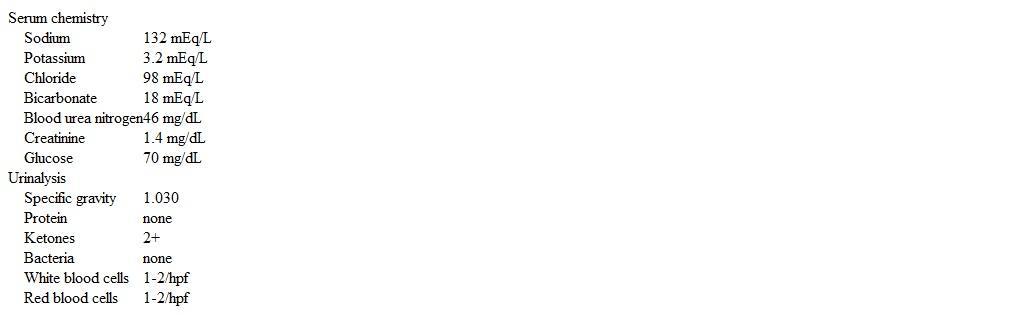 Which of the following is the most likely cause of this patient's decreased urine output?
 (Multiple Choice)
4.7/5 (77)
(77) 
Filters
- Essay(0)
- Multiple Choice(0)
- Short Answer(0)
- True False(0)
- Matching(0)