



 Chat with AI
Exam 2: Pediatric

Exam 1: Medicine2 k Questions
Exam 2: Pediatric723 Questions
Exam 3: Psychiatry336 Questions
Exam 4: Surgery563 Questions
Exam 5: Obstetrics & Gynecology469 Questions
Select questions type


A 17-year-old boy is brought to the emergency department due to cough and difficulty breathing. He first developed a nighttime cough about 3 weeks ago. The cough has progressed, now occurring throughout the day. For the past couple of days, the patient has felt fatigued during routine activities. He has no known chronic medical conditions and takes no medications aside from an over-the-counter cough medicine, which has not helped. Temperature is 37.2 C (99 F), blood pressure is 100/60 mm Hg, pulse is 110/min, and respirations are 30/min. Lung examination shows diminished breath sounds bilaterally in the anterior chest with no wheezing or crackles. Cardiac examination reveals tachycardia without murmurs. The neck is supple with distension of the jugular veins. Abdominal examination shows hepatosplenomegaly, and there is also nontender enlargement of the left testicle. Skin examination shows pallor. Complete blood count results are as follows:  Chest radiograph shows a large anterior mediastinal mass. Which of the following is the most likely diagnosis in this patient?
 (Multiple Choice)
4.9/5  (81)
(81) An 11-year-old girl is brought to the office due to an unsteady gait. Her parents first noticed increasing clumsiness 6 weeks ago, which has since progressed to difficulty standing and walking. The patient has had no recent illnesses, including fever, cough, or diarrhea. She takes no medication and has no allergies. She has scoliosis for which she sees an orthopedic surgeon twice a year. The patient was adopted, and the only known family history is sudden cardiac death in her biological father. Her adoptive mother has anxiety that is well controlled with medication. On examination, the patient is found to have a wide-based gait and constantly shifts her position to maintain balance. The lower extremities have decreased vibratory and position sense, and ankle jerks are absent bilaterally. Which of the following is the most likely diagnosis in this patient?
(Multiple Choice)
4.8/5 (85)
(85) A 12-year-old boy is brought to the office by his mother due to nausea and headache for 2 days. The patient has no fever or neck pain. Three weeks ago, he was treated for a skin infection with 5 days of oral cephalexin. The patient has no chronic medical conditions and takes no daily medications. Temperature is 37.2 C (99 F), blood pressure is 170/98 mm Hg, pulse is 98/min, and respirations are 20/min. Physical examination shows an alert child with periorbital edema. The neck is supple. Cardiac examination reveals no murmur. The lungs are clear to auscultation bilaterally. Trace pitting edema is present on the lower extremities. Laboratory results are as follows: 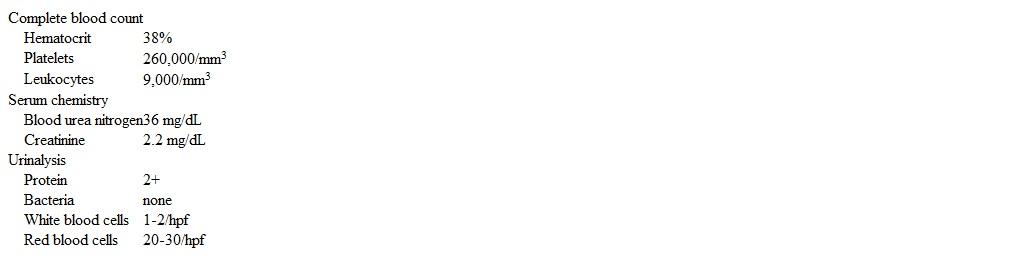 Which of the following is the most likely explanation for this patient's current condition?
 (Multiple Choice)
4.7/5 (78)
(78) A 7-year-old boy is brought to the emergency department due to bloody diarrhea. The patient was previously in good health. He began having mild watery stools 18 days ago that have gradually become more frequent. For the past 3 days, the stools have been grossly bloody. The family has just returned from a 4-week trip to Pakistan to visit extended family. Temperature is 36.8 C (98.2 F); other vital signs are normal. Physical examination shows mild left lower quadrant tenderness and active bowel sounds. There is no rebound tenderness. Stool samples are sent for microbiologic studies. Which of the following is the most likely cause of this patient's symptoms?
(Multiple Choice)
4.8/5 (77)
(77) A 7-year-old boy is brought to the emergency department after a seizure. He was watching television when he developed tonic-clonic movements lasting 5 minutes. The seizure stopped without intervention, but the boy had loss of urine and was confused afterward. The patient was born full term and has no known medical conditions. He has struggled academically in school and is often disruptive in class and unable to stay on task. Family history is significant for a maternal uncle with fragile X syndrome who lives in an assisted-living facility. On physical examination, the pupils are equal and reactive, and the fundi are normal. Mucous membranes are clear, and there is no cleft lip or palate or other facial dysmorphisms. The axillary and inguinal folds have multiple freckles; the chest and back have 6, darkly pigmented macules with smooth borders. This patient's diagnosis is most commonly associated with which additional finding?
(Multiple Choice)
4.8/5 (85)
(85) A 3-hour-old girl is evaluated in the neonatal intensive care unit for cyanosis. She was born at 38 weeks gestation by cesarean delivery for nonreassuring fetal heart tones. The mother is a 28-year-old primigravida who had an uncomplicated pregnancy. Apgar scores were 8 at both 1 and 5 minutes. The infant was initially rooming-in with her mother but was moved to the nursery shortly after delivery due to a dusky appearance. Pulse oximetry of the right hand and leg shows 72% on room air. The patient remains hypoxic after 10 minutes of breathing 100% oxygen delivered by hood. On examination, she is cyanotic and tremulous. She has low-set ears, micrognathia, and a cleft palate. Chest x-ray reveals an absent thymus. Echocardiography shows truncus arteriosus. Given the presumed diagnosis, this patient most likely has which of the following conditions?
(Multiple Choice)
4.9/5 (79)
(79) A 4-year-old girl is brought to the emergency department for evaluation of bloody diarrhea. Five days ago, she developed vomiting and diarrhea. The vomiting resolved, but she continued to have 4-5 episodes of diarrhea per day. The patient then developed bloody stools last night. She has had minimal fluid intake in the last 24 hours and has been sleeping most of the day today. Her younger brother had similar symptoms this week and required hospitalization 2 days ago for dehydration; his stool culture was positive for Escherichia coli O157:H7. The patient has no chronic medical conditions and has not traveled outside of the country. Temperature is 37.1 C (98.8 F), blood pressure is 120/70 mm Hg, pulse is 150/min, respirations are 30/min. She appears tired and anxious on physical examination. The oral mucosa appears dry, and capillary refill is 4 seconds. The remainder of the physical examination is unremarkable. The patient is admitted to the hospital for further management. Which of the following is the most appropriate therapy for this patient's condition?
(Multiple Choice)
4.9/5 (64)
(64) A 15-month-old boy is brought to the clinic for evaluation of worsening constipation. The patient has had chronic constipation since early infancy. His parents had tried giving him prune juice and increasing his dietary fiber with no improvement. The symptoms worsened after he transitioned from breast milk to cow's milk at age 1. The patient seems to strain even more now during bowel movements, and the stools are thin. While changing his diaper this morning following a bowel movement, his mother noticed a few streaks of bright red blood. The patient was born at term and has otherwise been healthy. Height and weight are at the 10th percentile. Temperature is 37.5 C (99.5 F), pulse is 130/min, and respirations are 30/min. The patient is awake and alert. Cardiopulmonary examination is unremarkable. The abdomen is protuberant and diffusely mildly tender to palpation. Bowel sounds are present, and there is no rebound or guarding. The external anus appears unremarkable. Rectal examination results in expulsion of stool and gas. Stool occult blood testing is positive. Which of the following is the best next step in management of this patient?
(Multiple Choice)
4.7/5 (94)
(94) A 1-hour-old girl is evaluated in the nursery for respiratory distress. Her mother had an uncomplicated pregnancy. At 38 weeks gestation, the mother had rupture of membranes with clear fluid. Two hours later during induction of labor, nonreassuring fetal heart abnormalities were noted, and an emergency cesarean delivery was performed. Temperature is 37.2 C (99 F). Pulse oximetry is 95% on 1 L oxygen via nasal cannula. Pulmonary examination reveals tachypnea, nasal flaring, intercostal retractions, and clear breath sounds. Cardiac examination shows tachycardia with normal heart sounds; femoral pulses are 2+ bilaterally. The abdomen is soft with no hepatosplenomegaly. Complete blood count is normal, and blood culture is pending. Chest x-ray reveals increased lung volumes and fluid in the interlobar fissures. Which of the following is the most likely etiology of this patient's symptoms?
(Multiple Choice)
4.8/5 (96)
(96) A 31-year-old man comes to the office for follow-up. Four weeks ago, the patient was diagnosed with sinusitis-associated frontal lobe abscess. Culture of the purulent material obtained by stereotactic needle aspiration grew multiple bacteria, including several species of Streptococcus and Bacteroides. He is receiving ceftriaxone and metronidazole therapy and his prior symptoms of headache and fever have resolved. The patient began experiencing numbness and a burning sensation in his toes several days ago that has progressed to involve the proximal feet. He also reports similar symptoms in his fingertips but has had no muscle weakness or back pain. He has no other chronic medical conditions and does not use tobacco, alcohol, or illicit drugs. Vital signs are within normal limits. Physical examination shows loss of pain, touch, and vibration sensations in the feet and bilateral fingers. Deep tendon reflexes and motor strength are normal. Blood cell counts and serum chemistry studies are within normal limits. Which of the following is the most appropriate next step in management of this patient's current symptoms?
(Multiple Choice)
4.8/5 (73)
(73) A 6-month-old boy is brought to the office for a routine checkup. He has met all expected developmental milestones, and all of his vaccinations are up to date. On physical examination, the patient's peripheral pulses are somewhat accentuated. Cardiac auscultation findings at the left sternal border are given below. What is the most likely diagnosis in this patient?
(Multiple Choice)
4.7/5 (91)
(91) A 58-year-old woman comes to the emergency department due to several hours of severe left-sided headache, nausea, and vomiting. She also has blurred vision and sees halos around lights. The patient has a history of hand tremors for which she recently started taking a new medication. She previously smoked, but does not use alcohol or illicit drugs. Temperature is 37 C (98.6 F), blood pressure is 150/90 mm Hg, and pulse is 96/min. The patient is in severe distress. Physical examination reveals left eye circum-corneal injection with a dilated and sluggish pupil. Visual acuity is decreased in the left eye. She has resting hand tremors and increased resistance to passive movements of the extremities. Which of the following medications is most likely causing her current symptoms?
(Multiple Choice)
5.0/5 (89)
(89) A 17-year-old boy is brought to the emergency department after his mother heard a loud crash and found him unconscious at the bottom of the stairs in their house. Vital signs are normal. Examination shows a confused adolescent with a 2-cm contusion on the forehead. Foot examination is shown in exhibit 1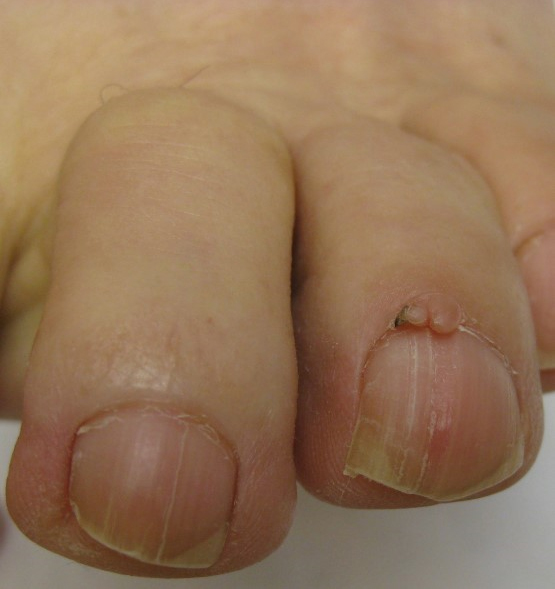 , and CT scan of the head is shown in exhibit 2.
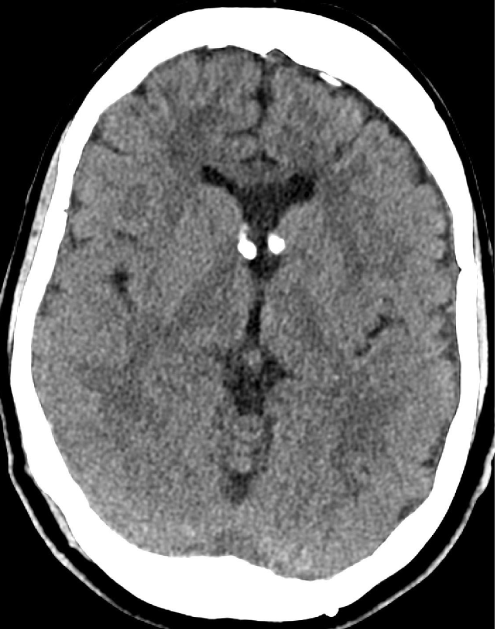 This patient most likely has which of the following underlying conditions?
, and CT scan of the head is shown in exhibit 2. This patient most likely has which of the following underlying conditions? (Multiple Choice)
4.8/5 (91)
(91) A 12-year-old boy is brought back to the emergency department (ED) by his mother due to worsening symptoms. The boy was evaluated in the ED yesterday for 3 days of fever, abdominal pain, generalized body aches, and headache. Evaluation revealed no significant abnormalities at that time, and the boy was sent home and advised to take ibuprofen. However, overnight he developed confusion and worsened abdominal pain. The patient lives near a lake surrounded by woods and often plays there with his friends. Temperature is 39 C (102.2 F), blood pressure is 90/60 mm Hg, pulse is 120/min, and respirations are 20/min. There is no neck stiffness or lymphadenopathy. Oropharynx is clear. A maculopapular rash is now present on the arms and legs. There is nonspecific generalized abdominal tenderness with no rebound or rigidity. Neurologic examination is nonfocal. Laboratory results are as follows:  CT scan of the abdomen shows no abnormalities. What is the most appropriate next step in management?
 (Multiple Choice)
4.8/5 (66)
(66) A 13-day-old full-term girl is brought to the physician during winter with a runny nose, cough, and fussiness over the past 2 days. Her birth history is unremarkable and she has been feeding and growing well. The girl has a sibling in day care, where other children have been ill. Her temperature is 37.8 C (100 F), respirations are 70/min, and pulse oximetry is 95% on room air. Examination shows a crying infant with clear rhinorrhea and bilateral wheezes and crackles. Which of the following complications is this patient at greatest risk of developing?
(Multiple Choice)
4.8/5 (75)
(75) A 6-hour-old girl is evaluated in the newborn nursery due to respiratory distress. She was born at 37 weeks gestation via spontaneous vaginal delivery after induction of labor for preeclampsia with severe features. Since birth, the baby has not been able to feed due to tachypnea. Birth weight is at <3rd percentile for gestational age. Temperature is 37.2 C (99 F) and blood pressure is normal. Pulse oximetry is 96% saturation on room air. Examination reveals a plethoric infant. The head is normocephalic with an open and flat anterior fontanelle. Cardiac examination reveals sinus tachycardia and no murmurs. Pulmonary examination reveals tachypnea; breath sounds are clear throughout, and there are no retractions. The infant has normal female infantile genitalia. Chest x-ray shows clear lung fields and a normal cardiac silhouette. Laboratory results are as follows:  Which of the following is the most likely cause of this patient's symptoms?
 (Multiple Choice)
4.8/5 (82)
(82) A 6-week-old boy is brought to the office by his parents for evaluation of inconsolable crying. The patient has cried almost continuously up to 4 hours every evening for the past 3 weeks. Pacifiers do not seem to calm him, and he often refuses to feed during this time, making the parents feel overwhelmed and worried. The patient is happy and alert during the rest of the day. He was born full term via uncomplicated spontaneous vaginal delivery and is growing well. He breastfeeds every 2-4 hours and has 2-3 soft stools daily. Temperature is 37.3 C (99.1 F). The anterior fontanel is soft. Otoscopic examination shows erythematous tympanic membranes that are compliant on insufflation bilaterally. Heart and lung examination is unremarkable, and the abdomen is soft. Which of the following is the most appropriate management of this patient?
(Multiple Choice)
4.8/5 (81)
(81) A 2-year-old boy is brought to the office for a routine visit. His parents are concerned that he is not as talkative as his twin sister. The patient's sister talks "constantly" and is starting to put 3 words together. The boy tends to be quieter and says about 70 words with some 2-word phrases; both children will be enrolled in preschool in the fall. The patient likes making beeping sounds when playing with toy trucks, but he does not play with his sister, only alongside her. The boy is up to date with vaccinations, and his growth parameters are average for his age. He points to a toy across the room, looks at his mother and smiles, and then brings the toy over to show her. When the physician approaches, the patient runs to hide behind his father and initially refuses to cooperate or make eye contact. When his mother tries to help him onto the examination table, he pushes her away and says, "Me do." Which of the following is the most likely diagnosis in this patient?
(Multiple Choice)
4.9/5 (93)
(93) Which of the following is the best next step in management of this patient?
(Multiple Choice)
4.9/5 (61)
(61) A 10-year-old boy is brought to the office due to left knee pain and difficulty walking. His parents say that he developed knee pain several months ago, but it was mild and did not affect his mobility. Over the past week, the patient has had increasing pain that prevents him from playing soccer or basketball. He describes the pain as continuous, nonradiating, and sometimes worse at night. The patient has taken ibuprofen but it has not relieved the pain. He does not recall any preceding trauma. He has had occasional fever over the last month; temperature today is 37.2 C (99 F). The patient has an antalgic gait and favors the right side. The left knee is swollen and erythematous. A tender, immobile mass is palpated above the left knee. Laboratory results are as follows:  X-ray of the knee shows a central lytic lesion in the distal femur with cortical layering, a "moth-eaten" appearance, and extension into the soft tissue. Which of the following is the most likely diagnosis in this patient?
 (Multiple Choice)
5.0/5 (83)
(83) 
Filters
- Essay(0)
- Multiple Choice(0)
- Short Answer(0)
- True False(0)
- Matching(0)