



 Chat with AI
Exam 2: Pediatric

Exam 1: Medicine2 k Questions
Exam 2: Pediatric723 Questions
Exam 3: Psychiatry336 Questions
Exam 4: Surgery563 Questions
Exam 5: Obstetrics & Gynecology469 Questions
Select questions type


A 4-week-old boy is brought to the clinic due to a change in bowel pattern. The patient was born at term and has been having a bowel movement after most feeds since birth. However, over the past week he has been stooling only 1 or 2 times a day, and the color has become consistently paler. The parents have also noticed progressive yellowing of the eyes over the last few weeks. The patient is exclusively breastfed and is in the 25th percentile for weight. He takes no medications. Temperature is 37.1 C (98.8 F). Physical examination shows a well-appearing infant with scleral icterus and jaundice of the face and chest. The abdomen is soft and bowel sounds are present. The liver is enlarged. The remainder of the examination is normal. Total bilirubin is 12.5 mg/dL. Hepatic ultrasound reveals absence of the gallbladder and confirms hepatomegaly. Which of the following laboratory patterns is most likely to be present in this patient?
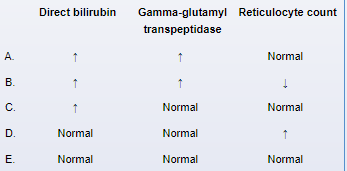
(Multiple Choice)
4.9/5  (69)
(69) A 13-year-old girl is brought to the clinic by her parents due to fatigue. The patient had been well until 2 months ago, when she began the seventh grade. She has since felt tired most days, especially after walking to classes. The patient takes no daily medications and follows a well-balanced diet. Menarche began at age 12, and menstrual cycles occur at 28-day intervals. Menses last 6-7 days and are sometimes accompanied by abdominal cramping. Temperature is 37.2 C (99 F), blood pressure is 105/70 mm Hg, pulse is 100/min, and respirations are 20/min. Weight is 46 kg (101.4 lb), which is at the 50th percentile. Pupils are equal and reactive. The conjunctivae are pale. Oropharyngeal examination shows a few brown macules on the lips and buccal mucosa. The neck is supple with no thyromegaly or lymphadenopathy. Cardiopulmonary examination is unremarkable. The abdomen is soft with a normal liver and spleen size. Distal pulses are 2+. Results of a complete blood count are as follows:  Which of the following is the best next step in management of this patient?
 (Multiple Choice)
4.7/5 (80)
(80) A 33-year-old man with a history of multiple sclerosis is brought to the emergency department due to new-onset leg weakness, numbness, and urinary incontinence. In the past, he has had several acute exacerbations of multiple sclerosis, causing vertigo, vision impairment, and upper extremity weakness, all of which improved after glucocorticoid treatments. A year ago he stopped taking disease-modifying therapy due to severe adverse effects. His vital signs are within normal limits. Mental status and cranial nerve examination are normal. Muscle strength in the upper extremities is 5/5 and in the lower extremities is 3/5. Pinprick sensation is decreased below the nipple. Proprioception is decreased over both lower extremities. Babinski reflex is present bilaterally. MRI of this patient is most likely to reveal new plaques in which of the following locations?
(Multiple Choice)
4.8/5 (85)
(85) A 4-year-old boy is brought to the emergency department by his parents for evaluation of a fever and headache. Two days ago, the boy began to have low-grade fever, cough, and congestion. Last night, his fever became higher, and he became fussy, more difficult to console, and less active. He slept poorly and woke up with a headache unrelieved with over the counter pain medications. The patient vomited twice prior to arrival. He has no medical conditions but has not received regular health maintenance or vaccinations. Temperature is 39.4 C (102.9 F), pulse is 110/min, and respirations are 20/min. Physical examination shows an irritable child. Pupils are equal and reactive; funduscopic examination is limited by photophobia. The oropharynx is erythematous. Nuchal rigidity is present and bilateral lower extremities flex when the neck is flexed. The remainder of the physical examination is normal. Cerebrospinal fluid results are shown below:  Which of the following pathogens is most likely responsible for this patient's presentation?
 (Multiple Choice)
4.9/5 (80)
(80) A 5-year-old boy is brought to the office for evaluation of multiple new growths on the face, as shown in the image below: 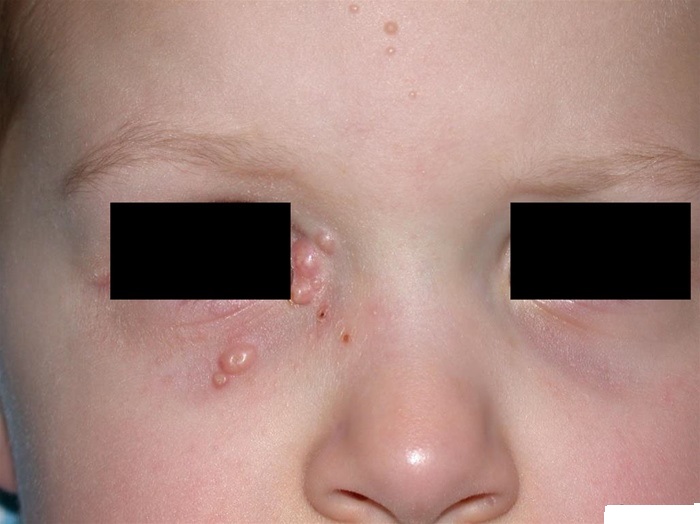 The patient can open and close his eyes without pain or difficulty. Examination shows no other abnormalities. What is the most appropriate next step in management?
 (Multiple Choice)
4.9/5 (78)
(78) A 47-year-old man comes to the emergency department after waking up this morning with a right-sided facial droop. The patient is unable to fully close his right eye. He has had no headache, neck stiffness, extremity weakness, or numbness but reports fatigue and low-grade fevers for the past several weeks. He has no chronic medical conditions and takes no medications. The patient occasionally uses alcohol and is sexually active with multiple women. Vital signs are within normal limits. Physical examination shows flattening of the right nasolabial fold, drooping of the right corner of mouth, and right-sided hyperacusis. Sensation to touch on the face is normal bilaterally. The remainder of the neurologic examination is normal. The parotid glands are enlarged bilaterally, and scattered enlarged cervical lymph nodes are present. Inspection of the external acoustic meatus and tympanic membrane shows no abnormalities. The lungs are clear to auscultation and heart sounds are normal. Laboratory results are as follows: 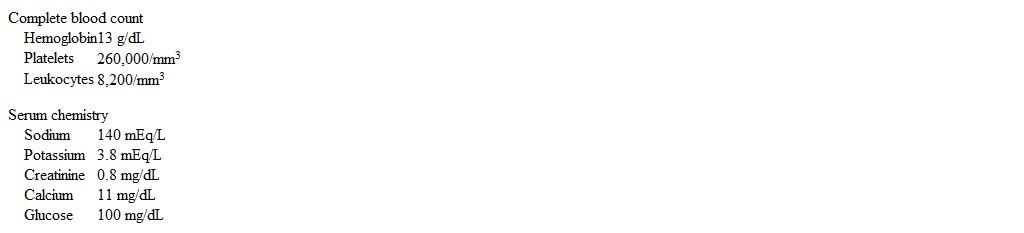 Which of the following is the most likely cause of this patient's facial paralysis?
 (Multiple Choice)
4.9/5 (86)
(86) A 16-year-old girl comes to the emergency department due to nausea and lower abdominal pain. The pain began yesterday but has become more severe over the past 12 hours. The patient describes the pain as "crampy" with periodic sharp and stabbing sensations. She has urinary frequency but no dysuria or hematuria. The patient has no appetite and vomited twice this morning. Her last bowel movement this morning was firm and nonbloody, but she still has a strong urge to defecate. The patient also started having vaginal spotting today. She has no medical history other than an episode of abnormal vaginal discharge 6 months ago that self-resolved. Menarche occurred at age 13, and the patient is unsure of her last menstrual period as they are irregular. Temperature is 36.7 C (98.1 F), blood pressure is 110/60 mm Hg, and pulse is 78/min. Examination shows tenderness to palpation in the left lower quadrant of the abdomen. Which of the following is the most likely explanation for this patient's condition?
(Multiple Choice)
4.8/5 (67)
(67) A 7-year-old boy is brought to the office for evaluation of anal pruritus. A month ago, the patient went on a weekend camping trip with a group of friends. During the weekend, they learned to swim in the lake and stayed together in a log cabin. After returning home, the patient began to have increasing anal pruritus that is most severe at night. He has continued to have a healthy appetite and has had no vomiting or diarrhea. The patient has no chronic medical conditions, takes no daily medications, and has no known allergies. Vital signs are normal. Physical examination shows a well-appearing patient in no apparent distress. Skin examination is normal. The lungs are clear to auscultation, and the abdomen is soft and nondistended. Inspection of the anus shows mild perianal erythema with multiple excoriations, but no induration, fluctuance, or fissures. Which of the following is the most appropriate treatment for this patient?
(Multiple Choice)
4.8/5 (80)
(80) A 68-year-old woman is admitted to the hospital due to a femoral neck fracture after a traumatic fall. The fracture is repaired, and her pain is treated with as-needed opioid medications. Over the course of her hospitalization, the patient develops nocturnal disorientation and mild agitation. Her husband says she is not like this at home. During morning rounds, the patient is pleasant and answers questions appropriately. Her condition resolves over the next few days, and she is discharged to the rehabilitation facility on day 7. Because of this patient's mental status changes, she is at increased risk for which of the following?
(Multiple Choice)
4.7/5 (85)
(85) A 10-hour-old boy in the newborn nursery has bilious emesis. He was born at 38 weeks gestation by vaginal delivery to a primigravid 39-year-old woman who received no prenatal care. The patient has voided once but has not yet passed meconium. Physical examination shows a hypotonic neonate with a flat face, prominent tongue, low-set ears, and slanted palpebral fissures. The hands are short with incurved fifth fingers, and a large space is present between bilateral first and second toes. The abdomen is soft and without distension, guarding, or rigidity. Auscultation reveals a loud holosystolic murmur most prominent at the left lower sternal border with a precordial thrill. A nasogastric tube is placed, and abdominal x-ray is shown below. 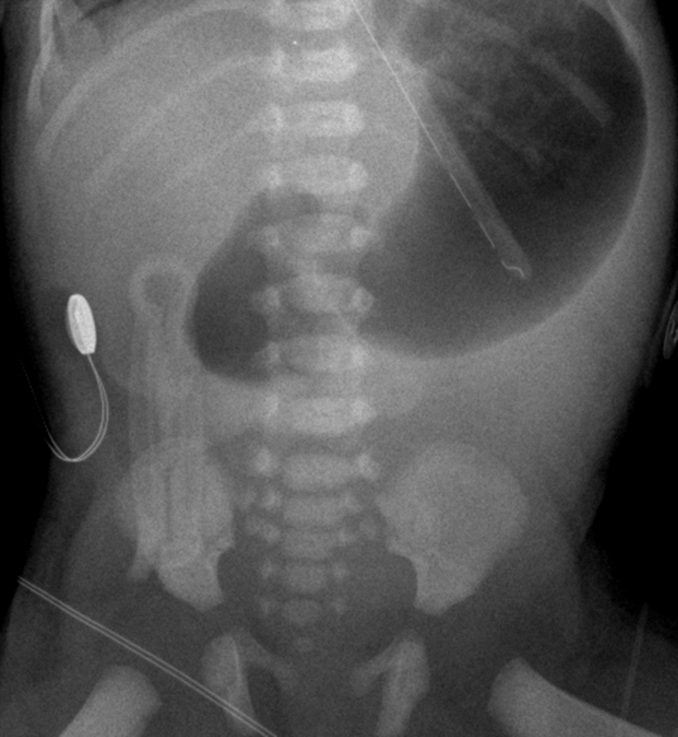 In addition to echocardiogram, which of the following is the best next step in this patient?
 (Multiple Choice)
4.7/5 (83)
(83) A 16-year-old girl is brought to the urgent care clinic after passing out. The patient was sitting at her desk in school when she gradually slid out of her desk to the floor and lost consciousness. The patient was unresponsive with her eyes closed for 20 minutes. She states, "I felt weak before I passed out, and I felt my head throbbing after it hit the floor". The school nurse documented her blood pressure during the episode as 128/76 mm Hg and pulse as 78/min. After the episode, the patient was alert and wanted to resume her school activities. She has no medical history. The patient is awake and alert. Her head is atraumatic. The pupils are equal and reactive to light. The lungs are clear to auscultation. Hearts sounds are without murmurs. Muscle strength is 5/5 in the upper and lower extremities. Gait is normal. ECG is normal. Which of the following is the most likely diagnosis in this patient?
(Multiple Choice)
4.8/5 (66)
(66) A 30-year-old man is brought to the emergency department due to a worsening headache. The patient has had episodic right-sided headaches over the past 6 months. Thirty minutes ago, he began experiencing a right temporal headache while at rest, which gradually worsened to severe pain over the next several minutes. He also had nausea and an episode of vomiting. The patient is now somnolent and difficult to rouse. He has no other medical conditions and had a normal medical evaluation a year ago for military enlistment. Temperature is 37 C (98.6 F), blood pressure is 150/90 mm Hg, pulse is 64/min, and respirations are 14/min. The patient withdraws all extremities to painful stimuli, but left-sided deep tendon reflexes are increased. There is no neck rigidity. Which of the following is the most likely underlying cause of this patient's current condition?
(Multiple Choice)
4.9/5 (87)
(87) A 4-hour-old boy is evaluated in the nursery for routine newborn care. The patient was born at 38 weeks gestation via spontaneous vaginal delivery to an 18-year-old woman who did not receive prenatal care or take prenatal vitamins. Birth weight is 3.6 kg (8 lb). Vital signs are normal. Examination shows a sleeping infant in no distress. There is molding of the occiput. A soft mass inferior to the umbilical stump is 1.4 cm in diameter and covered by skin. The mass increases in size when the infant cries and reduces into the abdominal cavity with gentle pressure. The mass does not seem to be tender to palpation. The rest of the examination is normal. Which of the following is the best next step in management of this patient's mass?
(Multiple Choice)
4.8/5 (70)
(70) A 13-year-old girl is brought to the clinic due to frequent headaches. She first developed mild headaches a year ago, which were treated intermittently with ibuprofen. Over the last 3 months, the headaches have progressively worsened in severity and now occur almost daily. The pain has awakened the patient from sleep multiple times. She has no chronic medical conditions and takes no additional medications. The patient's growth chart shows that height tracked along the 50th percentile until age 11; today it is at the 5th percentile. Weight remains stable at the 75th percentile. Temperature is 37.2 C (99 F), blood pressure is 110/70 mm Hg, and pulse is 90/min. Examination shows mild optic disc edema. The neck is supple. Cardiopulmonary examination is normal. Strength is 5/5 in the bilateral upper and lower extremities. Sensation is intact. Reflexes are 2+ bilaterally. Finger-nose-finger testing shows no dysmetria. The patient has a normal gait. Sexual maturity rating (Tanner) is stage 1. Skin examination is normal. MRI of the brain for this patient would most likely show which of the following?
(Multiple Choice)
4.8/5 (87)
(87) A 17-year-old man comes to the emergency department and complains of intense left flank pain that radiates to the groin. He refers to his symptom as "stone passage," which he has experienced "so many times since childhood." His uncle has the same problem. Urinalysis shows hexagonal crystals. The urinary cyanide nitroprusside test is positive. Which of the following is the most likely cause of this patient's condition?
(Multiple Choice)
5.0/5 (72)
(72) A 45-year-old, previously healthy man comes to the office due to worsening extremity weakness and numbness. Three months ago, the patient began experiencing numbness and weakness in both feet that made it difficult to climb stairs or stand up from a seated position. Two weeks later, he noticed weakness of his grip strength bilaterally but had no difficulty lifting his arms. The muscle weakness has been slowly progressing, and the patient now has difficulty buttoning his clothes, turning doorknobs, and walking on a level surface. He does not use tobacco or illicit drugs and drinks alcohol occasionally. Vital signs are within normal limits. Physical examination shows weakness of the small muscles of the hands and the hip girdle muscles bilaterally. Deep tendon reflexes are diffusely diminished, and there is loss of vibration and position sensation in the toes bilaterally. Which of the following findings is most likely to be associated with this patient's current symptoms?
(Multiple Choice)
4.8/5 (81)
(81) A 3-day-old girl is brought to the emergency department due to irritability. The patient was discharged yesterday evening after an uncomplicated labor and vaginal delivery. Since last night, she has been crying during her wake periods and sleeping up to 7 hours at a time. She refused to feed this morning. Temperature is 37 C (98.6 F) and pulse is 180/min. Weight today is down 5% from birth. The patient is crying and unable to be consoled by the mother. The anterior fontanelle is soft. Cardiac examination reveals regular tachycardia and no murmurs. Lungs are clear to auscultation, and abdominal examination is normal. The skin is clear. Glucose is 70 mg/dL. Leukocyte count is 3,000/mm3. Which of the following is the most appropriate treatment of this patient's clinical presentation?
(Multiple Choice)
4.8/5 (77)
(77) A 7-day-old girl in the neonatal intensive care unit with truncus arteriosus has poor feeding and abdominal distension. The patient has been hospitalized since birth at 38 weeks gestation via normal spontaneous vaginal delivery and is awaiting adequate weight gain prior to the repair of her congenital heart disease. She has been taking oral formula and has regained her birth weight. Temperature is 35 C (95 F), blood pressure is 60/30 mm Hg, pulse is 180/min, and respirations are 65/min. Pulse oximetry is 82% on room air. Physical examination shows a lethargic, cyanotic neonate with moderate abdominal distension and absent bowel sounds. Bright red blood is visible in her stool. A nasogastric tube is placed for decompression and bilious fluid is recovered. Abdominal x-ray is obtained. What is the most likely diagnosis in this patient?
(Multiple Choice)
4.8/5 (82)
(82) A 10-week-old girl is brought to the office by her mother for a well-infant examination after missing her visit 2 weeks earlier. She was born at 34 weeks gestation and weighed 2.2 kg (4 lb 14 oz) at birth. She has been breastfed exclusively since then, and her growth and development are appropriate for her chronological and gestational ages. Her physical examination is notable for mild pallor but is otherwise normal. The mother eats a balanced diet that includes meat products. At this time, which of the following is the most appropriate nutritional intervention for this patient?
(Multiple Choice)
5.0/5 (66)
(66) A 78-year-old, right-handed woman is brought to the emergency department due to confusion. Her husband states that the patient was in her usual state of health when he left the house this morning; he found her confused and exhibiting odd behavior when he returned 2 hours later. She had difficulty handling commonly used things, such as a phone, which she held upside down. Medical history includes hypertension and anxiety. Blood pressure is 138/70 mm Hg and pulse is 110/min and irregular. On physical examination, the patient is alert and attends to the examiner but does not follow instructions. She speaks fluently with clear articulation, although the content of her speech is nonsensical. The gaze is conjugate, and the pupils are equal, round, and reactive to light. Bilateral deep tendon reflexes of the upper and lower extremities are normal. Muscle strength is grossly normal, but examination is limited due to her inability to fully cooperate. Which of the following is the most likely site of the lesion causing this patient's current symptoms?
(Multiple Choice)
4.9/5 (65)
(65) 
Filters
- Essay(0)
- Multiple Choice(0)
- Short Answer(0)
- True False(0)
- Matching(0)