



 Chat with AI
Exam 2: Pediatric

Exam 1: Medicine2 k Questions
Exam 2: Pediatric723 Questions
Exam 3: Psychiatry336 Questions
Exam 4: Surgery563 Questions
Exam 5: Obstetrics & Gynecology469 Questions
Select questions type


A 30-minute-old boy is evaluated in the neonatal intensive care unit for cyanosis. The patient's 1-minute Apgar score was 8, but he developed cyanosis a few minutes after delivery. He was born by spontaneous vaginal delivery at 32 weeks gestation after his mother had preterm prelabor rupture of membranes and preterm labor. The mother received a dose of glucocorticoids and penicillin prophylaxis for group B Streptococcus prior to delivery. Birth weight was 1.7 kg (3 lb 12 oz). Temperature is 37 C (98.6 F), blood pressure is 66/42 mm Hg, pulse is 160/min, and respirations are 70/min. Pulse oximetry in the right upper extremity and left lower extremity is 65% on room air. Oxygen is administered, and the oxygen saturation improves to 92%. Cardiac examination shows a grade 1/6 systolic murmur at the left sternal border. Pulmonary examination shows grunting, intercostal and subcostal retractions, nasal flaring, and shallow respirations. Chest x-ray is shown in the exhibit. Which of the following is the most likely diagnosis in this patient?
(Multiple Choice)
4.8/5  (78)
(78) A 4-week-old girl is brought to the clinic for post-hospitalization follow-up. Her mother moved from Greece to the United States for a diplomatic position a few months prior to giving birth. The patient was born at term, and the mother's prenatal course and delivery were uncomplicated. Due to hyperbilirubinemia, the patient was in the nursery for 3 weeks of phototherapy. Bilirubin was normal at discharge. Since discharge, the girl's skin and eyes have remained yellow. Maternal blood type is AB, Rh-D positive. Infant blood type is A, Rh-D positive. The patient has been breastfeeding exclusively. Weight and length were at the 50th percentile at 2 weeks of age and remain at the 50th percentile today. Laboratory results today are as follows: 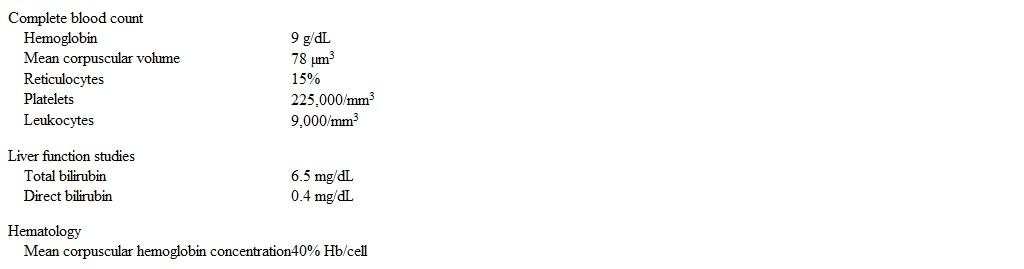 Which of the following is the most likely cause of this patient's condition?
 (Multiple Choice)
4.9/5 (71)
(71) A 9-year-old girl is brought to the emergency department due to sudden onset of uncontrollable, continuous writhing of the arms and hands and grimacing of the face. A month ago, she had a sore throat and fever that resolved after a few days without treatment. The girl and her family recently returned to the United States after living in Honduras for a year. The patient takes no daily medications and her vaccinations are current. Vital signs are normal. On examination, the patient has multiple dental caries, and the oropharynx is nonerythematous and without exudate or tonsillar enlargement. Cardiac examination reveals a pericardial friction rub. Laboratory studies show an erythrocyte sedimentation rate of 65 mm/h. ECG shows a prolonged PR interval and diffuse ST elevations. Infection with which of the following organisms is the most likely cause of this patient's symptoms?
(Multiple Choice)
4.9/5 (90)
(90) A 12-year-old girl is brought to the emergency department by her parents for assessment of confusion and rapid breathing. Three days ago the patient developed rhinorrhea, cough, and fever, which have since resolved. The parents say that over the past 48 hours the patient has had increased urination, abdominal pain, and fatigue progressing to somnolence. On arrival, the patient's temperature is 36.7 C (98 F), blood pressure is 110/70 mm Hg, pulse is 138/min, respirations are 36/min, and pulse oximetry is 99% on room air. On physical examination, she is ill-appearing with tachypnea, subcostal retractions, and dry mucous membranes. There is diffuse abdominal tenderness without rebound. Laboratory results are as follows: 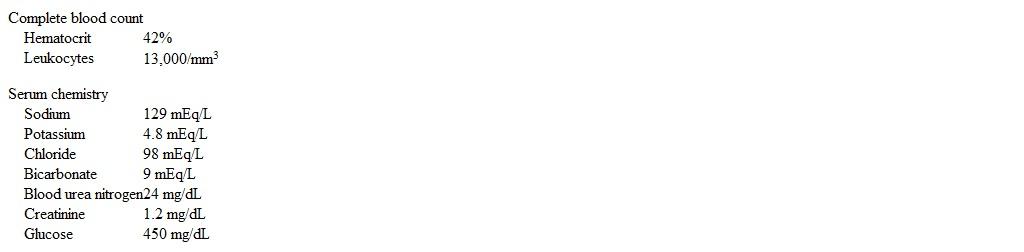 Which of the following is most likely decreased in this patient?
 (Multiple Choice)
4.8/5 (76)
(76) A 13-year-old boy is brought to the office due to progressive pain of the left knee for 3 months. The pain initially occurred only after basketball practice but improved with rest and ibuprofen. However, over the last several weeks, the patient has had knee pain within the first 15 minutes of practice. Last week, the pain became so severe that he missed practice and a game. The patient has had no fever, weight loss, or night sweats. The pain has not caused him to awaken. Vital signs are normal. Physical examination reveals tenderness over the left tibial tubercle, which appears more prominent than the right. The left knee has full range of motion and no palpable effusion. Extension of the left knee against resistance and squatting reproduces the pain. Which of the following is the most likely cause of this patient's knee pain?
(Multiple Choice)
4.9/5 (79)
(79) A 65-year-old man is brought to the emergency department due to right-sided weakness. The patient was at dinner when he suddenly experienced right arm weakness and difficulty using his fork. He also had trouble standing due to right leg weakness. Medical history is significant for hypertension, hyperlipidemia, and type 2 diabetes mellitus. Blood pressure is 164/90 mm Hg and pulse is 80/min and regular. Neurologic examination shows 2/5 muscle strength and 3+ deep tendon reflexes in the right upper and lower extremities. There is flattening of the left nasolabial fold, and he is unable to completely close the left eye. Which of the following is the most likely location of this patient's lesion?
(Multiple Choice)
4.9/5 (74)
(74) A 6-year-old boy is brought to the office for evaluation of a neck lump. His mother first noticed the mass 2 weeks ago while he was experiencing cold symptoms. His nasal congestion and fever resolved within several days with symptomatic treatment, but the mass failed to improve. The patient was born at full term without pregnancy complications and has been healthy until now. He has received all recommended vaccines and takes no medications. The patient is afebrile, and height and weight are at the 60th percentile for his age. Physical examination shows a 1.5-cm, soft, mildly tender mass in the midline upper neck. It moves up and down when the patient swallows; there are no other neck masses. The nasal turbinates are pink with no rhinorrhea, and the tonsils are normal with no erythema or exudates. The remainder of the examination shows no abnormalities. Which of the following is the most likely underlying cause of this patient's condition?
(Multiple Choice)
4.7/5 (75)
(75) A 10-year-old boy is brought to the clinic due to headache, vomiting, and visual disturbances. The patient has had 2 weeks of persistent headache; he was given over-the-counter analgesics but had no relief. He has also had daily episodes of nonbloody, nonbilious emesis. Neurologic examination shows bilateral retraction of the upper eyelids and limitation of upward gaze with a preference for downward gaze. Pupils react sluggishly to light but respond appropriately to accommodation. Strength, sensation, and deep tendon reflexes are normal. Gait is normal. Plantar reflexes are downgoing bilaterally. Which of the following lesions is most likely responsible for this patient's symptoms?
(Multiple Choice)
4.7/5 (84)
(84) A 4-week-old boy is brought to the office for his first well-child visit. The patient was born at 38 weeks gestation to a 27-year-old woman following an uncomplicated pregnancy and delivery. He has been exclusively breast-fed since birth and has had normal urine and stool output. The patient takes supplemental vitamin D and no other medications. His 4-year-old brother has neurofibromatosis but is otherwise healthy. The patient is well-appearing and vigorous. His weight and length are at the 50th percentile. There is a 5-cm skin lesion with overlying hair on the upper back, as shown below. The remainder of the skin examination is unremarkable. Which of the following is the most likely diagnosis for this patient? 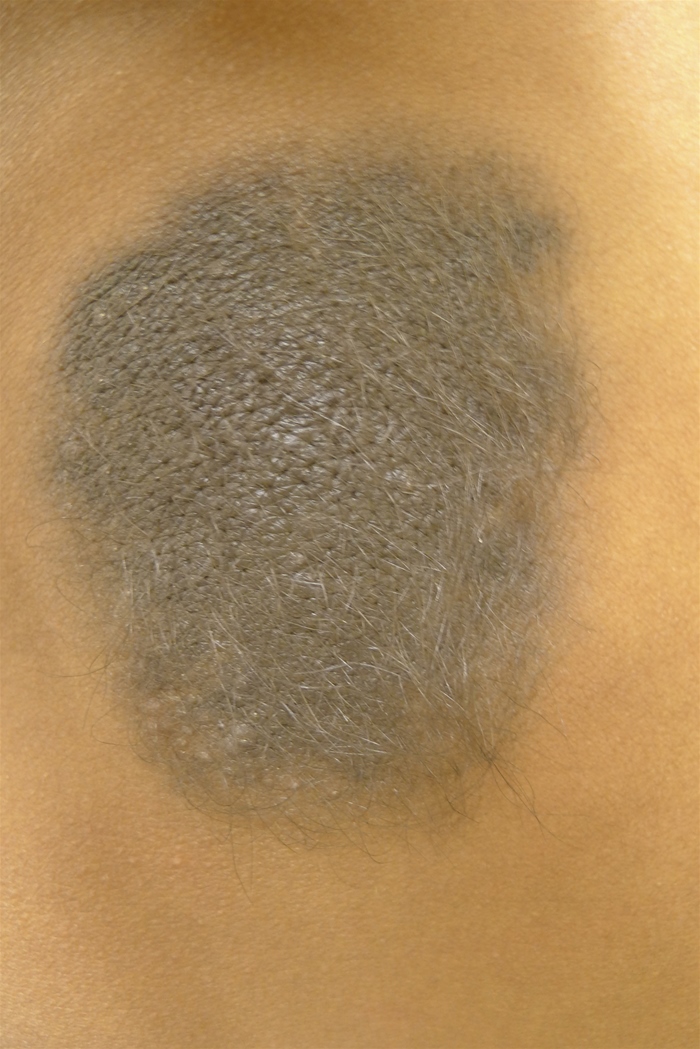
(Multiple Choice)
5.0/5 (88)
(88) A newborn boy is being evaluated in the nursery the day after delivery. The patient was born to a 26-year-old primigravid woman via spontaneous vaginal delivery at 39 weeks gestation. He was poorly arousable at delivery and required manual stimulation and brief oxygen supplementation. Apgar scores were 5, 6, and 8 at 1, 5, and 10 minutes, respectively. Birth weight and length were appropriate for gestational age. Temperature is 37.6 C (99.7 F) and oxygen saturation is 98% on room air. The patient arouses with an exaggerated startle reflex when examined. Cardiopulmonary examination is difficult due to his shrill cry throughout the evaluation but appears unremarkable. All limbs have a mild generalized hypertonicity, and there is rapid shaking of the upper extremities that resolves with passive movement of the limbs. Glucose level is 75 mg/dL. Leukocyte count is normal, and no bands are present. Which of the following is the best next step in management of this patient?
(Multiple Choice)
4.8/5 (91)
(91) A 5-day-old boy in the neonatal intensive care unit is evaluated for sudden-onset vomiting. The patient was born at 32 weeks gestation via vaginal delivery. Since birth, he has tolerated a mixture of expressed breast milk and preterm cow's milk-based formula administered via nasogastric tube. The patient has had emesis with the last 3 feeds; the first two were green, and the last had a coffee-grounds appearance. Temperature is 37.5 C (99.5 F). Vital signs reveal mild tachycardia. Physical examination shows a drowsy but arousable infant. The abdomen is moderately distended and appears tender to palpation. Bowel sounds are decreased. Abdominal radiograph reveals pneumatosis intestinalis. What is the best next step in management of this patient?
(Multiple Choice)
4.9/5 (97)
(97) A 73-year-old Caucasian man is brought to the office by his daughter, who is concerned that he might be depressed. He is a retired surgeon, and has lived alone ever since his wife died a year ago. His daughter visits him every 6 months; she feels bad about not being able to visit him more frequently because her job and family keep her very busy. He denies having any feelings of sadness, guilt, weight loss, loss of appetite, suicidal ideation, deafness, vertigo, and decreased or blurred vision. His medical problems include hypertension, diabetes mellitus-type 2 and a myocardial infarction 10 years ago. His current medications are glyburide, aspirin and enalapril. He denies the use of tobacco, alcohol, or drugs. His vital signs are within normal limits. He appears withdrawn, less energetic than usual, and walks stiffly. He sits with a stooped posture. He has a fixed facial expression, and his voice sounds monotonous. His deep tendon reflexes are 2+. Sensations and motor strength are normal. There is increased resistance to passive flexion. Which of the following types of gait is most likely to be present in this patient?
(Multiple Choice)
4.8/5 (80)
(80) A 3-month-old boy is brought to the office due to recurrent episodes of spitting up. He was breastfed for the first 2 months of life without any concerns. According to the mother, over the past 3 weeks, the patient has been vomiting within minutes after every feed. The emesis appears to be partially digested breast milk. However, he is eager to eat every 3 hours and has no color change, respiratory distress, or irritability with feedings. The patient was born at term following an uncomplicated pregnancy and is taking no medications. Vital signs are normal. On examination, lung and heart sounds are normal, and the abdomen is soft and nontender, without hepatosplenomegaly. The growth chart is shown in the image below: 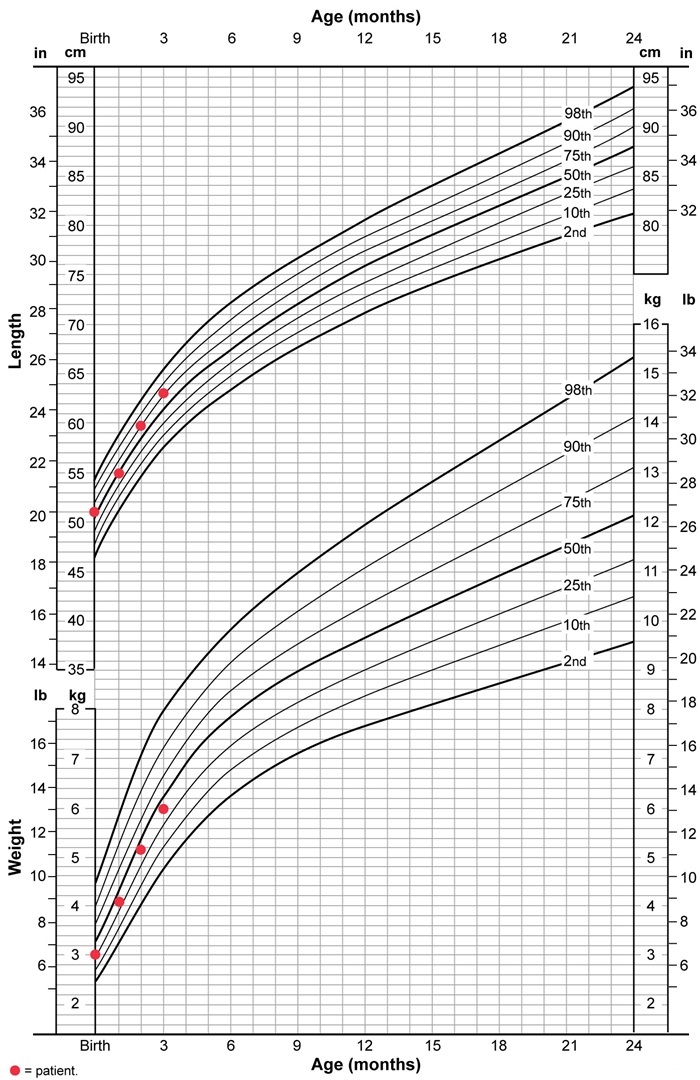 Which of the following is the best next step in management of this patient?
 (Multiple Choice)
4.8/5 (80)
(80) A 5-month-old girl is brought to the emergency department due to abnormal body movements. A month ago, the patient began to have occasional episodes in which she appeared startled for no apparent reason. The episodes were brief and occurred only a few times. However, their frequency has increased over the last 2 days. Temperature is 37.2 C (99 F), pulse is 160/min, and respirations are 30/min. During examination, the patient suddenly flexes at the hips and elbows for approximately 2 seconds. The patient does this several times before crying. Skin examination shows several hypopigmented, elliptical macules on the chest. The mother states that she has similar lesions. Which of the following intracranial lesions is most likely to be associated with this patient's underlying diagnosis?
(Multiple Choice)
4.8/5 (86)
(86) A 15-month-old boy is brought to the office for evaluation of bowed legs. The boy's mother says that his legs have always been slightly bowed, but the bowing appears to have worsened since he started walking a month ago. The patient does not appear to be in pain and is still able to play outside. He eats a varied diet and drinks 16 ounces of whole milk a day. He is an only child and was born at full term via vaginal delivery with no complications. The patient is at the 40th percentile for height and the 25th percentile for weight. On examination, he has full range of motion of bilateral hips and knee and ankle joints. The legs are of equal length and have no joint effusions. When the boy stands with his feet together, there is a tibiofemoral outward bend that results in a gap between the knees. The remainder of the examination is unremarkable. Which of the following is the best next step in management of this patient?
(Multiple Choice)
4.9/5 (71)
(71) A 4-year-old boy is brought to the office due to a 1-day fever of 38.4 C (101.1 F) and left-sided neck swelling. His mother says, "He was fine until yesterday, but now his neck is really bothering him." The patient has had no trauma to the area, has not been ill recently, and has no known sick contacts. Vaccinations are up to date. Physical examination shows a red, tender, and fluctuant mass approximately 2 cm in diameter in the left anterior cervical lymph node chain. Dentition and oropharynx are normal. There are no other areas of lymphadenopathy. Which of the following is the most likely infectious etiology?
(Multiple Choice)
4.8/5 (70)
(70) A 54-year-old man comes to the office due to right shoulder and arm pain. His symptoms began 3 days ago after playing golf for several hours. The patient states that his right arm feels weak, especially when lifting objects. He has no prior medical conditions and takes no medications. Physical examination shows spasm of the cervical paraspinal muscles. There is mild weakness of right elbow flexion, and the biceps reflex is decreased on the right. The pain improves when the patient is instructed to lift the right arm above the head and rest the hand on the top of his head. Which of the following is the most likely diagnosis?
(Multiple Choice)
4.8/5 (91)
(91) A 6-month-old girl is brought to the clinic by her mother due to a rash in her diaper area for the past 2 days. The patient has been fussy with diaper changes but otherwise well with no fever, vomiting, or diarrhea. There have been no changes in the type of diapers, soap, or wipes. The patient had thrush twice in the first month of life and acute otitis media a month ago that resolved with a course of antibiotics. Vital signs are normal. Physical examination shows a well-appearing infant. Mucous membranes are moist and have no lesions. Examination of the labial area is shown in the exhibit. 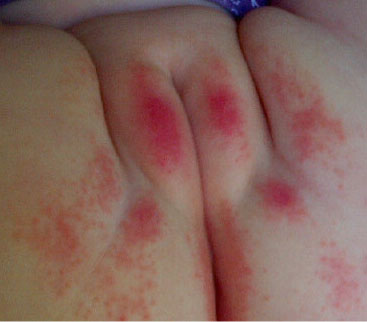 The remainder of the examination is normal. Which of the following is the best next step in the management of this patient?
 (Multiple Choice)
4.9/5 (91)
(91) A 15-year-old girl comes to the office because her menses have not started. She feels embarrassed because her friends have been "developing" and she looks younger than her peers. The patient has no headaches, visual changes, abdominal pain, or behavior changes. Her mother and maternal grandmother began menstruating around age 13. The patient is not sexually active and is not on contraception. Height is <3rd percentile and weight is at the 20th percentile. Vital signs are normal. Physical examination shows no breast development, normal external female genitalia, and Tanner stage 1 pubic hair development. Urine β-hCG is negative.
Which of the following is the best next step in management of this patient?
(Multiple Choice)
4.9/5 (74)
(74) An 11-year-old boy is brought to the office by his parents due to a pruritic skin rash for 2 weeks. The rash started on his hands and subsequently spread to the trunk and lower extremities. His mother reports that the patient is constantly scratching the rash and his sleep is now disturbed due to intense pruritus. A cousin who recently visited and shared a room with him had similar symptoms. The patient has had no fever and is up to date with routine vaccinations. Physical examination shows numerous 2- to 3-mm erythematous papules and vesicles with excoriation on his neck, hands, feet, and waistline. His chest and proximal arms and legs are unaffected. Which of the following is the most appropriate initial intervention in management of this patient?
(Multiple Choice)
4.8/5 (71)
(71) 
Filters
- Essay(0)
- Multiple Choice(0)
- Short Answer(0)
- True False(0)
- Matching(0)