



 Chat with AI
Exam 2: Pediatric

Exam 1: Medicine2 k Questions
Exam 2: Pediatric723 Questions
Exam 3: Psychiatry336 Questions
Exam 4: Surgery563 Questions
Exam 5: Obstetrics & Gynecology469 Questions
Select questions type


A 1-day-old boy is evaluated in the neonatal intensive care unit. The patient was born at 34 weeks gestation to a 25-year-old-primigravida after she underwent an induction for preeclampsia with severe features. The delivery was complicated by placental abruption, and a forceps-assisted vaginal delivery was performed due to an abnormal fetal heart rate tracing. Apgar scores were 5 and 8 at 1 and 5 minutes, respectively. Examination shows a comfortable, sleeping infant under a radiant warmer with a nasal cannula in place. There is a firm, well-demarcated swelling on the right parietal scalp with no discoloration or apparent tenderness. The remainder of the head and neck examination is unremarkable. The abdomen is soft with no organomegaly. Which of the following is the most likely cause of this patient's physical examination findings?
(Multiple Choice)
4.7/5  (65)
(65) A 9-month-old boy is brought to the office by his parents due to swelling of the feet and hands for the past day. They first noted the swelling when the patient refused to hold his bottle of morning formula. He has also had poor feeding and fussiness. The patient has had no preceding upper respiratory symptoms and no known sick contacts. He was recently adopted from Nigeria, and his family history is not available. Vaccines are up to date. Temperature is 38.3 C (101 F) and pulse is 150/min. On examination, the dorsal surfaces of the hands and feet on both sides are swollen and tender to palpation. The remainder of the patient's joints appear normal. He is unable to grasp the examiner's hands due to restricted range of movement. No rash is seen on skin examination. X-rays of the feet and hands reveal soft tissue swelling. What is the most likely cause of this patient's presentation?
(Multiple Choice)
5.0/5 (92)
(92) A 7-year-old boy is brought to the office for severe facial acne that has developed over the past few months. His mother tried treating it with topical benzoyl peroxide and a salicylic acid face wash with no improvement. She also noticed a significant increase in her son's growth, and he is now much taller than his fraternal twin brother. The patient is otherwise healthy with no chronic medical conditions and takes no medications. Height is at the 98th percentile and weight is at the 85th percentile for age and sex. Neurologic examination is normal. Skin examination shows severe cystic acne involving the face and shoulders. Examination reveals coarse pubic and axillary hair. Testicular volume is 2 mL. Bone age is 2 standard deviations higher than chronological age. Baseline LH levels are low and do not increase after stimulation with a GnRH agonist. Which of the following is the most likely diagnosis in this patient?
(Multiple Choice)
4.9/5 (80)
(80) A 5-year-old boy is brought to the clinic for follow-up of abdominal pain and diarrhea. Four days prior, he was evaluated at the onset of low-grade fever and mucus-filled diarrhea, and a stool culture was obtained. The parents were instructed to increase the patient's fluid intake and return in a few days. Since that time, his fevers have resolved, but he continues to have 5-6 episodes of watery, mucus-filled diarrhea daily. The patient has no chronic medical conditions. Temperature is 37.2 C (99 F) and blood pressure is 98/50 mm Hg. Mucous membranes are moist. Heart and lung examinations are normal. The abdomen is mildly distended and diffusely tender to deep palpation without hepatosplenomegaly or masses. Hemoccult testing is negative. Stool culture reveals a large growth of Campylobacter coli with the following susceptibilities:  Which of the following is the most appropriate treatment for this patient's condition?
 (Multiple Choice)
5.0/5 (74)
(74) A 3-year-old boy is brought to the clinic by his father due to fatigue and pallor. The patient was seen in another clinic a week ago for abdominal pain and diarrhea. A medication was prescribed to help slow the diarrhea, which resolved, but the patient has been much less playful over the last day. Temperature is 36.7 C (98 F), blood pressure is 110/70 mm Hg, pulse is 120/min, and respirations are 20/min. Physical examination shows an uncomfortable-appearing child with scleral icterus. Cardiac examination shows mild tachycardia with no murmurs. A few ecchymoses are noted along the upper and lower extremities. There is pitting edema along bilateral lower extremities to the knees. The remainder of the examination is unremarkable. Laboratory results are as follows:  Peripheral blood smear results are shown in the image below:
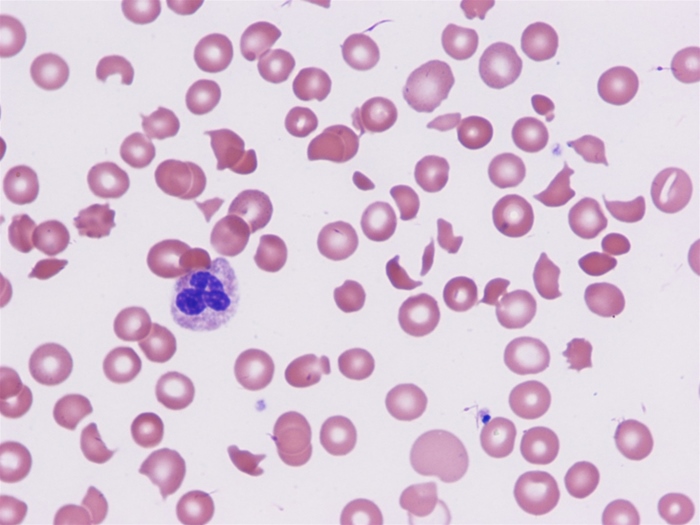 Which of the following is the most likely mechanism of this patient's condition?
Peripheral blood smear results are shown in the image below:
Which of the following is the most likely mechanism of this patient's condition? (Multiple Choice)
4.9/5 (82)
(82) A 12-year-old boy is brought to the emergency department by his parents as "he cannot walk anymore." The patient has had a pins-and-needles sensation and weakness in both feet for the past few days. This morning, he could not stand or move his legs and has bilateral thigh pain. Two weeks ago, the patient had a febrile diarrheal illness that resolved on its own. He has had no headaches, nausea, vomiting, or recurrent diarrhea. He and his family are vegetarians, and they recently visited a petting zoo. The patient has no significant past medical history, and vaccinations are up to date. On arrival, temperature is 36.7 C (98.1 F), blood pressure is 150/90 mm Hg, pulse is 92/min, and respirations are 16/min; pulse oximetry is 99% on room air. Physical examination shows symmetric flaccid paralysis of the lower extremities and absent ankle and patellar deep tendon reflexes. Sensation is intact to light touch in both legs. The upper extremities are weak and hyporeflexic. There is no photophobia or nuchal rigidity. Which of the following structures is primarily impaired in this patient's condition?
(Multiple Choice)
4.9/5 (85)
(85) A 72-year-old man with a 15-year history of HIV comes to the office with his wife due to worsening forgetfulness. The patient has had mild difficulty with short-term memory for the past 5 years but had a more noticeable decline over the last 3. He often forgets recent conversations and names of familiar people. The patient also has had difficulty multitasking and learning new skills such as using a new cell phone. He performs most daily activities independently but requires some assistance, such as a reminder list for shopping or driving directions, even for known neighborhoods. He has had no behavioral changes, hallucinations, or delusions. The patient has been taking antiretroviral therapy since his HIV diagnosis and has had consistent CD4 counts >200/mm3; his viral load has remained undetectable. Vital signs are within normal limits. Mini-Mental State Examination score is 22/30. The patient recalls 0 of 3 words after brief distraction and has difficulty copying a geometric figure. There are no other focal neurologic deficits. MRI of the head shows generalized cerebral atrophy with no mass lesions or white matter changes. Which of the following is the most likely cause of this patient's memory impairment?
(Multiple Choice)
4.8/5 (77)
(77) A 5-month-old boy is brought to the clinic by his parents for a routine follow-up. He was last seen at his well-child check at age 2 months. The patient continues to breastfeed well and recently began eating rice cereal. He can push up from prone position and roll from front to back. He has begun babbling and reaching for objects. The patient was born at term without complications. Vital signs are normal. Anterior fontanelle is open, soft, and flat. The head appears small relative to body size. The patient maintains head control while held on the mother's shoulder. Eyes and ears are in normal position. The palate is intact, and the neck is supple. Cardiopulmonary examination is normal. The abdomen is soft, and there is no organomegaly. Skin examination is unremarkable. Growth charts are shown in the exhibits.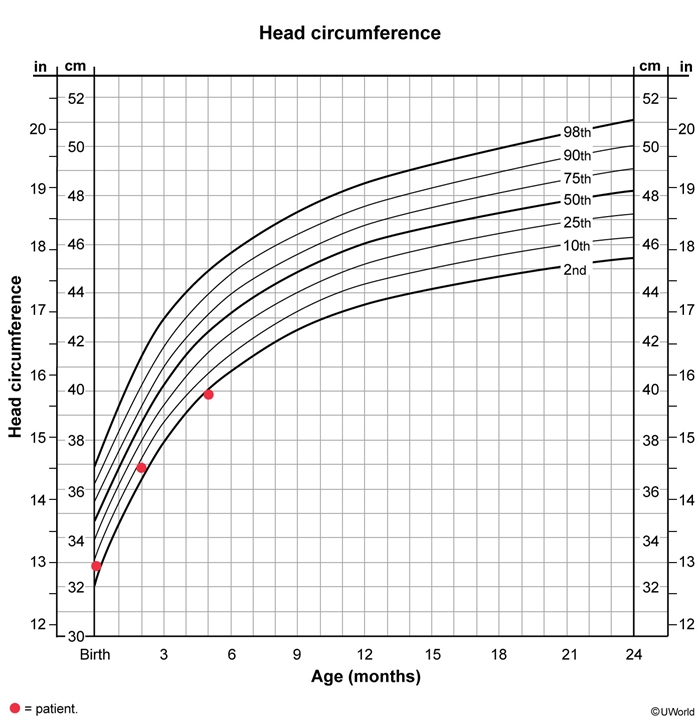
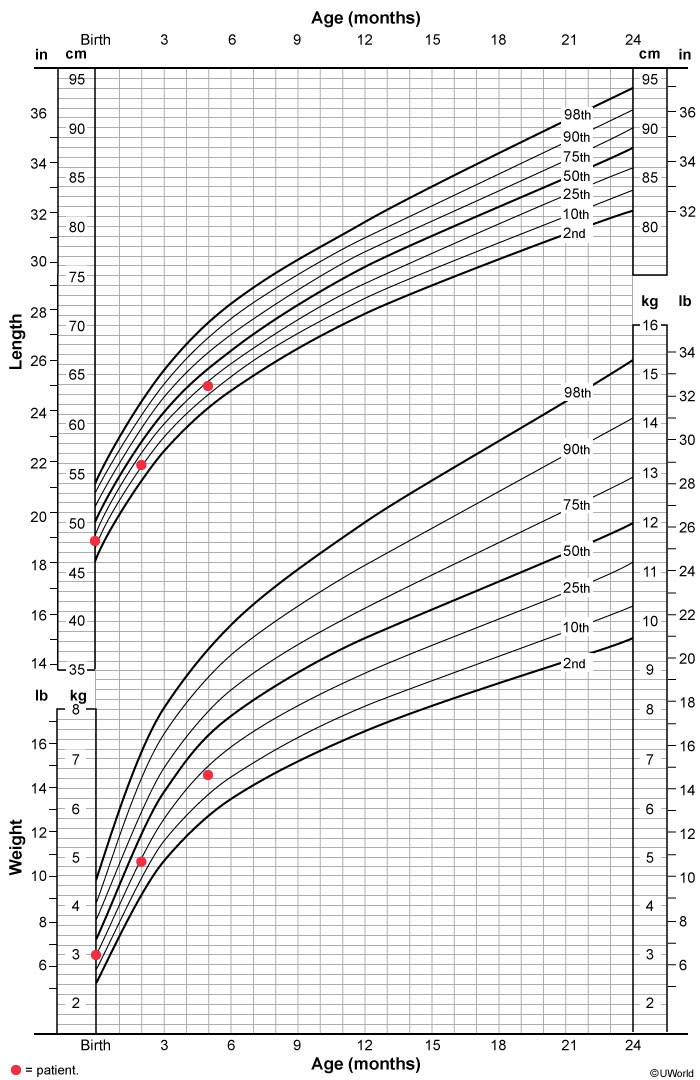 Which of the following is the best next step in management of this patient?
 (Multiple Choice)
4.9/5 (86)
(86) A 3-year-old girl is brought to the clinic for evaluation of right knee swelling. Her mother first noticed the swelling and a limp 2 months ago but attributed them to roughhousing with her brother. Typically, the limping was present in the mornings and resolved by midday. However, while bathing the patient last night, her mother noticed that the right knee was more swollen than usual. The knee is not painful, and the patient has had no fever or rashes. Temperature is 37.5 C (99.5 F). She can bear weight on both legs but has a noticeable limp. The right knee is swollen and slightly warm. The overlying skin appears normal and intact. There is no tenderness to palpation. Peripheral pulses are normal. Sensation is intact. This patient is at greatest risk for which of the following complications?
(Multiple Choice)
4.8/5 (67)
(67) A 10-year-old girl is brought to the office by her mother for evaluation of recent behavioral changes. The patient has been sleeping poorly and recently started wetting her bed. Her grades in school have dropped significantly, and she has been notably anxious and sad. The patient's parents are having financial difficulties and considering divorce. The father drinks alcohol most evenings after coming home from work. The mother appears stressed by her husband's drinking and is very concerned about her daughter. The physician has known the patient since she was a toddler and found her to be cheerful, lively, and cooperative at her checkup 6 months ago. After the mother leaves the room, the physician asks the patient about school and home, at which point she suddenly bursts into tears. After providing support, which of the following is the best next step in management of this patient?
(Multiple Choice)
4.7/5 (69)
(69) A 56-year-old man comes to the office due to muscle weakness. The patient once cycled 10-15 miles daily, but for the past several months, he could cycle only a few miles before his legs felt weak. He has also noticed occasional weakness of his arms and neck muscles and has had brief episodes of double vision in which his eyes could not properly focus. He was diagnosed with hypertension and hyperlipidemia 2 years ago and takes lisinopril and atorvastatin. The patient smoked a pack of cigarettes daily for 30 years before quitting 2 years ago. Vital signs are within normal limits. Physical examination shows normal pupils and ocular movements. Strength and deep tendon reflexes of the bilateral upper and lower extremities are normal. Which of the following would be most helpful for improving this patient's current symptoms?
(Multiple Choice)
4.9/5 (100)
(100) A 6-year-old girl is brought to the office for evaluation of pubic hair development. The girl's mother reports first noticing axillary hair a few weeks ago while dressing her for school. The patient has also had breast and pubic hair development but no vaginal bleeding, headaches, emesis, or visual disturbances. She has no medical conditions and takes no daily medications. The patient had 2 long bone fractures at ages 4 and 5. Family history is unremarkable. Physical examination reveals 2 large hyperpigmented macules with irregular contours on the left side of her back and chest. Axillae have secondary hair; there is no freckling. Bilateral breasts have budding and enlargement of the areola. There is coarse, dark pubic hair along the labia and the pubic junction. Which of the following is the most likely diagnosis in this patient?
(Multiple Choice)
4.9/5 (78)
(78) A 6-year-old boy is brought to the office due to bright red blood in the urine for the past day. He has had no dysuria, urgency, frequency, or pain. There is no history of trauma. He has no chronic medical conditions or recent infections and takes no medications. Temperature is 98.6 F (37 C), pulse is 80/min, blood pressure is 100/65 mm Hg, and respirations are 20/min. Examination shows normal cardiopulmonary, abdominal, and genital examinations. There is no flank or suprapubic tenderness. There is no edema. Laboratory results are as follows: 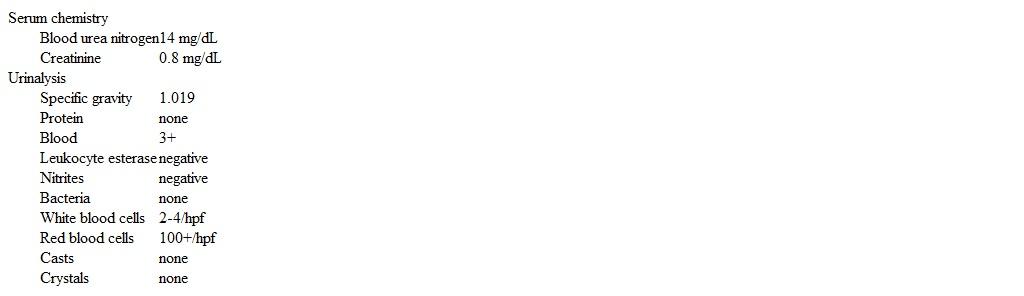 Which of the following is the most appropriate next step in management of this patient?
 (Multiple Choice)
4.8/5 (88)
(88) A 17-year-old girl is brought to the office due to a 14-day history of fever, neck "lumps," sore throat, and malaise. She has severe fatigue and has not been able to attend classes. She also has had difficulty swallowing because of throat pain. The patient has no cough, abdominal pain, nausea, or vomiting. She has no chronic medical conditions. Temperature is 38.7 C (101.7 F), blood pressure is 120/76 mm Hg, pulse is 86/min, and respirations are 24/min. Physical examination shows an uncomfortable patient who is breathing loudly through the mouth. There are no oral lesions. Tonsils are erythematous and markedly enlarged with bilateral exudates. Multiple tender, mobile, posterior cervical lymph nodes are palpable. Heart sounds are normal without murmurs. Lungs are clear without wheezing or rales. The abdomen is soft and nontender; the spleen is palpable 2 cm below the left costal margin. Which of the following complications is this patient most at risk for developing?
(Multiple Choice)
4.9/5 (80)
(80) A 9-year-old boy is brought to the emergency department due to lethargy, headache, and nausea since this morning. In addition, the patient has had decreased urine output over the past 48 hours. He reports no abdominal or joint pain, dysuria, or shortness of breath. The patient has no chronic medical conditions; 2 weeks ago, he had a sore throat that resolved spontaneously. Temperature is 37.2 C (99 F), blood pressure is 170/102 mm Hg, pulse is 98/min, and respirations are 20/min. The oropharynx is clear. The neck is supple, and there is no lymphadenopathy. Periorbital, scrotal, and pedal edema are present. There is no rash. Complete blood count is normal. Serum creatinine is 1.9 mg/dL. Urinalysis reveals moderate blood and 2+ protein. Which of the following is the best next step in management of this patient?
(Multiple Choice)
4.8/5 (73)
(73) An 18-month-old boy is brought to the emergency department for evaluation of a productive cough and fever. He has had 8 office and emergency department visits over the past year, all of which required antibiotics for diagnoses of sinusitis and pneumonia. He was delivered vaginally without complications. His older brother has had similar recurrent infections throughout his life. Temperature is 38.9 C (102 F), blood pressure is 90/60 mm Hg, pulse is 120/min, and respirations are 30/min. The patient's pulse oximetry is 99% on room air. Examination of the oropharynx reveals mildly enlarged tonsils without erythema or exudate. Auscultation reveals rales and rhonchi in both lungs, and point of maximal impulse is displaced to the right side of the chest. What is the most likely diagnosis?
(Multiple Choice)
4.7/5 (79)
(79) A 5-year-old boy is brought to the office by his parents due to behavioral difficulties. The patient just started kindergarten and has had difficulty staying focused on tasks and switching between activities. The teachers say that he is disruptive and often flaps and waves his hands. He was previously in a small preschool classroom with one-on-one teaching and was able to complete most activities with help. The patient's developmental history is notable for speaking his first word at age 19 months and walking at age 20 months. His mother also had learning difficulties, but she was able to graduate from high school with tutoring. Height and weight are at the 50th percentile, and head circumference is at the 90th percentile. Examination shows a prominent forehead and chin. Mild hypotonia and joint hypermobility are present in bilateral lower extremities. Which of the following is the most likely prognosis for this patient's condition?
(Multiple Choice)
5.0/5 (96)
(96) A 2-day-old girl is being evaluated in the newborn nursery. The patient was born at 38 weeks gestation to a 28-year-old primigravida via spontaneous vaginal delivery. The pregnancy was uneventful. Maternal blood type is B, Rh-D positive, and the patient's blood type is O, Rh-D positive. Apgar scores were 8 and 9 at 1 and 5 minutes, respectively. The patient is breastfeeding exclusively and has had 3 wet diapers in the last day. She passed meconium yesterday. The mother noticed mild yellowing of the skin after the last feed. Vital signs are normal. The patient is currently asleep. The anterior fontanelle is open, soft, and flat. There is a firm fluid collection in the left parietal scalp, localized within suture lines. The tympanic membranes are normal bilaterally. The oropharynx is clear and moist. Cardiopulmonary examination is unremarkable. The abdomen is soft with normal bowel sounds. The liver is palpable 2 cm below the costal margin. Skin examination shows jaundice, and there is mild scleral icterus. Which of the following is this patient's greatest risk factor for developing severe hyperbilirubinemia?
(Multiple Choice)
4.9/5 (83)
(83) A 16-year-old girl comes to the clinic due to a rash. The patient developed a pruritic red lesion on her back 5 days ago that has slowly grown. She has since developed multiple new lesions on the chest and back. The patient has tried over-the-counter topical antibiotics with no improvement. She also had a fever, headache, and malaise about a week ago, which resolved after 2 days. She has no chronic medical conditions, takes no medications, and has no allergies. The patient is a wrestler for her high school team. She is sexually active and uses combination oral contraceptives. Temperature is 37.2 C (99 F). Cardiopulmonary examination is normal. Skin examination shows multiple 0.5- to 1-cm (0.2- to 0.4-in) erythematous macules with minimal scaling on the chest, as seen in the exhibit,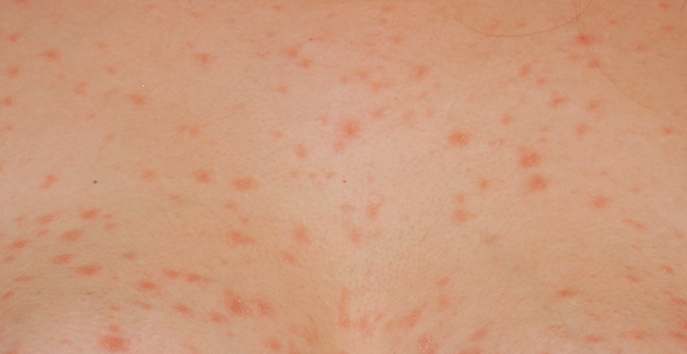 and back oriented along the lines of tension. There is a larger, 3-cm (1.2-in) erythematous patch on the upper back with scaling. The rash spares the palms and soles. Which of the following is the most likely diagnosis in this patient?
 (Multiple Choice)
4.9/5 (81)
(81) A 12-year-old boy is brought to the office for evaluation of intermittent dark urine and exertional fatigue for 2 weeks. He has had no trauma, fever, muscle aches, dysuria, or urinary frequency or urgency. The patient underwent aortic valve replacement with a mechanical valve for bicuspid aortic regurgitation a year ago, and he takes daily warfarin. Temperature is 37.5 C (99.5 F), blood pressure is 110/64 mm Hg, pulse is 98/min, and respirations are 16/min. Cardiac examination reveals a regular rate and rhythm with crisp mechanical heart valve clicks. Abdomen is soft and nontender. There is no edema. Urinalysis reveals the following:  What is the best next step in management?
 (Multiple Choice)
5.0/5 (81)
(81) 
Filters
- Essay(0)
- Multiple Choice(0)
- Short Answer(0)
- True False(0)
- Matching(0)