



 Chat with AI
Exam 2: Pediatric

Exam 1: Medicine2 k Questions
Exam 2: Pediatric723 Questions
Exam 3: Psychiatry336 Questions
Exam 4: Surgery563 Questions
Exam 5: Obstetrics & Gynecology469 Questions
Select questions type


A 3-year-old boy is brought to the emergency department due to loss of consciousness while playing at a park. The boy was short of breath from running when he appeared blue and went limp for approximately 10 seconds. His mother caught his fall and says that he regained consciousness quickly. He did not hit his head or experience any trauma. However, the patient has previously lost consciousness during excess crying and temper tantrums. The events are brief and accompanied by blue discoloration of his lips. The patient was born full term via normal vaginal delivery, and there was no known history of cyanosis or jaundice in the neonatal period. He has met all developmental milestones. The patient's father has hypertension and hyperlipidemia, and his paternal uncle has a seizure disorder. Temperature is 37.5 C (99.5 F), pulse is 110/min, and respirations are 45/min. Physical examination shows an alert and mildly cyanotic boy with a systolic ejection murmur along the mid to upper left sternal border. When the child squats, the murmur becomes louder and the cyanosis improves. The abdomen is soft, nontender, and nondistended. No organomegaly is present. Femoral and brachial pulses are equal and 2+. Deep tendon reflexes are 2+. Which of the following is the most likely diagnosis in this patient?
(Multiple Choice)
4.9/5  (79)
(79) A 2-year-old boy was hospitalized 24 hours ago after a swimming pool drowning. The patient had no pulse when he was removed from the pool. Cardiopulmonary resuscitation was initiated at the scene and continued for 20 minutes before spontaneous circulation was restored. The patient is intubated and receiving mechanical ventilation. Over the past 2 hours, he has had persistently elevated blood pressure and bradycardia. Temperature is 37 C (98.6 F), blood pressure is 145/84 mm Hg, pulse is 59/min, and respirations are 16/min. Oxygen saturation is 96% on 70% oxygen, with the ventilator rate set at 16/min. The patient is not receiving any sedating or analgesic medications and exhibits no eye or extremity movement in response to stimulation. Jugular venous pressure is normal. The lungs have bilateral crackles. There is no peripheral edema. What is the most likely explanation for this patient's hemodynamic abnormalities?
(Multiple Choice)
4.8/5 (85)
(85) A 6-day-old boy is brought to the emergency department due to spasms involving the whole body. The infant has had 3 days of difficulty latching on the breast, and this morning he was unable to nurse. The parents have been supplementing breastfeeding with a mixture of honey and goat milk. The infant lives in a religious commune with his parents, 3 older siblings, and 2 dogs. The members of the community do not accept vaccinations. The mother did not receive prenatal care and delivered vaginally with the assistance of her sister. The umbilical cord was cut with a pair of kitchen scissors. Temperature is 38.8 C (101.8 F). Examination shows an irritable infant with marked hypertonicity, neck stiffness, and inspiratory stridor. Auscultation of the heart and lungs is normal. The umbilical stump is swollen and has a small amount of purulent drainage. Cerebrospinal fluid analysis shows the following:  Cultures of the blood, cerebrospinal fluid, and umbilical stump are pending. Which of the following is the most likely diagnosis?
 (Multiple Choice)
4.9/5 (75)
(75) A 7-week-old boy is evaluated for persistent hypoxia. He has been in the neonatal intensive care unit since birth. He was born at 29 weeks gestation due to placental abruption and weighed 1150 g (2.5 lb). Six hours after delivery, the patient developed tachypnea, grunting, and cyanosis; a chest x-ray revealed ground-glass opacities. Surfactant was administered and mechanical ventilation was initiated. He remained on mechanical ventilation for the first 3 weeks of life. Ever since ventilation was discontinued, the patient has remained hypoxic and continues to require oxygen administration by nasal cannula. Temperature is 36.7 C (98 F), pulse is 124/min, and respirations are 50/min. He is awake and alert. No rhinorrhea or pharyngeal erythema is found. S1 and S2 are normal; a 1/6 systolic murmur is present at the lower left sternal border. Scattered rhonchi and rales are present in both lungs. The abdomen is soft without organomegaly. There is no extremity edema. Chest radiograph appears hazy bilaterally and demonstrates slightly decreased lung volumes. What is the most likely diagnosis for this patient's current presentation?
(Multiple Choice)
4.7/5 (70)
(70) A 6-year-old girl is brought to the clinic for evaluation of "strange behavior." Her parents have noticed that she seems to have conversations with herself when no one else is there, especially when she is alone in her room. In addition, when the girl dropped a plate at dinner, she said that "Mudsie did it" and that Mudsie was a friend who went to school with her. She states, "Mudsie is my invisible friend who is a bit clumsy, but I am teaching her to go slowly so that she gets better." The patient has no chronic medical conditions and has reached all her developmental milestones on time. Her maternal aunt was recently diagnosed with bipolar disorder. The patient has friends at school and gets along well with her 2 older siblings. She plays basketball, although she worries that she is not a good player because she drops the ball often. On mental status examination, the patient is friendly, cooperative, and responds appropriately to questions. She says that she can see and hear Mudsie but reports no other auditory or visual hallucinations. At one point in the interview, she looks over her shoulder and says, "Shhh, Mudsie, not now." Her parents are concerned that her behavior is abnormal and will interfere with her ability to make real friends. Which of the following is the most appropriate response?
(Multiple Choice)
4.9/5 (88)
(88) A 3-week-old boy is brought to the office due to worsening jaundice. A week ago, the parents noticed that the patient's eyes and face looked yellow, and his trunk has become increasingly yellow over the last 2 days. They describe his stool as consistently pale. The patient is exclusively breastfed and has been feeding well. The pregnancy and delivery were uncomplicated. Maternal blood type is O positive, and routine prenatal studies were normal. Temperature is 37.2 C (99 F), pulse is 140/min, and respirations are 50/min. Capillary refill is <2 seconds. Examination shows jaundice and hepatomegaly. Laboratory results are as follows:  Which of the following is the most appropriate diagnostic test?
 (Multiple Choice)
4.8/5 (69)
(69) A 62-year-old woman comes to the office due to upper extremity weakness and numbness. Three days ago, the patient was involved in a motor vehicle collision in which a truck rear-ended her vehicle. The patient did not hit her head or lose consciousness but experienced a tingling and burning sensation in all extremities, which she attributed to the stress of the accident. Since then, she has had numbness in her upper extremities and clumsiness of her hands. She reports difficulty picking up objects but has had no leg weakness or bowel or bladder disturbance. The patient is upset that the other driver refused to accept fault but reports no other ongoing stressors. She has a history of hypertension and osteoarthritis. Vital signs are within normal limits. Neck and back examination show no deformity or tenderness. There is weakness of hand grip bilaterally, and the triceps reflex is decreased on both sides. Decreased pinprick sensation is present on the fingers. The remainder of the neurologic examination is normal. Cervical spine x-ray reveals no vertebral dislocation or fracture, but diffuse spondylotic changes are present. Which of the following is the most likely cause of this patient's symptoms?
(Multiple Choice)
4.9/5 (67)
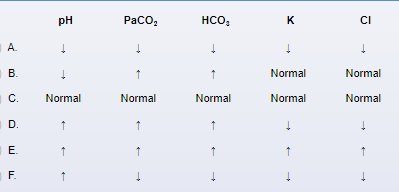
(67) A 4-week-old full-term boy is brought to the emergency department due to vomiting. His parents describe the emesis as undigested formula without blood or bile. The vomiting occurs after feeds and has increased in frequency and force over the past 6 days. However, the infant continues to bottle-feed every 1-2 hours. He previously had soft, yellow stools daily but has had no stool for the past 2 days. The patient was born at 39 weeks gestation through meconium-stained amniotic fluid with Apgar scores of 8 and 9. Temperature is 37.2 C (99 F), blood pressure is 70/30 mm Hg, pulse is 182/min, and respirations are 10/min; pulse oximetry is 98% on room air. Examination shows a thin, sleepy infant with a sunken anterior fontanelle and dry mucous membranes. Cardiac examination reveals tachycardia but no murmurs or gallops. The abdomen is soft, nontender, and nondistended. Which of the following laboratory findings would be expected in this patient?
(Multiple Choice)
4.8/5 (75)
(75) A 6-week-old boy is brought to the emergency department due to poor feeding. The mother reports that the infant starts breastfeeding but after a few minutes begins sweating and grunting and stops nursing. He was born to a 38-year-old woman who declined prenatal testing and had an uncomplicated home vaginal birth. The infant's weight is <5th percentile. Vital signs show tachycardia. Examination shows a round, dysmorphic face with upslanting palpebral fissures, a furrowed tongue, and abnormal palmar creases. Auscultation reveals a fixed split S2 and a grade 2/6 systolic ejection murmur best heard at the left upper sternal border. Bibasilar crackles are present. Which of the following congenital heart defects is most likely present in this patient?
(Multiple Choice)
4.9/5 (76)
(76) A 1-year-old boy is brought to the office for a routine visit. The patient recently transitioned from breast milk to whole milk and enjoys various table foods, including fruits, vegetables, and grains. The family is vegetarian and adds protein to his diet through beans and nut butters. He says 2 words, recently started walking, and often chews on his toys and books. The family lives in a house built in the 1940s that has no chipping paint and has recently been renovated, except for the basement and bedrooms. Height, weight, and head circumference are at the 50th percentile for age. Physical examination is normal. Capillary blood test results are as follows:  Which of the following is the most appropriate next step in management of this patient?
 (Multiple Choice)
4.8/5 (73)
(73) A newborn girl is evaluated in the delivery room for respiratory distress. The patient was born 15 minutes ago by spontaneous vaginal delivery at 37 weeks gestation to a mother who received no prenatal care. Temperature is 37 C (98.6 F), pulse is 176/min, and respirations are 70/min. Pulse oximetry is 82% on room air. Physical examination shows grunting; subcostal and suprasternal retractions; and cyanosis of the lips and tongue. The chest appears rounded and the abdomen appears flat. Auscultation reveals absent breath sounds on the left and clear breath sounds on the right. Heart sounds are loudest in the right chest. Which of the following is the best next step in management of this patient?
(Multiple Choice)
4.9/5 (72)
(72) A 13-year-old girl is brought to the emergency department due to a head injury. The patient was climbing a tree when she fell and injured the right side of her head. She briefly lost consciousness after the injury. On arrival, the patient is awake and reports pain over the right frontal area but has no focal neurologic deficits. CT scan of the head reveals a right frontotemporal epidural hematoma. Neurosurgery is consulted for craniotomy. While waiting for the surgery, the patient becomes somnolent and develops left lower extremity weakness. Bilateral pupillary responses are normal. Which of the following best explains this patient's worsening neurologic status?
(Multiple Choice)
5.0/5 (81)
(81) An 8-year-old boy is brought to the office by his mother, who says that the boy has become "unmanageable" over the past 2 years. He does not do anything that he is told, including chores and homework. He either makes excuses, saying that he "forgot," or does tasks "half-heartedly," often making careless mistakes while rushing through his work. The boy does not listen to his mother and argues with her about getting ready for school. He recently was taken to the principal's office for getting out of his seat and talking out of turn. The patient's teachers like him but describe him as "difficult to teach." His grades are poor, and he is at risk of not being promoted. The patient has also lost friends due to his intrusive behavior. His mood is usually upbeat, and he enjoys playing soccer and video games. The boy's weight is in the 40th percentile, his overall development has been normal, and he has met all developmental milestones. The family moved to a new neighborhood, and the patient started attending a different school last year. There is a family history of bipolar disorder in the patient's uncle. During the course of the evaluation, the boy repeatedly interrupts the discussion with rapid, loud speech. He jumps up and grabs the physician's stethoscope even after his mother tells him not to touch anything. Which of the following is the most likely diagnosis in this patient?
(Multiple Choice)
4.9/5 (78)
(78) A 6-month-old boy is brought to the office for follow-up after a urinary tract infection. The boy was initially brought in 2 weeks ago with fever for 4 days. A urine culture from a catheterized urine specimen at that first visit grew >100,000 colony-forming units of Escherichia coli. The fever resolved within 48 hours with antibiotic therapy, and a full course of antibiotics was completed. Renal ultrasound performed 2 days ago showed mild right hydronephrosis; voiding cystourethrogram revealed dilation of the right ureter with blunting of the right renal calyces. The patient has no prior medical conditions and is up to date with vaccinations. Temperature is 36.7 C (98 F). Physical examination shows a circumcised male with a normal abdominal examination. If untreated, which of the following is the most likely long-term complication of this patient's condition?
(Multiple Choice)
4.9/5 (71)
(71) A previously healthy 6-month-old child is brought to the physician for a routine examination. The parents state that during the past month, the child has been feeding poorly and has been fussier than usual. On examination, the child has a bulging anterior fontanelle and widely spaced sutures. Her scalp veins are also noted to be prominent. The remainder of the physical examination is within normal limits. The infant's growth chart is shown below. 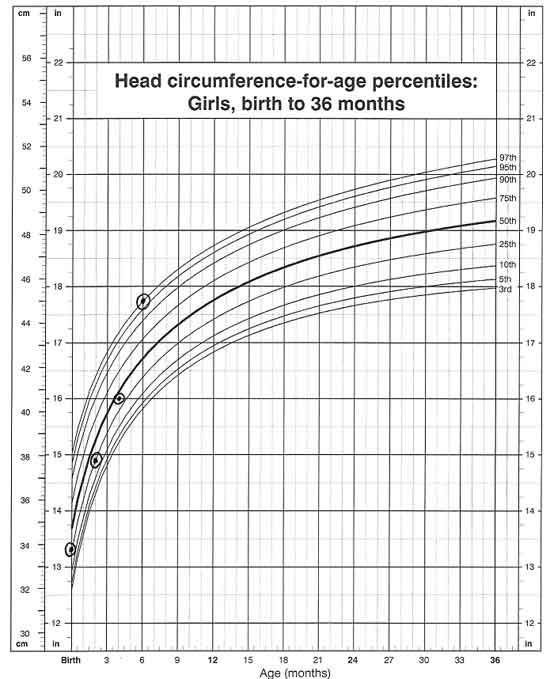 Which of the following is the best next step in the management of this patient?
 (Multiple Choice)
4.9/5 (79)
(79) A 6-week-old girl is brought to the office due to blood in the stool for the past week. The patient was born at 36 weeks gestation by spontaneous vaginal delivery and has been exclusively breastfed. Her stools had been soft but have become loose with streaks of blood and mucus. The patient has not had any fever, vomiting, or sick contacts. Weight is at the 25th percentile and has increased since her 1-month checkup. Temperature is 37 C (98.6 F), pulse is 135/min, and respirations are 30/min. Examination shows a playful and well-appearing infant. Cardiopulmonary examination is normal. The abdomen is soft. No anal fissure is present on rectal examination. A fecal occult blood test is positive. Which of the following is the best next step in management of this patient?
(Multiple Choice)
4.8/5 (87)
(87) A 4-year-old boy is brought to the physician for evaluation of binge-eating. He complains constantly of hunger and has temper tantrums when his parents refuse to give him additional snacks. Past medical history is significant for hospitalization during the first month of life for nasogastric feeding due to weak suck and hypotonia. The patient is status post orchiopexy for bilateral cryptorchidism at age 1 year. He also receives physical and speech therapies twice a week. His height is <5th percentile and weight is >99th percentile. On examination, he has a narrow forehead, a down-turned mouth, almond-shaped eyes, and small hands and feet. He has low muscle tone and a microphallus. Which of the following is the most likely cause of this patient's condition?
(Multiple Choice)
4.8/5 (94)
(94) A 6-year-old girl is admitted to the hospital due to a week of fever. The patient has a history of fulminant viral myocarditis for which she received a cardiac transplant 8 months ago. Viral studies prior to transplantation were negative for Epstein-Barr virus (EBV) and cytomegalovirus (CMV). She is taking maintenance immunosuppression medications. Temperature is 38.1 C (100.6 F), blood pressure is 102/74 mm Hg, pulse is 76/min, and respirations are 22/min. Heart examination reveals normal S1 and S2 with no S3 or S4 and no murmurs. Pulses are 2+ in all extremities. The lungs are clear to auscultation. There are several enlarged anterior cervical lymph nodes bilaterally. Laboratory results are as follows:  Echocardiogram shows normal heart structure and function. A CT scan of the chest reveals scattered bilateral atelectasis and several highly enlarged mediastinal lymph nodes. Which of the following is the most likely cause of this patient's symptoms?
 (Multiple Choice)
4.8/5 (80)
(80) A 21-day-old girl is brought to the office due to constipation. The patient urinates 5 or 6 times per day but has a bowel movement only every 2 or 3 days; her first stool occurred at approximately 50 hours of life. The mother states that breastfeeding seems to be going well except that the patient has to be awakened for almost every feed and falls asleep within minutes of initiating a feed. The mother did not receive routine prenatal care, and the girl was born at home. Temperature is 36.1 C (97 F), pulse is 110/min, and respirations are 28/min. Birth weight and length were at the 40th and 50th percentiles respectively; her weight today is 1% below her birth weight. Physical examination reveals a calm neonate with a slightly enlarged fontanelle and mild hypotonia. The abdomen is soft and nontender with no organomegaly. Bowel sounds are normal. Rectal examination shows a normal rectal tone with no anal fissures. Skin examination reveals jaundice extending from the head to the abdomen. Which of the following is the best next step in management of this patient?
(Multiple Choice)
4.9/5 (95)
(95) An 8-year-old girl is brought to the office due to a small amount of left-sided ear discharge that has persisted for the last 3 weeks. She was seen twice over the last 2 months and completed 2 courses of antibiotics, but the discharge has persisted. She has no pain or fever but has hearing loss on the left side. The patient has had recurrent ear infections and underwent tympanostomy tube placement at age 2. Immunizations are up to date. Vital signs are normal. Otoscopy reveals some scarring on the left tympanic membrane, with peripheral granulation and some skin debris. Which of the following is the most likely diagnosis in this patient?
(Multiple Choice)
4.8/5 (70)
(70) 
Filters
- Essay(0)
- Multiple Choice(0)
- Short Answer(0)
- True False(0)
- Matching(0)