



 Chat with AI
Exam 2: Pediatric

Exam 1: Medicine2 k Questions
Exam 2: Pediatric723 Questions
Exam 3: Psychiatry336 Questions
Exam 4: Surgery563 Questions
Exam 5: Obstetrics & Gynecology469 Questions
Select questions type


A 15-year-old boy is found to have a murmur during a routine sports physical examination. He has no complaints and has excellent exercise capacity. His maternal uncle died while swimming at age 24. The patient's blood pressure is 122/70 mm Hg and pulse is 63/min. A faint midsystolic murmur is heard along the lower left sternal border when the patient is supine. When the patient is asked to stand, a 3/6 systolic crescendo-decrescendo murmur is heard in the same location. Which of the following is the most likely mitral valve abnormality in this patient?
(Multiple Choice)
5.0/5  (78)
(78) A 3-day-old boy is in the neonatal intensive care unit for management of prematurity. For the past hour, the patient has had decreased spontaneous movements and tone. He has also had one episode of bradycardia and apnea. The patient was delivered vaginally at 28 weeks and 5 days gestation by a multiparous woman with cervical insufficiency. Apgar scores were 8 and 9 at 1 and 5 minutes, respectively. Birth weight was 1.04 kg (2 lb 5 oz). Prenatal laboratory studies and ultrasounds were normal. Rupture of membranes occurred 3 hours prior to birth. The amniotic fluid was clear, and there was no maternal fever. Temperature is 37.1 C (98.8 F). Head circumference is 28.5 cm, an increase of 3 cm from yesterday. Examination shows a lethargic neonate with a weak cry, tense fontanelle, and generalized hypotonia. The patient then develops a generalized seizure. Which of the following is the most likely cause of this patient's condition?
(Multiple Choice)
4.8/5 (95)
(95) A 16-year-old girl is brought to the office due to a day of joint pain and pruritic rash. Two days ago, the patient completed a 10-day course of amoxicillin-clavulanate for an episode of otitis media. Temperature is 38.2 C (100.8 F). On examination, the patient has a blanchable, erythematous, urticarial rash on the hands and feet. There are no target lesions, and the lips and oral mucosae are not involved. Generalized lymphadenopathy is present. Multiple joints are tender but not swollen. Ear examination shows no residual disease. Laboratory studies show a normal complete blood count, comprehensive metabolic panel, and urinalysis. What is the most likely outcome of this patient's current condition?
(Multiple Choice)
4.9/5 (71)
(71) A 2-month-old African American boy is brought to the emergency department due to persistent crying. Last evening, the infant began crying after his mother lifted his legs to change his diaper. Overnight, the patient was intermittently fussy and refused to breastfeed, and he has been difficult to console this morning. He was born at term via cesarean delivery due to breech presentation and was discharged on day of life 2. Temperature is 38.5 C (101.3 F). Cardiopulmonary examination is normal. The liver edge is 1.5 cm below the costal margin. Bilateral testicles are present and nontender. The right hip is held flexed, abducted, and externally rotated. The patient cries with palpation of the upper right thigh and resists movement along that hip. The left hip has full range of motion. Laboratory results are as follows:  Which of the following is the most likely diagnosis in this patient?
 (Multiple Choice)
4.9/5 (86)
(86) A 2-year-old girl is brought by her parents to the emergency department due to fever. Approximately 10 hours ago, the patient had several episodes of vomiting and began to feel increasingly lethargic. Vaccinations are up to date. Temperature is 39.8 C (103.6 F), blood pressure is 70/36 mm Hg, and pulse is 135/min. The patient is poorly responsive on examination. The abdomen is nontender and nondistended. A rash is present on the bilateral lower extremities. A representative photograph is shown below:  Antibiotic therapy is initiated, and a lumbar puncture is obtained. Gram stain of cerebrospinal fluid shows gram-negative diplococci. Which of the following additional studies should be obtained in this patient?
 (Multiple Choice)
4.7/5 (74)
(74) A 4-month-old boy is brought to the emergency department after an episode of generalized tonic-clonic seizure 30 minutes ago. The patient was born at 40 weeks gestation by spontaneous vaginal delivery. He was at the 50th percentile for height and weight, and had a normal physical examination. Since birth, the patient has had 3 episodes of upper respiratory infection and otitis media. His parents and older sister have no medical problems. On examination, the patient is lethargic. He weighs 4.2 kg (9.3 lb, <5th percentile). The anterior fontanelle is flat. Pupils are reactive with normal fundi. His tympanic membranes and pharynx are normal. He has round cheeks and a doll-like face. Heart sounds are normal without murmurs. Lungs are clear. The abdomen is protuberant and the liver is palpable 4 cm below the right costal margin. Extremities are thin. Laboratory results are as follows:  Urine dipstick is positive for ketones. Serum triglyceride and uric acid levels are increased. Which of the following is the most likely cause of this patient's condition?
 (Multiple Choice)
4.8/5 (75)
(75) A 14-year-old boy is brought to the emergency department by ambulance from his school. The patient is accompanied by his gym teacher, who says the boy suddenly developed left-sided abdominal pain during track practice. The patient has no significant medical history, and vaccinations are up to date. Temperature is 36.7 C (98 F), blood pressure is 65/30 mm Hg, pulse is 160/min, and respirations are 30/min. Oxygen saturation is 100% on room air. On examination, the patient is pale, diaphoretic, and in distress. Cardiopulmonary examination is normal. The abdomen is distended and diffusely tender to palpation. He has no skin rash. Bedside ultrasound examination reveals free fluid in the abdomen. Hemoglobin is 9 g/dL. Further evaluation of this patient would most likely reveal which of the following?
(Multiple Choice)
4.8/5 (98)
(98) A 1-year-old boy is admitted to the intensive care unit for severe respiratory distress and hypoxia requiring endotracheal intubation and mechanical ventilation. Medical history shows 2 prior episodes of pneumonia, chronic thrush, and tympanostomy tube placement for recurrent otitis media. His vaccinations are not fully up to date due to illness at the time of his well visits. The patient is at the 2nd percentile for height and weight. Physical examination shows diffuse crackles in both lungs. Laboratory results are as follows: 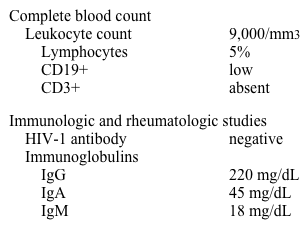 Which of the following is the best long-term treatment for this patient?
 (Multiple Choice)
4.9/5 (75)
(75) An autopsy is performed on an 11-week-old girl after the mother found the infant unresponsive in her bassinet after a nap. The parents had placed her on her side with a pacifier and without any loose bedding or items in the bassinet prior to the nap. The infant had a normal examination with appropriate weight gain at a well-child visit 3 weeks ago; she received vaccinations at that time including DTaP. After vaccination, she cried uncontrollably for an hour. The infant also recently had congestion, rhinorrhea, and fever for 3 days but had no symptoms for the past week. She was born at term via an uncomplicated spontaneous vaginal delivery. Birth weight was appropriate for gestational age. The infant lived at home with her parents and older brother, all of whom shared a room in a 1-bedroom apartment. The autopsy is inconclusive. Which of the following is a risk factor associated with this infant's cause of death?
(Multiple Choice)
4.9/5 (91)
(91) A 5-week-old girl is brought to the emergency department for increased fussiness. The infant had been feeding, voiding, and stooling normally since discharge from the nursery but has become increasingly irritable over the past 48 hours with decreased appetite and frequent crying. Temperature is 38.3 C (100.9 F). Mucous membranes are moist. Heart and lung examinations are unremarkable. The abdomen is soft and nondistended. A 5 × 6 cm area of redness and induration is noted along the left cheek and submandibular region; it has greatly expanded over the past hour. Leukocyte count is 22,000 cells/mm3. Blood, urine, and cerebrospinal fluid are collected for culture. The infant is admitted to the pediatrics unit, and broad-spectrum antibiotics are started. After 5 hours, the blood culture grows gram-positive cocci in pairs and chains. Which of the following is the most likely pathogen in this patient?
(Multiple Choice)
4.9/5 (80)
(80) A 12-year-old boy is brought to the office by his mother due to skin bruising, muscle aches, and fatigue. She is concerned that these symptoms are due to him being bullied at school, which the boy denies. He has also had significant nausea over the last week but has maintained adequate oral intake. The patient has no chronic medical conditions. Examination reveals mucosal pallor and numerous ecchymoses on the bilateral extremities. Laboratory results are as follows: 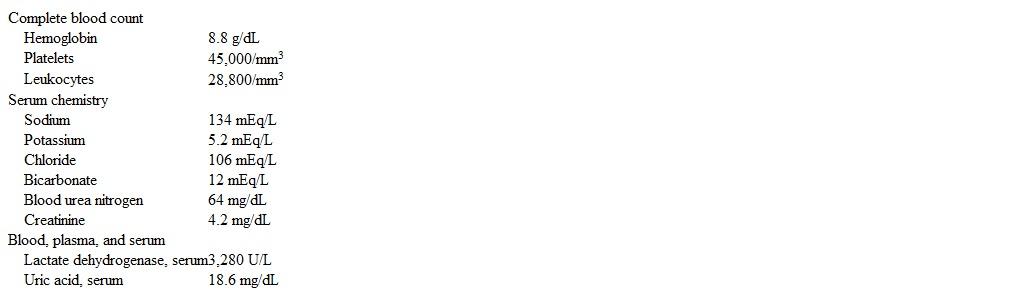 Peripheral blood smear reveals significant immature myeloid cells. Which of the following is the most likely underlying cause of this patient's acute renal failure?
 (Multiple Choice)
4.9/5 (85)
(85) A 3-day-old boy is brought to the emergency department due to bruising. The patient was born at 39 weeks gestation via vaginal delivery at home, and this is his first medical evaluation. He is breastfed exclusively. Vital signs are within normal limits. Several ecchymoses are visible on the extremities. Physical examination is otherwise unremarkable. Laboratory results are as follows:  Which of the following is the most likely cause of this patient's condition?
 (Multiple Choice)
4.8/5 (85)
(85) A 4-month-old boy is admitted to the intensive care unit for respiratory distress due to pneumonia. The infant developed cough and tachypnea 2 days ago with progressive worsening of hypoxia and work of breathing. He has had 2 months of poor weight gain and diarrhea, which have not improved despite changing to a hydrolyzed formula. The infant lives with his foster parents, who have 2 older children and a dog. The biological mother did not receive prenatal care after the first trimester. The child's birth weight was at the 60th percentile and current weight is at the 3rd percentile. Temperature is 39.5 C (103.1 F) and pulse oximetry is 74% on room air. Physical examination shows extensive oral thrush and generalized lymphadenopathy. Auscultation of the heart and lungs reveals a soft systolic ejection murmur and faint bilateral crackles. The remainder of the examination is normal. Laboratory results are as follows: 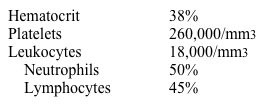 Endotracheal tube aspirate reveals Pneumocystis jirovecii. Which of the following abnormalities is most likely present in this patient?
 (Multiple Choice)
4.9/5 (77)
(77) A 4-month-old boy is brought to the emergency department due to 5 days of fever, cough, and shortness of breath. The patient was born at 38 weeks gestation via uncomplicated vaginal delivery. At age 2 months, he was diagnosed with cervical lymphadenitis that required prolonged oral antibiotics. Temperature is 38.5 C (101.3 F), blood pressure is 80/40 mm Hg, pulse is 120/min, and respirations are 40/min. Oxygen saturation is 95% on room air. The patient is alert and responsive. Oropharyngeal examination shows no abnormalities. Mild chest retraction and bilateral rales are present. Chest x-ray reveals bilateral pulmonary infiltrates. The patient is given appropriate empiric antibiotic therapy for pneumonia; however, after 3 days, he continues to be febrile and laboratory assessment shows increased leukocyte count. CT scan of the chest shows multifocal pneumonia with areas of cavitation. Cultures obtained via bronchoalveolar lavage grow a filamentous, gram-positive rod consistent with Nocardia infection. Immunodeficiency is suspected. Which of the following tests would most likely identify the underlying immune disorder in this patient?
(Multiple Choice)
4.8/5 (92)
(92) A 12-hour-old girl in the neonatal intensive care unit has bilious emesis. She was born at 35 weeks gestation by vaginal delivery to a 22-year-old woman who did not receive prenatal care and used cocaine during her pregnancy. The infant has urinated but has not had a bowel movement. She was able to take 2 bottle feeds by mouth but has been vomiting green fluid since the third feed. Birth weight was 2 kg (4 lb 6 oz), which is small for gestational age. Temperature is 36.9 C (98.4 F), pulse is 160/min, and respirations are 40/min. The abdomen is distended. The rest of the examination is unremarkable. Abdominal x-ray is shown below. 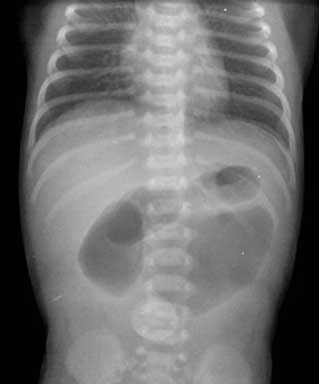 Which of the following is the most likely diagnosis in this patient?
 (Multiple Choice)
4.8/5 (81)
(81) A 7-year-old boy comes to the office with his parents due to bed-wetting. He achieved daytime dryness at age 4 but has never stayed dry overnight for more than 3 consecutive nights. His urinary stream is strong, and there is no dribbling, straining, or urgency. The child is irritable and inattentive, often interrupting his teacher and disrupting his classmates at school. His mother and father both achieved nighttime dryness at age 5. Height and weight are tracking along the 75th and 25th percentiles, respectively. Blood pressure is at the 90th percentile. On examination, the tympanic membranes are clear, and the tonsils are symmetrically enlarged. Cardiopulmonary, abdominal, and genital examinations are normal. Urinalysis and serum creatinine are normal. Which of the following is the best next step in management of this patient?
(Multiple Choice)
5.0/5 (87)
(87) A 52-hour-old girl is evaluated in the newborn nursery for abdominal distension. The patient was delivered at 40 weeks gestation to a 21-year-old woman by cesarean delivery for arrest of labor. Apgar scores were 8 and 9 at 1 and 5 minutes, respectively. The patient has been voiding appropriately but has not yet had a bowel movement. The abdomen is tense and distended. Rectal examination reveals no stool or release of gas. Feeds are held, and a nasogastric tube is placed successfully for decompression. Upright abdominal radiograph reveals multiple dilated loops of small bowel with paucity of air in the large intestine and rectum. The left lateral decubitus view shows free air above the liver, and an emergency laparotomy is performed. Thick, sticky stool is irrigated and evacuated from the ileum, and the colon appears diffusely narrow. This patient is at increased risk for which of the following comorbidities?
(Multiple Choice)
4.8/5 (88)
(88) A 14-year-old girl is brought to the emergency department due to 2 days of abdominal cramping, nausea, vomiting, and diarrhea. Today, she has developed fever and blood in the stool. The patient recently returned from a week-long summer camp and had no symptoms while she was away. She has common variable immunodeficiency that is managed with immunoglobulin replacement therapy. Prior to this illness, the patient had been generally well, except for an episode of sinusitis a month ago that was treated with amoxicillin-clavulanate. Temperature is 38.2 C (100.8 F) and pulse is 102/min. Abdominal examination shows mild, diffuse pain with palpation but no rebound tenderness or guarding. Stool ova and parasite testing is negative. Stool culture grows Salmonella species. Which of the following is the most likely underlying cause of this patient's current condition?
(Multiple Choice)
4.8/5 (95)
(95) A 68-year-old man is brought to the emergency department after a fall at home while walking to the kitchen. Prior to the fall, the patient did not have lightheadedness, chest pain, or palpitations, and he did not hit his head or lose consciousness during the fall or afterward. His wife says the patient has become increasingly weak over the past 6 months and has fallen several times. The patient has also become forgetful, and his wife thinks he even forgets to go to the bathroom, as he has urinated on himself on several occasions. He has a history of hypertension and osteoarthritis. The patient has never smoked but used to drink heavily until stopping 10 years ago. Blood pressure is 130/86 mm Hg and pulse is 80/min with no orthostatic changes. On physical examination, there is no carotid bruit, and cardiac examination is unremarkable. Neurological examination shows normal cranial nerves and fundoscopy. Bilateral lower extremity muscle strength is normal, but tone and reflexes are increased. Sensation to light touch, pain, and vibration are intact. Gait is slow and wide based, and the patient takes several small steps to turn around. Mini-Mental State Examination score is 21 of 30. Further evaluation of this patient is most likely to reveal which of the following findings?
(Multiple Choice)
4.9/5 (92)
(92) An 8-year-old girl is brought to the emergency department with lethargy and fever. The patient has had intermittent cough, fever, and headache for the past 3 weeks. She vomited before dinner last night and went to bed early. This morning, her father could not wake her up. The patient is otherwise healthy. She traveled with her family to rural Ecuador 2 months ago for a mission trip. She has no other recent travel and no known sick contacts. Temperature is 39.8 C (103.6 F). The patient is minimally responsive on examination. Funduscopy shows papilledema, and chest auscultation reveals decreased breath sounds and crackles over the right middle lobe. The results of lumbar puncture are as follows:  Which of the following organisms is the most likely cause of this patient's symptoms?
 (Multiple Choice)
4.8/5 (88)
(88) 
Filters
- Essay(0)
- Multiple Choice(0)
- Short Answer(0)
- True False(0)
- Matching(0)