



 Chat with AI
Exam 2: Pediatric

Exam 1: Medicine2 k Questions
Exam 2: Pediatric723 Questions
Exam 3: Psychiatry336 Questions
Exam 4: Surgery563 Questions
Exam 5: Obstetrics & Gynecology469 Questions
Select questions type


A 7-year-old girl is brought to clinic due to a diffuse headache. She first developed pain while working on a math assignment today. The headache was exacerbated by the sound of her classmates yelling at recess. She was permitted to lie down in a dark, quiet room, which helped. The patient had just returned to school today after a vacation, during which she hit her head on the passenger door when her mother's car collided with another car. The patient did not lose consciousness and was taken to the emergency department, where head imaging was normal. Since the incident, she has been more irritable at times. Vitals signs are normal. The patient has a normal affect and can easily recall details of the accident. Examination shows return of headache when asked to move her eyes left and right rapidly between 2 points held a short distance away. Neurologic examination is otherwise normal. Which of the following is the most likely cause of this patient's symptoms?
(Multiple Choice)
4.9/5  (84)
(84) A 4-year-old girl is brought to the emergency room due to seizures. Two hours ago, the patient reported a headache and was given acetaminophen; an hour later, she suddenly had a generalized tonic-clonic seizure that lasted 5 minutes. While en route to the hospital, the patient had another seizure that manifested as right arm shaking. She has no history of prior seizures, recent trauma, or recent infectious illness. The patient is up to date on vaccinations, has no medical conditions or developmental delay, and takes no medications. Temperature is 36 C (96.8 F), blood pressure is 92/60 mm Hg, pulse is 88/min, and respirations are 15/min. Oxygen saturation is 98% on room air. On examination, the patient is lethargic but opens her eyes to voice. She follows commands and answers questions with a single word. The head is normocephalic and atraumatic. The pupils are equal, round, and reactive to light. The neck is supple without meningeal signs. Muscle strength is decreased in the right upper and lower extremities. Point-of-care blood glucose is normal. CT scan of the head without contrast reveals no abnormalities. Complete blood count and serum electrolytes are normal. Appropriate seizure therapy is initiated, and electroencephalography is requested. What is the most appropriate next step in management of this patient?
(Multiple Choice)
4.8/5 (83)
(83) A 1-month-old boy is brought to the clinic due to poor feeding. When nursing, he becomes diaphoretic, and for the past week he has fed for only 5 minutes at a time before falling asleep. The patient was born full term via spontaneous vaginal delivery. Today, his weight is 30 g (1 oz) below birth weight. Temperature is 37 C (98.6 F). Blood pressure is normal. Examination shows a thin infant who is sleeping but easily arousable. Cardiac examination reveals tachycardia and a I/VI holosystolic murmur over the left lower sternal border with a diastolic rumble over the cardiac apex. The S2 is prominent. The patient is tachypneic, but the lung fields are clear to auscultation. There is no clubbing, cyanosis, or peripheral edema. Which of the following is the most likely cause of this patient's symptoms?
(Multiple Choice)
4.8/5 (92)
(92) A 24-year-old man comes to the office due to vision disturbances. The patient has a history of ankylosing spondylitis and experienced severe pain and redness of the eyes a month ago. Evaluation at that time showed acute anterior uveitis and prednisolone eye drops were prescribed, which the patient still uses. The eye symptoms resolved within a week of treatment, but over the past several days the patient has had blurry vision and has needed more light to read. He has also experienced glare while driving at night. The patient has no other medical conditions, and his only other prescribed medication is naproxen as needed. Vital signs are within normal limits. Ocular examination shows nonerythematous conjunctiva, clear corneas, and no hypopyon or opacities of the lenses. Funduscopic examination is normal. The remainder of the physical examination, including neurologic examination, shows no abnormalities. Which of the following is the most appropriate next step in management of this patient?
(Multiple Choice)
4.8/5 (75)
(75) A 7-year-old girl is brought to the office due to 6 months of increased school refusal since starting first grade. The patient has been prolonging her morning routine and argues when it is time to leave for school. The mother says, "She refuses to get out of the car when we arrive and starts crying about how the other kids laugh at her. I know she misses kindergarten because she keeps asking to go back." Her teacher reports that the patient gets frustrated easily, has difficulty following directions, and either makes up words rather than trying to sound them out or angrily refuses to read at all. The patient participates in dance class after school and plays with other kids in the neighborhood on the weekends. Growth curves, vital signs, and physical examination are normal. Which of the following is the most likely explanation for this patient's behavior?
(Multiple Choice)
4.9/5 (83)
(83) A 9-year-old boy is brought to the emergency department after having a seizure at school. His teacher says he suddenly fell to the ground with sustained flexion of the arms and extension of the legs, followed by clonic movements of his whole body for 5 minutes. The patient appeared sleepy after the episode, but his behavior is now at baseline. His parents arrive shortly after and note that the boy has been increasingly tired and irritable over the last few months, and his school performance has declined this semester. The patient has no medical issues and takes no medications. Physical examination shows decreased muscle strength on the left side of the body, with brisk deep-tendon reflexes in the left arm and leg. Visual field examination is normal. MRI of the brain reveals a space-occupying lesion in the right parietal lobe. Which of the following is most likely responsible for this patient's symptoms?
(Multiple Choice)
4.8/5 (87)
(87) A 5-month-old full-term boy is brought to the physician for fever. He was doing well until this morning, when he felt warm to his mother. He has had a "runny nose" and intermittent coughing but otherwise has been breastfeeding well. His 3-year-old brother had an upper respiratory tract infection last week. The infant takes vitamin D, and his vaccinations are up to date. His temperature is 38. 9 C (102 F), blood pressure is 90/60 mm Hg, pulse is 120/min, and respirations are 32/min. Pulse oximetry shows an oxygen saturation of 96%. Examination shows crusted rhinorrhea at the nares. The patient's chest radiograph is shown below. 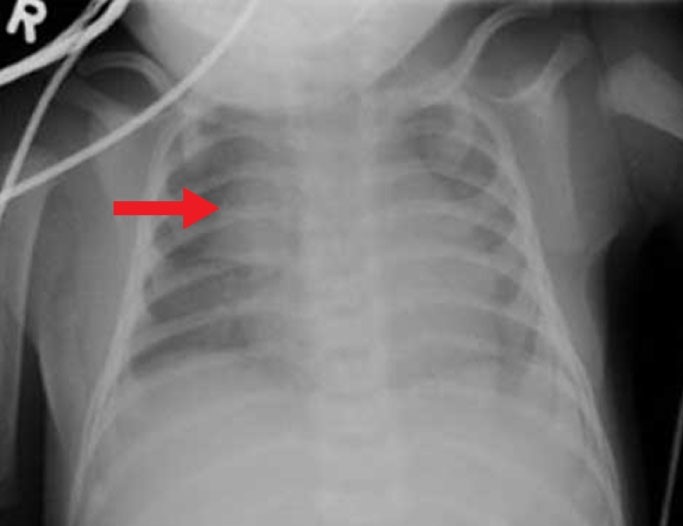 Which of the following is marked on this patient's chest radiograph?
 (Multiple Choice)
4.7/5 (78)
(78) A 9-year-old boy is brought to the office due to oozing skin lesions on his legs. The patient developed the rash yesterday and has been uncomfortable due to pain and pruritus. He and his father returned 4 days ago from their annual camping excursion; they had applied sunscreen and insect repellants during the trip. The patient takes no medications and has no known allergies. Skin examination shows a well-demarcated tan line starting just above the knee as well as scattered erythema with overlying vesicles in a linear arrangement below the knees. Some lesions appear wet and others have a thin, crusted coating. Which of the following mechanisms is most likely responsible for this patient's skin findings?
(Multiple Choice)
4.9/5 (94)
(94) A 7-year-old boy is brought to the office due to lethargy and dark urine. The patient has had no abdominal pain, fever, dysuria, urinary frequency, or urgency. Temperature is 37.4 C (99.3 F). Physical examination shows periorbital swelling and mild pedal edema. Cardiopulmonary examination reveals no abnormalities. The remainder of the examination is unremarkable. Laboratory results are as follows:  The serum C3 concentration is low, and the C4 concentration is normal. Which of the following is the most likely diagnosis in this patient?
 (Multiple Choice)
4.8/5 (80)
(80) An 8-month-old boy is brought to the emergency room due to fever and lethargy. The patient had been doing well at home until this morning, when he developed a fever of 38.6 C (101.5 F) and had several small episodes of nonbilious, nonbloody emesis. He was irritable but interactive and continued to drink fluids. The family suspected a viral illness but grew more concerned when the fever persisted and the patient became less responsive. Temperature is 39.4 C (103 F), blood pressure is 70/40 mm Hg, pulse is 130/min, and respirations are 29/min. A lumbar puncture reveals gram-negative diplococci in the cerebrospinal fluid. The patient is given empiric antibiotics and admitted to the pediatric intensive care unit. Which of the following isolation types is most appropriate for this patient's infection?
(Multiple Choice)
4.9/5 (67)
(67) A 17-year-old girl comes to the office due to a rash. She joined the high school cross country running team 2 months ago and has had a progressive itchy rash on her feet since that time. The patient tried replacing her running shoes and socks, but the symptoms continued. Medical history is unremarkable. Examination findings are shown in the image below:  Which of the following is the most appropriate treatment for this patient's condition?
 (Multiple Choice)
5.0/5 (81)
(81) A 2-month-old full-term girl is brought to the office for a well-baby visit. She drinks 5 oz of a standard cow milk protein-based formula every 4 hours. Her parents are concerned as she regurgitates a small amount of formula after each feed. The patient is "fussy" when the formula spills out of her nose but then calms down after burping. She has no coughing, gagging, or breathing difficulties. Her weight, height, and head circumference have been tracking along the 25th percentile since birth. Physical examination reveals intermittent smiling and cooing. The patient is able to lift her head briefly to 30 degrees while prone. Her lungs are clear to auscultation. The abdomen is soft, nontender, and nondistended. Which of the following is the best next step in management of this infant?
(Multiple Choice)
4.9/5 (71)
(71) A 17-year-old boy is brought to the clinic due to a breast mass. He first noticed pain beneath his right nipple a month ago, and over the last few weeks, the right breast has become enlarged. The patient has no chronic medical conditions and takes no medications. He is doing well in school, and family history is unremarkable. Height and weight are at the 75th percentile. Temperature is 37 C (98.6 F), blood pressure is 110/66 mm Hg, pulse is 100/min, and respirations are 20/min. Examination shows a prominent right breast with a palpable and tender, 5-cm, well-circumscribed mound deep to the right nipple. There is no axillary or cervical lymphadenopathy. Cardiopulmonary examination is unremarkable, and the abdomen is soft without tenderness. Examination of the external genitalia shows testes without a palpable mass. Sexual maturity rating (Tanner) is stage 5. Laboratory results are as follows:  Which of the following is the best next step in evaluation of this patient?
 (Multiple Choice)
4.8/5 (76)
(76) A 5-year-old boy is brought to the clinic due to 3 days of fever. For the past 2 days he has also had throat pain and has not eaten well. His father is worried because the boy is due to start the fall school term in 2 weeks. The patient has no chronic medical conditions and is current with his immunizations. He lives with his older brother, parents, and grandmother. Temperature is 38.3 C (101 F), blood pressure is 108/58 mm Hg, pulse is 108/min, and respirations are 18/min. The oropharynx has several scattered, 1-mm vesicles on the anterior palatine pillars. Several gray, shallow ulcers are also seen on the soft palate and uvula, but the tongue, lips, and buccal mucosa are spared. The skin has no rashes. The remainder of the physical examination is normal. Which of the following is the most likely pathogen associated with this patient's condition?
(Multiple Choice)
4.8/5 (93)
(93) A 4-year-old girl is brought to the emergency department due to a 1-week history of fever. Her family has also noticed that the patient is "much crankier than normal" and has decreased oral intake. She has had no cough, rhinorrhea, or emesis. She has no medical conditions, takes no daily medications, and has not received age-appropriate vaccines. Temperature is 39.4 C (102.9 F), blood pressure is 90/60 mm Hg, and pulse is 135/min. On physical examination, the patient is irritable and has mild facial flushing. Bilateral conjunctivae are injected. A 1.7-cm, tender, mobile anterior cervical lymph node is palpated. Cardiac examination demonstrates a regular rhythm and no murmurs, rubs, or gallops. The trunk and extremities have a blanching maculopapular eruption; the hands and feet are erythematous and edematous. An image of the patient's mouth is shown below. 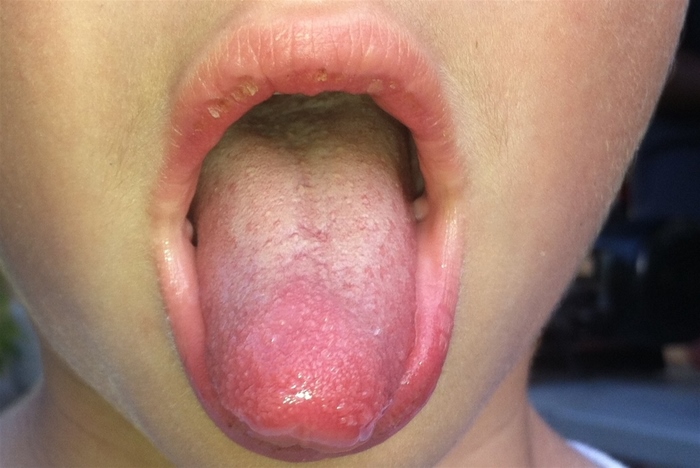 The posterior pharynx is mildly injected without exudates or tonsillar hypertrophy. Which of the following is the best next step in management of this patient?
 (Multiple Choice)
4.9/5 (60)
(60) A 3-year-old boy is brought to the clinic due to increased seizure frequency. Over the past year, the patient has had recurrent tonic-clonic seizures that are poorly controlled despite multiple antiepileptic medications. The seizures have become more frequent in the past month and now occur daily. The patient has developmental delay and receives speech and physical therapy. He was born at term without perinatal complications and has received all age-appropriate vaccinations. Family history includes mild intellectual disability in his father. Physical examination is notable for multiple 1- to 2-cm hypopigmented macules on the trunk and lower extremities. MRI of the brain reveals subependymal nodules, as shown in the image below: 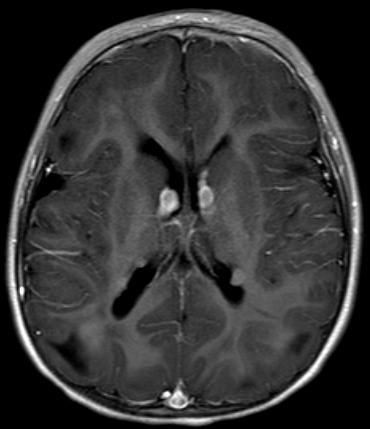 Which of the following is associated with the most likely underlying condition in this patient?
 (Multiple Choice)
4.7/5 (75)
(75) A 12-year-old girl is brought to the clinic by her parents for evaluation of decreased exercise tolerance and increased lethargy. Her parents say she becomes short of breath with minimal exertion, and for the past 2 weeks her gums have bled when she brushes her teeth. Temperature is 36.7 C (98 F); blood pressure and pulse are normal. Physical examination demonstrates pallor and hepatosplenomegaly. Laboratory results are as follows:  An extensive workup indicates that the patient has acute lymphoblastic leukemia, and the parents are informed that she will need chemotherapy. The parents do not consent to the treatment plan because they believe that the side effects will be too severe and that their child's quality of life will be poor. Despite an ethics consultation and a lengthy discussion about the benefits of treatment and likely consequences if therapy is withheld, the parents insist on taking her home without scheduling follow-up treatment. Which of the following is the most appropriate next step in the management of this patient?
 (Multiple Choice)
4.9/5 (79)
(79) A newborn boy is being evaluated in the nursery. The patient was born to a 24-year-old primigravida following a pregnancy complicated by polysubstance use, including opioids, benzodiazepines, and alcohol. The mother is now adherent to a methadone addiction management program and is taking sertraline for depression. The patient was born via cesarean delivery and was vigorous, with a birth weight of 3.8 kg (8 lb 8 oz). Newborn examination appears consistent with a near-term gestation and is otherwise unremarkable. Maternal and newborn urine drug screens are positive for opioids only. While the patient is being treated in the nursery, the mother asks if she will be able to breastfeed her newborn. Which of the following is an absolute contraindication to breastfeeding in this patient?
(Multiple Choice)
4.7/5 (73)
(73) A 4-year-old boy is brought to the emergency department by his father due to nausea, vomiting, diarrhea, and abdominal pain over the past 4 hours. Their home bathroom is being repainted due to peeling paint, and prior to the onset of symptoms the patient's father noticed that several pill bottles were open. Temperature is 37.2 C (99 F), blood pressure is 76/38 mm Hg, pulse is 160/min, and respirations are 34/min. On physical examination, the patient appears tired and is responsive only to painful stimuli. The oropharynx is clear but appears dry. Peripheral pulses are weak, and capillary refill is 4 seconds. Not long after examination, the boy develops hematemesis. Laboratory results are as follows: 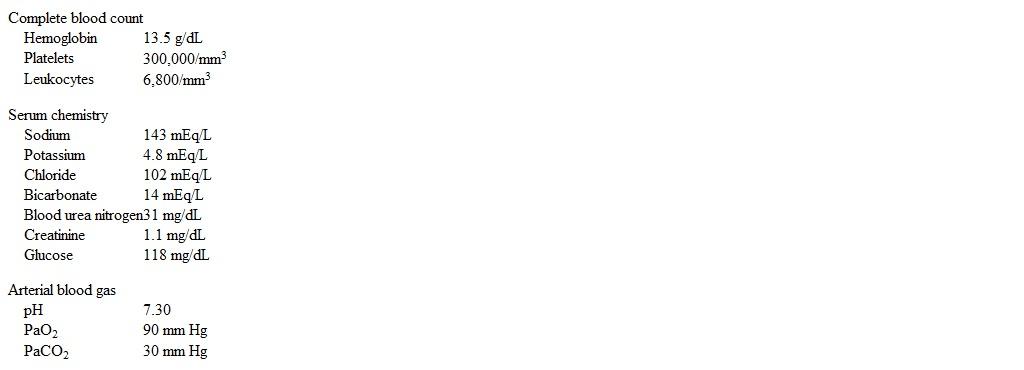 Chest and abdominal x-rays reveal several small opacities in the stomach and duodenum. Which of the following was most likely ingested by this patient?
 (Multiple Choice)
4.9/5 (70)
(70) A 12-year-old boy with cystic fibrosis is admitted to the hospital for fever, chills, shortness of breath, and worsened productive cough. The patient has been hospitalized multiple times for lung infections. Chest imaging reveals patchy lung infiltrates. Blood and sputum cultures are ordered, and piperacillin-tazobactam is started. Several hours later, the patient develops increased dyspnea, weakness, and new-onset back pain. Repeat examination shows tachycardia, mucosal pallor, and dark urine. No midline back tenderness or lower extremity neurologic deficits are present. Laboratory results are as follows:  Hemoglobin on admission was 11.8 g/dL. Which of the following is the most likely cause of this patient's clinical deterioration after hospitalization?
 (Multiple Choice)
5.0/5 (86)
(86) 
Filters
- Essay(0)
- Multiple Choice(0)
- Short Answer(0)
- True False(0)
- Matching(0)