



 Chat with AI
Exam 2: Pediatric

Exam 1: Medicine2 k Questions
Exam 2: Pediatric723 Questions
Exam 3: Psychiatry336 Questions
Exam 4: Surgery563 Questions
Exam 5: Obstetrics & Gynecology469 Questions
Select questions type


A 4-week-old, full-term boy is brought to the office due to vomiting. Since birth, he has had small spit-ups with feeding. However, for the past few days he has had forceful emesis after every feed that is worsening. The emesis consists of formula and is neither bilious nor bloody. Despite this, the patient has an excellent appetite and "always seems hungry." He passes one small stool every other day, and his last bowel movement was yesterday. Weight today is down 0.5 kg (1.1 lb) from a well-child visit 2 weeks ago. On examination, the patient is awake and alert. His anterior fontanelle is sunken and he has decreased skin turgor. Capillary refill is 3 seconds. The abdomen is soft, nontender, and nondistended. The scrotum has no erythema, and the testes are descended. Which of the following is the best next step in management of this patient?
(Multiple Choice)
4.9/5  (101)
(101) A 4-day-old girl is brought to the office due to bilateral eye discharge that began 2 days ago and is worsening. The patient's mother is a 20-year-old woman, gravida 2 para 2, who had limited prenatal care. During the first trimester, the mother was treated for a sexually transmitted infection. During the third trimester, group B streptococcal screening was positive. The mother had no additional testing or treatment during the pregnancy. Delivery occurred vaginally with no known complications at home under the care of a midwife. Temperature is 36.7 C (98.1 F). The patient has bilateral chemosis, severe eyelid swelling, and significant purulent discharge. The face and chest have mild jaundice. The rest of the examination is normal. Which of the following would most likely have prevented this infant's clinical findings?
(Multiple Choice)
4.8/5 (89)
(89) A 4-year-old boy is brought to the emergency department after drowning in a pool. The mother reports she was outside with her son in the back yard when she left him to go inside. She returned a few minutes later to find the boy submerged in the deep end of the pool. She removed him from the water and called 911. The patient was unresponsive but breathing when paramedics arrived. They placed him on oxygen and transported him to the hospital. Temperature is 33.9 C (93 F), blood pressure is 100/58 mm Hg, pulse is 120/min, and respirations are 44/min. Pulse oximetry is 89% on high-flow oxygen. On examination, the patient is somnolent. The pupils are equal and reactive to light. Nasal flaring and intercostal retractions are noted. Wheezing is present on auscultation of the lungs. He moves all extremities but does not follow commands. Which of the following is the first step in management of this patient?
(Multiple Choice)
4.7/5 (86)
(86) A newborn boy is evaluated in the nursery an hour after delivery. The infant was born via vaginal delivery to a 20-year-old primigravid mother who had routine prenatal care. The pregnancy was complicated by mild gestational hypertension without preeclampsia. The mother developed a fever 2 days ago and a vesicular rash on her face yesterday. On the day of delivery, the rash spread to her chest and abdomen and became intensely pruritic. She went into labor later that day and delivered the infant without difficulty. Skin-to-skin contact between the mother and infant was deferred due to the maternal rash. Apgar scores were 8 and 9 at 1 and 5 minutes, respectively. The boy weighs 2.95 kg (6 lb 8 oz). Vital signs and physical examination are normal. The mother does not recall having similar symptoms previously, but the father had a similar rash during his childhood. Which of the following is the most appropriate management of this infant?
(Multiple Choice)
4.8/5 (76)
(76) A 6-year-old boy is brought to the emergency department with severe shortness of breath. He has had a runny nose for the past week and fever, chills, and productive cough for 2 days. The patient was diagnosed with cystic fibrosis on newborn screening and has had multiple hospitalizations since infancy for respiratory infections requiring intravenous antibiotics. He also had multiple skin infections requiring incision and drainage over the past year. Temperature is 39.4 C (103 F), blood pressure is 90/60 mm Hg, pulse is 130/min, and respirations are 35/min. Pulse oximetry shows a SaO2 of 85% that improves to 92% after oxygen supplementation. Examination shows nasal flaring, intercostal retractions, and grunting, and auscultation reveals bibasilar crackles and expiratory wheezing. Chest x-ray reveals infiltrates in the right and left lower lobes. Influenza antigen testing is positive. Cefepime and oseltamivir are administered. Which of the following empiric antibiotics should also be administered in this patient?
(Multiple Choice)
4.9/5 (73)
(73) A 14-year-old girl is brought to the clinic for leg pain. She first noticed achiness in the ankles 3 months ago after starting a daily walking routine on a local trail to improve her health. The aches tend to be worse in the morning but improve over the day. The pain spread to the knees, elbows, and wrists over the past month. Prior to this, the patient had been sedentary and spent most of her time indoors watching television. In addition to the walking routine, she has transitioned to a plant-based diet. The patient feels tired most days despite sleeping 9 hours a night. Her weight has improved from the 95th percentile to the 90th percentile over the past 3 months, and her height is stable at the 75th percentile. Temperature is 37.3 C (99.1 F), pulse is 80/min, and respirations are 16/min. Cardiopulmonary examination is normal. Bilateral ankles, knees, elbows, and wrists have mild swelling and tenderness to palpation. Which of the following medications is most appropriate for this patient's condition?
(Multiple Choice)
4.8/5 (77)
(77) An 8-year-old girl is admitted to the hospital for relapsed acute myeloid leukemia. Based on a recent bone marrow analysis, the patient requires aggressive treatment that includes multiple chemotherapeutic drugs and bone marrow transplant; chance of survival after 5 years is 20%. She is cared for by her mother, father, and maternal grandmother, who moved in with the family to help with her care. After extensive discussions among the family members and the physician about treatment options and prognosis, the girl states that she does not want to be treated. She is behind in school; she says that the treatments make her feel terrible, and she wants to go home to have more time with her friends. The patient's parents appear to understand their daughter's concerns but want treatment started immediately. On examination, the patient is alert and interacting appropriately with no remarkable findings except for generalized pallor. Which of the following is the best next step in management of this patient?
(Multiple Choice)
4.9/5 (85)
(85) A 5-year-old boy is brought to the office by his parents due to concerns about his speech. The patient is talkative, speaks in full sentences, and has a large vocabulary. However, he frequently mispronounces words, and over 30% of his speech is unintelligible. The patient was born at 30 weeks gestation, and his newborn course was complicated by pneumonia requiring several days of mechanical ventilation. He has no chronic medical conditions. Height and weight have been consistent at the 25th percentile. His older sibling has autism spectrum disorder and participates in special education classes. When given a crayon and paper, the patient runs and climbs onto the examination table and writes his first name. Tympanic membranes are clear bilaterally. Mucous membranes are moist. The rest of the physical examination is normal. Which of the following is the best next step in evaluation of this patient?
(Multiple Choice)
4.9/5 (93)
(93) A 6-month-old girl is brought to the office for a well-child visit and routine vaccinations. The patient is exclusively breastfed and is urinating and stooling normally. One month ago, she was hospitalized for intussusception that was reduced successfully by air enema. The patient lives in a small apartment with her mother, brother, and maternal aunt, who is pregnant. Vital signs are normal. On examination, she has mild nasal congestion and clear rhinorrhea. The remainder of the examination is normal. Her mother is very concerned about the potential side effects of vaccinations. Which of the following is this patient's contraindication to the rotavirus vaccination?
(Multiple Choice)
4.9/5 (80)
(80) A 13-year-old girl is brought to the emergency department for a headache that has been worsening for the past 24 hours. The patient developed a headache yesterday morning after she returned home from a sleepover at a friend's house. The headache is located over the right frontal area and is pulsatile in quality. The patient has had similar headaches starting 2 years ago, initially occurring every other month but, over the last year, occurring monthly. She had difficulty completing her online homework assignments for school today due to worsening pain. The patient has also had intermittent nausea and vomited twice today. Acetaminophen has minimally improved the pain, and physical activity exacerbates the symptoms. Menarche occurred at age 12, and menstrual periods are regular. Temperature is 37 C (98.6 F), blood pressure is 110/72 mm Hg, pulse is 90/min, and respirations are 18/min. The patient is alert and oriented. The pupils are equal and reactive to light. The remainder of the neurologic examination is normal. Which of the following is the best next step in evaluation of this patient?
(Multiple Choice)
4.8/5 (63)
(63) A 2-week-old boy is brought to the office due to eye tearing and discharge. For the past few days, the patient's left eyelid has crusted over and become matted shut during sleep. The discharge is easily cleaned with a washcloth, but his mother is now cleaning the eye every 2 hours. The boy has also had mild nasal congestion but continues to breastfeed well. The patient was born at term via vaginal delivery and was discharged after 1 day of routine newborn care. Temperature is 37.2 C (99 F). Physical examination shows a few shallow, linear abrasions across the left cheek and lower eyelid. The eyes were cleaned prior to the visit, and examination shows increased tears on the left side. The conjunctivae are clear bilaterally. Fluorescein dye testing on the left eye shows equal distribution on the cornea and conjunctiva. After 5 minutes, a large amount of dye persists and drains over the lower eyelid and down the cheek. Which of the following is the most likely diagnosis in this patient?
(Multiple Choice)
4.9/5 (74)
(74) A 1-day-old girl undergoes routine congenital heart disease screening in the newborn nursery. The patient was born via spontaneous vaginal delivery to a 23-year-old primigravid woman after an induction of labor at 40 weeks gestation. The pregnancy and the delivery were uncomplicated, and the patient has stayed with her mother since delivery. The patient is breastfeeding and has voided and stooled twice. Pulse oximetry obtained while breathing room air is 99% oxygen saturation in the right hand and 91% in the right foot. The patient is well appearing. No cyanosis is seen. Femoral and brachial pulses are 2+. Which of the following is most likely cause of this patient's clinical presentation?
(Multiple Choice)
4.9/5 (79)
(79) A 9-month-old girl is brought to the office due to fever and poor feeding over the past day. During the last few days, the patient has become more fussy than usual and developed a fever yesterday. Today, she has not finished her formula bottles, and her stools have been slightly loose but nonbloody. Temperature is 39 C (102.2 F), pulse is 142/min, and respirations are 36/min. The fontanelle is open, soft, and flat. Tympanic membranes are clear bilaterally. Cardiac examination shows normal heart sounds; there are no murmurs, rubs, or gallops. The lungs are clear to auscultation bilaterally. The abdomen is soft and bowel sounds are present. The skin has no rashes or erythema. Urinalysis reveals positive nitrites and leukocyte esterase. Which of the following is the most appropriate pharmacotherapy for this patient?
(Multiple Choice)
4.9/5 (96)
(96) A 2-year-old boy is brought to clinic by his parents for a routine well-child visit. He has no known medical conditions and is growing and developing appropriately. The patient is starting to put words into short sentences and sleeps well at night. His diet consists mostly of cheese and yogurt. He drinks approximately five 8-oz cups (1183 mL) of whole cow's milk each day. Two months ago, the patient's family moved from Greece to the United States. He has no allergies and immunizations are up to date. Height and weight are at the 25th percentile. Temperature is 36.7 C (98.1 F). The conjunctivae and mucous membranes are pale. The lungs are clear to auscultation bilaterally. Cardiac examination reveals tachycardia and a 2/6 systolic murmur along the left upper sternal border. Complete blood count is as follows:  Which of the following additional findings is most likely to be present in this patient?
 (Multiple Choice)
4.9/5 (86)
(86) A 36-year-old woman is evaluated in the clinic due to left hand clumsiness. The patient works as an office secretary and has been having difficulty typing. Six months ago, she had an episode of vertigo and difficulty walking that improved after several weeks. The patient also has a history of bipolar disorder and takes valproic acid. On physical examination, she is asked to close her eyes and stretch out her arms with the palms facing up. Several seconds later, her left arm involuntarily drifts downward and the palm turns toward the floor. Which of the following best explains the findings observed in this patient?
(Multiple Choice)
4.8/5 (76)
(76) A 4-week-old male infant with hypoplastic left heart syndrome has had difficulty feeding and an episode of vomiting over the last 24 hours. He was born at term via normal spontaneous vaginal delivery. The patient underwent palliative heart surgery at age 1 week; the procedure involved cardiotomy and extensive intracardiac and aortic arch repair. His postoperative course was uncomplicated, and he has remained in the hospital for weaning of oxygen and titration of cardiac medications. Two additional palliative surgeries are planned. Temperature is 38.3 C (101 F), blood pressure is 80/40 mm Hg, pulse is 175/min, and respirations are 70/min. Pulse oximetry is 80% on room air. He is cyanotic and small for his age. Cardiopulmonary examination is notable for distant heart sounds, tachycardia, and tachypnea. Abdominal examination is normal. Chest radiographs from a week ago and today are shown below. 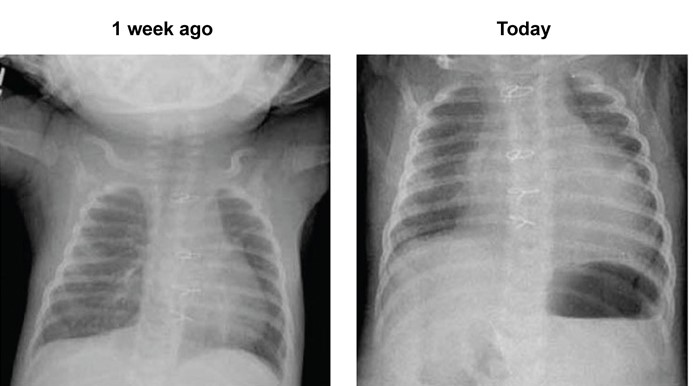 Which of the following is the most likely cause of this patient's acute presentation?
 (Multiple Choice)
4.8/5 (94)
(94) A 9-month-old girl is brought to the clinic for left eye redness and tearing that began last evening. Temperature is 37 C (98.6 F), pulse is 130/min, and respirations are 30/min. Examination of the left eye shows clear tearing on the eyelashes with conjunctival erythema. The left cornea and globe are larger than the right. The patient blinks frequently and turns away when light is shined in the left eye. Extraocular muscle movements are intact and appear nonpainful. The patient has a port-wine stain overlying the left forehead, eyelids, and cheek. Her mother says the lesion is more erythematous than normal, but there is no tenderness, warmth, or pruritus on examination. Which of the following is the best next step in management of this patient?
(Multiple Choice)
4.9/5 (88)
(88) A 4-year-old boy is brought to the emergency department with fever and neck pain. He has had rhinorrhea, nasal congestion, and a sore throat for the past week. Two days ago, he developed fever and worsening neck pain. Today, the patient has refused to eat or drink. He has no chronic medical conditions and immunizations are current. Temperature is 39.7 C (103.5 F), pulse is 120/min, and respirations are 24/min. On examination, the patient appears tired and uncomfortable. Palpation of the neck reveals bilateral anterior cervical lymphadenopathy. The patient refuses to move his neck; passive extension is painful. His voice is muffled. Mouth opening is limited by pain, and the tonsils appear erythematous and symmetrically enlarged with gray exudates. The uvula is midline. Chest auscultation reveals good bilateral air entry without stridor or rhonchi. Lateral neck radiograph shows widened prevertebral space but no other abnormalities. Which of the following is the most likely diagnosis in this patient?
(Multiple Choice)
4.9/5 (85)
(85) A 56-year-old man comes to the office due to burning pain in his feet. The patient initially began experiencing pins and needles in his toes several months ago, which gradually worsened to involve the entire foot. Lately, he has had burning and cramping pain daily in both feet, which is more pronounced at night. The patient has had occasional back pain but has no chronic medical conditions and takes no medications. He is a construction worker and is frequently exposed to vibrating machinery. He does not smoke but drinks 4-6 beers daily and more on the weekends. Vital signs are within normal limits. Physical examination shows loss of bilateral ankle reflex and impaired light touch and vibration sensation in both feet. The remainder of the examination reveals no abnormalities. Hemoglobin A1c and methylmalonic acid levels are within normal limits. Which of the following is the most likely cause of this patient's symptoms?
(Multiple Choice)
4.9/5 (83)
(83) A 6-day-old girl is seen in the newborn unit for persistent jaundice. She was born at 39 weeks gestation to a primigravid 17-year-old woman with O+ blood type, who had an unremarkable pregnancy and normal prenatal laboratory results. On the first day of life, the infant developed jaundice on the face that has now spread to below the umbilicus and to the palms. Phototherapy was initiated, but repeated attempts at stopping therapy have resulted in rebound hyperbilirubinemia. The infant is feeding well, has normal urine output, and is passing soft, yellow stool. Temperature is 36.7 C (98 F). Vital signs are normal. On examination, the patient is asleep but easily aroused. The sclerae are icteric. The abdomen is soft and nontender, the liver is nonpalpable, and the spleen is enlarged. The skin shows generalized jaundice. Laboratory results at 24 hours of life showed hemoglobin of 15.7 g/dL, total bilirubin of 13 mg/dL, and direct bilirubin of 0.2 mg/dL. Current laboratory results are as follows: 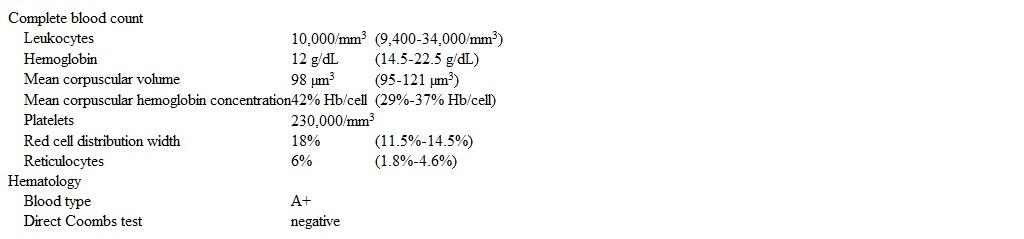 Which of the following is the most likely cause of this patient's anemia?
 (Multiple Choice)
4.7/5 (76)
(76) 
Filters
- Essay(0)
- Multiple Choice(0)
- Short Answer(0)
- True False(0)
- Matching(0)