



 Chat with AI
Exam 2: Pediatric

Exam 1: Medicine2 k Questions
Exam 2: Pediatric723 Questions
Exam 3: Psychiatry336 Questions
Exam 4: Surgery563 Questions
Exam 5: Obstetrics & Gynecology469 Questions
Select questions type


A one-year-old girl is brought to the emergency department (ED) by her mother due to a one-day history of fever and drowsiness. The child has been irritable since yesterday. On examination, she is hypothermic, lethargic and has nuchal rigidity. She flexes her hips when her neck is flexed. She appears septic, and large petechial and purpuric lesions are developing on her body. In the ED, she suddenly becomes hypotensive. Despite aggressive fluid and antibiotic resuscitation, the child dies. What will most likely be revealed as the cause of death during the autopsy of this child?
(Multiple Choice)
4.9/5  (76)
(76) A 70-year-old right-handed man is brought to the emergency department due to right-sided weakness and urinary incontinence that began suddenly 10 hours ago. He has had type 2 diabetes mellitus for the past 20 years and hypertension for the past 28 years. On examination, muscle strength is 4/5 in the right upper extremity and 1/5 in the right lower extremity, and Babinski sign is present on the right side. Sensation is decreased throughout the right foot and leg. Visual fields are full with no deficits, and speech is normal. Which of the following arteries is most likely to be occluded?
(Multiple Choice)
5.0/5 (74)
(74) A 7-day-old African American boy is being evaluated in the hospital. He was admitted yesterday due to sepsis after being brought to the emergency department with fever and vomiting. The patient is receiving intravenous antibiotics, and blood cultures grew Escherichia coli. He had been breastfeeding prior to admission, but feeds are being held due to vomiting. The patient was born at term, and there were no complications during the pregnancy and delivery. Temperature is 38.2 C (100.8 F) and pulse is 158/min. Examination shows jaundice. The liver is palpable 4 cm below the costal margin. Laboratory results are as follows: 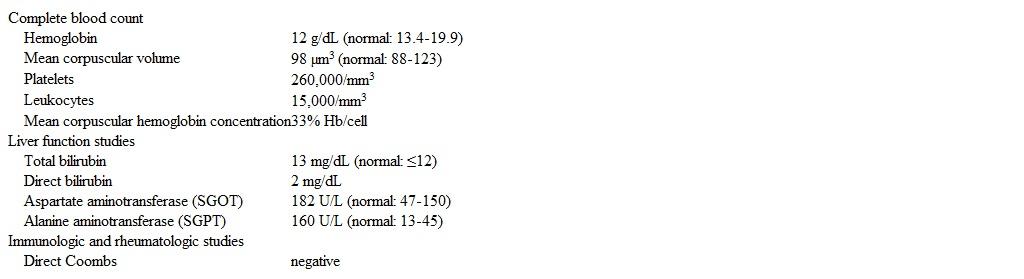 Which of the following is the most likely cause for this patient's condition?
 (Multiple Choice)
4.8/5 (69)
(69) 
Filters
- Essay(0)
- Multiple Choice(0)
- Short Answer(0)
- True False(0)
- Matching(0)