



 Chat with AI
Exam 2: Pediatric

Exam 1: Medicine2 k Questions
Exam 2: Pediatric723 Questions
Exam 3: Psychiatry336 Questions
Exam 4: Surgery563 Questions
Exam 5: Obstetrics & Gynecology469 Questions
Select questions type


A 7-year-old boy is brought to the office to follow-up on a flare of atopic dermatitis. Ten days ago, the patient was prescribed a medium-potency topical corticosteroid for 2 eczematous plaques on the left leg that were intensely pruritic. His parents have been appropriately applying the medication twice a day and have also continued to apply topical emollients twice a day as maintenance therapy. Vital signs are normal. Skin examination is shown in the exhibit. 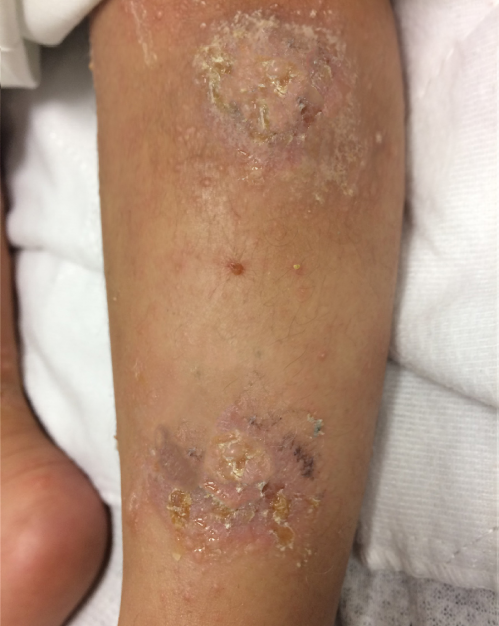 Which of the following is the most appropriate next step in managing this patient?
 (Multiple Choice)
4.9/5  (88)
(88) A 1-day-old boy is brought to the emergency department due to worsening cyanosis. He was delivered at home via spontaneous vaginal delivery. The mother received no prenatal care and is unsure of the gestational age at delivery. The neonate did well after delivery and has breastfed several times. Two hours ago, he developed rapid breathing and cyanosis. On examination, the patient is hypotensive. Pulse oximetry from the right hand is 80% on room air and does not improve with 100% inspired oxygen. Physical examination shows a diffusely cyanotic infant. Cardiac examination reveals tachycardia, a regular rhythm, and no murmur. The patient is tachypneic but has normal breath sounds bilaterally. Chest x-ray is normal. Echocardiography is pending. Laboratory results are as follows:  Which of the following is the best next step in the management of this patient?
 (Multiple Choice)
4.9/5 (90)
(90) A 65-year-old woman is brought to the office by her daughter due to forgetfulness and bizarre behavior. She recently began living with her daughter, who has noticed that the patient frequently misplaces items, forgets the purpose of an errand, and asks the same questions repeatedly. The patient had a left anterior cerebral artery embolic stroke 4 months ago. Her right leg weakness has slightly improved with physical rehabilitation at a nursing facility, but she still has to use a walker for ambulation. Her daughter states that prior to the stroke, the patient was living on her own and was "very social, outgoing, and full of life." Now, she is completely withdrawn and has no interest in day-to-day activities. She has also become suspicious of her daughter and is hoarding things. Other medical history includes hypertension and atrial fibrillation. On physical examination, the patient has a flat affect, normal speech, and right lower extremity weakness. Mental status examination shows short-term memory loss. Mini-Mental State Examination score is 22/30 and Clock-Drawing reveals executive cognitive dysfunction. Which of the following is the most likely cause of this patient's memory impairment?
(Multiple Choice)
4.9/5 (76)
(76) A 16-month-old girl is brought to clinic by her father for behavior concerns. For the last 6 weeks, the patient has been less interactive with family members and increasingly irritable. Her last checkup was at 12 months, when she met all developmental milestones and was growing appropriately. Since then, the patient has not attained new milestones in speech, gross motor, or fine motor development, which her father attributes to recent social stressors because the parents are undergoing a divorce. Temperature is 37.3 C (99.1 F), blood pressure is 140/90 mm Hg, and pulse is 70/min. The patient has poor eye contact. The anterior fontanelle is closed. Cardiopulmonary examination is unremarkable. The skin is pink and well perfused. Growth charts for head circumference, height, and weight are shown in the exhibits. 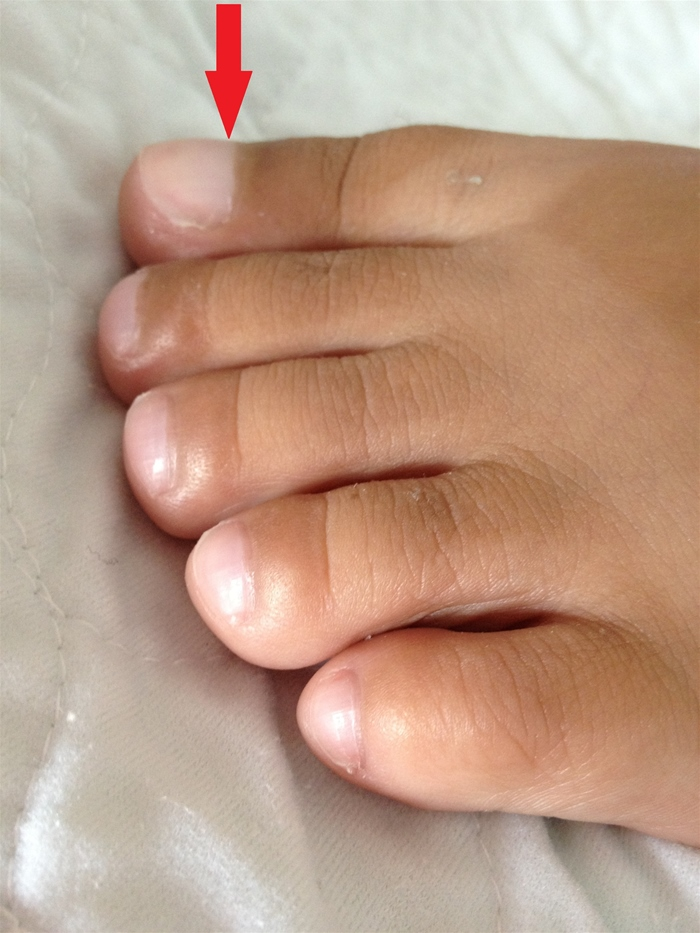
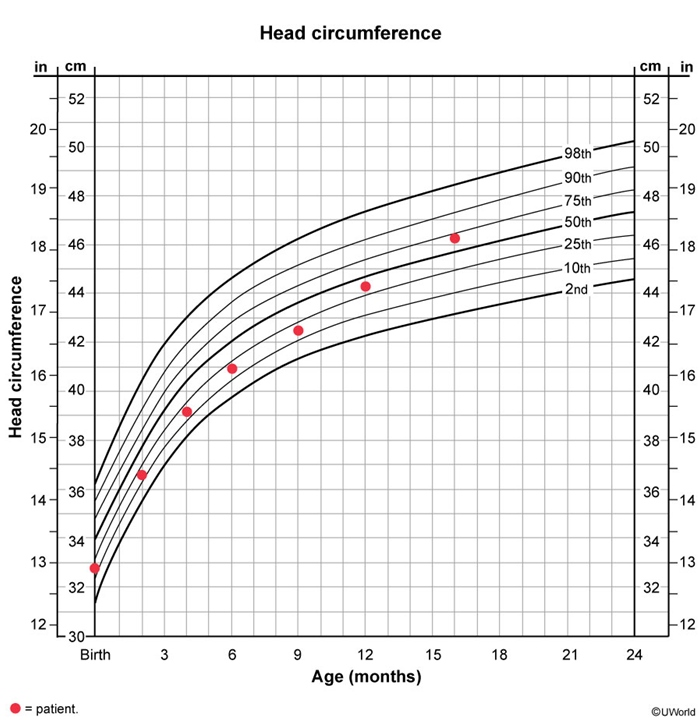 Which of the following is the most likely cause of this patient's presentation?
 (Multiple Choice)
4.9/5 (83)
(83) A 6-year-old girl is brought to the office by her parents after they noticed the development of axillary and pubic hair. She has also had a significant growth spurt over the past year. There has been no change in her behavior or school performance. The patient has no headaches, vomiting, or visual disturbances. She has no chronic medical conditions and takes no medications. Family history is unremarkable. BMI is at the 97th percentile for age and sex. The abdomen is soft, nontender, and nondistended. Axillary hair is present and pubic hair is Tanner stage 3; external genitalia are normal. The breasts are Tanner stage 3. Neurologic examination is normal. Bone age is advanced. Serum FSH and LH levels are elevated. Which of the following is the most likely etiology of this patient's symptoms?
(Multiple Choice)
4.9/5 (69)
(69) A 30-year-old woman comes to the office due to increasing muscle weakness. The patient has not been able to grip her coffee mug or open jars due to weakness in her hands. She has also had some loss of sensation in the upper extremities that has caused her to cut herself while doing craft projects. The patient was in a motor vehicle collision 7 years ago in which she sustained a whiplash cervical spine injury. She has no other medical conditions. BMI is 22 kg/m2. Physical examination reveals moderate wasting of the small muscles of the hand. Bilateral upper extremities have impaired pain and temperature sensation. Light touch, vibration, and position senses are all intact. Which of the following is the most likely diagnosis in this patient?
(Multiple Choice)
4.8/5 (73)
(73) A 14-year-old girl is brought to the emergency department after throwing a notebook at her teacher, rambling about "bats on the ceiling," and trying to run out of school. Medical history is significant for asthma, for which she uses albuterol as needed, and attention-deficit hyperactivity disorder, for which she takes extended-release mixed amphetamine salts on school days. There has been no recent change in the patient's medications. Family history is significant for Graves disease in her mother and schizophrenia in her maternal aunt. The patient says, "There are bats everywhere. They can hurt me now that all sorts are involved." She is alert but appears fearful and distracted and makes poor eye contact. Her father says that this behavior is uncharacteristic but that she has been behaving "oddly" for a few days, sleeping poorly, appearing anxious, and staring at her bedroom walls. Several weeks ago, the patient started missing multiple days of school and did not want to go out with friends, saying that her joints hurt too much. She has also recently experienced headaches and poor concentration. Temperature is 37.2 C (99 F), blood pressure is 110/70 mm Hg, pulse is 98/min, and respirations are 18/min. Laboratory results are as follows: 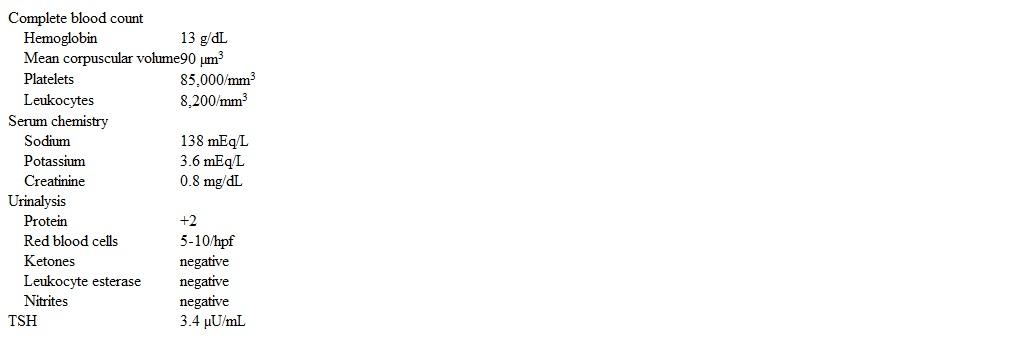 Urine and blood toxicology are negative. Which of the following is the most appropriate next step in management of this patient?
 (Multiple Choice)
5.0/5 (72)
(72) A 13-year-old girl is brought to the office by her mother due to abdominal pain. The mother says, "She's had occasional stomachaches for the last few weeks. I thought it was just menstrual cramps, but she has started skipping meals and looks like she is losing weight." Her mother also reports that the patient has become increasingly irritable, locking herself in her bedroom and coming out only to watch television. The patient says that her mother is "freaking out about nothing" and that she feels "fine." She denies nausea, vomiting, or a change in eating or bowel habits. Medical history is significant for seasonal allergies treated with loratadine as needed. Vital signs are within normal limits. A 5-kg (11-lb) weight loss is noted since her last visit 6 months ago. Physical examination is significant for a flaky, eczematous rash around the mouth involving the nasolabial folds. The abdomen is soft and flat with no tenderness to palpation. A bilateral hand tremor is noted, and further neurological examination shows globally decreased reflexes. Which of the following is the most likely explanation for this patient's presentation?
(Multiple Choice)
4.9/5 (82)
(82) A 1-month-old girl is brought to the office due to a large birthmark on the right side of the face and scalp. The lesion has become raised and increasingly bright red. There is no bleeding or oozing. Vital signs and growth parameters are normal. The lesion is shown in the exhibit;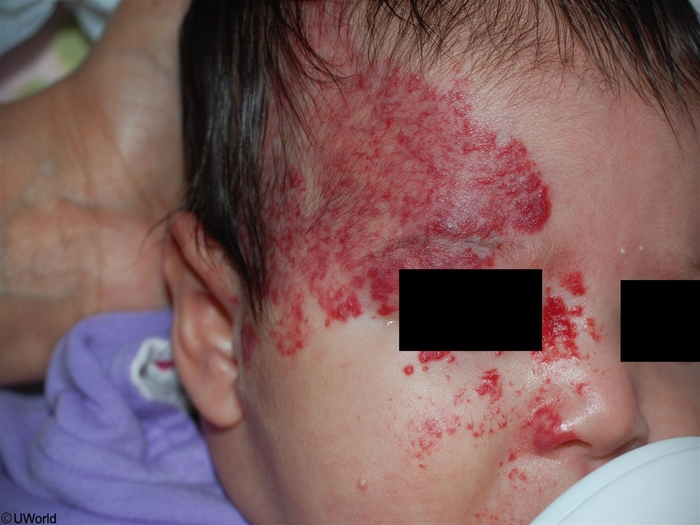 examination is otherwise unremarkable. MRI of the head and echocardiography reveal no abnormalities. Which of the following is the most appropriate therapy for this patient?
 (Multiple Choice)
4.9/5 (71)
(71) A 4-year-old boy is brought to the office by his mother for a routine health maintenance visit. The patient has been toilet trained for 2 years. He sees a pediatric dentist every 6 months and has no dental caries. The boy's mother describes him as a picky eater. She states that he prefers to eat bananas, apples, and bread but dislikes vegetables, meat, and milk products. He participates in a weekly community soccer league. He had acute gastroenteritis twice during infancy, but has no chronic medical conditions and takes no medications. The boy lives with his mother, who is a single parent, and 2 older brothers. He attends preschool 5 days per week and is learning to write his name. His mother says that he is not a social child and prefers to play with his best friend or his brothers. Which of the following preventive health measures is most appropriate at this visit?
(Multiple Choice)
4.9/5 (78)
(78) A 1-year-old African American girl is brought to the office for routine evaluation. She is learning how to walk and says "mama" and "dada." She recently transitioned from breast milk to cow's milk. Review of systems is negative. Both parents have sickle cell trait and her sister has sickle cell disease. Her height and weight are appropriate for her age. Physical examination shows a well-appearing, well-nourished child with no abnormalities. Laboratory results are as follows: 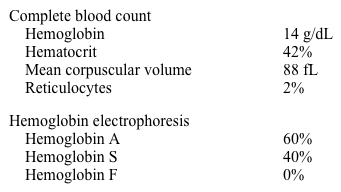 What is the most common complication of her condition?
 (Multiple Choice)
5.0/5 (89)
(89) A 12-year-old girl is brought to the office due to nasal congestion for the past 2 weeks. The nasal discharge has become thick and green, and fever started today. On physical examination, the patient has mucopurulent nasal drip and tenderness over the maxillae. The remainder of the examination is normal. Medical history includes 2 prolonged episodes of sinusitis this year and a recent episode of Giardia lamblia infection. The patient was hospitalized last year for Streptococcus pneumoniae bacteremia; prior to this, the patient was in good health. She has had asthma since age 3 but takes no medications other than bronchodilators as needed. Developmental milestones were achieved on time. Immunizations are up to date. Height and weight are currently at the 5th percentile for age. Laboratory results are as follows:  A diagnosis of acute sinusitis is made, and antibiotic therapy is initiated. Which of the following is important in long-term management of this patient?
 (Multiple Choice)
4.8/5 (75)
(75) A 4-year-old girl is brought to the office due to painful urination. For the past 2 days, the patient has cried during urination; only a small amount comes out each time. She has no vomiting, nausea, or fever. Medical history is unremarkable except for functional constipation since starting day care at age 2 and 3 episodes of cystitis in the past year. The patient completed a 3-day course of trimethoprim-sulfamethoxazole 6 weeks ago for the prior episode of cystitis. Temperature is 37.2 C (99 F), blood pressure is 98/56 mm Hg, and pulse is 110/min. On examination, the patient is not in acute distress. The suprapubic region is moderately tender to palpation. There is no back pain. Genitalia are normal. Anal fissures are present at the 12 o'clock and 2 o'clock positions. Rectal examination shows normal tone and hard stool in the rectal vault. Urinalysis results are as follows: 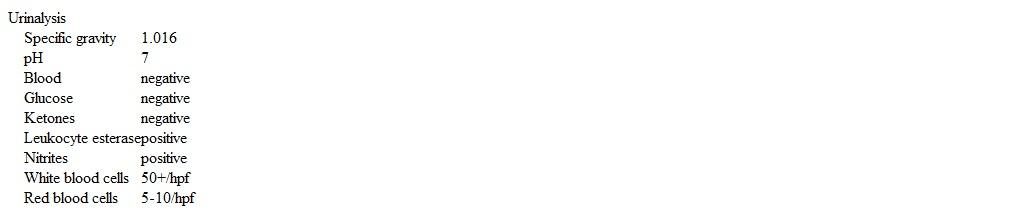 Urine culture shows 100,000 colonies of Escherichia coli. Which of the following most likely contributed to this patient's current illness?
 (Multiple Choice)
4.9/5 (77)
(77) A 14-year-old girl is brought to the emergency department due to progressive weakness in the lower limbs for 3 weeks. Her parents first noticed clumsiness, which has progressed to difficulty walking over the last week. The patient had a fever, cough, and congestion about 1 month ago and has otherwise been well. She has a history of high plantar arches requiring orthotics and mild scoliosis. The patient takes no medication and has no allergies. Her parents and 2 older siblings are healthy. Vital signs are normal. On examination, she has a wide-based gait and has difficulty maintaining balance without assistance. Strength is 2/5 in the lower extremities and 5/5 in the upper extremities. There is decreased vibratory and position sense in the lower extremities. MRI shows cervical spinal cord atrophy. When discussing the most likely diagnosis with the patient's parents, which of the following statements is most accurate?
(Multiple Choice)
4.9/5 (73)
(73) A 12-year-old boy is brought to the emergency department by his parents due to bilateral eye pain. The patient and his family are on a ski vacation, and he had played in the snow all day. Over the past hour, the patient has had progressively worsening pain in both eyes. Temperature is 37.2 C (99 F). Visual acuity is 20/40 in both eyes. Extraocular movements are intact, and pupils are reactive bilaterally. There is no tenderness to palpation. Bilateral conjunctivae are erythematous with increased tearing of both eyes. The anterior chamber appears normal. Fluorescein examination reveals diffuse punctate corneal staining bilaterally. Which of the following most likely contributed to this patient's presentation?
(Multiple Choice)
4.8/5 (77)
(77) A 4-year-old boy is brought to the office due to bedwetting. Toilet-training was initiated at age 2 when he learned the words "pee" and "poop." His parents are concerned that the boy still urinates in his bed at least 1 night a week despite avoiding fluid intake 2 hours prior to bedtime. The patient's older sisters were toilet-trained during the day and night by age 3. He has a soft bowel movement in the toilet every day. The boy is active and plays outside for at least an hour a day. He has no medical problems and takes no medications. Physical examination shows a well-nourished, talkative boy. There is no sacral dimple or hair tuft. Testes are descended bilaterally, and the urethral meatus is at the tip of the glans. He can hop on each foot for a few seconds. He identifies the colors of "pee" and "poop" as yellow and brown, respectively. What is the best next step in management of this patient?
(Multiple Choice)
4.9/5 (89)
(89) A 17-year-old girl is brought to the clinic due to headaches and daytime sleepiness. Six weeks ago, the patient was involved in a motor vehicle collision. She was driving her car when she was hit by another car on the passenger side. The patient hit her head on the window and briefly lost consciousness. She was taken to the emergency department, where CT scan of the head was normal. The patient was diagnosed with a concussion and discharged. She rested at home for 2 days before returning to school. The patient has been eager to participate in class but has a dull headache when reading. The headache is worsened with loud noises. She also has felt sleepy in class and has had difficulty falling asleep at night. The patient has no medical conditions and takes no medications. Temperature is 37.3 C (99.1 F), blood pressure is 115/75 mm Hg, and pulse is 70/min. Pupils are equal and reactive. Cranial nerves II-XII are grossly intact. The neck is supple. Strength, sensations, and reflexes are equal. Gait is normal. Which of the following is the best next step in management of this patient?
(Multiple Choice)
4.9/5 (72)
(72) A 4-year-old boy is brought to the clinic for evaluation of fever and pain with urination. The fever began yesterday morning, and in the evening the patient would cry while urinating. Ibuprofen improved his fever and pain, but he began to vomit this morning. Medical history includes a febrile urinary tract infection at age 13 months that resolved after a course of antibiotics. At that time, a renal and bladder ultrasound was normal. Temperature is 39.1 C (102.4 F). Palpation elicits suprapubic and right-sided costovertebral angle tenderness. Urinalysis reveals positive nitrites and leukocyte esterase. A urine culture shows >100,000 colony-forming units/mL of Escherichia coli. The patient is given antibiotics, and his symptoms resolve in 24 hours. A repeat renal and bladder ultrasound is normal. Which of the following is the best next step in management of this patient?
(Multiple Choice)
4.9/5 (75)
(75) Which of the following should be administered to this patient?
(Multiple Choice)
5.0/5 (69)
(69) An 18-year-old woman comes to the office due to recurrent headaches. In the past, the patient has had occasional headaches, especially during term exams or other stressful situations. However, over the past 3 months, she has had 4 episodes of severe headache. They are always left sided, throbbing, associated with nausea, and spontaneously resolve after 12-24 hours. The patient also reports feelings of numbness and tingling in her extremities prior to the headaches. She has no chronic medical conditions and underwent an appendectomy several years ago. The patient is sexually active with her boyfriend and began taking combined oral contraceptives 6 months ago. Vital signs are within normal limits. Physical examination, including neurological examination, shows no abnormalities. Which of the following is the best next step in management of this patient?
(Multiple Choice)
4.9/5 (69)
(69) 
Filters
- Essay(0)
- Multiple Choice(0)
- Short Answer(0)
- True False(0)
- Matching(0)