



 Chat with AI
Exam 2: Pediatric

Exam 1: Medicine2 k Questions
Exam 2: Pediatric723 Questions
Exam 3: Psychiatry336 Questions
Exam 4: Surgery563 Questions
Exam 5: Obstetrics & Gynecology469 Questions
Select questions type


A 16-year-old boy is brought to the clinic due to decreased vision. The patient has noticed some blurriness in his right eye for a few months, and it was confirmed during a vision test when he tried to obtain his driver's license last week. He has no chronic medical conditions. His mother had surgery last year to remove an adrenal tumor. Temperature is 37.1 C (98.8 F), blood pressure is 110/72 mm Hg, pulse is 90/min, and respirations are 20/min. Visual acuity shows 20/60 in the right eye and 20/30 in the left eye. Dilated funduscopic examination of the right eye shows a yellow tumor with tortuous vessels and optic disc edema, findings consistent with retinal hemangioblastoma. In the left eye, there is a smaller lesion along the temporal side of the retina. Skin examination shows a 4-cm, light brown patch on the left lower eyelid extending to the left cheek. Examination is otherwise unremarkable. Which of the following is the most likely diagnosis in this patient?
(Multiple Choice)
4.7/5  (81)
(81) A 16-year-old girl comes to the office for an initial patient visit. Medical conditions include asthma and mild acne. The patient maintains a B+ average at school. She does not smoke or use illicit drugs regularly but has tried alcohol and marijuana at parties a few times. She is not sexually active. When asked about extracurricular activities, the patient confides that she is thinking about quitting her high school softball team because "the other girls are mean, and I just don't enjoy playing anymore." When asked to describe how she feels, she hesitantly mentions that she gets depressed at times and frequently feels self-conscious and that no one likes her. The patient appears uncomfortable and nervously asks the physician. "You won't say anything about this to my parents, will you?" Which of the following is the most appropriate response to the patient?
(Multiple Choice)
4.7/5 (71)
(71) A 15-year-old girl is brought to an urgent care clinic for evaluation of a headache that began 12 hours ago. Yesterday, the patient underwent a tonsillectomy and adenoidectomy for obstructive sleep apnea. The surgery was uncomplicated, and she was discharged home last evening. The patient has been sipping clear fluids and taking acetaminophen every 4-6 hours. However, she developed a dull, left-sided headache before falling asleep last night and woke this morning with throbbing pain near her left temple. The headache is similar in quality to those she has experienced since age 12. Vital signs are normal. BMI is 31 kg/m2. The patient appears uncomfortable and holds her head in her hands but is alert and oriented. Cranial nerves II-XII are intact. Photophobia is present, and funduscopic examination is normal. Oropharyngeal examination reveals bilateral fibrin clots coating the tonsillar fossae, findings consistent with a normal postoperative course. Cardiopulmonary examination is normal. Neurologic examination shows normal tone, strength, and gait. Which of the following is the best next step in management of this patient?
(Multiple Choice)
4.9/5 (109)
(109) A 63-year-old man comes to the office due to a 3-year history of tremor. The tremor initially started in the left hand but over the last 6 months has progressed to involve both hands. The patient is a professional illustrator for a marketing agency and has been having difficulty performing at his job due to constant shaking. His other medical condition includes asthma, for which he uses albuterol and fluticasone inhalers. Vital signs are normal. Examination reveals a moderate tremor with hands outstretched; the tremor worsens during finger-to-nose testing. Muscle tone, gait, and limb coordination are normal. Serum TSH is normal. Which of the following is the most appropriate treatment for this patient?
(Multiple Choice)
4.8/5 (78)
(78) A 65-year-old, right-handed man comes to the emergency department due to sudden-onset, right-sided weakness. The patient was watching television an hour ago, when his family noted that his face appeared "twisted." He also experienced weakness of his right arm and leg but no headache, nausea, vomiting, or loss of consciousness. The patient has a history of hypertension and is nonadherent with medications. He is a former smoker with a 20-pack-year history. Temperature is 36.7 C (98.1 F), blood pressure is 164/72 mm Hg, pulse is 65/min, and respirations are 14/min. Physical examination shows weakness of the right lower face and right upper and lower extremities. Pupillary reflexes, ocular movements, and visual field testing are normal bilaterally. Speech is without aphasia, and the patient correctly names his left and right arms. Sensory examination is normal throughout. Noncontrast CT scan of the head reveals no intracranial bleeding. Which of the following is the most likely site of a lesion in this patient?
(Multiple Choice)
4.8/5 (82)
(82) A 5-year-old boy is brought to the emergency department by his parents due to fever and knee pain. The patient was diagnosed with streptococcal pharyngitis 2 weeks ago and treated with a 10-day course of amoxicillin. Two days ago, he developed fever and fatigue and started eating and drinking less than usual. Today, he cries every time he bends his right knee, and he refuses to walk. Temperature is 39.4 C (102.9 F). On examination, the patient appears tired but alert and is reading a book with his father. The right knee is swollen and tender to palpation. The patient holds the knee in a flexed position and has pain with passive range of motion. Laboratory results are as follows:  X-ray of the right knee shows joint effusion and soft tissue swelling. Which of the following is the best next step in management of this patient?
 (Multiple Choice)
4.8/5 (66)
(66) A 7-year-old boy is brought to the office by his parents due to 2 days of sore throat, poor appetite, and malaise. Several classmates have missed school due to similar symptoms. The patient has no cough, rhinorrhea, or nasal congestion. He takes no daily medications and has no known allergies. Immunizations are up to date. Temperature is 38.9 C (102 F), blood pressure is 110/70 mm Hg, pulse is 130/min, and respirations are 16/min. On examination, the tonsils are swollen and covered with thin, white exudates. Small, tender anterior cervical lymph nodes are palpated. Rapid streptococcal antigen detection testing is negative. Which of the following is the most appropriate next step in management of this patient?
(Multiple Choice)
4.8/5 (77)
(77) A 7-year-old boy is brought to the office for a follow-up visit after orchiopexy last week. The patient was recently adopted and, at his well child check a month ago, was diagnosed with an undescended left testicle that was palpable in the inguinal canal. The surgery was uncomplicated, and he is doing well. The patient is otherwise healthy and takes no medications. Height and weight are at the 40th and 50th percentiles, respectively. Physical examination shows a well-nourished boy. Abdomen is soft, nontender, and nondistended. The penis is circumcised, and the meatal opening is at the tip of the phallus. Both testes are palpable in the scrotum. Healing surgical scars are present in the groin. Compared to the general population, this patient is at an increased risk for which of the following conditions?
(Multiple Choice)
4.8/5 (96)
(96) A 1-day-old boy is admitted to the neonatal intensive care unit due to macrocephaly and jaundice. The patient was born by spontaneous vaginal delivery at 41 weeks gestation to a 38-year-old woman, gravida 4 para 3 (2 live vaginal births and a first-trimester miscarriage), who had consistent prenatal care. The mother traveled to central Africa during the first trimester. While there, she developed fever that lasted 2 weeks along with swollen lymph nodes and muscle aches that resolved spontaneously. The patient's weight and length are at the 25th percentile; head circumference is above the 97th percentile. Vital signs are normal. Diffuse jaundice is noted on examination. The liver is palpable 4 cm below the costal margin. Heart and lung sounds are normal on auscultation. CT scan of the head reveals hydrocephalus and diffuse intracranial calcifications. Laboratory results include total bilirubin 7.2 mg/dL and direct bilirubin 5.5 mg/dL. Which of the following maternal exposures most likely resulted in this patient's condition?
(Multiple Choice)
4.9/5 (80)
(80) A 3-year-old boy is brought to the office due to nasal discharge for the past 2 weeks. His mother reports whitish nasal discharge that has become progressively thicker and more malodorous. The patient has had no fever, cough, or shortness of breath. He is eating normally. Medical history includes congenitally acquired HIV, and the patient has taken antiretroviral therapy since birth. Three months ago, CD4 cell count was 520/mm3. He has received all age-appropriate vaccinations. The patient lives with his parents, 6-year-old brother, and a pet dog. His father smokes cigarettes outside of the house. Growth parameters are at the 40th percentile for age. On examination, the patient is playful and interactive. There is purulent drainage from the right nostril, and the right nasal mucosa and turbinates are erythematous and swollen. There is no discharge from the left side, and the left turbinates are pink and nonedematous. The oropharynx and tonsils are normal. There is no cervical lymphadenopathy. Which of the following is the most likely cause of this patient's current symptoms?
(Multiple Choice)
4.9/5 (79)
(79) A 5-month-old boy is brought to the emergency department with a 2-day history of projectile vomiting, diarrhea, and an episode of generalized tonic-clonic seizure activity just prior to arrival. He has been exclusively formula-fed since birth. He was born at 39 weeks gestation and had a "natural birth" at home. The pregnancy and delivery were uncomplicated. The boy did not undergo newborn screening due to parental preferences. His parents and 4-year-old sister are all healthy. One of his maternal uncles is intellectually disabled and lives in a long-term care facility. The boy's weight, height, and head circumference are at the 10th percentile. Physical examination shows fair hair and skin, blue eyes, an eczematous rash, and mild dehydration. His urine has a musty odor. Which of the following is the most appropriate diagnostic test for this patient's condition?
(Multiple Choice)
4.8/5 (76)
(76) A 4-year-old girl is diagnosed with Bordetella pertussis infection after an outbreak at her day care center. She has paroxysmal coughing fits and is prescribed a course of macrolide antibiotics. The patient lives with her 30-year-old parents and 1-year-old sister. Her family members have up-to-date immunizations and are asymptomatic. Which of the following is the most appropriate way to limit the immediate risk of infection in household contacts?
(Multiple Choice)
4.9/5 (69)
(69) An 18-month-old girl is brought to the office by her parents due to difficulty breathing. The patient has had a runny nose and congestion since yesterday. Coughing started last night and has worsened throughout the day. The patient is drinking fluids and voiding is normal. She was hospitalized at age 4 months for bronchiolitis and had a recent urgent care visit after putting a bead in her nose. The patient takes no daily medications and vaccinations are up to date. Temperature is 37.8 C (100 F), blood pressure is 90/60 mm Hg, and respirations are 30/min. Pulse oximetry is 97% on room air. During examination, the patient coughs and cries but is easily consoled. The cough is harsh, and inspiratory stridor is heard when she is crying but resolves at rest. The lungs are clear to auscultation. Which of the following is the most likely cause of the patient's symptoms?
(Multiple Choice)
4.9/5 (81)
(81) A couple who is expecting a first child comes to the office to discuss circumcision. They recently learned that the baby is a boy, but they have not decided whether to have him circumcised. The father says that he is circumcised and had expected his son would also be. However, the mother says one of her closest friends thinks circumcision is "barbaric." The couple wants to know the health implications of neonatal circumcision. Which of the following is the most appropriate response?
(Multiple Choice)
4.7/5 (72)
(72) A 4-year-old girl is brought to the clinic due to swelling on the neck. The mother first felt a few lumps on the patient's neck 2 days ago while brushing her hair. Their size has not changed. The patient has had no recent fever, cough, rhinorrhea, or sore throat. She goes to preschool. The family has not traveled outside of the United States. Temperature is 36.6 C (97.9 F), blood pressure is 94/66 mm Hg, pulse is 78/min, and respirations are 14/min. Physical examination shows several nontender, soft, mobile, subcentimeter anterior cervical lymph nodes bilaterally. The oropharynx is clear and cardiopulmonary examination is normal. There is no hepatosplenomegaly. The remainder of the examination is unremarkable. Which of the following is the best next step in management of this patient's examination findings?
(Multiple Choice)
4.9/5 (103)
(103) A 2-year-old girl is brought to the office by her mother, who noticed an abnormality in the genital area while changing her diaper. The patient has had multiple diaper rashes over the last 6 months but has had regular bowel movements and no dysuria or hematuria. She has no chronic medical conditions and no known allergies. Vital signs are normal. On pelvic examination, the labia minora appear thin, are fused together at the midline, and partially block the urethral meatus. Multiple excoriations are seen, but there is no rash or perianal involvement. No vaginal discharge is seen at the introitus. Internal pelvic examination is deferred. Which of the following is the most likely diagnosis in this patient?
(Multiple Choice)
4.7/5 (64)
(64) A 65-year-old man is evaluated for slowly progressive, right-hand clumsiness for several months. Medical history is significant for hypertension and end-stage renal disease, for which he undergoes hemodialysis 3 times a week. The patient is retired and not physically active. He does not use tobacco, alcohol, or illicit drugs. Blood pressure is 130/90 mm Hg and pulse is 80/min. BMI is 20 kg/m2. Examination shows decreased sensation over the 4th and 5th fingers of the right hand, along with a weaker grip and weaker hand flexion at the wrist compared to the left side. Overall muscle mass and tone are decreased in all four extremities. Which of the following is the most likely site of nerve injury?
(Multiple Choice)
4.8/5 (87)
(87) A 6-year-old girl with Down syndrome is brought to the clinic due to behavioral changes. Over the past month, she has stopped running, tripped frequently while walking, and accidentally knocked toys over more often than normal. The patient was toilet-trained at age 4, but recently she began having frequent urinary accidents while playing and has started wearing a diaper again. Physical examination shows an ataxic gait. Muscle tone is decreased throughout. Bilateral ankle deep tendon reflexes are hyperreflexic. When the soles of the feet are firmly stroked, the big toes move upward and the other toes fan out. Urinalysis is normal. Which of the following is the most likely cause of this patient's presentation?
(Multiple Choice)
4.9/5 (82)
(82) A 3-year-old boy is brought to the emergency department by his parents for evaluation of sudden-onset abnormal breathing and shortness of breath. Yesterday morning, the patient developed a runny nose. Over the past 12 hours, he developed a fever and has had difficulty breathing. Temperature is 40 C (104 F) and respirations are 48/min. Pulse oximetry shows 86% on room air. On physical examination, the patient appears anxious and is sitting up, leaning forward, and drooling. Inspiratory stridor and suprasternal retractions are present. His lips are mildly cyanotic. Which of the following is the best next step in management of this patient?
(Multiple Choice)
4.8/5 (80)
(80) A 3-year-old boy is brought to the emergency department due to abdominal pain. The pain began several hours ago and comes and goes. During these episodes, he holds his belly, screams, and draws up his legs. He has had nonbloody, nonbilious vomiting 3 times since the last painful episode. Between the episodes, the patient has no pain and is playful. His last bowel movement was yesterday and was normal. Two weeks ago, he had gastroenteritis that resolved after 3 days. He otherwise has no chronic medical conditions and takes no medications. Temperature is 37.2 C (99 F), blood pressure is 95/50 mm Hg, and pulse is 100/min. Abdominal examination shows a soft abdomen that is tender with voluntary guarding to palpation at the right upper and lower quadrants. Rectal examination reveals no fissures or hemorrhoids. The remainder of the examination is normal. Ultrasound of the abdomen is shown in the image below: 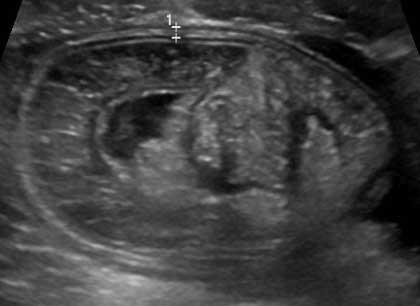 Which of the following is the best next step in management of this patient?
 (Multiple Choice)
4.8/5 (94)
(94) 
Filters
- Essay(0)
- Multiple Choice(0)
- Short Answer(0)
- True False(0)
- Matching(0)