



 Chat with AI
Exam 2: Pediatric

Exam 1: Medicine2 k Questions
Exam 2: Pediatric723 Questions
Exam 3: Psychiatry336 Questions
Exam 4: Surgery563 Questions
Exam 5: Obstetrics & Gynecology469 Questions
Select questions type


A 62-year-old woman comes to the emergency department feeling "dizzy." While at a grocery store today, the patient was looking up at a high shelf when she suddenly experienced a spinning sensation accompanied by nausea. She closed her eyes and sat down in the aisle, and the symptoms resolved after about a minute. The patient has had no headache, earache, tinnitus, or hearing impairment. The symptoms recurred 30 minutes later when she bent down to get into her car. Currently, she feels well and has no symptoms. Medical history is significant for hypertension, hyperlipidemia, and type 2 diabetes mellitus. She previously smoked a pack of cigarettes a day but quit 10 years ago. Which of the following is most likely to reveal the underlying cause of this patient's symptoms?
(Multiple Choice)
4.9/5  (72)
(72) A 32-year-old man comes to the office due to excessive sleepiness for the past several months. He says, "I am very worried that I will lose my job. I feel like napping all the time and once fell asleep while talking with a customer. The other day, I nearly had an accident when I fell asleep while driving." The patient is also concerned that he occasionally hears voices while falling asleep and finds himself "temporarily frozen" and unable to move on awakening. He has a history of hypertension controlled with hydrochlorothiazide. His family history is noncontributory. The patient does not smoke cigarettes or drink alcohol but does smoke marijuana a few times a month. Physical examination is remarkable for obesity and no other abnormalities. Which of the following is the most appropriate treatment for this patient?
(Multiple Choice)
5.0/5 (92)
(92) A 2-year-old boy is brought to the office due to fever, cough, and irritability lasting 3 days. Medical history is significant for a perirectal abscess that was drained at age 9 months. Temperature is 38.9 C (102 F), blood pressure is 100/70 mm Hg, pulse is 124/min, and respirations are 24/min. Eyes, ears, nose, and throat examinations are normal. Bilateral patchy crackles are auscultated in the lower lobes. Chest x-ray confirms bilateral focal pneumonia. The patient receives empiric antibiotic therapy; however, he is persistently febrile after 3 days. CT scan of the chest reveals a small, left pleural effusion and enlarged paratracheal and hilar lymphadenopathy, in addition to the bilateral pneumonia. Fine-needle biopsy of the lymph nodes and lung tissue shows an inflammatory reaction with granuloma formation. Biopsy cultures grow Burkholderia (Pseudomonas) cepacia. What is the mechanism most likely responsible for this patient's current infection?
(Multiple Choice)
4.9/5 (81)
(81) A 1-month-old boy is brought to the office for evaluation of blood-streaked stools. The patient was born at full term via spontaneous vaginal delivery and has been breastfed exclusively. The mother says he usually has 5 yellow, seedy stools daily, but over the past 3 days they have become loose and streaked with blood and mucus. The infant nurses every 2-3 hours but spits up a small amount of breast milk with every feed. The mother recently completed a course of antibiotics for mastitis but otherwise takes no daily medications and has a regular diet. The patient's weight, length, and head circumference have been tracking along the 40th percentile. Vital signs are normal. The infant appears well. The abdomen is soft and nontender. No fissures are noted on anal examination. A fecal occult blood test is positive. Which of the following is the most likely cause of this patient's condition?
(Multiple Choice)
5.0/5 (77)
(77) A 3-month-old girl is brought to the clinic by her father due to fever and fussiness. A fever developed in the patient 2 days ago, and she has been receiving scheduled acetaminophen. The fever initially improved after medication administration but returned several hours later. Now, the patient does not want to feed and is not finishing her bottles but has had no vomiting. She has no rhinorrhea, cough, or congestion. The patient was born at term and had no complications. She has intermittent constipation for which she takes prune juice. Immunizations are up to date. Temperature is 39.4 C (102.9 F) and pulse is 160/min. Examination shows a tired-appearing girl. The fontanel is open and flat. Tympanic membranes are clear with normal bony landmarks. There are no exudates in the posterior oropharynx. The lungs are clear to auscultation bilaterally. The abdomen is soft and bowel sounds are present, but the girl cries during palpation of the lower abdomen. Which of the following is the best next step in management of this patient?
(Multiple Choice)
4.8/5 (85)
(85) A 3-year-old girl is brought to the office for a health supervision examination. The patient has met developmental milestones appropriately and is up to date on immunizations. Temperature is 36.6 C (97.9 F), blood pressure is 156/96 mm Hg, and pulse is 100/min. She appears well nourished. On abdominal palpation, there is mild tenderness in the right lower and upper quadrants and a palpable mass in the right abdomen. Ultrasound reveals a 12-cm, heterogenous, solitary mass arising from the upper pole of the right kidney. Which of the following is the most likely diagnosis for this patient?
(Multiple Choice)
4.8/5 (90)
(90) A 16-year-old girl is brought to the clinic for evaluation of fatigue. The symptoms began about 6 months ago. She has had no fever, cough, vomiting, diarrhea, weight loss, or depressed mood. The patient is doing well in school. She also reports intermittent pain in her arms and legs over the past 2 years. The patient has no significant medical history and takes no medications. She was adopted at age 3, and her family history is unknown. Height and weight are at the 5th percentile for age. Temperature is 36.7 C (98.1 F), blood pressure is 110/70 mm Hg, pulse is 78/min, and respirations are 14/min. There is no nasal congestion, and the oropharynx appears normal. Cardiac examination shows normal S1 and S2 without murmurs. The lungs are clear without wheezing or crackles. The abdomen is soft and nontender. The liver is palpable 4 cm below the right costal margin, and the spleen is palpable 10 cm below the left costal margin. Skin examination shows no rashes or jaundice. Lymph nodes appear unremarkable. Pubic hair and breast development are consistent with Tanner stage 1. Laboratory results are as follows:  Which of the following is the most likely diagnosis in this patient?
 (Multiple Choice)
4.9/5 (84)
(84) A 31-year-old woman comes to the office due to vision disturbances. The patient is a software developer and works on a computer most of the time. She first noticed blurry vision 2 months ago. Since then, she has had several episodes of blurry and double vision, especially toward the end of the workday. Two days ago, she experienced neck discomfort and had difficulty holding her head up, which resolved after a night's rest. The patient does not use tobacco, alcohol, or illicit drugs. Vital signs are within normal limits. On physical examination, pupils are 3 mm, round, and reactive to light. There is no ptosis, and ocular movements are normal. No neck deformity or tenderness is present. Muscle strength, deep tendon reflexes, and sensation are normal in the bilateral upper and lower extremities. Further evaluation reveals antibodies directed against nicotinic receptors on the motor endplate. Which of the following is the most appropriate next step in evaluation of this patient?
(Multiple Choice)
5.0/5 (80)
(80) A 14-year-old girl is brought to the clinic for a routine well-child visit. The girl has been healthy and her only concern is that she has not yet had a menstrual period. Most of her friends have undergone menarche, and she wants to know when she will start menstruating. She wears corrective glasses for myopia. Her father is 190.5 cm (6 ft 3 in) tall, and her mother is 183 cm (6 ft) tall. On examination, the patient's height and weight are at the 5th and 55th percentiles, respectively. Blood pressure is 140/90 mm Hg in the right upper arm and 90/40 mm Hg in the lower extremities. Multiple pigmented nevi are scattered on the face and chest. Which of the following complications is this patient most at risk of developing?
(Multiple Choice)
4.8/5 (71)
(71) A 14-month-old boy is admitted to the hospital for treatment of pneumonia. The patient has a fever, cough, and labored breathing. He has had 3 episodes of bronchiolitis during infancy and an episode of pneumococcal pneumonia 2 months ago that required intubation and hospitalization in the intensive care unit. The patient also has a history of recurrent otitis media. He takes no medications, and vaccinations are up to date. Weight is 7 kg (15 lb 7 oz, <3rd percentile). Temperature is 39.6 C (103.3 F), blood pressure is 90/50 mm Hg, pulse is 128/min, and respirations are 38/min. On examination, the patient appears listless and is in mild respiratory distress. Bilateral ear canals contain purulent drainage. Crackles are heard in the left lung base. Laboratory results are as follows: 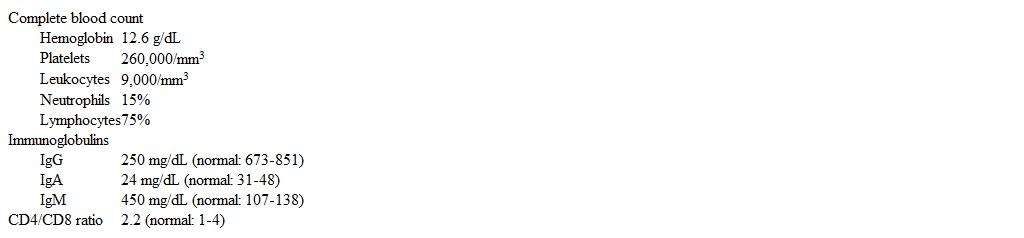 Which of the following is the most likely diagnosis in this patient?
 (Multiple Choice)
4.7/5 (82)
(82) A 60-year-old man is brought to the emergency department after he was found unresponsive at the bottom of a stairwell. Upon arrival, the patient is hemodynamically stable but has a Glasgow coma score of 7. There are no other obvious injuries. CT scan of the head reveals no skull fractures or large hematoma. The patient is intubated for airway protection. His mentation does not improve over the next several hours, and diffuse axonal injury is suspected. Which of the following neuroimaging findings is most suggestive of this patient's diagnosis?
(Multiple Choice)
4.7/5 (76)
(76) A 5-month-old boy is brought to the clinic due to fussiness and fever for 2 days. His medical history is significant for previous episodes of otitis media, oral candidiasis, and gastroenteritis due to rotavirus. The patient is at the third percentile for weight. His temperature is 39.3 C (102.8 F), pulse is 120/min, respiratory rate is 28/min, and blood pressure is 80/60 mm Hg. Physical examination shows an erythematous, bulging right tympanic membrane with poor mobility on pneumatic otoscopy. The lymph nodes are not palpable, and the tonsils are not visualized. Laboratory results are as follows: 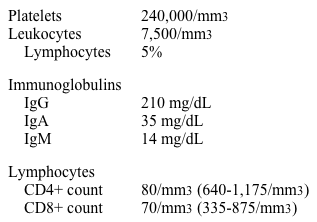 Which of the following is the most likely etiology of this patient's condition?
 (Multiple Choice)
4.8/5 (62)
(62) A 15-month-old boy is brought to the emergency department due to irritability and vomiting. His parents say that the patient was more tired than usual yesterday and went to bed early. This morning, he awoke crying and has been inconsolable. His mother attempted to feed him, but he has vomited twice today. Three weeks ago, the patient had similar symptoms and was admitted to the hospital and diagnosed with enteroviral meningitis. He has a history of 2 episodes of pneumonia requiring hospitalization as an infant. Temperature is 40.1 C (104.2 F). On examination, the patient is awake but crying and inconsolable in his mother's arms. Heart and lung examinations are unremarkable, and the abdomen is soft. There is a diffuse macular rash over the trunk. Lumbar puncture results are as follows:  Gram stain reveals no organisms. The patient is suspected to have chronic viral meningitis. Which of the following additional findings is most likely to be found in this patient?
 (Multiple Choice)
4.9/5 (89)
(89) A 1-year-old boy is brought to the emergency department for evaluation of a nosebleed that has been difficult to control. Since last week, the patient has had bouts of epistaxis that occurred with minimal trauma. His parents were previously able to control the bleeding episodes by pinching the nose and using ice, but this has not stopped the bleeding today. Temperature is 37.2 C (99 F) and pulse is 160/min. Examination shows an alert child who is well developed, anicteric, and pale. Examination of the nares shows slow, steady blood flow from the left anterior nasal septum. Cardiac examination reveals tachycardia. The abdomen is soft, nontender, and without hepatosplenomegaly. The skin has multiple ecchymoses over the left shoulder and bilateral lower extremities and many petechiae in the groin. Laboratory studies are as follows:  Peripheral smear reveals morphologically normal-appearing leukocytes, erythrocytes, and platelets. Which of the following is the most likely cause of this patient's bleeding?
 (Multiple Choice)
4.8/5 (77)
(77) A 2-day-old girl develops seizures and a bulging anterior fontanelle. Temperature is 36.8 C (98.2 F), pulse is 180/min, and capillary refill is >4 seconds. Cardiac examination reveals tachycardia. Neurologic examination shows rhythmic contractions of the upper extremities, tongue thrusting, and lip smacking. Head ultrasound is shown below: 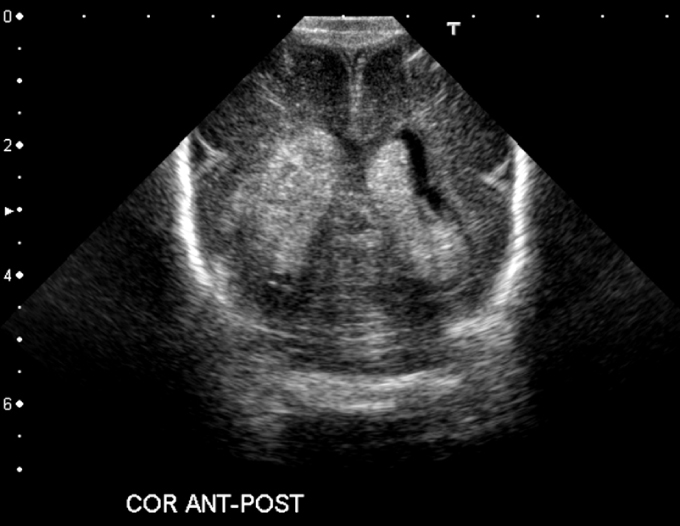 Which of the following conditions most likely led to this patient's condition?
 (Multiple Choice)
4.9/5 (81)
(81) A 5-day-old girl is brought to the emergency department due to fussiness. The patient was born at home to a 36-year-old woman, gravida 5 para 5, via spontaneous vaginal delivery. The mother received no prenatal care. The newborn has been breastfeeding exclusively and has had nonbloody, nonbilious vomiting after feeds for the past day. Head circumference and length are at the 50th percentile. Weight is at the 20th percentile. Temperature is 37.2 C (99 F) and pulse is 180/min. The newborn has poor tone and is jaundiced. The anterior fontanelle is sunken with overriding sutures. Eye examination shows bilateral cataracts. Ears are in the normal position, and the palate is intact with a normal tongue. Cardiopulmonary examination is normal. The liver is palpable 4 cm below the costal margin. Which of the following is the most likely cause of this newborn's presentation?
(Multiple Choice)
4.9/5 (64)
(64) A 17-year-old boy comes to the office before participating in long-distance running. The patient has a 2-year history of type 1 diabetes mellitus and takes insulin glargine at bedtime and insulin lispro before meals. His home blood glucose levels range from 90 to 130 mg/dL, and he has had no episodes of hypoglycemia. The patient wants to run a marathon and has begun training recently. Physical examination is normal. Hemoglobin A1c is 6.5%. Which of the following is the most appropriate recommendation to manage his diabetes mellitus during long-distance training?
(Multiple Choice)
4.9/5 (80)
(80) A week-old boy is brought to the emergency department due to vomiting and poor feeding. His mother received appropriate prenatal care, and the full-term infant was delivered at home. Temperature is 36.7 C (98 F), blood pressure is 40/24 mm Hg, pulse is 164/min, and respirations are 46/min. Physical examination is notable for sunken eyes, a depressed anterior fontanelle, and dry mucous membranes. Capillary refill is 3 seconds, and skin turgor is decreased. No abdominal masses are noted. Genital examination shows a normal uncircumcised penis with bilateral testes palpable in the scrotum. Laboratory results are as follows:  Which of the following is most likely to be increased in this patient?
 (Multiple Choice)
4.9/5 (81)
(81) A 7-year-old boy is brought to the clinic by his mother for evaluation of rhinorrhea. Three days ago, the patient developed rhinorrhea and a cough that is worse at night. For the past day, he has had intermittent, mild pain around the upper cheeks, particularly when leaning forward. He had fever on the first day of illness but has been afebrile for 48 hours. The patient's appetite is decreased, but he is drinking fluids and voiding normally. He has no chronic medical conditions and takes no medication. Immunizations are up to date. Temperature is 37.6 C (99.7 F), pulse is 100/min, and respirations are 20/min. The patient is well-appearing and comfortable on examination. The tympanic membranes are clear. Nasal discharge is profuse and yellow-green in color. The posterior oropharynx is erythematous. Palpation over the upper cheeks bilaterally causes mild discomfort. Cardiopulmonary examination is unremarkable. The abdomen is soft with no organomegaly. Which of the following is the best next step in management of this patient?
(Multiple Choice)
5.0/5 (80)
(80) A 6-hour-old boy is in the newborn nursery with tachycardia. He was born at 40 weeks gestation to a 30-year-old woman with Graves' disease that was treated with surgical resection approximately 6 months before the pregnancy. Subsequently, the mother became mildly hypothyroid and was treated with levothyroxine during the pregnancy. The infant's weight is 2080 g (4 lb 9 oz) (<5th percentile), temperature is 37.2 C (99 F), and pulse is 190/min. Examination shows an irritable but consolable infant with warm, flushed skin. Which of the following is the most likely cause of this infant's condition?
(Multiple Choice)
4.7/5 (75)
(75) 
Filters
- Essay(0)
- Multiple Choice(0)
- Short Answer(0)
- True False(0)
- Matching(0)