



 Chat with AI
Exam 2: Pediatric

Exam 1: Medicine2 k Questions
Exam 2: Pediatric723 Questions
Exam 3: Psychiatry336 Questions
Exam 4: Surgery563 Questions
Exam 5: Obstetrics & Gynecology469 Questions
Select questions type


A 3-day-old girl is brought to the emergency department due to a day of copious, purulent eye drainage. She was born vaginally to a 31-year-old woman, gravida 3 para 3. The family declined routine prophylactic medications, including vitamin K, erythromycin ointment, and hepatitis B vaccination, for the newborn. The patient was discharged with her parents at 24 hours of life. She has been breastfeeding exclusively and voiding and stooling normally. Temperature is 36.8 C (98.2 F). Examination shows bilateral eyelid edema, conjunctival injection, and purulent discharge. The anterior fontanel is open, soft, and flat. The nares are patent, and the oral mucosa is clear without lesions or thrush. Auscultation reveals clear lungs bilaterally and no murmurs. The abdomen is soft, nontender, and nondistended, and the external genitalia appear normal with no discharge. Which of the following is the most likely diagnosis?
(Multiple Choice)
4.9/5  (89)
(89) A 16-year-old boy is brought to the emergency department due to 3 weeks of progressive shortness of breath during physical activity. The patient stopped playing golf 2 weeks ago after he became short of breath while walking the course. He also feels more tired and weaker than usual. The patient has had no rash, cough, chest pain, palpitations, dizziness, or fever. His medical history is notable for sickle cell disease; he has had a few hospitalizations for pain crises and an episode of acute chest syndrome. The most recent hospitalization was 6 months ago. The patient's only medication is oxycodone, which he takes intermittently for pain. Temperature is 36.7 C (98.1 F), blood pressure is 120/70 mm Hg, pulse is 120/min, and respirations are 18/min. Examination shows a tired-appearing but comfortable adolescent with conjunctival pallor. Laboratory results reveal:  Which of the following is the most likely underlying mechanism for this patient's laboratory findings?
 (Multiple Choice)
4.8/5 (68)
(68) A 4-month-old boy is brought to the clinic for a health supervision examination. The patient was born via cesarean delivery at 37 weeks gestation to a primigravid mother. He spent 1 week in the neonatal intensive care unit for management of hypoglycemia and poor feeding. The patient has had no significant issues since discharge and has been feeding well. He is currently at the 99th percentile for weight. On physical examination, the patient's tongue is enlarged, and the right leg is significantly larger in circumference than the left. The remainder of the examination is normal. In addition to routine vaccinations, which of the following is the best next step in management of this patient?
(Multiple Choice)
4.7/5 (73)
(73) A 5-year-old boy is brought to the office due to behavioral difficulties at school. His grandmother says, "This past year has not been easy for him, but he's been hitting other kids and breaking their toys." The patient was adopted by his grandmother a year ago after his parents died in a motor vehicle collision. He attends the same school but no longer wants to play with his friends or join group activities. The patient wakes up a few times a week, crying about monsters and asking to sleep in his grandmother's room. He can ride a bike and draw complex shapes. Vital signs are within normal limits, and he is tracking adequately on growth curves. Physical examination is unremarkable. The patient is restless and rams a toy truck into a stuffed animal repeatedly while his grandmother speaks. He makes poor eye contact and answers most questions by saying "I don't know" despite his grandmother's encouragement. Which of the following is the most likely diagnosis?
(Multiple Choice)
4.8/5 (75)
(75) A 12-year-old girl is brought to the clinic for evaluation of poor posture. She is an avid gymnast, and for the past couple of months, her coach has noticed that her shoulders seem uneven when she stands. The patient has had no back pain or trauma. She has no chronic medical conditions and has not undergone menarche. Her mother had scoliosis during adolescence but did not require treatment. BMI is at the 25th percentile. Vital signs are normal. Examination shows a right-sided rib rise with mild scapular prominence on forward bending. There is no tenderness along the spine, and neurologic examination is normal. The legs are equal in length. The patient has Tanner stage 3 development. Plain radiograph of the spine reveals right thoracic scoliosis with a Cobb angle consistent with mild scoliosis. Which of this patient's current findings is the greatest risk factor for curve progression?
(Multiple Choice)
4.9/5 (82)
(82) A 6-year-old girl is brought to the clinic for evaluation of knee pain. The patient first had soreness in her right knee 4 days ago, after her first gymnastics class. Her mother gave her acetaminophen and massaged her knee, but this did not help. The patient also developed a limp over the past 2 days. She has no chronic medical conditions and does not take daily medications. Height is at the 50th percentile and weight is at the 75th percentile. Temperature is 37.9 C (100.2 F). When walking, she limits weight-bearing on her right side. When supine, the right hip is held flexed with the knee pointed laterally. There is limited internal rotation and extension of the right hip. The right knee has full range of motion and there is no tenderness on palpation around the knee. Laboratory evaluation shows leukocyte count of 11,500/mm3 and C-reactive protein of 8 mg/L (normal: <10). Ultrasound of the hips shows small, bilateral effusions. Which of the following is the most likely diagnosis in this patient?
(Multiple Choice)
4.7/5 (74)
(74) A 4-month-old boy is brought to the clinic by his mother due to concerns of appearing pale. Over the past few days, he has been sleeping more than usual and is less interactive. The boy is exclusively breastfed, and he slept through two of his usual feeding sessions yesterday. He continues to have good urine output. The patient was born at 40 weeks gestation and had a normal nursery course. His mother's prenatal course was unremarkable. However, the patient's newborn screen revealed an extra band representing gamma tetramers on hemoglobin electrophoresis. The patient takes a vitamin D supplement daily. Vital signs are normal. He appears tired and has mild scleral icterus. The remainder of the examination shows no abnormalities. Laboratory evaluation of this patient would most likely show which of the following?
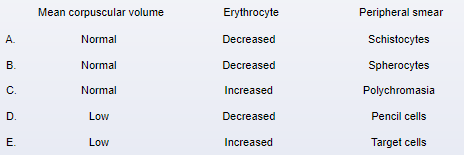
(Multiple Choice)
4.8/5 (78)
(78) A 5-year-old girl is brought to the office due to "wetting the bed." Since age 3, she had been urinating and stooling while on the toilet during the day and night, with no accidents. However, for the past 2 weeks, the patient has wet the bed nightly. She is also more thirsty than usual, urinates more often during the day, and has had accidents at school. Review of systems is positive for fatigue and negative for dysuria and hesitancy. The patient has had no major illnesses and has met all developmental milestones. A month ago, the family moved to a new house after her brother was born. Vital signs are normal. Weight and height are at the 20th and 40th percentile, respectively, but both were at the 40th percentile at her well-child visit 3 months ago. Physical examination shows a tired-appearing girl. Mucous membranes are dry. The rest of the examination is unremarkable. Which of the following is the most likely explanation for this patient's symptoms?
(Multiple Choice)
4.9/5 (71)
(71) A 4-month-old boy is brought to the office for follow-up after a recent urgent care visit to evaluate noisy breathing. The noisy breathing began shortly after birth and worsens when he cries or eats. He was given an inhaled bronchodilator and oral corticosteroid but there has been no improvement. The patient is fed cow's milk-based formula and feeding seems to tire him, so it takes about 40 minutes to finish each bottle. He has normal-appearing stools daily. The patient was born at 37 weeks via spontaneous vaginal delivery. He is at the 20th percentile for height and weight. He attends daycare, his parents are nonsmokers, and they have a cat. The patient is afebrile with normal vital signs. Physical examination shows biphasic stridor that is louder on exhalation. The stridor improves with extension of the neck but does not improve with prone positioning. There is no cough, rhinorrhea, or skin changes. Which of the following is the most likely cause of this patient's symptoms?
(Multiple Choice)
4.9/5 (89)
(89) A 28-year-old man with a history of spinal cord injury comes to the emergency department due to headache, restlessness, and excessive sweating for the past several hours. A year ago, the patient was involved in a motor vehicle collision that caused a C6 spinal cord injury, leading to paraplegia and neurogenic bladder. He has no other medical concerns. Temperature is 36 C (96.8 F), blood pressure is 170/100 mm Hg, and pulse is 52/min. Physical examination shows facial flushing and excessive perspiration. The lungs are clear to auscultation and heart sounds are normal. The abdomen is soft with a mass palpable in the lower abdomen. A suprapubic catheter is present. Neurologic examination demonstrates absence of pain and temperature sensation below the nipples and paraplegic and spastic lower extremities, unchanged from previous examination. Further evaluation reveals occlusion of the urinary catheter and urinary retention. The urinary catheter is changed, which leads to rapid improvement in the patient's symptoms and hypertension. Which of the following best explains the observed findings in this patient?
(Multiple Choice)
4.7/5 (63)
(63) An 8-year-old girl is brought to the office due to enuresis. Although she has been toilet-trained since age 3, she has been wetting the bed most nights for the past 6 months. The patient has had no episodes of daytime incontinence. She goes to sleep easily at night in her own room. Her mother reports that she moves around a lot when sleeping and snores loudly. The patient is often tired after coming home from school and naps for 2 hours most afternoons. On examination, tympanic membranes are clear. The nasal septum is straight, and there is no rhinorrhea; there is tonsillar hypertrophy. There is no cervical adenopathy. The lungs are clear to auscultation and heart sounds are normal. Urinalysis is unremarkable. The patient is at greatest risk for which of the following complications?
(Multiple Choice)
4.8/5 (76)
(76) A 2-week-old boy is brought to the office due to persistent yellowing of the skin and eyes. In the first few days of life, his parents were told the patient had jaundice that would likely improve over time. However, they feel that his color has not changed significantly. The patient was born at term, and his parents declined the hepatitis B vaccine because the mother's serologic studies confirm she is immune. The boy is exclusively breastfed and voids frequently. He has 3 or 4 bowel movements daily, and the stools are light yellow. The patient's only medication is vitamin D. Weight today is 3.5 kg (7.7 lb), increased from 3.4 kg (7.5 lb) at birth. Examination reveals scleral icterus and jaundice of the face and chest. The abdomen is soft with normal bowel sounds. The remainder of the examination is normal. Total bilirubin is 10.0 mg/dL and direct bilirubin is 7.4 mg/dL. Aspartate aminotransferase and alanine aminotransferase are within normal limits. Maternal blood type is O, Rh-D positive. Which of the following is the best next step in management of this patient?
(Multiple Choice)
4.7/5 (93)
(93) A 45-year-old man comes to the office due to increased irritability and problems at work. The patient, who is usually outgoing and friendly, began to experience significant irritability 2 months ago and has since gotten in trouble at work for inappropriate and rude behavior on several occasions. His performance as a bank loan officer has also suffered and he has made numerous mathematical errors. The patient is in danger of being fired and is very distressed. He has no medical history, but his father experienced a similar change in behavior around the same age and died 15 years later in a nursing home. Temperature is 36.7 C (98.1 F), blood pressure is 125/79 mm Hg, pulse is 74/min, and respirations are 14/min. The patient cannot sit still during the examination and makes repeated involuntary writhing movements that are most prominent in the upper extremities. Deep tendon reflexes are 3+ bilaterally in the upper and lower extremities. He scores 22/30 on the Montreal Cognitive Assessment (normal: ≥26). An MRI is ordered. Which of the following structures shows the most characteristic pattern of atrophy in this patient's disease?
(Multiple Choice)
4.9/5 (77)
(77) An 8-year-old boy is brought to the clinic for evaluation of a limp. The patient first noticed a mild ache in his upper right thigh 6 days ago. The pain is worse in the evening and improves after sleep. He does not recall an injury but notes that the pain started after returning from a weeklong camping trip. His group went hiking each day of the trip except for 2 days in the middle, during which some campers, including the patient, were experiencing vomiting and diarrhea. He had a similar pain in his left thigh 6 months ago, which resolved after a few days. The patient is otherwise healthy and takes no medications. Temperature is 37.8 C (100 F). He bears little weight on his right leg while walking. There is no gross abnormality or tenderness along the thigh. While supine, the patient holds the right hip slightly flexed, resisting extension and internal rotation. Skin examination is normal. Laboratory evaluation reveals a leukocyte count of 8,000/mm3 and erythrocyte sedimentation rate of 10 mm/h. Ultrasound of the right hip shows a small intracapsular fluid collection. Which of the following is the best pharmacotherapy for this patient?
(Multiple Choice)
4.8/5 (78)
(78) A 1-week-old girl is brought to the emergency department by ambulance due to fever and irritability. She was born at term via precipitous vaginal delivery and had an uncomplicated nursery course. Prenatal laboratory results included a positive group B streptococcal screen, for which the mother received intrapartum antibiotics. The infant's mother and father are both age 16, and the father is not involved in the infant's care. The infant lives with her mother and maternal grandparents in their home. The mother is present in the emergency department along with both of her parents. Temperature is 38.3 C (101 F) and pulse oximetry is 87% on room air. The infant is intermittently apneic and appears cyanotic. Anterior and posterior fontanelles are bulging. Pulmonary examination reveals tachypnea, intercostal retractions, and clear breath sounds bilaterally. The infant's examination is concerning for meningitis and the child requires intubation and mechanical ventilation; however, the mother refuses the procedure. Which of the following is the best next step in management of this patient?
(Multiple Choice)
4.7/5 (71)
(71) A 10-month-old girl is brought to the office because she has not yet begun to stand. She can pull herself along the floor using her arms but drags her legs. The patient was born at 32 weeks gestation by spontaneous vaginal delivery after the mother developed preeclampsia with severe features. Apgar scores were 7 and 8 at 1 and 5 minutes, respectively. On physical examination, the patient is alert and well appearing. She says "mama" and "dada." Mild hypertonia of the upper extremities is noted; bilateral lower extremities are hypertonic with significant resistance to passive extension. Patellar reflexes are brisk. Bilateral feet have equinovarus deformities, but the examination shows no other dysmorphic features. The Babinski reflex is present bilaterally. Which of the following is the most likely diagnosis for this patient?
(Multiple Choice)
4.9/5 (99)
(99) A 7-year-old Vietnamese boy is brought to the clinic for a routine health maintenance examination. He underwent a splenectomy a year ago for persistent anemia and jaundice. He has received the pneumococcal and meningococcal vaccinations and takes penicillin prophylaxis. His paternal uncle died from complications of hemolytic uremic syndrome 35 years ago. Physical examination reveals a well-appearing child. The sclerae are anicteric. The abdomen is soft and nontender; no masses are palpable. Several well-healed laparoscopy scars are noted. Complete blood count is as follows:  Peripheral blood smear with Wright stain is shown in the exhibit.
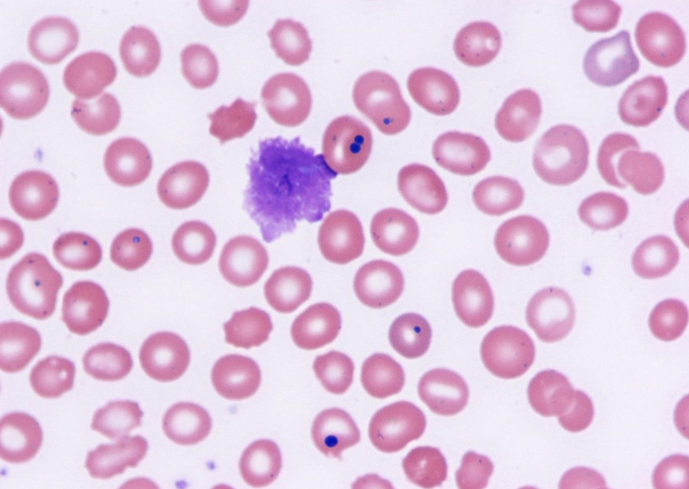 This patient's findings are most likely related to which of the following?
Peripheral blood smear with Wright stain is shown in the exhibit. This patient's findings are most likely related to which of the following? (Multiple Choice)
4.9/5 (79)
(79) A 3-month-old boy is rushed to the emergency department for evaluation of cyanosis. The baby appeared "bluish-pale" during a bottle feeding this morning and still appears "dusky." The parents say that this color change has occurred during crying or feeding for the past few days. The patient also seems to tire and breathe faster after a few minutes of feeding. Review of systems is negative for fever, coughing, choking, and gagging. Temperature is 36.7 C (98 F); blood pressure is 84/50 mm Hg in the right arm, 85/55 mm Hg in the left arm, 88/58 mm Hg in the right leg, and 87/52 mm Hg in the left leg; pulse is 155/min; and respirations are 54/min. Pulse oximetry shows an oxygen saturation of 80% on room air. The infant is crying and the cyanosis is most prominent in the lips and tongue. Auscultation reveals a single S2, and a harsh crescendo-decrescendo systolic murmur is heard at the left upper sternal border. The abdomen is soft, nontender, and nondistended. No digital clubbing is present. Capillary refill is <2 sec. Which of the following is the most likely diagnosis in this patient?
(Multiple Choice)
4.8/5 (93)
(93) A 1-hour-old boy is evaluated in the newborn nursery for feeding difficulty. The patient was born at 40 weeks gestation to a 22-year-old primigravida via spontaneous vaginal delivery. Apgars were 8 and 9 at 1 and 5 minutes, respectively. The boy was placed on his mother's chest for skin-to-skin care and has been attempting to breastfeed. He was able to latch and begin feeding but within 1 minute, his face developed a blue tinge. The boy cried, and his color improved. His mother tried repositioning the patient a few times, but his skin continued to turn blue shortly after feeding with return of normal color after crying. Temperature is 37.2 C (99 F), and pulse is 150/min. Pulse oximetry is 97% and 96% on room air, measured from the right hand and left foot, respectively. The palate appears intact. Lung examination shows equal sounds bilaterally. There are no murmurs or gallops. Peripheral pulses are strong. The abdomen is soft, and there is no organomegaly. The skin appears pink. Chest radiograph is normal. Which of the following is the best next step in evaluation of this patient's symptoms?
(Multiple Choice)
4.9/5 (72)
(72) A 48-year-old woman with diabetes mellitus comes to the office for a routine follow-up. The patient reports difficulty falling asleep and feeling exhausted and sleepy during the day over the past several weeks. On further questioning, she describes vague discomfort in her legs between the knees and ankles that is worse at night. The patient often gets out of bed to move around, which transiently improves the symptoms. She has a history of gestational diabetes and was diagnosed with type 2 diabetes mellitus 3 years ago for which she takes metformin. Her most recent hemoglobin A1c level was 7.6%. Blood pressure is 126/68 mm Hg and pulse is 76/min. BMI is 32 kg/m2. Lower extremity examination shows scattered dilated superficial veins but no skin ulceration. Sensation to light touch and vibration is normal in the toes. Ankle and knee reflexes are normal bilaterally. Which of the following is the best next step in evaluation of this patient?
(Multiple Choice)
4.7/5 (75)
(75) 
Filters
- Essay(0)
- Multiple Choice(0)
- Short Answer(0)
- True False(0)
- Matching(0)